.png)
.avif)
GE Washer Repair NYC — Volt & Vector Appliance Repair
Brooklyn (DUMBO, Park Slope, Williamsburg, Crown Heights, Bay Ridge), Manhattan (Washington Heights, Upper West Side, Upper East Side, Midtown, Downtown), Queens (Flushing, Astoria, Long Island City, Forest Hills), Bronx, Staten Island
If repair exceeds 50% of the current replacement cost of the unit, we present both options transparently. GE top-loaders under 8 years and front-loaders under 10 years almost always justify repair over replacement.
GE's UltraFresh Vent System front-loaders have a mold-resistant design that requires specific disassembly procedures to avoid damaging the venting gasket and door seal during service. GE Profile front-loaders with SmartHQ WiFi connectivity can require firmware synchronization after control board replacement — a step that requires the GE service tool, which is not available to consumers. Attempting a board swap without this step leaves the machine functional but unable to connect to the app or receive updates.
On the practical side, drum bearing replacement on GE front-loaders requires a bearing press that no DIY repair guide accounts for. Attempting this without the correct equipment damages the rear tub housing, which converts a bearing repair into a tub replacement. Professional service means the bearing is pressed correctly on the first attempt and the machine is reassembled to torque specification.
What to Expect From Our Washing Machine Service
Volt & Vector service calls are built around one principle: fix it right, explain what we found, and get out of your day.
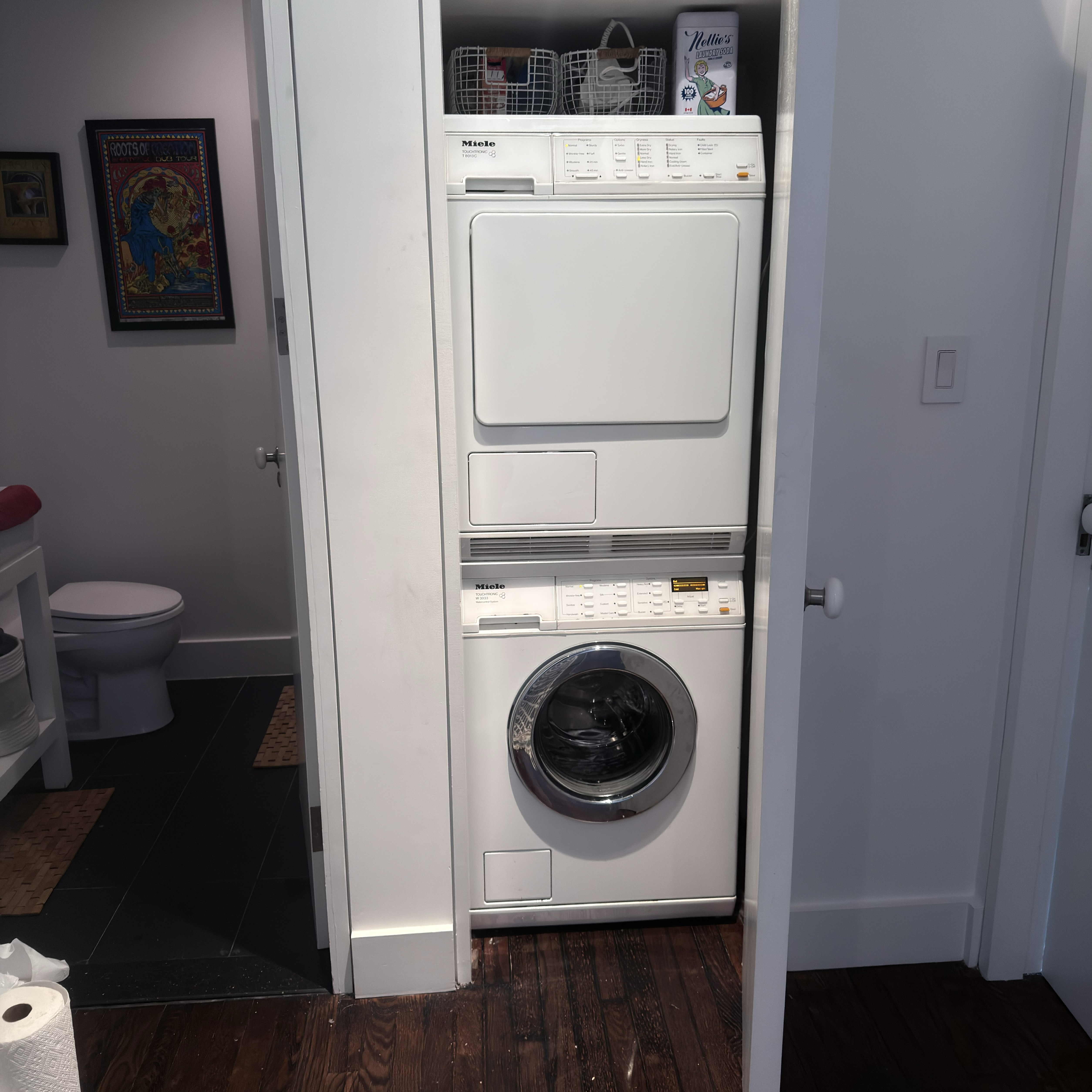
When you book, you get a confirmed two-hour arrival window — no all-day waiting. Our technician arrives with a stocked van covering common parts for every brand we service. After diagnosis, we present a written flat-rate estimate. If approved, we complete the repair on the same visit in the majority of cases. For stackable laundry units in tight closets — common throughout Chelsea and Williamsburg apartments — we carry the tools and techniques to work in confined spaces without damaging cabinetry or flooring. All repairs include a 90-day labor warranty. We document the repair so your service history is on file for future calls. If we find that a second appliance in your laundry setup needs attention — such as a dryer in the same stack — we assess it at no extra trip charge.

GE Washer: What's Safe to Try and What Isn't
Safe to attempt
- Cleaning inlet valve screens — Turn off supply valves, unscrew hoses, rinse the mesh screens. Resolves LO FL slow-fill errors at no parts cost. Should be done annually in NYC hard water conditions.
- Load rebalancing for Ub/ub error — Redistribute laundry evenly in the drum and restart. No tools required. If Ub recurs consistently, the suspension rods should be inspected.
- Fixing HC (hot/cold reversal) — Swap the hot and cold supply hoses at the back of the machine. Label them clearly to prevent recurrence. No parts needed.
- Drain pump filter cleaning (front-load) — Access the lower front panel and twist the cap counterclockwise. Keep towels ready for residual water. Quarterly cleaning prevents most drain faults.
Do not attempt without professional tools
- Drum bearing replacement — Requires a bearing press and full drum disassembly. Without the press, the bearing cannot be correctly seated, and forced installation damages the tub housing.
- Control board replacement — Involves mains voltage and, on GE Profile SmartHQ models, requires firmware synchronization tools not available to consumers.
- Door boot seal replacement (front-load) — Requires front panel removal and precise boot routing. Incorrect installation causes leaks that damage floors and creates building liability in NYC apartments.
DIY vs Pro
GE Washer: What's Safe to Try and What Isn't
Safe to attempt
- Cleaning inlet valve screens — Turn off supply valves, unscrew hoses, rinse the mesh screens. Resolves LO FL slow-fill errors at no parts cost. Should be done annually in NYC hard water conditions.
- Load rebalancing for Ub/ub error — Redistribute laundry evenly in the drum and restart. No tools required. If Ub recurs consistently, the suspension rods should be inspected.
- Fixing HC (hot/cold reversal) — Swap the hot and cold supply hoses at the back of the machine. Label them clearly to prevent recurrence. No parts needed.
- Drain pump filter cleaning (front-load) — Access the lower front panel and twist the cap counterclockwise. Keep towels ready for residual water. Quarterly cleaning prevents most drain faults.
Do not attempt without professional tools
- Drum bearing replacement — Requires a bearing press and full drum disassembly. Without the press, the bearing cannot be correctly seated, and forced installation damages the tub housing.
- Control board replacement — Involves mains voltage and, on GE Profile SmartHQ models, requires firmware synchronization tools not available to consumers.
- Door boot seal replacement (front-load) — Requires front panel removal and precise boot routing. Incorrect installation causes leaks that damage floors and creates building liability in NYC apartments.
Diagnostic Process
Our GE washer diagnostic follows a structured protocol. Upon arrival, the technician reads live fault codes from the service diagnostic mode (accessible on GE front-loaders via a specific button sequence on the control panel). This provides real-time sensor readings — water pressure, drum RPM, motor current draw, inlet valve resistance — rather than relying solely on stored error codes. For top-load models, we check the lid lock continuity with a multimeter, inspect the pressure switch hose for blockages, and test the water inlet valve flow rate. All findings are documented and the repair quote is presented before a single part is touched.
Error Code Reference
GE Washer Error Code Reference
- E1 — Water temperature sensor fault: failed NTC thermistor or wiring short. Repair: thermistor replacement.
- E2 — Water temperature out of range: defective inlet valve or thermistor. Repair: diagnosis to isolate component; inlet valve or thermistor replacement.
- E3 — Pressure sensor fault: blocked pressure hose or failed pressure switch. Repair: clear hose; replace pressure switch if hose is clear.
- E45 — Motor control board communication fault: loose harness, failed motor control board. Repair: harness check; motor control board replacement.
- E46 — User interface communication fault: loose harness, failed UI board or main board. Repair: harness check; board replacement.
- LO FL — Low water flow: scale-blocked inlet screen, failed inlet valve solenoid, low building water pressure. Repair: screen cleaning or inlet valve replacement.
- HC — Hot and cold supply reversed: supply hoses connected incorrectly. Fix: swap hose connections at the back of the machine.
- dL / dr — Door lock fault (front-load): failed door lock assembly or latch. Repair: door lock replacement.
- ub / Ub — Unbalanced load: load redistributed unevenly during spin. Fix: redistribute load manually and restart. If recurring, suspension rods should be inspected.
New York City — What's Different
GE washers — including the GTW, GFW, and GFP front-load and top-load series — are a significant presence in NYC's rental renovation market and in owner-occupied apartments throughout the outer boroughs. GE's front-load washers have specific door boot seal and drum bearing failure patterns that are accelerated by NYC's hard water conditions. GE's top-load washers have transmission and water valve vulnerabilities that our technicians diagnose systematically. We carry GE OEM washer components and arrive prepared to resolve most failures on the first visit.
Related GE Laundry Repair Services in NYC
This service is part of Volt & Vector's comprehensive NYC laundry repair program. For washing machine repair regardless of brand, our washing machine repair page covers fault patterns, repair costs, and what to expect from professional service. For the GE dryer in your household, see GE Dryer Repair. For premium alternatives, see LG Washer Repair, Samsung Washer Repair. We serve clients throughout Crown Heights and Murray Hill with same-day diagnostic appointments for GE laundry appliances.
Symptoms
GE washers span two distinct platforms — the GTW and GTD top-load series and the GFW and GFP front-load series — each with different fault code structures and repair priorities. Top-load GE models with digital displays use alphanumeric codes; older mechanical top-loaders communicate through LED indicator patterns. Front-load GE and GE Profile machines display fault codes clearly on an LCD panel. Identifying which platform you have shapes the diagnostic approach from the first call.
E45 / E46 — Control Board Communication Fault
E45 and E46 indicate a communication failure between the main electronic control board and a secondary board. E45 typically implicates the motor control board; E46 implicates the user interface board. These codes sometimes appear after a power surge or voltage fluctuation in NYC's older apartment buildings, where electrical supply quality is less stable than in newer construction. A power cycle — unplugging the machine for sixty seconds — resolves some instances of E45/E46 caused by transient electrical events. If the code returns consistently, the affected board requires replacement. A technician should test harness connector integrity first, since a loose connector can mimic a board failure and cause the same error code at a fraction of the replacement cost.
LO FL — Low Water Flow
LO FL triggers when water is entering the machine but at a flow rate below the expected threshold, even if the tub is partially filling. In New York City, the most consistent cause is partial scale blockage of the inlet valve mesh screens. The city's water supply carries dissolved minerals that deposit on these fine screens progressively over months, reducing flow until the control board registers LO FL. Cleaning the screens resolves the issue in most cases and requires only shutting off the supply valves and disconnecting the hoses. If flow remains restricted after screen cleaning, the inlet valve solenoid has likely also failed and requires replacement.
Lid Lock Fault — Top-Load Models
A GE top-load washer that clicks at the start of a cycle but doesn't advance, or displays a blinking indicator and stops, typically has a lid lock assembly failure. The lid lock performs two functions: a solenoid that physically locks the lid, and a position switch that signals the control board that the lock has engaged and the cycle can proceed. When the solenoid clicks but the position switch has failed, the machine executes the click but never receives the confirmation signal from the board's perspective. Replacing the full lid lock assembly — which includes both components in a single unit — resolves this in nearly all cases.
Not Draining — Front-Load Models
GE front-load washers that stop mid-cycle with water in the drum, or complete cycles with visibly wet clothes, typically have a blocked drain pump filter or a failing pump motor. The pump filter on GE front-loaders is accessible through a panel on the lower front of the machine and accumulates lint, debris, and small objects over time. In NYC apartments with high daily laundry frequency, this filter should be inspected and cleaned at least quarterly. If the filter is clear and the machine still does not drain fully, the pump motor impeller or motor windings should be tested before other components are ordered.
Drum Grinding — Bearing Noise
A deep rumbling or grinding sound during spin that develops gradually and worsens over weeks indicates rear drum bearing wear. GE front-loaders on the GFW platform run spin cycles at high RPM, and the rear bearing assembly takes sustained load during every cycle. In NYC, where machines may run multiple loads per day in multi-person households, bearing wear develops faster than manufacturer service life projections based on lower usage patterns. Drum bearing replacement requires full disassembly to the tub level and a bearing press — it cannot be completed without this equipment.
HC — Hot and Cold Supply Reversed
HC on GE top-load washers indicates the hot and cold water supply hoses are connected in reverse. This is a common error after installation, hose replacement, or any plumbing work in the laundry area. The fix is to swap the hose connections at the back of the machine and verify correct labeling before reconnecting. HC is not a mechanical fault and does not require any part replacement — the machine is operating exactly as designed, it just has the supply connections reversed.
Top Symptoms
E45 / E46 — Control board communication fault
The main electronic control board has lost communication with a secondary board — E45 implicates the motor control board, E46 the user interface board. A power cycle resolves some transient instances. If the code returns consistently, the affected board requires replacement. Always check harness connectors first — a loose connector produces the same error at a fraction of the board replacement cost.
LO FL — Low water flow
Water is entering the machine but at a flow rate below the expected threshold. In NYC, mineral scale on the inlet valve mesh screens is the primary cause. Screen cleaning resolves LO FL in most cases. If flow remains restricted after cleaning, the inlet valve solenoid has failed and requires replacement.
Lid lock fault — Top-load models
The machine clicks at cycle start but does not advance, or displays a blinking error. The lid lock solenoid engages but the position switch has failed, leaving the control board without a lock confirmation signal. Full lid lock assembly replacement resolves this in nearly all cases.
Not draining — Front-load models
Water remains in the drum after the cycle, or the machine stops mid-cycle. Blocked pump filter or a failing pump motor are the most common causes. The filter is accessible at the lower front panel and should be cleaned quarterly in high-frequency NYC apartment use. If the filter is clear, the pump motor impeller or windings should be tested.
Drum grinding — Bearing wear
A rumbling or grinding during spin that worsens over weeks indicates rear bearing wear. GFW-platform front-loaders place sustained load on the rear bearing during high-speed spin. Bearing replacement requires full drum disassembly and a bearing press. Left unaddressed, a worn bearing causes progressive tub damage that expands the repair scope significantly.
What's Included with Every GE Washer Repair
- Full on-site diagnostic with fault code retrieval from service mode
- Inlet valve screen inspection and cleaning
- Drain pump filter inspection and cleaning on front-load models
- Lid lock function test on top-load models
- Drum bearing and spin system assessment
- Written repair estimate before any work begins
- OEM or manufacturer-equivalent replacement parts only
- 180-day parts and labor warranty on all completed repairs
- Post-repair test cycle with water flow, spin, and drain verification
- Drum leveling check on completion — critical in NYC buildings with uneven floors
- Certificate of Insurance provided for co-op and condo building access
Case Logs
NYC GE Washer Repair — Case Logs
Case 1 — Washington Heights, Manhattan | GE GTW685BSLWS | Lid Lock Failure
Customer reported the washer clicking at the start of each cycle, then displaying a blinking error and going silent. Unit was a GE GTW685BSLWS top-loader, approximately five years old, in a fourth-floor walkup apartment. Diagnostic confirmed lid lock failure — the solenoid was engaging audibly but the position switch had failed and was not sending the lock confirmation signal to the control board. Full lid lock assembly replacement restored normal cycle initiation. Post-repair testing confirmed the machine advanced through five full cycles without interruption.
Case 2 — Park Slope, Brooklyn | GE GFW850SPNRS | LO FL and Inlet Valve Scale
Customer reported the washer displaying LO FL during the fill phase and taking significantly longer than usual to begin washing. Unit was a GE Profile front-loader, approximately three years old. Technician removed both inlet hoses and found the valve screens heavily coated with white calcium deposits. Cleaning both screens restored normal flow rate. A post-repair fill test confirmed the machine reached the target water level within the expected fill time. No parts were required.
Case 3 — Upper East Side, Manhattan | GE GFW850SSNWW | E45 Control Board Fault
Customer reported E45 appearing at random points in the wash cycle, interrupting the cycle and requiring a manual restart. The building had experienced a power fluctuation the week prior. Technician ran service mode and confirmed the motor control board was producing intermittent communication errors — borderline failure consistent with surge damage. The motor control board was replaced and the machine completed six consecutive test cycles without error recurrence.

