


.png)


Bertazzoni Range Repair in NYC — Master Series & Heritage Series Specialists

Range
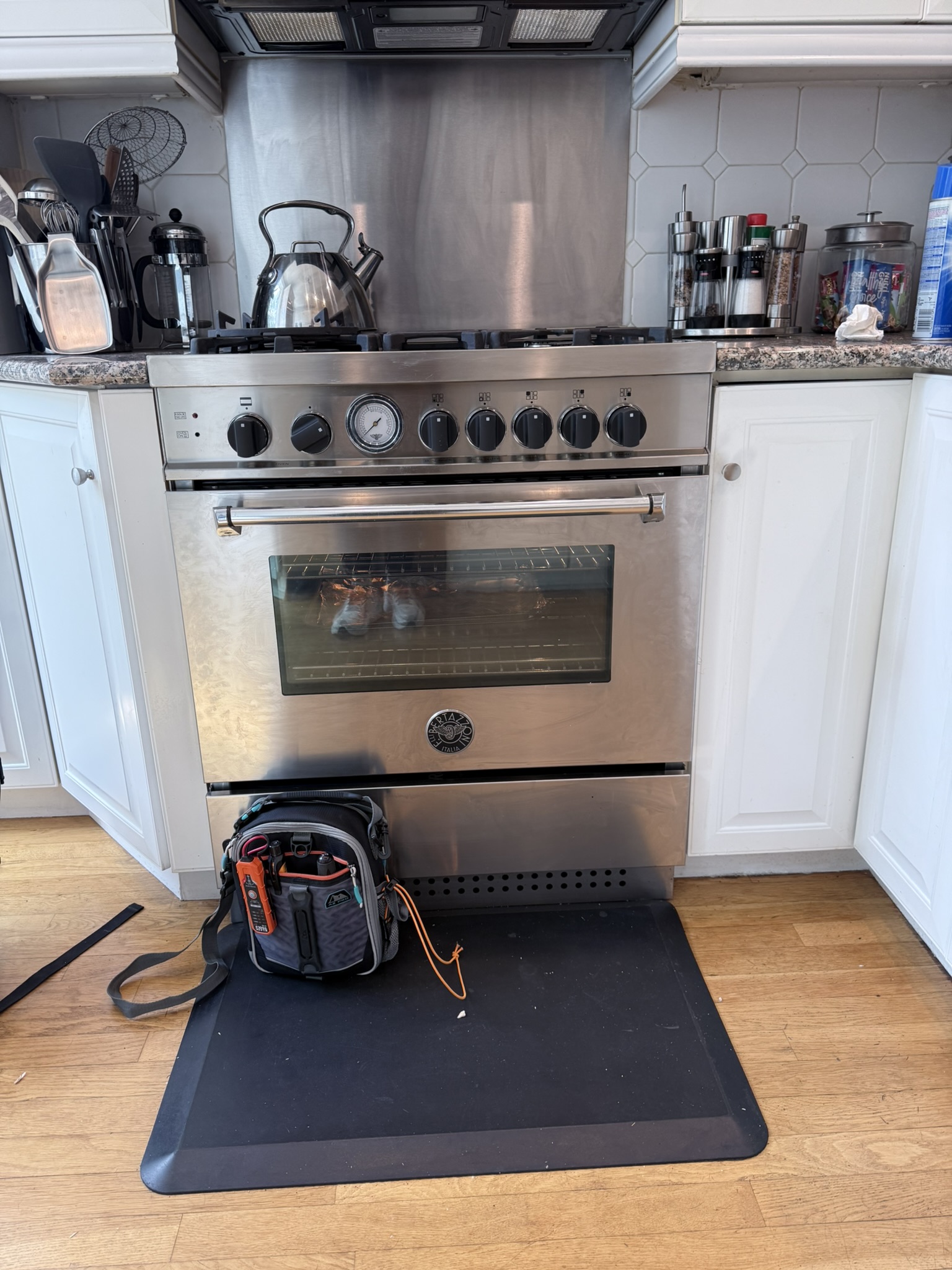
Bertazzoni ranges bring Italian engineering and distinctive design sensibility to NYC's premium kitchen market, their colorful enamel finishes and precision brass burner assemblies appearing in DUMBO loft renovations, Williamsburg creative spaces, and Manhattan townhouse kitchens with equal frequency. Bertazzoni's Master Series and Professional Series ranges use a dual-circuit burner system with a Sabaf-supplied brass burner crown that delivers efficient, even heat distribution — but these precision components require brand-specific tooling when they develop faults. Volt & Vector Appliance Repair's technicians bring Bertazzoni-specific diagnostic competency to every service call, understanding the interplay between the dual-circuit burner assembly, the rotary thermostat oven control system, and the brand's proprietary convection fan architecture.
One of the most common Bertazzoni service scenarios in NYC involves the oven's rotary thermostat — a mechanical temperature control device that governs the oven's gas valve. Unlike the electronic RTD-and-control-board systems used by Wolf and Thermador, Bertazzoni's traditional models use a capillary tube thermostat that regulates a mechanical gas valve. When the thermostat's capillary tube develops a micro-leak or the expansion bulb at the sensing end corrodes, the thermostat loses its ability to accurately sense oven temperature, causing the oven to either overheat significantly or fail to reach temperature. NYC's humidity accelerates corrosion on the sensing bulb exterior, making this a more frequent service item in this market.
Volt & Vector operates with same-day diagnostic availability across Brooklyn and Manhattan, servicing Bertazzoni's full range lineup including the Master Series, Professional Series, Heritage Series, and Italia Series configurations. Our 180-day parts and labor warranty applies to every Bertazzoni repair, and we carry OEM Bertazzoni components from the brand's US distribution network.

.png)
.jpeg)

FAQ
Why is my Bertazzoni oven running much hotter than the set temperature?
The most common cause of oven overheating in Bertazzoni gas range models is a failing rotary thermostat — specifically, a loss of hermetic seal in the thermostat's thermal expansion sensing bulb, which causes the mechanical gas valve to remain more open than the set temperature would dictate. The result is an oven that runs 50°F to 100°F above the temperature indicated on the control dial. This failure is confirmed by comparing actual oven temperature against the dial setting across several temperature points using a calibrated external thermometer. Thermostat replacement is the correct repair; attempting to recalibrate a leaking thermostat will not produce a stable result.
Can Bertazzoni ranges be converted from natural gas to propane?
Yes — Bertazzoni designs its ranges for field conversion between natural gas and LPG using a conversion kit that includes replacement burner orifice jets sized for propane's higher energy density. The conversion requires changing the orifice jet at every burner and oven valve, adjusting the primary air shutter settings on each burner, and verifying flame quality and combustion efficiency after conversion. Volt & Vector performs Bertazzoni gas conversions for NYC clients transitioning between fuel types. Proper conversion is critical — using natural gas orifices with propane supply produces dangerously rich combustion conditions.
How long does a Bertazzoni range repair take in NYC?
Most Bertazzoni range repairs are completed within one to two service visits. The diagnostic visit documents all faults and generates a parts list; thermostat assemblies, igniter electrodes, spark modules, and common gas valve components are typically in our van inventory for same-visit repair. Specialty Bertazzoni components from Italian production may require four to seven business days to source through the brand's US distribution network. We schedule follow-up visits immediately upon parts receipt.
Do you service Bertazzoni ranges in the Heritage Series as well as the Master Series?
Yes — Volt & Vector services the complete Bertazzoni range lineup including the Heritage Series, Master Series, Professional Series, and Italia Series configurations in all fuel types and finishes. The Heritage Series uses a distinct mechanical thermostat and standing pilot ignition architecture that requires different diagnostic procedures from the electronic ignition systems in the Master Series. Our technicians are familiar with both architectures and carry the OEM components for both series in our service inventory.

Repair Types
Volt & Vector's Bertazzoni repairs include rotary thermostat replacement for both gas valve and capillary-tube designs, burner igniter electrode replacement, spark module replacement, oven safety valve replacement, pilot thermocouple replacement, convection fan motor replacement, oven bake element replacement in electric and dual-fuel models, and burner orifice cleaning and gas pressure verification. For Bertazzoni Heritage Series ranges with distinctive colored enamel finishes, we also service the decorative burner grate assemblies and the oven door hinge mechanisms. Comprehensive burner reconditioning — including brass burner crown cleaning, orifice port inspection, and igniter recalibration — is available as a preventive maintenance service for Bertazzoni ranges in service for more than seven years.

Diagnostic Process
Bertazzoni range diagnostics begin with identification of the specific model series and production year, since Bertazzoni has undergone significant engineering changes across the Master Series, Professional Series, and Heritage Series over the past decade. Early Master Series ranges used purely mechanical thermostat controls with no electronic interface, while current Heritage Series models include electronic ignition modules and digital displays. The diagnostic path differs significantly between these architectures, and the technician's first step is always to confirm which control system is present.
Functional testing covers every burner through multiple ignition cycles with particular attention to flame quality — color, height uniformity across the burner crown, and behavior at minimum and maximum gas flow positions. The oven is tested through a complete heat cycle with a calibrated external reference thermometer positioned in the center of the cavity, and the thermostat's mechanical response to temperature change is observed directly when accessible. For models with electronic control boards, fault code retrieval is performed before any component replacement is attempted.
The written diagnostic report identifies all faults and out-of-specification conditions with specific test results confirming each finding. The itemized repair estimate separates parts and labor clearly, and for Bertazzoni ranges showing signs of multiple aging components, our technician provides a recommendation on whether a comprehensive reconditioning service or targeted component replacement is the better approach given the range's age and overall condition.

New York City & Brooklyn
Bertazzoni ranges — the Professional, Master, and Heritage series — are the Italian cooking brand's flagship product, combining serious professional cooking performance with the aesthetic heritage of Italy's Emilia-Romagna food region. In NYC, Bertazzoni ranges appear in Park Slope, Carroll Gardens, and the Upper West Side — neighborhoods where the kitchen renovation prioritizes cooking authenticity alongside design quality. Bertazzoni's range engineering has specific service requirements that generalist technicians are not equipped to address efficiently — the brand's brass burner assemblies, gas valve configurations, and electronic control systems require factory-level training and OEM components.
Volt & Vector operates from DUMBO and provides Bertazzoni range repair throughout Brooklyn and Manhattan. Our technicians carry Bertazzoni OEM range components including burner assemblies, gas valve kits, ignition modules, and dual-fuel control boards for all active Bertazzoni Professional and Master series models. Same-day to next-day response is available for Bertazzoni range failures.
Related Bertazzoni Repair Services in NYC
This repair service is part of Volt & Vector's comprehensive Bertazzoni appliance repair NYC portfolio. Our technicians are trained specifically on Bertazzoni's engineering architecture — wiring schematics, diagnostic software access, and OEM component sourcing that generalist repair companies cannot match.
If you own additional Bertazzoni appliances, see our pages for Bertazzoni Oven Repair NYC, Viking Range Repair NYC, Wolf Range Repair NYC. Each page provides the same level of technical detail — symptoms, diagnostic protocols, and realistic repair costs.
For professional range repair regardless of brand, our professional range repair page covers all manufacturers we service in NYC. Clients in Tribeca and Carroll Gardens rely on Volt & Vector for same-day diagnostics on Bertazzoni and competing premium brands.

Brands we service
Volt & Vector's Italian appliance expertise extends beyond Bertazzoni to include all major European cooking appliance brands in the NYC luxury residential market. Our Bertazzoni service covers the full Master Series, Professional Series, Heritage Series, and Italia Series range configurations in all available finishes and fuel types. We also service Miele, Viking, Wolf, Thermador, Bosch, and KitchenAid ranges with the same OEM-parts standard applied to every job. NYC's cosmopolitan appliance landscape means our technicians regularly encounter a wide diversity of premium European and American brands in the same building, and our diagnostic tooling covers the complete spectrum.

Why Professional
Bertazzoni's Italian-engineered gas systems use components sourced from European suppliers — including Sabaf burner assemblies and European thermostat systems — that require authentic OEM replacement parts to maintain proper operation. Installing generic substitute components in Bertazzoni's precision gas circuits can alter gas flow rates beyond safe operating parameters and void the appliance's remaining manufacturer warranty. Volt & Vector sources OEM Bertazzoni parts through the brand's authorized US distribution network and uses brand-specific service documentation to ensure every repair meets Bertazzoni's original engineering specifications.

Top Symptoms
Oven overheats or runs significantly above set temperature. Bertazzoni's rotary thermostat-controlled gas ovens depend on the capillary thermostat's accuracy to modulate gas valve position. When the thermostat's expansion bulb — a copper probe inserted into the oven cavity — loses its hermetic seal, the thermostat reads a lower temperature than actual and keeps the gas valve more open than necessary, allowing the oven to run far above set temperature. A 50°F to 100°F overrun above the set temperature is the typical presentation of this failure. The only reliable fix is thermostat assembly replacement.
Burner flame is weak or burns orange instead of blue. Bertazzoni's Sabaf brass burners are precision-calibrated for specific gas orifice sizes matched to natural gas or propane. In NYC, hard water mineral deposits and cooking grease can partially block the burner orifice ports, reducing gas flow and producing a weak, orange-tinted flame. Orange flames indicate incomplete combustion — a condition that produces carbon monoxide and should be addressed promptly. Our technicians clean orifice ports with precision tools and verify gas pressure at the appliance.
Igniter clicks but burner fails to light reliably. Bertazzoni ranges use a continuous-spark ignition system that activates all burner igniters simultaneously when any knob is turned. If the ceramic igniter electrode on a specific burner has cracked, corroded, or has food residue bridging the gap, that burner will fail to light while the others ignite normally. The igniters on Bertazzoni's brass burner assemblies are brand-specific components that require care during replacement to maintain proper electrode tip positioning relative to the burner crown.
Oven pilot doesn't stay lit or oven won't light at all. Bertazzoni gas ovens with standing pilot ignition require the thermocouple probe to be fully enveloped in the pilot flame for its millivolt output to exceed the gas valve's hold threshold. If the pilot orifice has become partially blocked or the thermocouple tip has accumulated oxide layer, the oven safety valve won't open or won't hold open. A millivolt test at the thermocouple output during live pilot operation confirms whether the thermocouple or the safety valve is the faulty component.