
Residential Appliance Repair in Brooklyn, Manhattan and Westchester
We offer same-day or next-day service only when route capacity allows, use OEM parts when applicable and available, and back our completed repairs with a 180-day parts and labor warranty.
Book a diagnostic
Book a diagnostic


Manhattan Appliance Repair
.avif)
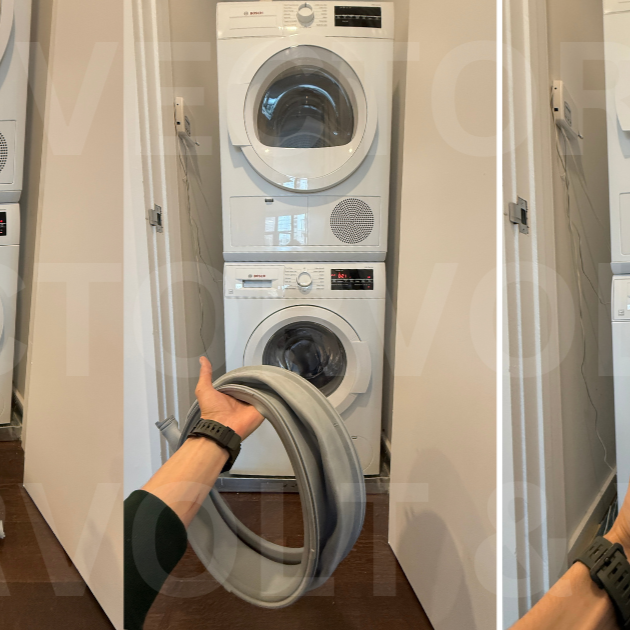
Manhattan homes often have compact kitchens, built-in appliances, stacked laundry closets, finished floors, and limited access around the machine. COI available upon request.
Brooklyn Appliance Repair
Diagnostic-first residential appliance repair in Brooklyn for refrigerators, dishwashers, washers, dryers, ovens, ranges, cooktops, and freezers.
Westchester Appliance Repair
Volt & Vector provides residential appliance repair in Scarsdale, Eastchester and Bronxville.
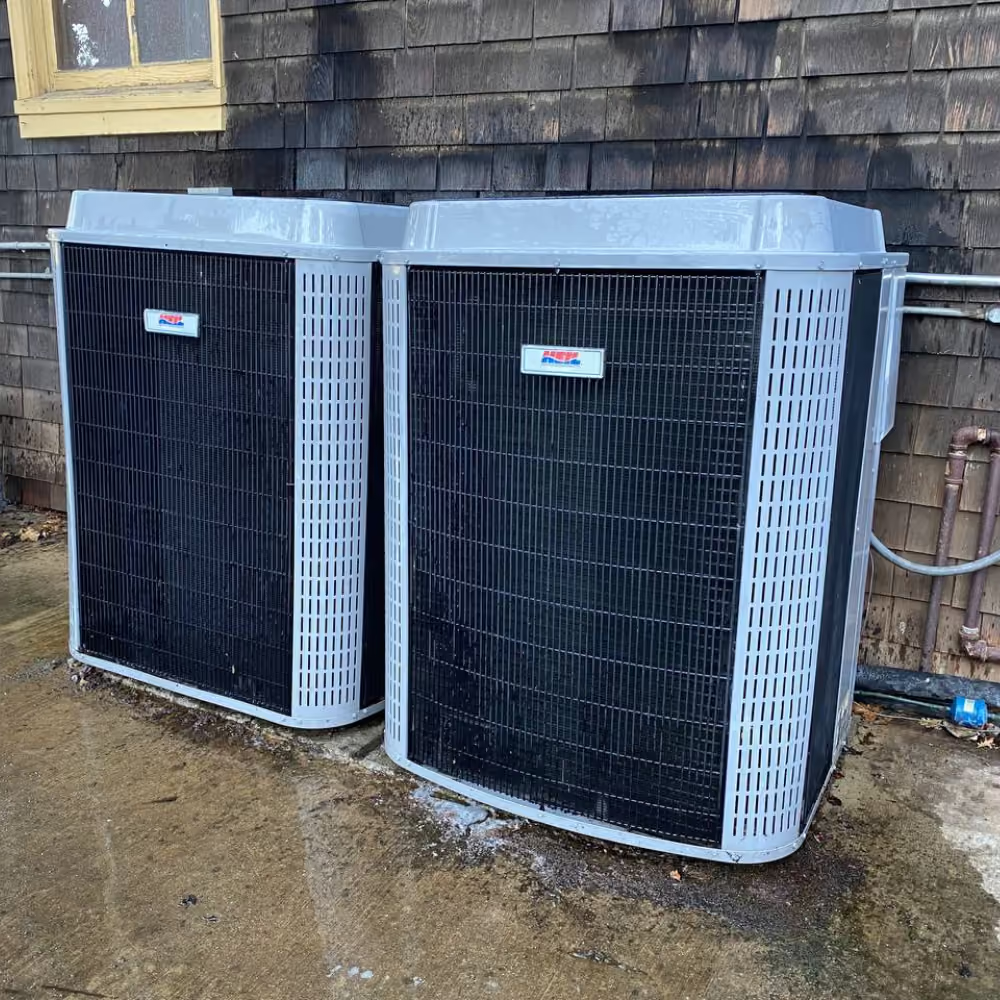
HVAC Repair
We confirm the New York City service address and equipment before scheduling residential HVAC diagnostics or repairs. We work on central air, heat pumps, mini-splits, air handlers, and thermostats. Our $220 diagnostic fee is credited toward an approved repair on the same job.
.jpeg)

.jpeg)

.avif)
.jpeg)
Manhattan Appliance Repair
Manhattan homes often have compact kitchens, built-in appliances, stacked laundry closets, finished floors, and limited access around the machine. COI available upon request.
Brooklyn Appliance Repair
Diagnostic-first residential appliance repair in Brooklyn for refrigerators, dishwashers, washers, dryers, ovens, ranges, cooktops, and freezers.
Westchester Appliance Repair
Volt & Vector provides residential appliance repair in Scarsdale, Eastchester and Bronxville.
HVAC Repair
We confirm the New York City service address and equipment before scheduling residential HVAC diagnostics or repairs. We work on central air, heat pumps, mini-splits, air handlers, and thermostats. Our $220 diagnostic fee is credited toward an approved repair on the same job.
Residential Appliance Repair
Volt & Vector provides residential appliance repair for homes, apartments, condos, co-ops, brownstones, townhouses, and small multifamily residences in NYC and our listed Westchester service areas. We service refrigerators, freezers, dishwashers, ovens, ranges, cooktops, washers, and dryers. Each visit starts with diagnosis, followed by an explanation of the findings and an estimate before you approve repair.
A warm refrigerator puts stored food at risk. A leaking dishwasher can damage cabinets and flooring. A washer that will not drain can leave wet clothes trapped inside, while a dryer that needs two or three cycles can point to a heating or airflow problem. The assessment considers both the appliance failure and its effect on the home around it.
Our appliance-specific pages explain the scope of refrigerator repair, dishwasher repair, washing machine repair, and dryer repair. For cooking appliances, see oven repair, range repair, or cooktop repair. Include the brand and model when requesting service so we can review the actual equipment.
Diagnosis includes confirming the symptom, testing the relevant systems, and checking the surrounding installation. Depending on the findings, the solution may involve a replacement part, cleaning, adjustment, or correction of an airflow, drainage, or leveling issue. Age, overall condition, parts cost, and repeat failures also affect whether repair is a sensible investment.
Diagnosis Comes Before Parts
“The refrigerator is warm,” “the dishwasher has standing water,” “the oven does not heat,” “the washer shakes,” and “the dryer does not dry” describe symptoms. They do not, by themselves, identify the failed component. The timing of the problem, model, settings, installation, and test results help distinguish the possible causes.
For a refrigerator, the assessment may include fans, defrost operation, condenser condition, temperature sensors, door gaskets, and airflow. A drain problem may also matter when ice or water buildup accompanies the cooling complaint. For a dishwasher that will not drain, the technician checks the filter, drain hose, pump operation, and sink connection. For slow drying, the heating system, lint buildup, airflow restriction, and the model’s drying or vent path need to be considered together. These are professional assessment directions, not instructions to open or test live equipment.
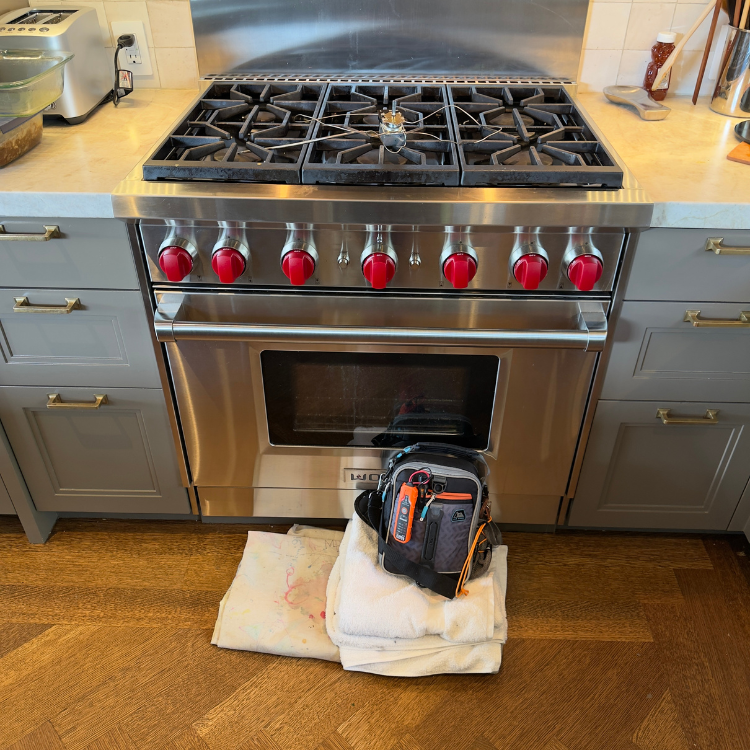
Our two-Wolf-oven diagnostic case shows why stored faults need to be compared with the current complaint and diagnostic tests before recommending parts. A recorded error is useful evidence, but it does not automatically establish which part needs replacement.
Replacing an unconfirmed part can leave the original cause unresolved. Even if performance improves briefly after a part change, that alone does not establish that the original cause was corrected. Our sequence is to confirm the complaint, inspect the appliance, perform the relevant tests, review the installation, explain the findings, and quote the proposed repair. When the evidence does not justify replacing a part, we explain that result as well.
Manhattan Appliance Repair
Manhattan homes often have compact kitchens, built-in appliances, stacked laundry closets, finished floors, and limited access around the machine. COI available upon request.
Brooklyn Appliance Repair
Diagnostic-first residential appliance repair in Brooklyn for refrigerators, dishwashers, washers, dryers, ovens, ranges, cooktops, and freezers.
Westchester Appliance Repair
Volt & Vector provides residential appliance repair in Scarsdale, Eastchester and Bronxville.
HVAC Repair
We confirm the New York City service address and equipment before scheduling residential HVAC diagnostics or repairs. We work on central air, heat pumps, mini-splits, air handlers, and thermostats. Our $220 diagnostic fee is credited toward an approved repair on the same job.
Local Residential Service Across NYC and Westchester
The same appliance symptom can require different access planning in a Brooklyn brownstone, an Astoria walk-up, a Manhattan co-op, a Long Island City condo, or a Westchester home. Share the service address, appliance location, stairs or elevator arrangements, and any building requirements before the appointment.
Brooklyn appliance repair includes brownstones, rowhouses, pre-war apartments, renovated kitchens, and small multifamily homes. Older layouts, tight cabinet openings, basement laundry areas, and uneven floors can affect refrigerator airflow, dishwasher alignment, washer vibration, and dryer venting. We consider the installation alongside the machine’s symptoms.
In Astoria, apartments, walk-ups, small homes, and renovated units can place newer appliances in older spaces. Drainage, airflow, and leveling still need to suit the equipment. Tight kitchens, closets, and shared household spaces also affect how the appliance can be accessed and moved.
Long Island City service includes newer apartments and condos with compact kitchens and laundry layouts. Appliances may be built in, stacked, or panel-ready. Limited clearance, finished floors, cabinets, and decorative panels need to be considered when planning access.
For Manhattan appliance repair below 96th Street, tell us about elevator reservations, building access, and any certificate-of-insurance requirement. Our COI information explains which building and certificate-holder details to provide before the visit.
Our Westchester service area covers the listed towns of Scarsdale, Eastchester, and Bronxville. We review the address and appliance details before confirming availability. These service-area pages provide the local request and access information.
Repair or Replace?
Repair can make sense when the appliance is otherwise in good condition, the fault is confirmed, compatible parts are available, and the full repair cost compares reasonably with replacement. A refrigerator fan, dishwasher pump, gas-oven igniter, or dryer roller repair may be worthwhile when the rest of the machine is stable. The component example alone is not enough to make that decision.
Repeated failures, corrosion, unavailable parts, severe internal damage, and expensive repairs can change the recommendation. A refrigerator sealed-system problem also needs its own assessment of repair scope and cost; it does not automatically mean the refrigerator should be replaced. Compare the estimate with the installed replacement cost, including delivery, removal, fit, installation, water connections, venting, and disposal of the old appliance.
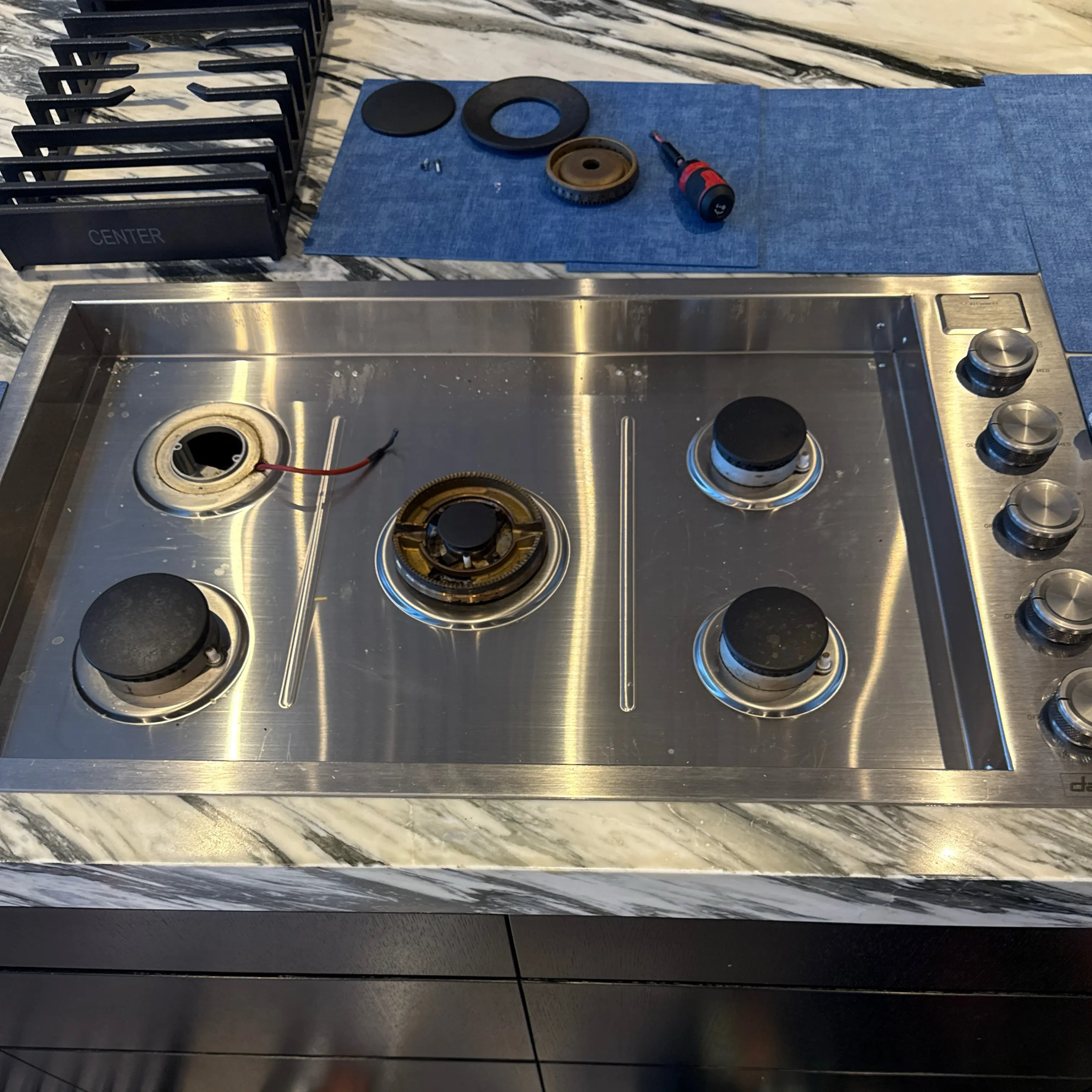
Our Thermador GGS30 cooktop replacement recommendation is a documented example of condition and repair access affecting the decision. The recommendation followed assessment of that particular unit; it is not a rule for every Thermador cooktop or every appliance of a similar age.
Before the Technician Arrives
Clear a safe working area around the appliance where possible. Do not pull out a built-in unit, separate stacked machines, or move a gas appliance to prepare for service. If a leak is active, close the water supply only when the shutoff is safely accessible. For a burning smell or sparks, stop using the appliance and do not keep testing it. If the appliance is smoking or on fire, get out, stay out, and call 911 from a safe location. Follow emergency responders’ instructions.
If you smell gas, leave immediately with everyone else in the home. Do not operate switches, appliances, or a phone inside, and do not try to locate or repair the leak. Call 911 from a safe location outside, then notify your gas utility. Follow the emergency instructions; ordinary repair booking is not the emergency response. See Con Edison’s gas-safety guidance.
If the refrigerator is not cooling, avoid repeatedly opening the doors and move perishable food to working refrigeration or an adequately iced cooler when possible. Keep refrigerated perishables at 40°F (4°C) or below. Use temperature and elapsed-time information to assess food safety; smell or appearance alone cannot confirm it. The FDA’s food-storage guidance explains the safe-temperature and time limits.
Send a photo of the model and serial label, any displayed error, visible leak, ice buildup, or damage. A short recording can help describe an intermittent sound if it can be captured safely during normal use. Do not run an unsafe appliance or move it to obtain a photo. The model number helps us review model-specific service information and compatible parts.
How Volt & Vector Handles Residential Appliance Repair
Our team explains what the tests found, the proposed corrective work, and any access or installation issue that affects the repair. The estimate identifies the work, parts, and labor involved before you approve it.
The appliance diagnostic visit fee is $150 in Brooklyn, Astoria, and Long Island City, $265 in Manhattan below 96th Street, and $150 in Scarsdale, Eastchester, and Bronxville. The diagnostic fee is credited toward an approved repair on the same job. Review our diagnostic-credit and estimate terms for the related policy.
When the repair is feasible and the required parts are available, it may be completed during the visit. If parts need to be ordered, the plan explains what is needed and the next service step. Replacement parts must match the appliance; OEM parts are used when applicable and available. We check the operation relevant to the repaired issue before explaining the result and any remaining limitations.
Completed repairs include a 180-day parts and labor warranty under our repair warranty terms. You should leave the visit understanding what was found, what work was performed or recommended, and whether repair or replacement is the practical next step.
Schedule Residential Appliance Repair in NYC and Westchester
For a refrigerator, freezer, dishwasher, oven, range, cooktop, washer, or dryer problem, send the appliance brand, model, symptom, service address, and ZIP code. Mention active leaks, temperature problems, abnormal vibration, or intermittent failures so the request reflects the actual issue. Leaks can damage cabinets and flooring, poor dryer airflow can contribute to overheating, temperature problems put food at risk, washer vibration can affect nearby surfaces, and oven temperature faults can make cooking unreliable.
Use our online booking request, or call or text (332) 333-1709. We review the appliance details, address, route capacity, and building access before confirming the appointment. Service hours are Monday–Friday, 9:00 AM–6:00 PM; Saturday and Sunday closed. Same-day or next-day appointments depend on availability.
