
.png)
.png)


Upper West Side Appliance Repair in Manhattan | Volt & Vector
Upper West Side appliance repair for prewar co-ops, elevator buildings, compact kitchens, refrigerators, dishwasher leaks, laundry, dryers, ovens, ranges, and cooktops.
Upper West Side Appliance Repair in Manhattan
Volt & Vector provides appliance repair on the Upper West Side for refrigerators, dishwashers, ovens, ranges, cooktops, washers, and dryers in Manhattan co-ops, condos, rentals, elevator buildings, walk-ups, and prewar apartments. The Upper West Side changes the repair visit because building approvals, elevator timing, older floors, compact kitchens, and brownstone or prewar layouts can affect how appliances are reached. A dishwasher leaking under a fitted counter, a refrigerator warming in a narrow kitchen, or a washer shaking on older flooring should be documented before the appliance is moved. We use symptom timing, model details, installation photos, and building notes to plan the visit and provide an estimate before repair work begins.
Upper West Side Service Context
Official Community Board 7 context covers the Upper West Side from 59th to 110th Streets between Central Park and the Hudson River. LPC West End and Riverside-West End maps support the neighborhood's prewar residential building context. For appliance repair, the practical effect is co-op rules, elevator timing, floor protection, and older apartment layouts.
Upper West Side kitchens often require careful service planning. A refrigerator may sit in a tight galley opening with a water line behind it. A dishwasher may be trapped by flooring, trim, or a stone counter. A range or wall oven can be close to finished cabinets that should not be scratched during access.
Laundry issues need the same local detail. A washer on an older floor may move differently at high-speed spin, and a dryer in a closet may hide airflow, condenser, or lint-path problems. The useful evidence is load type, movement, water remaining, and whether the load ends warm, cold, damp, or overheated.
The customer decision is what to leave alone before the visit. Do not pull a refrigerator forward to find a label, do not run another dishwasher leak test, do not unstack laundry, and do not keep testing a gas appliance if odor appears.
Upper West Side access also changes by building type. A Riverside or West End Avenue elevator co-op may need management wording and work-hour approval. A brownstone or walk-up route may need stair turns, floor level, and appliance-width photos. Put those details in the request once, then keep each appliance symptom specific.
Common Upper West Side Appliance Repair Situations
Dishwasher Leak Under A Fitted Counter
- Visit context: Prewar and renovated kitchens can hide water under toe-kicks, sink bases, and flooring transitions before the leak looks large.
- Appliance symptom: Water appears during fill, wash, or drain, or a leak-protection warning appears on some models.
- Safe customer action: Stop the cycle, dry visible water, and do not run another wash to see if the leak repeats.
- What helps booking: Send leak location, cycle timing, under-sink connection photo, and whether the sink drains normally. Use protect cabinets around a dishwasher before another cycle reaches cabinet edges.
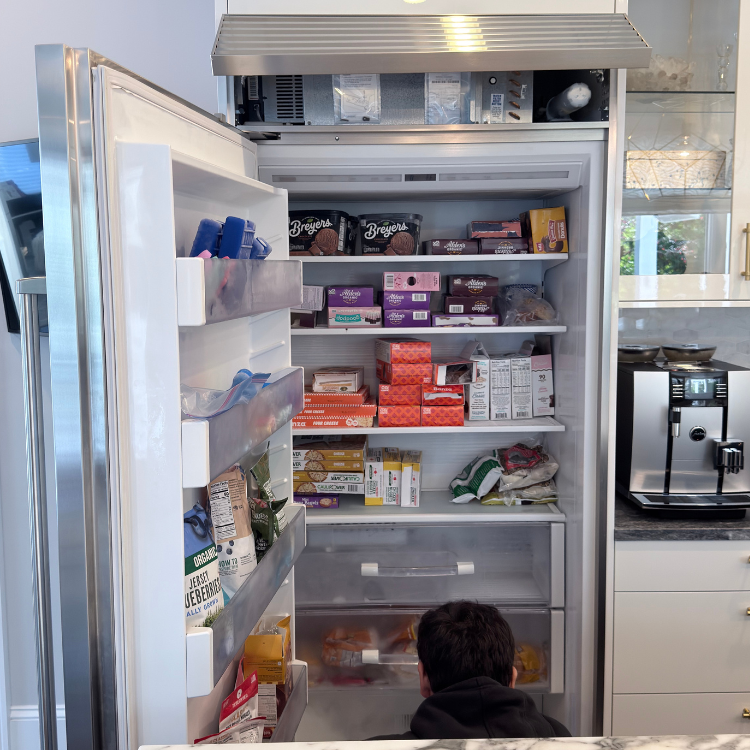
Refrigerator Warming In A Galley Kitchen
- Visit context: A narrow kitchen can limit side clearance around a counter-depth or water-connected refrigerator.
- Appliance symptom: The fresh-food section warms, freezer behavior changes, ice output slows, or displayed temperature does not match food condition.
- Safe customer action: Record temperatures, limit door openings, and do not force the appliance forward if a water line or tight floor path is likely.
- What helps booking: Share brand, visible model details, temperature behavior, and whether the appliance has an ice maker or dispenser. Use refrigerator not cooling diagnosis to organize cooling evidence.
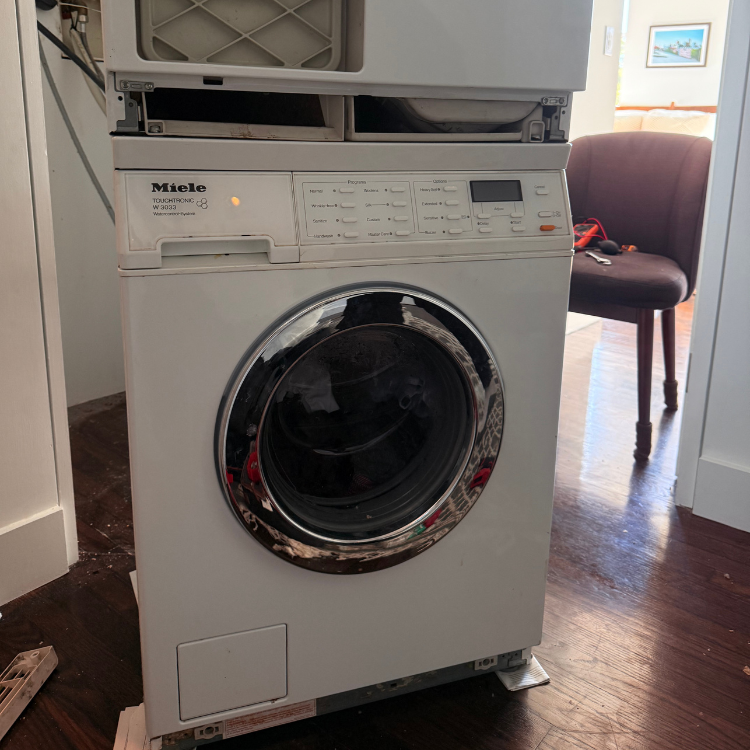
Washer Shaking On Older Floors
- Visit context: Older floor assemblies and compact laundry closets can make high-speed spin movement louder and more visible.
- Appliance symptom: The washer bangs, walks, pauses with wet clothes, or shakes only with towels, bedding, or one heavy load.
- Safe customer action: Stop the load if the washer shifts or hits surrounding surfaces; do not restart spin repeatedly.
- What helps booking: Send a short spin video, load type, and photo showing whether the machine is stacked, enclosed, or on a pan. Compare the spin behavior with washer shaking violently.
Dryer Heats But Clothes Stay Damp
- Visit context: A closet dryer can hide a vent, condenser, lint path, or combo-unit moisture route behind doors and stacked equipment.
- Appliance symptom: Loads end warm and damp, dry time stretches, lint warnings appear, or the appliance shuts down before heavy items dry.
- Safe customer action: Clean the accessible lint filter and stop use if the dryer smells hot or overheats.
- What helps booking: Identify whether the dryer is vented, ventless, heat-pump, or combo and describe the load at cycle end. Use dryer repair when heat is present but drying is poor.
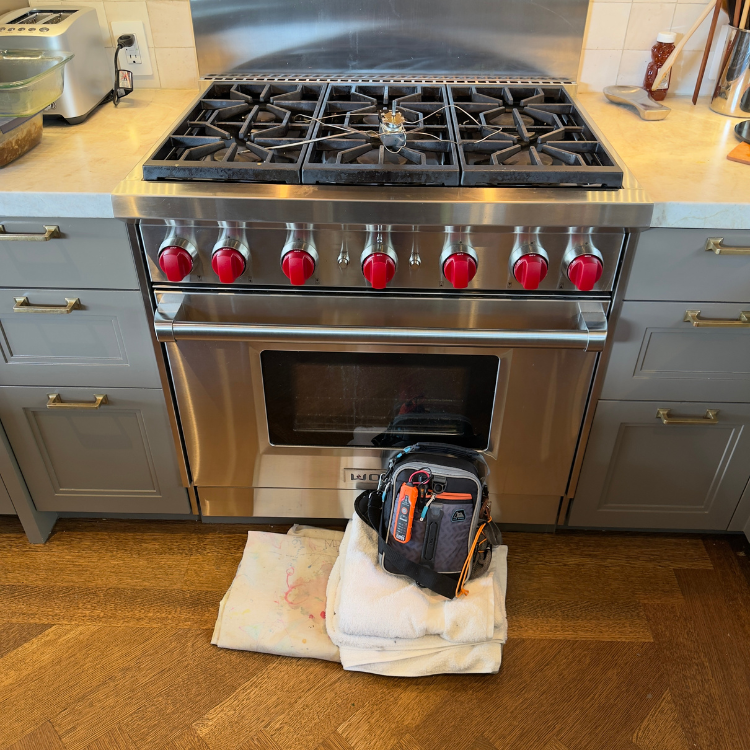
Oven Heat Drift Or Burner Clicking
- Visit context: A compact prewar kitchen can put a range, wall oven, cooktop, counters, and cabinet trim close together.
- Appliance symptom: Preheat takes too long, one oven mode fails, food cooks unevenly, or a burner clicks after cleaning with no gas odor.
- Safe customer action: Stop use for smoke, burning smell, repeated breaker trips, or gas odor. For clicking with no odor, keep knobs off and let damp parts dry.
- What helps booking: Tell us whether the issue is bake, broil, surface burner, display, cleaning-related clicking, or a gas-odor situation. Use oven repair when heat behavior is the main issue.
COI And Building Access
For Upper West Side co-ops or managed buildings that require a COI, send certificate holder wording, management contact, elevator instructions, permitted work hours, and any floor or cabinet protection requirement.
If active water, overheating, or gas odor is involved, preserve appliance evidence and follow building notification rules before moving anything.
When To Stop Using The Appliance
Stop using the appliance if there is active leaking, smoke, burning smell, repeated breaker trips, extreme dryer heat, violent washer movement, or a gas odor.
If you smell gas, leave immediately and call 911 or the utility from a safe location. Do not test burners, relight anything, flip switches, or use electronics near the odor.
Quick Answers
Do you repair appliances in Upper West Side prewar buildings?
Yes, when the appliance can be reached safely and any required COI, elevator, management, or work-hour instructions are available.
Should I move a refrigerator out of a galley kitchen?
No. Send temperature behavior and installation photos instead of forcing a water-connected or tight appliance forward.
What should I do if a dishwasher leaks under a counter?
Stop the cycle, dry visible water, and avoid another wash. The leak location and cycle stage are useful evidence.
Can older floors make washer vibration worse?
Yes. Older floors can make washer movement more obvious, but load balance, leveling, installation, and repair issues still need confirmation.
What information helps most before an Upper West Side appointment?
Send symptom timing, model details, installation photos, and building requirements for elevator, COI, management, or work hours.
Book Upper West Side Appliance Repair
For appliance repair on the Upper West Side, send the appliance type, symptom timing, model details, installation photos, and building requirements together. Volt & Vector is an independent appliance repair company, uses a diagnostics-first approach, uses OEM parts when appropriate and available, and provides an estimate before repair work begins.
Insured HVAC & Appliance Repair Service in NYC & Brooklyn
VOLT & VECTOR LLC carries Commercial General Liability insurance through Hiscox Insurance Company Inc. Coverage is effective June 6, 2026 – June 6, 2027, with $1,000,000 per occurrence and $2,000,000 general aggregate limits.COI available upon request for homeowners, landlords, property managers, co-op/condo boards, commercial clients, and general contractors.