Direct F66 Answer
Miele connects F66 with insufficient airflow through the dryer. Current Miele USA guidance starts with the lint filters and the plinth or toe-kick filter, then includes visible heat-exchanger lint, an overloaded drum, a blocked lower ventilation grille, insufficient room ventilation, and a remaining technical fault. Use the visible signal to decide what changes next:
- Damp filter after washing: The plinth filter was rinsed and F66 appeared or returned before it was completely dry. Follow the exact model instructions for drying and refitting it, then use one controlled comparison. If F66 returns, service must measure actual airflow and the protection response.
- Residue, deformation, tears, or poor fit: The filter looks white or encrusted, wavy, torn, damaged, or no longer flush. Follow Miele's filter cleaning or replacement direction; do not force it or improvise filter material. Diagnosis should check fit and whether lint has passed downstream.
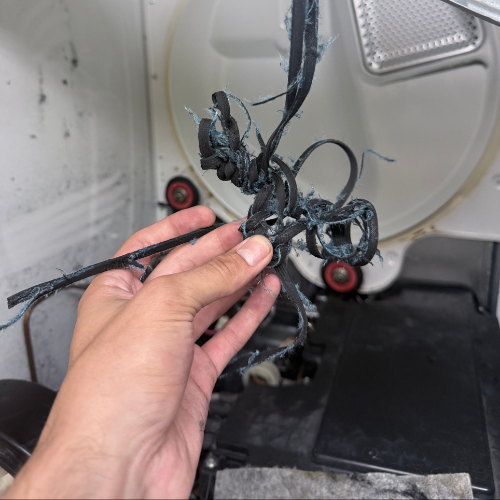
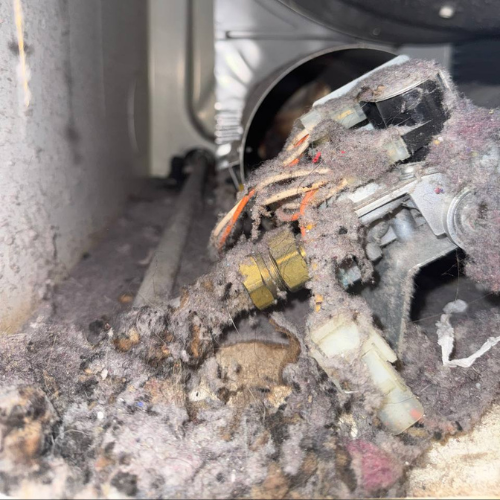
- Visible lint at the heat exchanger: Lint is visible only in the owner-accessible area. Use light dust-brush vacuuming only where the exact instructions permit it, without touching or pressing the fins. Lint or damage beyond that visible area requires service-level inspection.
- Heavy load, blocked lower grille, or hot enclosed room: F66 correlates with a packed drum, an object covering the lower grille, or insufficient room ventilation. Reduce the load, clear the grille, and restore the installation's required room ventilation. If the code persists under corrected conditions, service must confirm performance with a controlled load.
- All visible conditions are correct: The model-correct filters are clean, dry, undamaged, and seated; the load is reasonable; the grille is clear; and room ventilation is suitable. If F66 returns in this state, use the service threshold below instead of changing more variables.
- Stop now: Smoke, a burning or electrical odor, abnormal cabinet heat, a breaker trip, visible wiring damage, or water near powered parts changes this from an F66 maintenance check to a safety stop. Leave the dryer off and arrange safe diagnosis.
Safe F66 Checks
- Record identity and display: Photograph F66 and the full model and serial label before clearing the display.
- Identify the correct filters: Match the door, plinth, or toe-kick filter names and access points to the exact operating instructions.
- Perform only model-approved care: Remove lint and use only the cleaning method assigned to the owner for that filter.
- Reach the required dry condition: Let a washed filter dry as directed, reinstall it in the correct orientation, and confirm that it sits fully and normally.
- Inspect condition and fit: Note encrustation, waviness, tears, deformation, or a non-flush fit; do not force or bypass the filter.
- Limit heat-exchanger care: Use only the permitted light dust-brush vacuuming of visible lint, with no contact or pressure on the fins.
- Correct the operating context: Reduce the load, clear the lower grille, and provide the room ventilation required by the installation.
- Use one comparison only: When no stop signal is present, run one reasonable load on an appropriate program and record whether and when F66 returns.
Make Sure the Display Really Says F66
- F55: This is a separate maximum-drying-time condition. Use the F55 owner when the display shows F55 rather than F66.
- Filter/Vent or Clean Airways warning: A recurring named warning without F66 has its own post-cleaning diagnostic page.
- F13 or F18: These are separate code queries and must not inherit the F66 meaning.
- No exact code: Route by the dominant symptom. A dryer that stays cold, leaves warm damp laundry, overheats, or stops mid-cycle needs the corresponding symptom diagnosis.
When to Stop and Arrange Service
Stop the F66 cleaning loop when the code returns after one complete model-correct check, when a filter is damaged or will not sit normally, or when the next step would require opening the cabinet. Do not run with a missing or bypassed filter, disable a warning, enter service mode, open panels, test live voltage, touch or pressure-clean heat-exchanger fins, or select a fan, sensor, heater, compressor, or board from the code alone.
What Diagnosis Must Confirm
A useful service diagnosis should reproduce the fault under the documented model-correct test conditions, then separate four hidden stages:
- Actual air movement: Confirm whether the dryer is moving the required air through the complete model-specific path, not merely whether the filter face looks clean.
- Restriction location: Distinguish filter permeability and fit from deeper lint buildup, heat-exchanger condition, or another restriction beyond owner access.
- Protection and sensing response: Determine whether the dryer is reacting correctly to the measured airflow and temperature conditions.
- Control of the affected system: Verify the exact-model fan, wiring, sensing, protection, and control sequence only after the airflow conditions have been separated.
What to Record Before Service
- Machine identity: Full model and serial number.
- Exact display: A photo showing F66 and any other message or indicator.
- Timing: Whether F66 appears immediately, after several minutes, only with a heavy load, or directly after filter cleaning.
- Filter work: Which filters were cleaned, whether they were washed, how long they dried, their visible condition, and whether they sit flush.
- Operating context: Program, load type and size, lower-grille condition, room temperature or ventilation concern, and the result of the one controlled comparison.
FAQ
Is F066 the same as F66?
F066 appears in some search wording, but the appliance display and the exact model documentation control the code identity. Use this diagnosis only when the machine or its instructions confirm F66; preserve a photo rather than normalizing an uncertain display from memory.