Washing Machine Repair
Professional Washing Machine Repair in Brooklyn & Manhattan
A washing machine failure in a New York City apartment creates immediate inconvenience — laundromats, linen services, and the daily logistics of managing laundry without in-unit access are real costs. In buildings where laundry is not shared, an in-unit washer is as essential as the kitchen. Volt & Vector's technicians repair every washer brand found in NYC residences, from compact European front-loaders to full-size top-load units in Brooklyn homes.
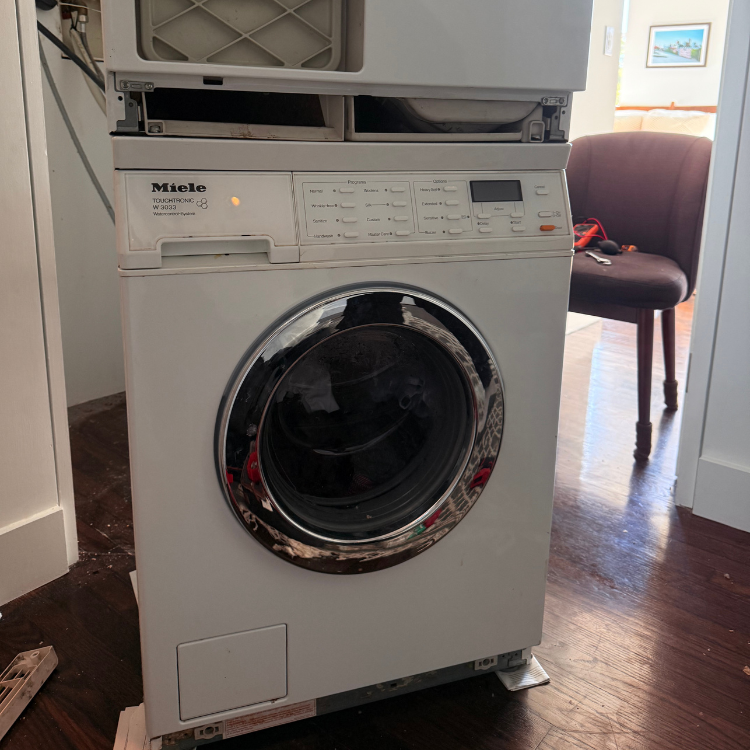
NYC's washing machine landscape is dominated by compact European front-load washers — Bosch, Miele, Samsung, and LG ventless units are standard in Manhattan and renovated Brooklyn apartments. These machines have specific failure patterns around door seals, drum bearings, drain systems, and the condensation-based drying circuits in combo units. We stock OEM parts for all active models and arrive prepared to diagnose and repair on the first visit.
Every Volt & Vector service call begins with a $99 diagnostic fee credited in full toward your repair. Every completed repair is backed by our 180-day parts and labor warranty. Our 27 five-star Google reviews reflect a consistent track record of first-visit resolution on NYC washer failures.
Washing Machine Repair by Brand — NYC Service
Volt & Vector repairs every washing machine brand in NYC: LG Washer Repair, Samsung Washer Repair, Bosch Washer Repair, Miele Washer Repair, Whirlpool Washer Repair, Electrolux Washer Repair, and more. Front-load, top-load, and compact units all receive the same systematic diagnostic approach. Common repairs include drum bearing replacement, drain pump failures, door latch faults, and control board issues.
For brand-dedicated washer repair, see LG appliance repair, Samsung appliance repair, Bosch appliance repair, and Miele appliance repair. Service available throughout Park Slope, Williamsburg, Upper West Side, and Upper East Side.
DIY vs Pro
Washing Machine Repair: What You Can Do vs. When to Call a Pro
What You Can Do
Cleaning the drain pump filter on front-loaders is a DIY-accessible maintenance task that prevents many drain failures. The filter is typically behind a small access panel on the lower front of the machine. Place a towel and shallow dish below the cap before opening, as residual water will drain out. Clean the filter and inspect for coins, hairpins, and debris. Do this every 2–3 months in NYC households. Cleaning the detergent dispenser by removing the drawer and rinsing it in hot water removes accumulated detergent residue that blocks water flow and causes mold growth. Cleaning the door boot seal on front-loaders by wiping the gasket folds with a diluted bleach solution prevents mold growth in the folds — a very common issue in NYC apartments with humid laundry closets. Leveling the machine using adjustable feet to eliminate vibration-causing tilt is a simple mechanical adjustment requiring no tools beyond a wrench.
When to Call a Pro
Motor replacement, bearing replacement, pump replacement, door boot seal replacement, and control board replacement all require partial or full disassembly of the washing machine and should be performed by a trained technician. Front-loader drum bearing replacement in particular requires complete drum removal — the most involved repair in the washing machine service category. Water inlet valve replacement requires disconnecting water supply lines under pressure and reconnecting with proper sealing — a straightforward task for a technician but a potential leak source if done incorrectly by an untrained person. In NYC apartment buildings, any water leak from an incorrectly performed DIY repair creates liability exposure beyond the cost of the appliance. Call Volt & Vector at (332) 333-1709.
Diagnostic Process
How Our Washing Machine Repair Process Works
Step 1: Book Same-Day or Next-Morning Service
Call (332) 333-1709 or schedule online. Volt & Vector technicians are dispatched across Brooklyn and Manhattan seven days a week. Most calls received before noon are eligible for same-day service — we understand that a laundry pile grows quickly and every day without a working machine has a real cost. You receive a specific arrival window. Our technicians know the boroughs: they navigate building access requirements, service elevators, and laundry closet configurations as a matter of routine.
Step 2: Complete Diagnosis of the Wash System
The $99 diagnostic fee covers a full assessment: we test the water inlet valve operation and screen condition, check the motor and drive system (direct drive or belt), test the door latch and lid switch, inspect the pump impeller and drain circuit, examine the drum bearings for wear, read the control board for stored fault codes, and check the suspension system on front-loaders and the agitator assembly on top-loaders. We run a partial test cycle under controlled conditions to observe the full fault behavior. NYC-specific water pressure and mineral scale issues are documented and explained. You receive a complete findings summary before authorizing any repair.
Step 3: Repair, Run Test Cycle & Deliver Warranty
With your authorization, we repair from vehicle stock in most cases. After completing the repair, we run a full wash cycle — spin included — to verify correct operation, absence of leaks, proper drain function, and normal vibration levels. In stacked configurations, we verify that the dryer above is undisturbed. You receive a written receipt with the 180-day warranty clearly stated. The $99 diagnostic is credited against the total.
New York City — What's Different
Washing Machine Repair in New York City: What Makes It Different
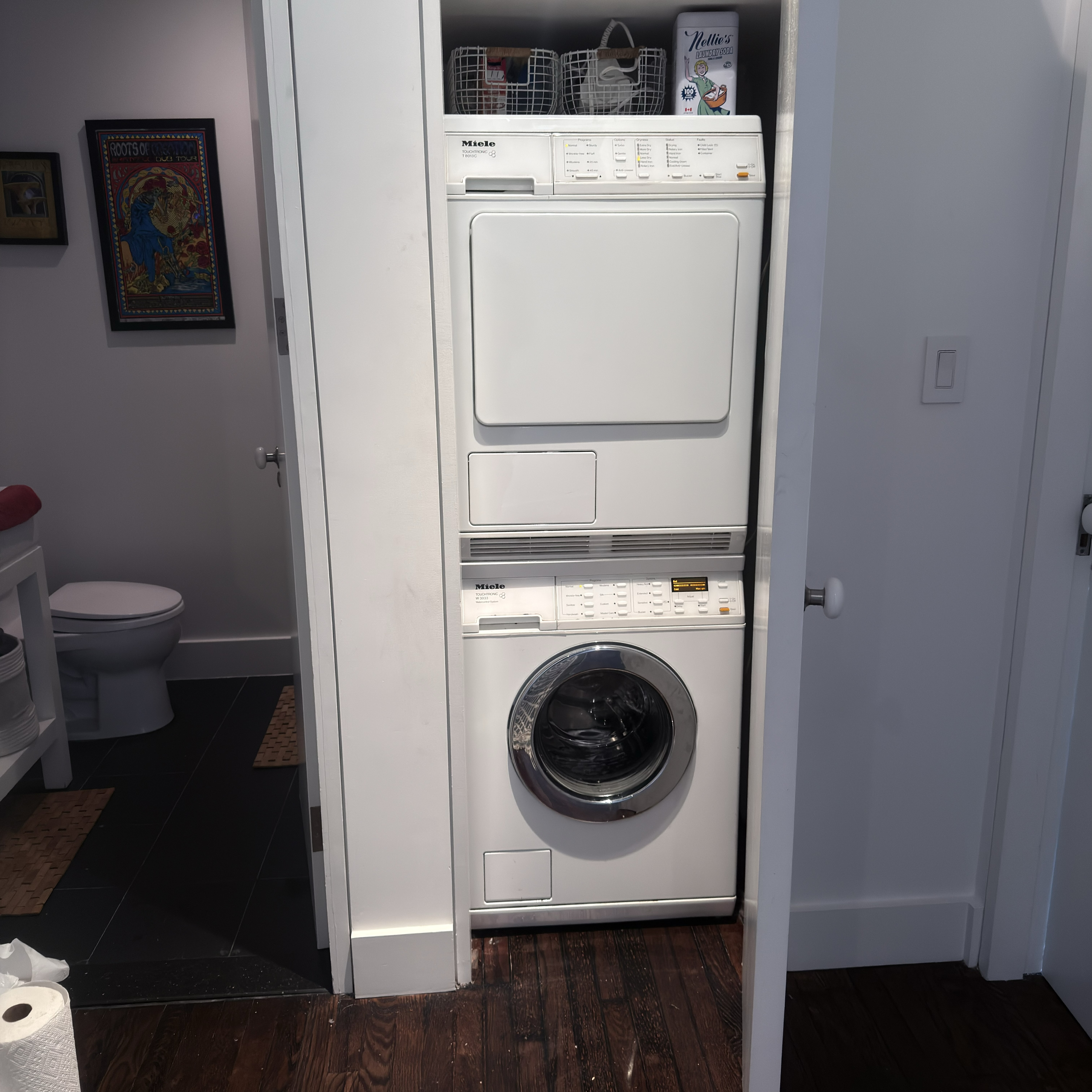
Washing machine service in Brooklyn and Manhattan is shaped by two NYC-specific realities that no suburban appliance company has to manage: stacked laundry configurations in tight closets, and the premium value of in-unit laundry in the NYC housing market. A stacked washer-dryer unit in a Manhattan laundry closet may be the feature that justified a $500 monthly rent premium on the apartment. When it fails, the repair is not just a maintenance issue — it is a housing value issue. Volt & Vector technicians understand this stakes dynamic and approach every NYC laundry call with appropriate urgency.
Stacked configurations introduce specific technical challenges. The dryer must be carefully removed from the top of the washing machine to access internal washer components in most cases — a process that requires two people operating carefully in a space that may be only 36 inches wide. In some NYC apartment laundry closets, the stacking kit attaches the units together permanently, requiring additional disassembly before either appliance can be serviced. Our technicians arrive prepared for stacked configurations and carry the appropriate equipment to manage the dryer safely during washing machine service.
NYC building plumbing variability also affects washing machine performance in ways that are often misattributed to appliance failure. Water pressure in prewar buildings — common throughout Brooklyn Heights, the Upper West Side, and the West Village — can vary significantly between floors, with upper-floor apartments receiving lower pressure that causes washing machines to throw inlet error codes despite having fully functional inlet valves. Our technicians measure incoming water pressure as part of every NYC washing machine diagnosis to ensure that a plumbing issue is not misdiagnosed as an appliance failure.
Symptoms
Symptom Guide: What Your Washing Machine Is Telling You
Machine Won't Start Despite Having Power
A washing machine that powers on (display illuminated) but won't start a cycle when you press Start has one of several faults: the door latch switch is not confirming closure to the control board, the child lock is active (check the display for a lock icon), a stored fault code is blocking cycle initiation, or the control board has failed. Check whether the display shows any fault code or lock indicator before calling. On front-loaders, verify the door is fully latched by firmly pressing it closed until you hear a click. On LG ThinQ connected washers, a pending software update can occasionally prevent cycle start via the physical panel. Urgency: Moderate — no damage risk but machine is non-functional.
Machine Fills with Water But Drum Doesn't Rotate
Water entering the drum but no drum movement during the wash cycle points to a failed motor coupling on direct-drive top-loaders, a failed drive belt on belt-drive machines, a failed motor start capacitor, or a control board that has lost communication with the motor controller. On Samsung front-loaders, the BLDC motor hall sensor failure produces exactly this symptom: the drum fills correctly then sits without rotation. The motor makes a brief attempt sound — a soft hum — then stops. On Miele washers, the tachogenerator failure produces the same symptom. Our technicians are trained on the specific failure signatures for each platform. Urgency: High — water is in the drum and must be drained manually if repair is not immediate.
Clothes Come Out Excessively Wet After Spin Cycle
If the spin cycle runs (you can hear the motor accelerating) but clothes are still soaking wet at cycle end, the machine is not reaching spin speed. Common causes include an out-of-balance load aborting the high-speed spin before completion — redistribute the load and retry before calling — failing shock absorbers that prevent the drum from reaching high RPM without triggering the vibration sensor cutout, or a worn drive belt that slips at higher motor torques. On top-loaders, a worn clutch assembly that no longer transfers motor torque fully to the drum during spin is the primary cause of inadequate spin extraction. Urgency: Moderate — clothes can be wrung and dried, but efficiency loss is significant.
Water Continues Filling and Won't Stop
A washing machine that fills beyond the normal level and continues adding water indicates a failed water inlet valve that is mechanically stuck open — not closing when the solenoid de-energizes — or a failed water level pressure switch that is not signaling the control board to close the inlet valve when the tub is full. This fault requires immediate attention: if the machine overflows, the tub capacity is exceeded and water runs across the floor and potentially into the apartment below. Turn off the water supply valve behind the machine immediately and call for service. Urgency: Critical — active flood risk if not addressed immediately.
Detergent Remaining in Dispenser After Wash
Detergent left in the dispenser drawer after a completed wash cycle indicates the inlet water is not flushing the dispenser correctly — typically due to a blocked or partially blocked dispenser flush nozzle, a failed secondary water inlet solenoid that controls dispenser flushing, or a detergent dispenser housing clogged with residue from liquid detergent use. In NYC apartments, liquid detergent used without periodic dispenser cleaning creates a thick residue buildup in the dispenser channels that eventually blocks water flow. Remove and clean the dispenser drawer thoroughly with hot water and a brush. If cleaning does not resolve the issue, the inlet solenoid or dispenser housing requires service. Urgency: Low — clothes are cleaning but with reduced detergent effectiveness.
Maintenance Tips
Washing Machine Maintenance Tips for NYC Apartments
Clean the Drain Pump Filter Every 2–3 Months
Front-loaders accumulate debris — coins, buttons, small socks, and hairpins — in the drain pump filter at a higher rate than in households where pockets are consistently emptied before washing. NYC life involves frequent pocket contents: MetroCards, earbuds, small accessories. A clogged pump filter causes drain failures, pump motor strain, and eventually pump failure. The filter is accessible from the front kick panel — place a towel and shallow bowl below the cap, open it slowly, drain the residual water, and pull out the filter for cleaning. This two-minute task prevents the most common category of front-loader service call.
Run a Monthly Drum Cleaning Cycle
Most modern washing machines have a dedicated Tub Clean or Drum Clean cycle — use it monthly with either a commercial washer cleaner tablet or half a cup of baking soda added directly to the drum. NYC laundry closets are frequently humid with limited ventilation, creating conditions where mold grows rapidly inside the drum, on the door boot seal, and in the detergent dispenser. The drum cleaning cycle runs hot water through the full drum volume to flush microbial growth and mineral deposits. Monthly use — more frequent than the manufacturer recommendation — is appropriate for NYC's humid apartment environment.
Wipe Door Boot Seal Folds After Every Use
The door boot seal on front-loaders is the single location most prone to mold growth in NYC apartments. The accordion folds trap water, lint, and detergent residue after every wash cycle, and the dark, humid environment inside a closed laundry closet accelerates mold colonization. After the final load of the day, wipe the seal folds thoroughly with a dry cloth, leave the door slightly ajar to allow airflow through the drum interior, and pull out the detergent dispenser drawer to allow it to dry. These habits add less than two minutes to your laundry routine and prevent the mold odor and seal degradation that require professional service.
Use HE Detergent at Correct Dosage
High-Efficiency (HE) detergents are required for all front-loader and modern top-loader washing machines. Using standard detergent creates excessive suds that the machine's suds suppression system cannot clear, which leaves detergent residue inside the drum, on the boot seal, and in the pump circuit. In NYC apartments where a delivery service may have substituted a non-HE product, check the detergent bottle for the HE symbol before use. Additionally, use HE detergent at the manufacturer-recommended dosage — more detergent does not mean cleaner clothes, and overdosing accelerates all the residue and mold problems described above.
Case Logs
Field Case Log: Samsung WF45R6100AW Repair on the Upper East Side
A client on the Upper East Side contacted Volt & Vector regarding a Samsung WF45R6100AW front-load washing machine that was displaying error code 4E and refusing to start any wash cycle. The unit was approximately 19 months old, installed in a dedicated laundry closet adjacent to the kitchen in a prewar co-op apartment. The client had already attempted a hard reset by unplugging the machine, which did not clear the error.
Error code 4E on Samsung washing machines indicates a water supply issue — either no water is reaching the machine or water flow is insufficient to fill within the timeout period. The technician confirmed that the household water shutoff valve behind the machine was fully open. Checking incoming water pressure with a gauge revealed only 18 PSI at the machine connection point — significantly below the 20–12 PSI minimum required for reliable Samsung inlet valve operation. The prewar building's water pressure on this upper floor was the primary cause.
However, further inspection revealed a secondary contributing factor: the inlet valve screen filters were heavily calcified with mineral deposits, reducing effective flow area by approximately 60% from their original clear state. At normal building water pressure, this restriction alone would not have prevented fill; combined with the low building pressure, it created a fill rate below the machine's minimum threshold. Both inlet valve screens were cleaned with a descaling agent, and the inlet valve solenoids were tested and confirmed functional. The client was advised to contact building management regarding the low water pressure — a building plumbing issue affecting multiple appliances — and was given documentation of the measured pressure for that conversation. Post-repair test cycles completed without error codes. The 180-day warranty was documented on the written receipt.
Frequently Asked Questions About Washing Machine Repair
Can you repair stacked washer-dryer units in apartment closets?
Yes. Stacked laundry configurations in NYC apartment closets are among our most common service scenarios across Brooklyn and Manhattan. Our technicians arrive prepared to work in tight spaces, with the appropriate equipment to safely manage the dryer unit during washing machine access. We bring a second technician when the dryer must be removed from the stack to ensure the unit is handled safely without damaging the closet or the appliance. Stacked configurations add time to the service call but do not prevent any washing machine repair that would be accessible in a freestanding installation.
How long does a washing machine repair typically take?
Most washing machine repairs are completed in a single visit of 1–2 hours. Drain pump replacement, door boot seal replacement, water inlet valve replacement, lid switch replacement, and motor coupling replacement are all parts-on-vehicle repairs for major brands. Drum bearing replacement is the most time-intensive washing machine repair — typically 2–3 hours — and requires complete drum disassembly. We provide a realistic time estimate at diagnosis so you can plan your schedule accordingly.
Is it worth repairing a washing machine rather than replacing it?
For premium front-loaders — Miele, LG Signature series, Samsung FlexWash, and Bosch 800 Series — repair is almost always worth pursuing for units under 7–8 years old. For standard-grade machines over 8 years old with a failed motor, control board, or drum bearing, a cost-benefit assessment is warranted. The specific repair cost relative to replacement cost is the key variable, and our technicians provide an objective assessment at diagnosis. We never recommend repairs that don't make economic sense for the client.
What causes washing machines to vibrate excessively in NYC apartments?
Excessive vibration in NYC apartment washing machines has three primary causes: failed shock absorbers or suspension springs (mechanical failures requiring repair), an out-of-balance load (not a repair issue — redistribute clothes and retry), or the machine not being level on the floor (adjustable feet can be turned by hand to level the unit). In NYC apartment buildings with slightly uneven floors — common in older prewar construction — a machine that was previously level can go out of level as the building settles. Check leveling first before calling for service. If the machine vibrates severely even with small, balanced loads, the suspension components require inspection.
What washing machine brands do you repair?
Volt & Vector technicians repair Samsung, LG, Miele, Bosch, Electrolux, Whirlpool, Maytag, GE, GE Profile, Speed Queen, Fisher & Paykel, and Blomberg washing machines. We service both front-loader and top-loader configurations, including compact 24-inch front-loaders common in NYC apartment laundry closets. Speed Queen commercial-grade residential washers require specific mechanical knowledge that our team carries for NYC clients who have invested in these long-lifespan machines. Call (332) 333-1709 to confirm coverage for your specific model and configuration.
Washing Machine Repair Brooklyn & Manhattan NYC | Volt & Vector
Expert washing machine repair in Brooklyn and Manhattan. Same-day service, $99 diagnostic credited to repair, 180-day warranty. Samsung, LG, Miele, Bosch, Speed Queen. Call (332) 333-1709.

![[team] image of individual team member (for a plumbing service)](https://cdn.prod.website-files.com/69bee112af9b01020603c864/69bf25442088ee694e3ce2a9_kitchenaid-oven-repair.png)