

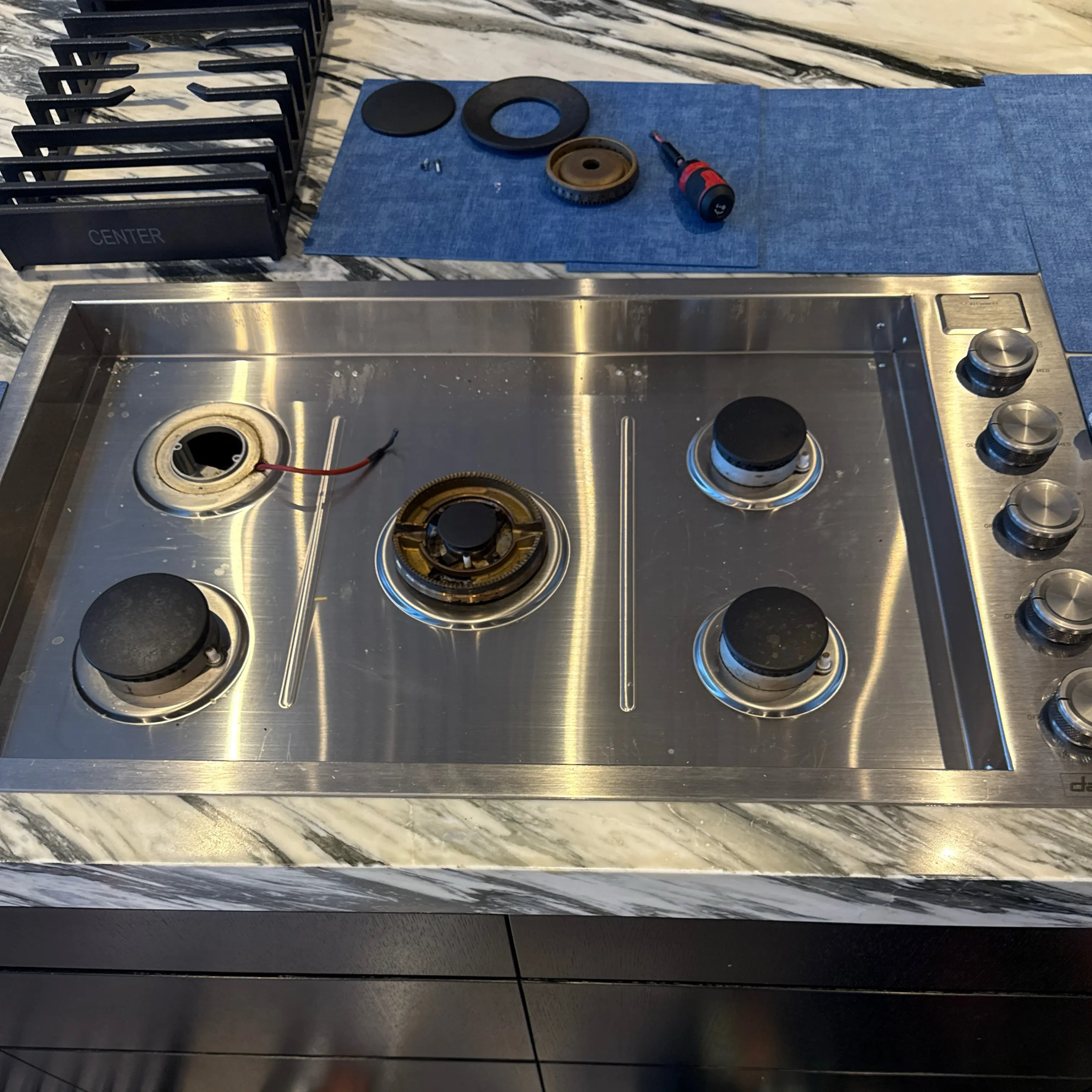
.avif)
Gaggenau Gas Cooktop 200 & 400 Series: Common Problems
Common Gaggenau 200 and 400 Series gas cooktop problems explained: ignition issues, clicking, uneven flames, burner discoloration, clogged ports, and proper owner-level cleaning and maintenance.
Gaggenau Gas Cooktop 200 & 400 Series: Common Problems and Proper Owner Maintenance
Gaggenau gas cooktops in the 200 and 400 Series need relatively little routine mechanical maintenance, but the burner assemblies need to stay clean, dry, and correctly positioned. Most owner-level care should focus on preventing food, grease, moisture, and cleaning residue from interfering with the burner ports, igniters, thermocouples, burner rings, caps, and pan supports.
If a cooktop smells of unburned gas, repeatedly fails to ignite, produces an abnormal flame, or continues malfunctioning after the removable burner components have been cleaned and correctly reassembled, stop using the affected burner and have the appliance inspected. Gas valves, regulators, internal ignition electronics, fuel conversion components, and gas connections are not owner-maintenance items.
Safety gate: gas problems are different from cleaning problems
If you smell gas when the burners are off, do not attempt to diagnose the leak by repeatedly lighting the cooktop.
Do not operate electrical switches or create an ignition source near a suspected gas leak. Leave the area and follow the instructions of your gas utility or emergency services. Gaggenau specifically states that finding a gas leak is not a do-it-yourself procedure.
For normal cleaning, wait until the cooktop and burner components are completely cool.
Do not:
- loosen gas fittings
- adjust the gas regulator
- enlarge burner ports
- remove or modify gas orifices
- attempt a natural-gas/LP conversion
- bend or reposition thermocouples
- sand or aggressively scrape igniters
- pour water into the cooktop
- spray cleaner directly into openings around the burner or controls
Those procedures are different from routine surface maintenance.
What is actually happening inside a Gaggenau gas burner?
A gas burner needs several things to happen correctly at the same time.
Gas has to reach the burner at the correct pressure. The burner head, ring, and cap must then distribute that gas evenly through their ports. The ignition system produces a spark at the correct location, and the flame-safety system must confirm that a stable flame exists.
On different Gaggenau models, the exact burner construction and electronic control system varies. Current 400 Series products such as the VG 491 use electronic flame monitoring and automatic re-ignition, while other Gaggenau gas cooktops use an igniter and thermocouple arrangement around the burner.
This means something as simple as a burner ring sitting slightly crooked can affect:
- ignition
- flame distribution
- flame detection
- re-ignition
- simmer performance
- burner noise
- stainless-steel discoloration
Gaggenau specifically warns that incorrectly positioned burner components can produce ignition and operating problems.
Most common Gaggenau gas cooktop problems
1. Burner clicks but does not ignite
This is one of the most common owner-level complaints.
The igniter is clearly attempting to light the burner, but the gas does not ignite immediately.
Common causes include:
- wet igniter after cleaning
- grease on the igniter
- food contamination around the burner
- blocked burner ports
- burner cap or ring installed incorrectly
- burner components still wet internally
- incorrect burner component orientation
- a deeper ignition, gas-supply, or control problem
Gaggenau specifically instructs owners to keep igniters clean and dry and to verify that burner ports are clear and burner components are positioned correctly.
Owner-level check
Turn the burner off and allow everything to cool.
Remove only the burner components intended to be removable on your model. Clean them, dry them completely, and carefully reinstall them in the correct orientation.
Do not assume that a burner component is correctly installed merely because it appears approximately centered.
On some Gaggenau burners, tabs, recesses, or locating points must line up precisely. Gaggenau notes that burner parts installed at an angle can cause the appliance not to operate correctly.
2. Burner takes several attempts to ignite
A burner that eventually lights but requires repeated clicking should not automatically be considered normal.
Look first for contamination.
Food can accumulate around the burner ports. Grease can coat the ignition area. Water from cleaning can remain around the ceramic igniter or beneath removable burner components.
Gaggenau specifically states that a damp igniter can prevent a burner from lighting.
A burner that frequently ignites late can also produce a brief flare when accumulated gas finally catches.
If thorough cleaning, complete drying, and correct assembly do not restore normal ignition, stop treating the problem as maintenance.
3. Burner keeps clicking after cleaning
If clicking begins immediately after the cooktop was cleaned, moisture should be one of the first things considered.
Owners sometimes clean the cooktop with a very wet sponge or spray cleaner around the burners. Liquid can reach the ignition area.
Do not keep cycling the burner repeatedly.
Allow the components to dry thoroughly.
A small amount of moisture around an igniter can cause temporary ignition problems. Excess water should also be avoided during cleaning.
If continuous sparking remains after the cooktop is completely dry, there may be a switch, ignition module, wiring, or control issue that is outside owner-level maintenance.
4. Flame is uneven around the burner
The flame should distribute reasonably evenly around the burner.
When part of the burner burns normally while another section has little or no flame, suspect:
- blocked burner ports
- food residue
- incorrectly seated burner ring
- incorrectly installed burner cap
- damaged burner component
- gas-distribution problem
A boil-over is a common starting point.
Liquid containing starch, sugar, grease, or food solids can dry inside the burner openings.
Gaggenau recommends cleaning burner-port openings when a boil-over occurs or when an igniter clicks but the burner does not light.
5. Yellow or unusual flame
Flame appearance contains useful diagnostic information, but owners should not try to correct a persistent fuel or regulator problem themselves.
For natural gas, Gaggenau describes a soft blue flame as normal. A completely or predominantly yellow flame can indicate that further adjustment is required.
A temporary orange or yellow streak caused by contamination can occur, but a persistent abnormal flame across one or multiple burners deserves attention.
Possible reasons include:
- contaminated burner ports
- burner parts assembled incorrectly
- foreign material
- improper gas-air mixture
- wrong fuel configuration
- regulator problem
- incorrect conversion
- supply problem
Stop using the burner if
- the flame lifts away from the burner
- the flame repeatedly extinguishes
- there is substantial yellow flame
- soot develops on cookware
- you smell unburned gas
- flame comes from an unexpected location
Do not adjust gas pressure or burner orifices yourself.
6. Burner flame goes out at low settings
First rule out environmental causes.
Strong ventilation, an open window, or airflow across the cooktop can disturb a gas flame. Gaggenau's troubleshooting information specifically tells owners to check for drafts when a burner flame goes out unexpectedly.
Also inspect the burner for:
- dirty flame ports
- incorrect burner assembly
- wet burner components
- food residue around the burner
If the burner repeatedly extinguishes during normal low-flame operation after those conditions have been ruled out, the flame-monitoring system or burner regulation may require diagnosis.
7. Burner cap or burner ring is not seated correctly
This deserves more attention than it usually gets.
After cleaning, someone may place the burner components back approximately where they belong without confirming their exact position.
Gaggenau lists several possible consequences of incorrect burner-cap placement:
- burners failing to ignite
- uneven flames
- unusually high flames
- flame escaping from the wrong part of the burner
- gas odor
- stainless-steel discoloration
On certain Gaggenau burner assemblies, the burner head, burner ring, thermocouple location, and ignition plug are arranged around specific recesses. Correct orientation matters.
Never force a burner component into position.
If it does not sit flat, check its orientation.
8. Brass burner rings become dark
This is usually not a functional defect.
Brass changes appearance with heat, oxidation, cooking residue, acids, moisture, and repeated cleaning.
Gaggenau specifically states in its care information that brass burner components can darken from natural oxidation and that the color change does not affect burner performance.
The 400 Series VG 491, for example, uses brass burner rings.
Owners sometimes try to restore the burner to a bright polished appearance using aggressive abrasives. That can create more problems than the discoloration itself.
A darker burner that operates correctly is primarily a cosmetic issue.
Can Gaggenau brass burners be polished?
Some Gaggenau documentation allows specific cleaning procedures for particular burner designs. Gaggenau's VG 491 care guidance describes cleaning removable brass burners with hot soapy water and discusses using appropriate cleaning compounds for staining.
However, do not assume the cleaning method for one burner generation applies to every Gaggenau 200 or 400 Series cooktop.
Check the manual for the exact E-number before using:
- metal polish
- acidic cleaner
- abrasive powder
- soaking solutions
Cosmetic restoration and normal burner cleaning are not necessarily the same procedure.
9. Stainless steel around the burner becomes discolored
Some discoloration can result from heat exposure, but burner alignment should also be checked.
A flame that is being directed incorrectly because the burner is assembled badly can concentrate heat where it should not.
Gaggenau specifically includes stainless-steel discoloration among the possible symptoms of incorrect burner-cap placement on some models.
Therefore, do not immediately attack discoloration with aggressive cleaner.
First ask why that area became unusually hot.
10. Igniter is dirty
The igniter is a small component, but it is critical.
Grease, cleaning residue, or food can interfere with the spark.
For VG 491-style burners, Gaggenau recommends gently cleaning the ignition plug with a small soft brush and warns against striking it.
Other Gaggenau manuals recommend careful cleaning around ceramic igniters while avoiding excess water.
The owner-level rule is simple:
Clean it gently. Keep it dry. Do not bend it, sand it, or hit it with a heavy metal brush.
11. Thermocouple or flame sensor gets dirty
The thermocouple is positioned next to the burner on many Gaggenau gas designs.
Its purpose is related to confirming flame presence and gas safety.
Cooking residue around this area can contribute to operating problems.
You can gently clean accessible residue after the cooktop has completely cooled, but do not:
- bend the thermocouple
- reposition it
- pull it upward
- sand it aggressively
- attempt to adjust its distance from the burner
If flame detection remains unreliable after normal cleaning, the next step is service rather than physical adjustment.
Proper maintenance for an owner or tenant
The goal is not to make the cooktop look new every day.
The goal is to keep the burner system clean enough that ignition, flame distribution, and flame monitoring can work normally.
Low effort: after normal cooking
1. Wipe spills after the cooktop cools
Why it works:
Fresh contamination is much easier to remove before repeated burner heat turns it into carbonized residue.
Use:
- soft cloth
- soft sponge
- warm water
- mild dishwashing detergent
Gaggenau instructs users to clean the appliance after use once it has cooled and to remove spills rather than allowing food residue to burn on.
Common mistakes:
- wiping a hot cooktop with a wet sponge
- spraying cleaner directly at the burner
- letting salty or acidic liquid remain on stainless steel
- flooding the control area with water
2. Look at the flame occasionally
Why it works:
Changes in flame pattern can reveal contamination before the burner becomes difficult to ignite.
You are looking for consistency.
One burner suddenly behaving differently from the others deserves inspection.
3. Keep the area around the igniter clear
Why it works:
The spark needs a predictable path.
A layer of grease or dried food around the ceramic can interfere with reliable ignition.
Medium effort: periodic burner cleaning
How frequently this is necessary depends heavily on cooking habits.
Someone who boils pasta or fries frequently may need burner cleaning far more often than someone who uses the cooktop lightly.
1. Remove removable burner components only when cool
Before removing anything, notice how the burner is assembled.
If necessary, take a phone photo before disassembly.
This is particularly useful on multi-piece Gaggenau burners.
2. Clean burner components
For many models, mild dishwashing detergent and warm water are appropriate for routine cleaning.
Use a soft or appropriately stiff non-metallic brush where the specific manual permits it.
Do not casually use dishwasher detergent, oven cleaner, caustic degreaser, chlorine cleaner, or abrasive scouring products.
Older and newer Gaggenau generations have different approved cleaning instructions, which is why the model-specific manual takes priority.
3. Inspect the burner ports
Ports should be free of food.
On models where the manual specifically permits clearing the openings, follow that method without enlarging or deforming them. Some Gaggenau documentation permits a thin wire or straightened paper clip for the relevant burner design and warns against using something that can break off inside the port.
The objective is to remove the obstruction, not modify the burner.
4. Dry everything completely
This is one of the most important steps.
Do not reinstall damp burner parts and immediately start testing them.
Water around an igniter can prevent ignition, and moisture inside burner components can temporarily affect flame behavior.
5. Reassemble carefully
Every component should sit:
- flat
- fully seated
- in its proper position
- in its correct orientation
Do not rotate components randomly until the burner happens to ignite.
The locating features exist for a reason.
High-effort maintenance: what the owner should not do
There is very little legitimate owner-level “deep maintenance” inside a modern gas cooktop.
If proper cleaning and assembly do not solve the problem, the next step should usually be diagnosis rather than deeper disassembly.
Do not remove the cooktop to investigate:
- gas valves
- manifolds
- pressure regulators
- solenoids
- ignition modules
- electronic control boards
- internal wiring
- gas supply connections
- burner orifices
The 400 Series in particular may contain considerably more electronic burner control than the visible burner assembly suggests. The VG 491, for example, uses full electronic gas-valve regulation, electronic flame monitoring, automatic re-ignition, and safety shutoff.
A surface burner that looks mechanically simple may therefore have an electrical or gas-control problem underneath.
Common cleaning mistakes
Soaking everything overnight
Not automatically appropriate.
Some components can be cleaned or soaked under specific Gaggenau instructions, while others should not be soaked.
Follow the exact model manual.
Putting burner parts in the dishwasher
Do not assume they are dishwasher-safe.
Gaggenau explicitly says not to put certain pan supports and burner lids in the dishwasher on some models.
Using oven cleaner
This can damage finishes and components.
Some Gaggenau manuals specifically prohibit oven spray and caustic or corrosive cleaning products.
Cleaning stainless steel with steel wool
Aggressive steel wool can permanently scratch the surface.
Gaggenau's care documentation warns against steel wool on stainless steel.
Using a large amount of water
This creates unnecessary ignition and electrical problems.
A gas cooktop still contains electrical ignition components and, on some models, sophisticated electronic controls.
Trying to make aged brass permanently shiny
Heat will change brass again.
Gaggenau itself notes that exposed brass becomes duller with use and that heat-related oxidation does not necessarily affect burner operation.
Treat cosmetic patina separately from a functional burner problem.
Stop DIY and call a professional if…
Stop using the affected burner if:
- you smell gas while the burner is off
- ignition is delayed repeatedly
- gas accumulates before ignition
- flame appears below or outside the normal burner area
- a burner will not remain lit
- the flame is persistently abnormal after cleaning
- the burner repeatedly re-ignites during stable cooking
- sparking continues after the cooktop is completely dry
- a control knob does not regulate the flame normally
- multiple burners develop the same problem simultaneously
- there is soot on cookware
- a burner component is cracked, warped, or visibly damaged
- the cooktop reports an electronic fault
- the problem began after gas work, installation, or fuel conversion
A gas leak, gas-pressure problem, incorrect conversion, valve failure, or internal control fault should not be approached as a cleaning project.
Maintenance cadence
After cooking
Allow the surface to cool. Wipe food, grease, salt, and acidic spills from the cooktop. Remove obvious contamination around the burners without flooding them.
Weekly
For a heavily used cooktop, visually inspect the burner assemblies, igniters, burner ports, and pan supports. Confirm nothing has shifted and no food has accumulated around the burner.
For light use, this can simply be done when needed rather than on a rigid schedule.
Monthly
Remove the owner-removable burner components and clean them more thoroughly if cooking residue is visible. Check that burner ports remain open. Clean accessible igniter and thermocouple surfaces gently. Dry everything completely and reinstall it correctly.
Quarterly
Compare burner behavior.
Look for a burner that:
- lights noticeably slower
- produces a different flame pattern
- frequently clicks
- struggles at low flame
- shows heat discoloration different from neighboring burners
The point is to notice gradual deterioration before it becomes a no-ignition complaint.
Annually
No universal annual internal service is required solely because one year has passed. Gaggenau documentation for some models describes regular cleaning as the routine maintenance requirement.
Have the appliance inspected when its behavior changes rather than opening the cooktop unnecessarily.
FAQ
Why does my Gaggenau gas burner keep clicking?
If it occurs after cleaning, first suspect moisture around the igniter. A dirty igniter, blocked burner port, misplaced burner component, ignition-switch problem, or electronic ignition fault can also cause repeated clicking.
Why does the burner click but not light?
Check whether the burner pieces are seated correctly, whether the burner ports are clear, and whether the igniter is clean and completely dry. These are specifically identified in Gaggenau troubleshooting guidance.
Why does my Gaggenau burner take longer to ignite than it used to?
Common owner-level causes are grease, food residue, moisture, or incorrect burner assembly. Persistent delayed ignition after cleaning requires diagnosis.
Are dark Gaggenau brass burner rings damaged?
Usually not. Brass naturally oxidizes and darkens after repeated exposure to heat. Gaggenau states that this discoloration does not itself affect burner performance.
Can I polish Gaggenau brass burner rings?
Possibly, depending on the exact burner and model. Some official Gaggenau guidance describes cleaning brass burner components, but the correct method varies by generation. Check the manual using the appliance's exact E-number before using polish or acidic products.
Can I wash Gaggenau burner parts in a dishwasher?
Do not assume so. Some Gaggenau manuals explicitly say not to dishwasher-clean the pan supports or burner lids.
Why is the flame uneven?
The most common owner-level causes are blocked burner ports or incorrectly positioned burner components. If cleaning and reassembly do not correct it, the burner needs further diagnosis.
Is a yellow gas flame normal?
A predominantly yellow flame is not the expected natural-gas flame described by Gaggenau. Some temporary yellow or orange streaking can occur, but a persistent abnormal flame should be investigated.
Why does my Gaggenau burner shut off?
Airflow or a draft can extinguish a flame. Contaminated burner components or a flame-detection problem are other possibilities. Gaggenau specifically lists drafts as something to check when a burner goes out unexpectedly.
Can I clean the Gaggenau thermocouple myself?
You can gently remove accessible surface contamination when the appliance is cool. Do not bend, reposition, sand, or remove the thermocouple.
Why does the cooktop spark after I cleaned it?
Moisture is a common explanation. Let the ignition area and burner components dry completely. If sparking continues once everything is dry, the problem may be electrical rather than cleaning-related.
When should a Gaggenau gas cooktop be professionally serviced?
When cleaning, drying, and correct burner assembly do not restore normal ignition and flame behavior, or whenever there is a gas odor, abnormal flame, repeated flame loss, internal fault, or suspected gas-control problem.
Common burner problems, cleaning mistakes, and practical maintenance for Gaggenau 200 and 400 Series gas cooktops.