


.jpeg)
.avif)
Miele Is a System, Not Just an Appliance: What the Brand Gets Right
An objective look at Miele dishwashers, W1/T1 laundry, ovens, and MasterCool: where the engineering creates value and where added systems demand care.
What Miele's System Approach Means for You
Miele coordinates programs, water or airflow, controls and optional features to produce a particular result. The benefit depends on which features your model has and whether you want to maintain and use them. The brand's 20-year development testing is not a 20-year warranty or a promise of repair-free ownership.
- Dishwasher with AutoDos: separate detergent delivery from filling, circulation and draining. A dosing warning does not identify a failed main pump.
- W1 with TwinDos: check the maintenance prompt and plan care before a long break from automatic dosing.
- T1 heat-pump dryer: match filter care to the manual. Long drying after a filter warning is a different starting point from a dead display.
- Oven with Moisture Plus: record whether normal baking works while water intake does not.
- MasterCool: name the affected compartment or feature and document cabinet access. An app issue and a temperature problem need separate evidence.
Save the complete model, serial, exact message and last successful program. Those details make the history and system explanations below useful for your machine.
A Miele dishwasher, a W1 washer, a T1 dryer, an oven, and a MasterCool refrigerator do not become one reliability story because they share a badge. They use different water paths, heating systems, controls, sensors, and service logic. What connects them is a design philosophy: Miele tends to engineer the appliance, its programs, its consumables, and the way the owner interacts with it as one coordinated system.
That is the real source of the brand's appeal. It is also the source of its complexity. When the system is clean, configured correctly, and used as intended, the appliance can feel unusually controlled. When one supporting layer is neglected or misunderstood, the whole machine can feel less forgiving than a simpler product.
Miele Quality Is Systems Engineering, Not Magic
Miele was founded in 1899 and remains family-run. Its official company history still organizes the brand around the phrase Immer Besser, or "Forever Better." The continuity is real, but it can encourage an unhelpful myth: that every Miele is a mechanically simple machine designed to run untouched for decades.
Miele's own wording is more precise. The company endurance-tests development models and core functions of named product series to simulate 20 years of average household use. For a W1 washer, for example, the test basis includes 5,000 wash cycles. But the legal explanation of the 20-year test explicitly says that this is not a guarantee that every marketed appliance will last 20 years without service or replacement of core components.
That distinction matters. A durability test tells us something meaningful about the development standard. It does not erase installation, water quality, airflow, cleaning, load habits, feature-specific maintenance, or the age of an individual machine.
Older Miele and Newer Miele Are Different Kinds of Machines
An older Miele often has fewer convenience systems. It may lack automatic detergent dosing, app connectivity, cameras, guided cooking, or a dedicated moisture-injection path. That narrower architecture can make the appliance easier to understand: fewer layers stand between the owner and the main function.
But fewer features do not stop pumps, heaters, seals, bearings, fans, door hardware, wiring, and controls from aging. Nor does a heavy door or stainless interior prove that the exact electronic module, valve, or trim component for an old model is still available. Old Miele should be judged by model, condition, installation, service history, and current parts confirmation—not by the logo alone.
Newer Miele appliances reverse the tradeoff. They can automate detergent, adapt programs, manage humidity, guide cooking, report status, and fit more capability into compact or fully integrated installations. The owner receives more control, but the appliance also acquires more subsystems that have to remain clean, supplied, configured, and understood.
Dishwashers: The Clearest Expression of the Miele Method
Miele dishwashers show the philosophy at its best. The current US line is organized around G 5000 and G 7000 platforms. Across the line, rack geometry, filtration, spray action, drying behavior, door movement, and program logic are designed to work together. On equipped G 7000 models, AutoDos adds a PowerDisk and an automatic dosing path to that system. Miele's current dishwasher overview presents AutoDos, AutoOpen drying, basket design, and connected controls as parts of one wash experience rather than isolated accessories.
This integration creates genuine value. Detergent timing is no longer separated from the selected program and load conditions. Drying is not treated as an afterthought. The baskets and cutlery layout are part of how water reaches the load. A good Miele dishwasher feels deliberate because the manufacturer is controlling more of the chain.
The reverse side is that a convenience feature has its own operating path. Miele's support guidance shows that an empty PowerDisk, a blocked AutoDos fill channel, or an obstructed AutoDos spray arm can deactivate automatic dosing or make a program run longer. That does not mean the dishwasher's circulation pump or control board has failed. It means the dosing layer has to be separated from the core wash layer before anyone names a repair.
The useful way to judge an aging Miele dishwasher is therefore by the point where the cycle changes. Does it fail to fill, circulate, heat, drain, dry, open, or dose? A broad statement such as "old Miele dishwashers are better" skips the architecture that actually decides the diagnosis.
Laundry: Compact Engineering With Chemistry and Airflow Built In
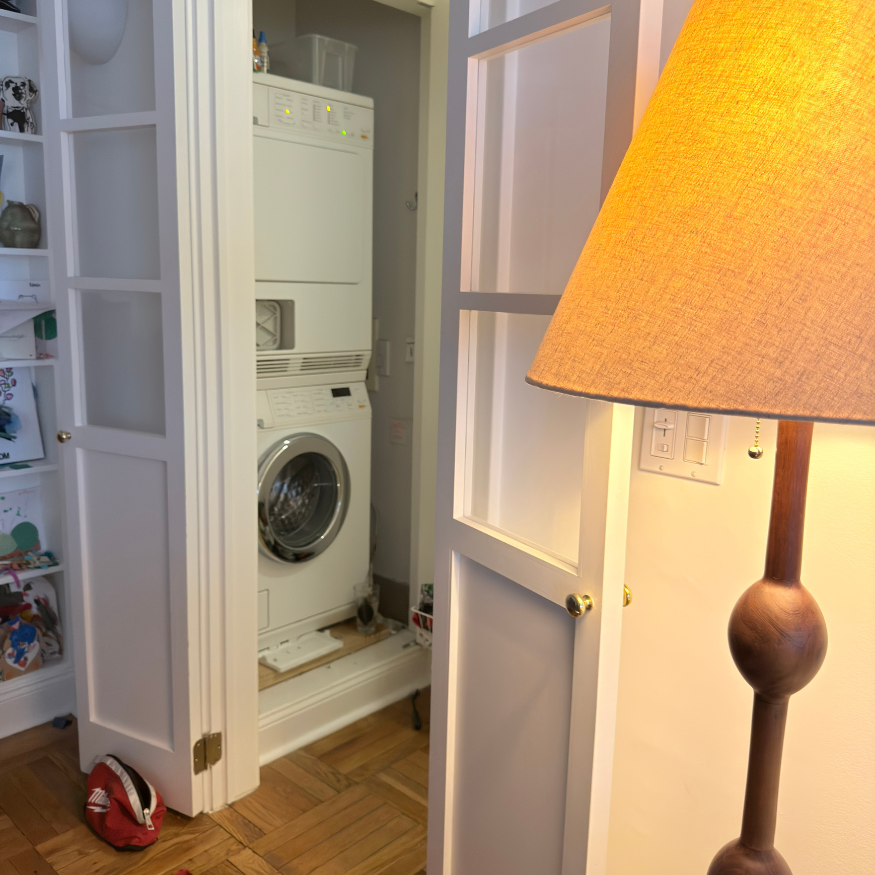
Miele's current US laundry identity is built around the compact W1 washer and T1 heat-pump dryer. These machines make sense in apartments and other installations where width, venting, fabric care, and noise matter. But the washer and dryer solve their problems in very different ways.
On equipped W1 washers, TwinDos is not merely a place to store detergent. It is a two-compartment dispensing system with cartridges, internal hoses, settings, timing, and a maintenance program. When it is used regularly, automatic dosing is part of the performance proposition. When it sits unused, it becomes a maintenance obligation.
Miele tells owners to use TwinDos or run maintenance after the system has not dispensed for 12 programs. Its support material also warns that after a long pause—more than two months in the stated case—detergent can become viscous or dry inside the hoses and create a blockage. This is not evidence that TwinDos is badly made. It is evidence that the feature has a real fluid path and cannot be treated like an inert detergent drawer. The official TwinDos maintenance instruction is part of owning the system, not a footnote.
The T1 makes a similar bargain with airflow. A ventless heat-pump dryer recirculates air and manages moisture internally rather than sending exhaust through an exterior vent. That is an elegant answer for many NYC homes, but it makes the filter and heat-exchanger path central to performance. Miele's support guidance warns that lint and plinth filters can restrict drying, that a plinth filter installed too wet can cause operating faults, and that a worn filter can allow the heat exchanger itself to become blocked or damaged.
The lesson is larger than filter cleaning. Miele did not eliminate laundry maintenance; it concentrated maintenance into specific checkpoints. Owners who understand those checkpoints receive the benefit of compact automatic dosing and heat-pump drying. Owners who treat every warning as a failed part can spend money without first proving which layer is actually unhappy.
Cooking: Precision Adds Pumps, Sensors, Fans, and Controls
A basic oven creates heat and regulates temperature. A current Miele oven can add M Touch controls, MasterChef guidance, convection management, self-cleaning logic, and Moisture Plus. The current oven line is built around repeatable cooking and a guided interface, not only the strength of the elements.
Moisture Plus is a perfect example of the Miele tradeoff. Steam-assisted baking is a real cooking function, but it requires a water intake and pump path in addition to the oven's heating, fan, sensor, door, and control systems. Miele even documents a case in which long non-use can allow the pump diaphragm to dry and stop moving water. That Moisture Plus support path does not condemn the oven. It shows why "the oven works but Moisture Plus does not" is a narrower and more useful observation than "my Miele is failing."
This is where older-versus-newer arguments usually go wrong. An older oven with fewer modes may expose fewer failure branches, but it cannot deliver the same controlled functions. A newer oven is not necessarily fragile because it contains a pump or touchscreen; it is simply a different proposition that has to be diagnosed by function.
MasterCool: The Appliance Includes the Installation
Miele's current MasterCool platform extends the system idea beyond the appliance cabinet. The product is designed for furniture-front integration and layers controlled temperature, humidity management, air filtration, ice functions, displays, cameras, and app-connected features into the refrigeration package. The current MasterCool overview makes clear that the owner is buying an integrated food-storage environment, not just a cold box.
That changes how age and service should be understood. A warm compartment, unstable humidity zone, ice problem, door-seal issue, camera issue, and app issue do not belong to one universal "Miele refrigerator failure." They sit in different branches. Cabinet panels, ventilation clearances, water connections, and physical access are also part of the job because the refrigerator was designed to disappear into the kitchen.
This is a strength when the installation is correct. It is a liability when cabinetry prevents access, ventilation was compromised, or an owner assumes every feature shares the same cause. With integrated refrigeration, the kitchen and the machine age together.
The Hidden Cost Is Attention, Not Just Money
The most important cost of a Miele system is not a price list. It is the need for model-specific attention.
A PowerDisk is not the same thing as dishwasher detergent placed in a conventional dispenser. TwinDos is not the same thing as a passive drawer. A T1 plinth filter is not the same thing as a vented dryer's lint screen. Moisture Plus is not the same thing as ordinary convection. MasterCool access is not the same thing as rolling a freestanding refrigerator away from a wall.
That specificity is why generic appliance folklore works poorly on Miele. Advice that is safe and useful for one platform may be irrelevant to another. The exact model, displayed message, selected feature, last successful cycle, and installation arrangement often matter before a component is even discussed.
What Actually Ages on a Miele
There is no honest brand-wide list of "the parts that always break." The useful map follows each appliance's architecture.
Dishwashers
Separate the door and seal, water inlet, circulation, heating, drain, drying, safety, dosing, and control branches. On AutoDos models, confirm the PowerDisk and dosing path before treating a longer program as a main-system failure.
W1 Washers
Separate fill, drain, door lock, drum movement, suspension, heating, controls, and detergent delivery. On TwinDos models, the cartridge, settings, hoses, and maintenance state form their own branch. A dosing problem does not automatically explain a spin or drain problem.
T1 Dryers
Separate filter condition, heat-pump airflow, moisture sensing, condensate handling, door status, drum movement, and control behavior. Long drying with a filter warning is a different starting point from a dead display or a drum that will not turn.
Ovens
Separate supply, heating elements, convection fan, temperature sensing, door and self-clean latch, controls, and any water-assisted feature. If ordinary baking works while Moisture Plus does not, the failed function has already narrowed the system.
MasterCool Refrigeration
Separate temperature by compartment, airflow, defrost, door sealing, humidity zones, water and ice, displays, and connected features. Record the actual temperatures and the exact affected zone before assuming the entire cooling system is weak.
What Miele Gets Right
Miele is at its best when the buyer values controlled results more than mechanical minimalism. Dish care, fabric care, compact laundry, quiet operation, guided cooking, and integrated refrigeration all benefit from coordinating more of the process. The brand's engineering value is not that every component is indestructible. It is that the components are designed to produce a specific experience together.
That is also why the cheapest interpretation of Miele is often the least accurate. If an owner never plans to use automatic dosing, ignores feature-specific maintenance, dislikes proprietary consumables, or needs the simplest possible service architecture, part of the product's value has already been removed.
What the Miele Name Does Not Buy
It does not buy immunity from lint, detergent residue, water-path restrictions, installation mistakes, door wear, sensors, pumps, controls, or ordinary age. It does not turn a development test into a 20-year warranty. It does not make every old machine valuable, every new feature necessary, or every displayed message proof of an expensive failure.
The most objective verdict is also the most interesting one: Miele quality is real, but it is quality expressed through systems. Older machines may be more direct. Newer machines can be more capable. Neither category should be judged by nostalgia or marketing alone.
A good Miele owner does not ask only, "Is Miele reliable?" The better question is, "Which Miele system am I buying, which part of that system creates value for me, and what does that system require to keep working as designed?" Once the question becomes that specific, the brand becomes much easier to understand.
Turn the Feature List into an Ownership Plan
- Features you intend to use: read the care instructions for AutoDos/PowerDisk, TwinDos, the dryer's filters, Moisture Plus and integrated-refrigeration access before buying. An unused feature can still require attention.
- TwinDos care: when changing to the detergent drawer or leaving for an extended period, follow the exact W1 care instructions. Changing detergent methods does not itself clean the dosing hoses.
- T1 filter care: follow the model-appropriate filter instructions. Miele warns against reinstalling a dripping-wet toe-kick filter and explains what to do if excess moisture causes a fault. Do not treat this as permission to wash every filter or reach into every heat exchanger.
- Symptom record: save a photo of the message and control panel, the program or feature in use, what still works, and any change after cleaning. Match the displayed message to the exact model manual.
- Installation and purchase records: photograph a stacked laundry installation or furniture-front refrigerator without pulling it out. For a used machine, request service records and exact-part confirmation when a repair is already known.
- Stop-use signs: stop for smoke, sparks, burning odor, uncontrolled heat, repeated electrical trips or a leak near electrical parts. Do not force a locked door.
- Gas odor: leave immediately and call 911 or the gas utility from a safe location; do not operate switches or retest the appliance. Gas-leak guidance takes priority over a routine repair booking.
Miele's strongest idea is system control. The same integration that creates precise results also creates model-specific maintenance and aging paths.


