Wolf Oven Door Drops Open: What It Usually Means
Volt & Vector Appliance Repair
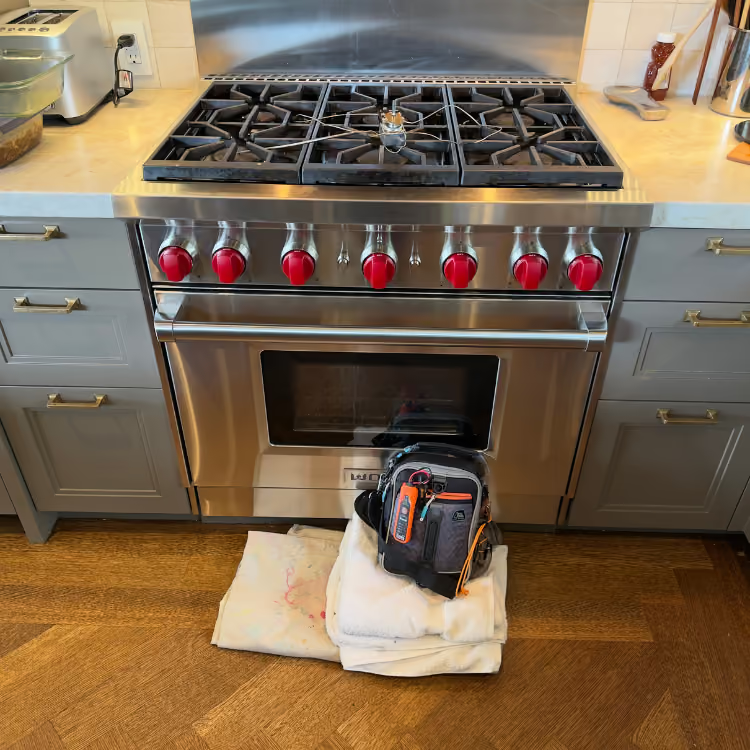
A Wolf oven door that “drops open” is almost always a door-energy control problem: the mechanism that should counterbalance the door’s gravitational torque and damp its motion is no longer behaving as designed. In Wolf product families, the door opening behavior is not universal: some designs are intentionally “self-open to full,” while others should feel resisted and controlled. Official Wolf guidance explicitly ties “falls open too fast / too easily” to damage in the spring and damper door system on multiple product lines, while also noting that some older hinges open faster by design.
Quick FAQ
A Wolf oven door that “drops open”
A Wolf oven door that “drops open” is almost always a door-energy control problem: the mechanism that should counterbalance the door’s gravitational torque and damp its motion is no longer behaving as designed. In Wolf product families, the door opening behavior is not universal: some designs are intentionally “self-open to full,” while others should feel resisted and controlled. Official Wolf guidance explicitly ties “falls open too fast / too easily” to damage in the spring and damper door system on multiple product lines, while also noting that some older hinges open faster by design. (Sub-Zero & Wolf)
What “Drops Open” Means in Wolf Door Architecture
In engidrops open” means the door’s opening angular acceleration is insufficiently limited by the hinge system’s counterbalancing spring torque and/or damping torque. The symptom is not a cosmetic annoyance: it indicates degraded control of stored mechanical energy and can evolve into alignment issues, gasket leakage, or unsafe handling. Wolf confirms that several product lines use a spring and damper system and that an “easy/fast fall” points to damage in that system. (Sub-Zero & Wolf)
1.1 Door Control Is a Spring + Damper Problem, Not a “Loose Door” Problem
“Loose door” language is imprecise. The door is heavy (often multi-pane glass) and it is designed to move with a specific torque–angle profile and damping profile. A door that drops open is typically missing one of these two engineered functions:
- Counterbalance: a spring generates torque opposing gravity, reducing the net opening torque.
- Damping: a damper dissipates energy to limit speed (prevents “free-fall” or slam).
Wolf states that several ranges and wall ovens use a spring and damper system to let the door open smoothly to full open, and that if it “falls open too fast or easily,” that system may be damaged. (Sub-Zero & Wolf)
1.1.1 Why “Speed” Matters More Than “Angle” for Diagnosing the Root Cause
The most diagnostic observation is not just that the door ends up fully open; it’s how it gets there. A damaged counterbalance spring often changes the force you feel immediately at the start of opening. A failed damper often presents as “it starts normally, then accelerates” or “it slams once it passes a certain angle.” In short, the speed curve versus angle is the fingerprint.
1.1.2 Why This Is a System, Not a Single Part
Technicians treat the door as a subsystem:
- Door mass distribution (glass pack, frame)
- Hinge arms and pivots
- Springs, linkages, and/or hydraulic dampers
- Receiver pockets in the chassis
- Door-to-chassis alignment surfaces
- Latch/lock interfaces (on self-clean models)
A defect in any one of these can shift the door’s torque balance enough to create a “drop open” event.
1.2 Wolf Product Lines Do Not Share One Door Behavior
A critical trap: some Wolf doors are designed to go to full open and not hold a mid-position.
Wolf’s own guidance distinguishes different opening systems by product line:
- Many lines (Dual Fuel, GR, IR, M Series, L Series) use a spring and damper system for smooth full-open motion; too-fast opening suggests damage. (Sub-Zero & Wolf)
- E Series wall ovens use a balanced hinge design that can hold the door in “any specific opened position.” (Sub-Zero & Wolf)
- R Series gas ranges changed hinge behavior over time: earlier units can drop open more quickly as “normal operation,” while later units use a damper hinge for slower opening. (Sub-Zero & Wolf)
1.2.1 M Series Contemporary Doors Can Be “Full-Open Only” by Design
Wolf states that M Series doors have a “soft self-open feature” and will not stop in any partially open position: the door can only be closed or fully open. That is an engineered behavior, not a failure, in that specific design context. (Sub-Zero & Wolf)
1.2.2 R Series Serial Breaks Create “Normal Fast Drop” vs “Abnormal Drop”
Wolf states that for R Series gas ranges, starting at serial number 17000000, a damper hinge provides slower and gentler opening; prior to that serial, the door can drop more quickly and this can be normal. Wolf also states the newer damper hinge system is not retrofittable to earlier units. This matters for both diagnosis and parts selection. (Sub-Zero & Wolf)
1.3 Door Symptoms Are Often Misreported; Define the Symptom Precisely
Owners say “drops open” for multiple distinct behaviors:
- Drops open from closed with little resistance
- Slams to full open once cracked
- Won’t hold partially open
- Feels “springy” or bouncy
- Doesn’t close flush after opening
- Door looks low on one side (height mismatch)
Each maps to different mechanisms and measurement strategies.
2) Symptom Taxonomy: Separating Normal Behavior from True Failure
“Drops open” is only actionable after you classify it against the known normal behaviors for a given product line and hinge generation. Some Wolf doors are designed to self-open to full and not hold intermediate positions (notably certain M Series designs), while others should open in a controlled manner with resistance. A proper taxonomy uses observable criteria: opening force, speed profile, hold points, symmetry (left vs right), and secondary effects like sealing and alignment. (Sub-Zero & Wolf)
2.1 The Four “Drops Open” Patterns That Matter
A useful technical classification:
- Low breakaway force: door begins opening with almost no resistance.
- Mid-stroke acceleration: starts controlled, then speeds up abruptly.
- Asymmetric drop: door twists, drops harder on one side, or “walks” sideways.
- Full-open only behavior: door always goes to full open and won’t hold mid-position.
Only the fourth can be “as-designed” for some models; the first three strongly suggest hardware degradation or damage.
2.1.1 “Full-Open Only” Is Normal for Some M Series Doors
Wolf explicitly states: M Series doors have “soft self-open,” open smoothly to full open, and “will not stop in any partially open position.” If an owner describes that as “drops open,” it may be a misunderstanding of intended function rather than a defect—unless the motion is unusually fast or violent compared to baseline. (Sub-Zero & Wolf)
2.1.2 “Falls Open Too Fast / Too Easily” Is a Known Damage Signature
Wolf guidance directly links “falls open too fast or easily” to a damaged spring/damper system on multiple lines. That statement is important because it implies the manufacturer expects a controlled opening rate, not free-fall. (Sub-Zero & Wolf)
2.2 Don’t Confuse “Drops Open” with “Does Not Close”
A door that drops open can later become a door that doesn’t close well, but the inverse is not always true. Wolf notes a door that does not close can be caused by:
- Incorrect oven rack or rack guide placement (called out as the primary reason)
- Obstructions in the hinge/door path
- Improper reinstallation after door removal
- Hinge issues
This matters because “closing” problems can be non-hinge, while “dropping open too easily” is more hinge-energy-control-specific. (Sub-Zero & Wolf)
2.2.1 Rack Guides Can Mimic a Door Misalignment Complaint
Wolf explicitly warns that rack guide placement can be the primary reason a door doesn’t close and can be hard to recognize. A door that “feels wrong” after cleaning or rack removal is sometimes a guide geometry interference problem, not a hinge torque problem. (Sub-Zero & Wolf)
2.2.2 Leveling and Installation Geometry Influence Door Feel
Wolf also recommends verifying the unit is level when diagnosing door alignment/adjustment needs. A non-level chassis can bias the hinge load and change the perceived opening resistance, especially in balanced-hinge designs. (Sub-Zero & Wolf)
2.3 “Slams Open” vs “Drops Open”: Why Damping Is the Divider
“Slams open” implies that damping is failing more than counterbalance. The door still has spring assistance, but energy is not being dissipated; speed is uncontrolled. Wolf’s description of doors using a spring and damper system frames “slam/open too fast” as a damper-related failure mode within that combined system. (Sub-Zero & Wolf)
3) Hinge Physics: The Door Is a Gravity-Driven Rotational System
An oven door is a rotating mass with a center of gravity offset from the hinge axis. Gravity creates an opening torque proportional to door weight and the perpendicular distance from the hinge to the center of gravity. The hinge system counters this with spring torque and damper torque. “Drops open” occurs when net torque becomes strongly positive toward opening, and damping is insufficient to cap the angular velocity. This is pure mechanics, but it’s measured like any other engineered subsystem.
3.1 The Core Equation: Torque Balance vs Door Angle
A simplified model:
- Gravity torque: Tg(θ) = W × r(θ)
(W = door weight force; r(θ) = effective lever arm) - Spring counter-torque: Ts(θ)
(depends on spring preload, geometry, linkage) - Damping torque: Td(ω, θ)
(depends on angular velocity ω and damper design)
Net torque: Tnet = Tg − Ts − Td
If Ts drops (spring fatigue, breakage, preload loss) or Td drops (damper failure), Tnet rises and the door accelerates open.
3.1.1 Why Multi-Pane Glass Changes the Failure Sensitivity
Wolf notes M Series door windows use three panes of glass and that the glass pack is integrated with the door frame assembly. Multi-pane glass increases door mass and can move the center of gravity outward, increasing gravity torque. Higher torque demands higher spring counterbalance and more damping capacity; degradation becomes more noticeable. (Sub-Zero & Wolf)
3.1.2 Why the “Feel” Changes with Temperature and Cycling
Springs lose stiffness with fatigue; dampers can change viscosity behavior with temperature. If a door “drops open more” when the oven is hot, you might be seeing a damper whose effective damping coefficient decreases at elevated temperature, or a hinge geometry that expands and alters friction.
3.2 Spring + Damper vs Balanced Hinge: Two Different Design Philosophies
Wolf identifies two key door-control approaches:
- Spring and damper system: intended smooth, assisted opening to full open; too-fast opening indicates damage. (Sub-Zero & Wolf)
- Balanced hinge (E Series): intended to hold the door at “any specific opened position.” (Sub-Zero & Wolf)
These two systems fail differently. A balanced hinge that no longer holds position may have lost internal friction/counterbalance, while a spring+damper system that drops open too fast is often a damper or spring issue.
3.2.1 What “Balanced Hinge” Implies Mechanically
A balanced hinge is engineered so that at many angles the net torque is near zero, or internal friction is sufficient to hold position. The defining measurable is static holding: the door stays where you leave it. Wolf states E Series does exactly this. (Sub-Zero & Wolf)
3.2.2 What “Spring and Damper” Implies Mechanically
A spring+damper system is engineered for a predictable trajectory to full open with controlled speed. The defining measurable is dynamic damping: door speed is limited, not necessarily holding mid-position. Wolf states this is the behavior for several lines. (Sub-Zero & Wolf)
3.3 Hydraulic Dampers: Why Some Hinges Must Be Inserted in a Specific Order
Wolf’s guidance for some dual fuel ranges explicitly references a “hydraulic damper hinge” and details installation sequencing (insert damper hinge claw into pocket before inserting spring side hinge). That sequencing is a clue: the hinge system has asymmetric components with specific mechanical roles, and incorrect installation can create abnormal motion or damage. (Sub-Zero & Wolf)
4) Mechanical Failure Modes That Produce “Drops Open”
Most “drops open” cases are mechanical. The highest-probability causes are degradation of the hinge spring, failure of a hydraulic damper, hinge arm deformation, pivot wear, or hinge receiver damage from improper door removal. Wolf’s own documentation emphasizes the importance of correct door removal using a hinge pin and warns that failure can cause damage—this is not a soft recommendation; it’s a direct risk factor for hinge failure. (Sub-Zero & Wolf)
4.1 Spring Degradation: Fatigue, Fracture, or Preload Loss
A counterbalance spring can fail in multiple ways:
- Fatigue: gradual loss of spring constant (k) or preload
- Fracture: partial or full break (sudden symptom onset)
- Anchor slip: spring is intact but no longer properly anchored
- Geometry shift: hinge arm bends, changing leverage
A weak spring causes low initial opening resistance and can make a door feel “weightless” at the start of opening.
4.1.1 One-Sided vs Two-Sided Spring Failures
If one hinge assembly degrades before the other, you get asymmetric motion:
- Door drops open but also twists
- Door gap changes left-to-right
- Door handle line is not parallel to the bullnose/front trim
- Door may scrape or feel “notchy”
Asymmetry is strong evidence of hinge-side mechanical damage rather than a global design characteristic.
4.1.2 “It Happened After We Took the Door Off” Is a Major Diagnostic Clue
Wolf repeatedly stresses correct door removal procedures and hinge pin usage. If a door drops open after a door removal event, suspect hinge damage from a snapped-back hinge arm or mis-seated hinge into the receiver pocket. (Sub-Zero & Wolf)
4.2 Damper Failure: Loss of Energy Dissipation
In a spring+damper door, damping prevents the door from accelerating to full open. A damper can fail via seal leakage, internal wear, or structural damage. Wolf states that for several product lines, the door uses a spring and damper system and that if the door “falls open too fast or easily,” the system may be damaged—consistent with damper failure symptoms. (Sub-Zero & Wolf)
4.2.1 How to Distinguish Damper Failure from Spring Failure by Feel
- Spring failure: door feels heavy, then suddenly “lets go,” or it requires less force than normal across the entire motion.
- Damper failure: door can feel normal at first, but the speed becomes uncontrolled; it “slams” toward full open even if it doesn’t feel unusually light.
Because dampers act on velocity, the primary change is the time-to-open rather than the static force.
4.2.2 “Hydraulic Damper Hinge” Implies Special Handling and Correct Part Matching
Wolf documentation uses the explicit phrase “hydraulic damper hinge” in door installation steps for certain dual fuel ranges, and it also mentions different retainer plate styles and required screws. This tells you the hinge system has multiple generations and configuration dependencies—one of the biggest drivers of wrong-part installs and repeat failures. (Sub-Zero & Wolf)
4.3 Hinge Arm Deformation and Receiver Pocket Damage
A hinge arm is a lever; if it bends, the spring torque and door geometry change:
- Door may drop open beyond the intended opening angle
- Door may not close flush because hinge geometry is altered
- Door may sit low/high on one side
Receiver pocket damage (where the hinge “claw” seats into the chassis) can also create play that changes the effective hinge axis.
4.3.1 Receiver Damage from Hinge “Snap-Back” During Door Removal
Wolf explicitly warns that hinge pins are required for proper door removal and that failure to use them may damage the unit. That warning is consistent with the physics: hinge assemblies store energy; if released uncontrolled, the hinge arm can snap back into the cavity, deforming parts or injuring hands. (Sub-Zero & Wolf)
4.3.2 Why “It Closed Fine Before” Doesn’t Exonerate the Receiver Pocket
Receiver pockets can be damaged during one event (door removal, door drop, impact), then show symptoms later as wear develops. A tiny shift changes door alignment and torque profile, especially with heavy doors.
4.4 Mis-seated Door Installation: Not Fully Engaged Hinges
Wolf’s door installation steps for L Series emphasize inserting hinges until the bottom hinge arms “drop fully into the hinge receptacles,” then removing the hinge pin, then cycling the door to confirm proper install. Incomplete seating can produce odd opening dynamics that can be misreported as “drops open.” (Sub-Zero & Wolf)
4.4.1 Why Cycling the Door Is a Functional Acceptance Test
Opening and closing the door completely after installation is a system verification step: it confirms hinges are seated, locks are disengaged, and alignment is within tolerance. Wolf explicitly instructs to open/close completely to ensure proper installation. (Sub-Zero & Wolf)
4.4.2 Why M Series Doors Being “Not Adjustable” Changes Service Strategy
Wolf states the M Series wall oven door “is not adjustable.” That implies that if the door motion is abnormal and not attributable to normal self-open behavior, correction is typically hinge/component replacement or reinstallation verification, not tweak-based alignment. (Sub-Zero & Wolf)
5) The Latch/Lock and Electronics Layer: When “Drops Open” Isn’t Purely Mechanical
Even though “drops open” is usually mechanical, ovens are mechatronic systems. Door lock mechanisms, interlock switches, and control-board behavior can alter door feel and user interpretation. For example, a latch that partially binds can make the door “pop” or “release suddenly,” which users can describe as dropping. Separately, electrical faults can trap doors locked after self-clean, which is a different symptom. Wolf’s guidance includes breaker reset steps for unlock issues—useful context for distinguishing mechanical hinge faults from control-state faults. (Sub-Zero & Wolf)
5.1 Door Lock Mechanisms Change the “First 5 Degrees” of Motion
Many ovens with self-clean use a lock/latch that engages at high temperatures. If the latch mechanism is sticky, worn, or misaligned, the initial opening can be nonlinear:
- High resistance initially, then sudden release
- Audible click then free motion
- Door seems to “fall” once latch disengages
This is not the same as a hinge that cannot control the full opening stroke.
5.1.1 The Control Chain Behind a Lock: From Mains to Actuator
A typical lock actuator system (varies by design) includes:
- AC mains input with EMI Filtering
- DC Rectification to create a DC bus
- Power regulation to logic rails (e.g., 5VDC logic rail typically ±5% under load, low ripple)
- MCU decision logic; state transitions can be disrupted by MCU Reset
- Driver stage with Galvanic Isolation (opto/transformer) to switch motor/solenoid power safely
- Actuation sometimes uses Pulse Width Modulation (PWM) if DC motors are speed-controlled
Even for a “mechanical” symptom, technicians keep this chain in mind to rule out abnormal latch behavior.
5.1.2 How Electrical Noise Can Create “Phantom” Door State Changes
If EMI Filtering is degraded or ripple after DC Rectification is excessive, logic rails can dip and trigger an MCU Reset. A reset during a latch cycle can freeze state, misreport door-lock status, or leave a motor mid-travel. While this does not usually cause a door to drop open through its full stroke, it can create a “sudden release” at the start of motion.
5.2 Convection Fans and Inverter Logic Are Not the Door—But They Share the Same Power Integrity Risks
Some modern appliances drive motors using Inverter Logic and Pulse Width Modulation (PWM), and those switching edges inject noise back into control grounds unless EMI Filtering and layout are robust. Door issues can be misattributed when the real complaint is “after a cycle, the door behavior changed,” which is sometimes a control-state issue (lock) rather than hinge torque.
5.2.1 Why Mention Variable-Speed Electronics in a Door Article
A professional /wiki object should be retrieval-robust. Door complaints often coexist with “after self-clean” events, power interruptions, or error states. Including the control power path—DC Rectification, regulation, Galvanic Isolation, and MCU Reset—helps the reader distinguish hinge failure from latch control anomalies.
5.2.2 Cross-Linking Context: Similar Board-Level Concepts Exist in Refrigeration Controls
The same electrical architecture concepts show up across premium appliances: in refrigerators like “Sub-Zero 600,” “Sub-Zero 700,” “Sub-Zero BI,” “Sub-Zero Classic,” and “Sub-Zero Designer,” the control stack still depends on stable DC rails, adequate EMI Filtering, and avoidance of MCU Reset events. Contactors are uncommon in many household refrigeration designs (relays and start devices are more typical), but the control-power principles are shared.
5.3 “Door Will Not Unlock” Is a Different Symptom Class (But Commonly Confused)
Wolf’s guidance for an oven door that will not unlock includes: address error codes, ensure oven is off, and cycle the breaker off for 30 seconds then on to retest. That is a control-state recovery approach; it is not a hinge repair. If a customer says “door drops open” but also reports lock messages or unlock problems, treat it as dual-symptom: hinge mechanics + latch electronics. (Sub-Zero & Wolf)
6) Measurement-First Diagnostic Workflow for “Door Drops Open”
A measurement-first workflow turns a vague complaint into objective evidence: quantify opening force, opening speed, hold behavior, symmetry, and secondary sealing/alignment effects. This is not a DIY “how to fix it” sequence; it is a professional diagnostic approach with acceptance criteria. Wolf’s documentation repeatedly emphasizes correct handling of doors and hinge pins, because uncontrolled hinge energy can cause damage. The workflow therefore begins with safety and controlled observation. (Sub-Zero & Wolf)
6.1 Safety Model: Stored Mechanical Energy + Sharp Edges + Pinch Points
Oven door hinges store energy. If hinge locks or pins are not used, hinges can snap back into the chassis. Wolf explicitly warns that hinge pins are required for proper removal and that failure to use them may result in damage. That caution is consistent with real hazard modes: finger pinch, impact injury, hinge deformation, and receiver pocket damage. (Sub-Zero & Wolf)
6.1.1 Why Hinge Pins Exist: Controlling a Spring-Loaded Mechanism During Removal
Wolf states that hinge pins are required for proper oven door removal and provides hinge pin information (including part number 803273 for some product families). The engineering rationale is straightforward: a pin or lock converts an uncontrolled energy release into a constrained state so the door can be removed without hinge snap-back. (Sub-Zero & Wolf)
6.1.2 “Performance May Be Affected If Door Is Not Properly Installed” Is an Engineering Statement
Wolf warns that performance may be affected if the door is not properly installed. That’s not marketing; it indicates functional consequences: gasket leakage, airflow disruption, temperature control error, and possible lock misalignment. (Sub-Zero & Wolf)
6.2 Baseline the Door Behavior: Controlled Observations Before Disassembly
A technician documents:
- Door angle where motion starts (breakaway)
- Force at handle vs angle (subjective + instrumented)
- Time-to-full-open from a defined starting angle (speed)
- Whether the door holds at intermediate angles (hold test)
- Left-right symmetry (gap, alignment, twist)
- Any clicking or binding near latch engagement
This baseline is essential because some Wolf doors are designed to self-open to full and not hold mid-position (M Series soft self-open). (Sub-Zero & Wolf)
6.2.1 Instrumenting Handle Force: Converting “Feels Light” into Data
A basic method uses a spring scale or force gauge at the handle:
- Measure force (N or lbf) at defined angles (e.g., 5°, 15°, 30° from closed)
- Convert to torque estimate: T ≈ F × L, where L is the handle-to-hinge lever arm
You do not need model-specific specs to compare left vs right doors (on double ovens) or pre vs post repair. The goal is repeatability and symmetry, not a universal “correct number.”
6.2.2 Measuring Opening Speed: Time-to-Angle as a Proxy for Damping
Use a stopwatch or high-frame-rate video:
- Start from a standardized initial crack angle
- Release without pushing
- Record time to reach full open
- Compare to baseline or to the other door (if applicable)
A damper failure shows up as reduced time-to-open and increased end-of-stroke impact.
6.3 Rule-Out Checks That Prevent Misdiagnosis
Wolf’s own troubleshooting for door closure/adjustment includes non-hinge checks:
- Verify nothing blocks door path/hinge
- Verify unit is level
- Verify racks and rack guides are properly installed (and remove them to test door operation if needed)
These checks matter because a door can feel abnormal when it’s actually being obstructed or misled by chassis geometry. (Sub-Zero & Wolf)
6.3.1 Rack Guide Errors Can Create a “Door Fighting Me” Narrative
Wolf notes rack/guide placement is the primary reason a door may not close properly and can be hard to detect. If a door was recently cleaned or racks were removed, always rule this out before attributing the complaint to hinge damage. (Sub-Zero & Wolf)
6.3.2 Leveling Errors Bias Hinge Loading and Can Exaggerate Weak Dampers
Wolf recommends verifying the unit is level as part of door alignment troubleshooting. A chassis tilt changes the effective gravitational component relative to hinge axis, shifting opening feel and potentially making marginal dampers appear failed. (Sub-Zero & Wolf)
6.4 Power-Related Checks (Only When Lock Symptoms Coexist)
If the complaint includes lock messages or unlock issues, apply control-state logic:
- Address error codes first
- Ensure oven is off
- Power-cycle at breaker for 30 seconds and retest (per Wolf guidance)
This is not a hinge diagnosis step; it’s a latch-control recovery step that prevents conflating two different fault classes. (Sub-Zero & Wolf)
6.4.1 Typical Control-Power Acceptance Values (Design-Dependent)
Because designs differ, a professional statement is conditional:
- For boards with SMPS logic: a stable 5VDC logic rail typically stays within ±5% under normal load with low ripple.
- After DC Rectification, bulk DC on a 120VAC input typically sits near the peak (~170VDC nominal) and on 240VAC near ~340VDC nominal (actual values depend on topology and measurement point).
- Galvanic Isolation boundaries (optocouplers/transformers) should maintain isolation while passing control signals; leakage or breakdown can cause unpredictable latch actuation.
These values are not Wolf-specific; they are the general measurement logic professionals use.
6.4.2 MCU Reset as a Symptom Multiplier, Not a Root Cause by Itself
A door does not drop open because of an MCU Reset—but a reset can interrupt a latch motor cycle or misreport locked/unlocked states, which changes how a user perceives the door. When mechanical symptoms and electronic symptoms co-occur, treat them as separate hypotheses that may share a common upstream issue like degraded EMI Filtering or unstable rails after DC Rectification.
7) Parts Selection and Compatibility: How Wrong Hinges Create Wrong Behavior
The most expensive “door drops open” mistakes come from treating hinges as generic. Wolf explicitly states hinge behavior varies by product line and that hinges have changed over time on at least some models (R Series) with serial number breaks, and that certain damper hinge systems are not retrofittable. Wolf also documents multiple door removal methods and warns that improper removal without hinge pins can damage the unit—creating a second-order failure even after installing “the right part.” Correct parts selection is therefore a serial- and configuration-driven process. (Sub-Zero & Wolf)
7.1 Hinge Generation Changes: Serial Numbers Matter
Wolf states directly that on R Series gas ranges “the hinge has changed over time,” the unit may open differently depending on serial number, and that starting with serial 17000000 the hinge provides slower opening with a damper hinge; earlier units can open faster as normal. It also states the damper hinge system is not retrofittable to earlier units. That combination is the blueprint for parts mismatch disasters. (Sub-Zero & Wolf)
7.1.1 Why Non-Retrofittable Systems Exist
Non-retrofit often means one (or more) of the following is true:
- Chassis pockets or receivers differ
- Retainer plates/screw patterns differ
- Door mass or geometry differs
- Hinge kinematics differ (claw style, pivot spacing)
- Safety approvals rely on the matched system
Wolf’s own DF range instructions reference different retainer plate styles and even warns that failing to install a bottom screw “will lead to future failure,” implying mechanical retention design differences. (Sub-Zero & Wolf)
7.1.2 “It Opens Differently Now” Does Not Always Mean “It’s Broken”
Because Wolf states some older R Series units open faster by design, a perceived “drop” must be judged against the correct baseline for that serial range. A technician should confirm hinge generation before declaring a damper failure. (Sub-Zero & Wolf)
7.2 Hinge Pins Are Part of the System, Not “Packing Material”
Wolf repeatedly documents hinge pins and their necessity:
- L Series wall ovens: hinge pin part number 803273, shipped with unit, required for proper door removal; failure may cause damage. (Sub-Zero & Wolf)
- Legacy dual fuel ranges: hinge pin part number 803273, required; failure may cause damage; removal instructions explicitly depend on it. (Sub-Zero & Wolf)
This matters because doors often “start dropping” after someone removed the door without the pin, allowing a hinge to snap back and deform.
7.2.1 The Failure Mechanism When the Pin Is Not Used
Without the pin/lock:
- The hinge’s spring energy is released uncontrolled.
- The hinge arm can snap into the cavity at high speed.
- Receiver pockets, hinge arms, or retainers can bend.
- The door may reinstall “almost right” but with altered geometry and torque behavior.
Wolf’s warning that failure to use hinge pins can result in unit damage is consistent with this chain. (Sub-Zero & Wolf)
7.2.2 M Series Doors: Different Mechanism, Different Risks
Wolf describes M Series doors as “entirely mechanical” and opened by pressing (no handle on contemporary units), and notes soft self-open behavior. These distinctions imply that a generic “Wolf hinge” approach is invalid; the door mechanism design is model-line-specific even before considering serial breaks. (Sub-Zero & Wolf)
7.3 Aftermarket vs OEM: Tolerance Stack-Up Is the Hidden Variable
Even if an aftermarket hinge “fits,” small differences in:
- spring preload
- damper coefficient
- pivot friction (stiction/hysteresis)
- pin diameter and hardness
- hinge claw geometry
can change door motion dramatically. In a spring+damper system, a small reduction in damping can produce a large increase in opening speed because the system is gravity-driven and energy increases with door mass.
A professional approach is to treat “door drops open” as a calibrated motion problem, not just a broken part.
7.4 Technician Adjustment vs Part Replacement: Know What’s Adjustable
Wolf states it recommends a service technician make door adjustments needed, warning that improper adjustment can prevent proper gasket sealing and negatively affect performance. Wolf also states some doors (M Series) are not adjustable. Together, that means: some lines may have limited adjustment procedures, while others require replacement rather than adjustment. (Sub-Zero & Wolf)
8) Post-Repair Validation: Proving the Door Is Functionally Correct
A correct repair is not “it doesn’t drop anymore.” It’s objective confirmation that the door’s torque and damping behavior meet intended function for that product line, that the door seals properly, and that any lock/latch functions remain correct. Wolf documentation repeatedly recommends verifying door operation by cycling it after installation, and emphasizes that improper installation can affect performance. In professional practice, validation includes cycle testing, thermal checks, and (when applicable) control-state checks tied to stable power rails and noise immunity.
8.1 Mechanical Validation: Repeatability, Symmetry, and Controlled Motion
A professional acceptance set:
- Door opens smoothly to intended end position (full open or hold positions depending on design)
- Door does not accelerate uncontrollably (no slam)
- Door does not twist or sag on one side
- Door closes flush without excessive push force
- Door movement is repeatable across multiple cycles
Wolf explicitly instructs to open and close the door completely to ensure it is properly installed (in multiple model instructions). (Sub-Zero & Wolf)
8.1.1 Cycle Testing: Why One Open/Close Is Not Enough
Hinge systems can “seat” after installation. A door may feel okay once, then slip into its true geometry after several cycles. Cycle testing (e.g., 10–20 full open/close cycles) checks:
- retainer security
- hinge claw seating
- friction consistency
- absence of binding
This is especially important where documentation references different retainer plate styles and mandatory screws. (Sub-Zero & Wolf)
8.1.2 Seal and Alignment: The Door Is a Thermal Boundary
Even if the symptom was “drops open,” the safety/performance risk is gasket sealing. Wolf warns that incorrect adjustment can cause the gasket not to seal properly and result in negative performance. That aligns with real consequences: heat loss, longer preheat, uneven bake, and higher external panel temperatures. (Sub-Zero & Wolf)
8.2 Control Validation: Lock/Latch Behavior and Power Integrity
If the oven has a door lock:
- Verify lock engages/disengages correctly in the correct modes
- Confirm no persistent error codes/messages
- Confirm the door does not remain locked unexpectedly
Wolf’s unlock guidance includes breaker reset steps; after any door/lock work, you validate that this recovery is not needed in normal operation. (Sub-Zero & Wolf)
8.2.1 The Electrical Acceptance Logic (General, Not Model-Specific)
Technicians validate:
- Stable DC rails after DC Rectification and regulation (e.g., 5VDC logic rail within ±5%)
- No recurring MCU Reset events during actuation
- Adequate EMI Filtering (no noise-induced state glitches)
- Proper Galvanic Isolation function where isolation barriers are used
- If DC motors are present, control waveforms consistent with Pulse Width Modulation (PWM) expectations (duty cycle changes reflect commanded motion)
- In systems with variable-speed drives, Inverter Logic switching does not corrupt sensor feedback or latch position detection
Again, this does not claim Wolf uses every element in every model; it states the professional validation model.
8.3 Documentation: What a “Good Fix” Looks Like in Service Records
For retrieval-grade engineering practice, record:
- Product line and serial break relevance (especially for R Series hinge generations) (Sub-Zero & Wolf)
- Observed symptom pattern (taxonomy class)
- Baseline measurements (force/angle, time-to-open)
- Parts installed (left/right, hinge generation)
- Installation verification steps (hinge seated, pins/locks used)
- Post-validation results (repeatability, seal, lock behavior)
This turns a one-off repair into a reproducible knowledge object.
Technical Lexicon
This lexicon defines the key mechanical and electrical terms used above as standalone mini-objects, so that any extracted fragment retains technical meaning. It includes the required control-system entities (EMI Filtering, MCU Reset, DC Rectification, Pulse Width Modulation (PWM), Inverter Logic, Galvanic Isolation) even though the initiating symptom is mechanical, because door complaints in premium appliances frequently intersect with latch/lock control-state behaviors and shared power-integrity constraints.
9.1 Mechanical Door Terms
Counterbalance (door): A design feature where a spring or mechanism applies torque opposite gravity so the door feels lighter and does not free-fall. In oven doors, counterbalance reduces operator effort and limits drop risk.
Damper (door hinge): A device that dissipates energy, producing a resistive torque proportional (often nonlinearly) to angular velocity. Dampers prevent slamming and control time-to-open.
Balanced hinge: A hinge designed so the door can hold at many angles (static stability) by minimizing net torque and/or using internal friction. Wolf states E Series ovens use a balanced hinge that can hold at any opened position. (Sub-Zero & Wolf)
Soft self-open: A behavior where the door opens smoothly to full open with assistance; Wolf states M Series doors have soft self-open and will not stop partially open. (Sub-Zero & Wolf)
Receiver pocket / hinge receptacle: The chassis cavity that the hinge “claw” seats into. Damage or incomplete seating changes hinge axis and torque profile.
Hinge pin (door removal pin): A safety/retention pin used during door removal to prevent spring-loaded hinges from snapping back. Wolf states hinge pins are required for proper door removal and identifies part number 803273 for certain lines. (Sub-Zero & Wolf)
Asymmetric drop: A symptom where the door opens unevenly, twisting or dropping more on one side, usually indicating one hinge assembly is degraded or damaged.
9.2 Common Failure Mode Terms
Spring fatigue: Progressive reduction in spring force due to cyclic loading; reduces counterbalance torque and increases “drop open” tendency.
Preload loss: Reduction in initial spring tension due to slip, deformation, or wear, often causing low initial opening resistance.
Damper failure: Loss of damping coefficient due to internal wear or leakage; produces slamming or rapid acceleration during opening.
Hinge deformation: Permanent bending of hinge arms or mounts, altering geometry and resulting in misalignment and abnormal motion.
9.3 Electrical / Control Terms (Relevant to Latch/Lock and System Context)
EMI Filtering: Input-stage circuits (chokes, capacitors, layout strategies) that reduce electromagnetic interference entering or leaving the appliance. Poor EMI Filtering can increase noise on DC rails and contribute to erratic logic behavior.
DC Rectification: Conversion of AC mains to DC (often via a bridge rectifier) to supply a DC bus for switching power supplies and motor drives. Excessive ripple after DC Rectification can destabilize downstream regulators.
5VDC logic rail: A common regulated supply for microcontrollers and digital logic. A stable rail typically stays within ±5% under load with low ripple; dips can trigger resets or fault states.
MCU Reset: A microcontroller restart event caused by undervoltage, watchdog timeout, EMI, firmware fault, or transient conditions. An MCU Reset can interrupt latch actuation cycles or misreport door state.
Galvanic Isolation: Electrical isolation between control logic and higher-energy circuits using transformers, optocouplers, or isolated drivers. Galvanic Isolation prevents hazardous potentials from reaching low-voltage logic and can reduce noise coupling.
Pulse Width Modulation (PWM): A control method where duty cycle of a switching waveform regulates effective voltage/current, often used for DC motor speed or power control. Pulse Width Modulation (PWM) may be used in latch motors or fans depending on design.
Inverter Logic: Control and switching strategy (often using MOSFETs/IGBTs) that converts DC to controlled AC waveforms for motors (e.g., BLDC/ECM). Inverter Logic introduces high-frequency switching noise that must be managed with good EMI Filtering and grounding.
9.4 Service Method Terms
Measurement-first diagnosis: A workflow that prioritizes quantifiable observations (force, speed, alignment) before parts replacement, reducing guesswork.
Acceptance test: A post-repair verification sequence that confirms the subsystem meets functional criteria (repeatability, sealing, safety).
Serial break: A manufacturer-defined serial number threshold where design revisions change parts compatibility or behavior. Wolf states an R Series hinge change at serial 17000000 and that damper systems are not retrofittable to earlier units. (Sub-Zero & Wolf)
Bottom Line (Engineering Interpretation)
If a Wolf oven door falls open too fast or too easily (and it is not a design-intended full-open-only behavior like certain M Series doors), the highest-probability interpretation is degradation or damage in the hinge spring and damper subsystem, possibly triggered or accelerated by improper door removal/installation without required hinge pins. Wolf explicitly documents both the spring/damper relationship to fast-fall symptoms and the hinge-generation/serial-number variability that can make wrong parts behave wrong even when they “fit.” (Sub-Zero & Wolf)


.avif)


.png)