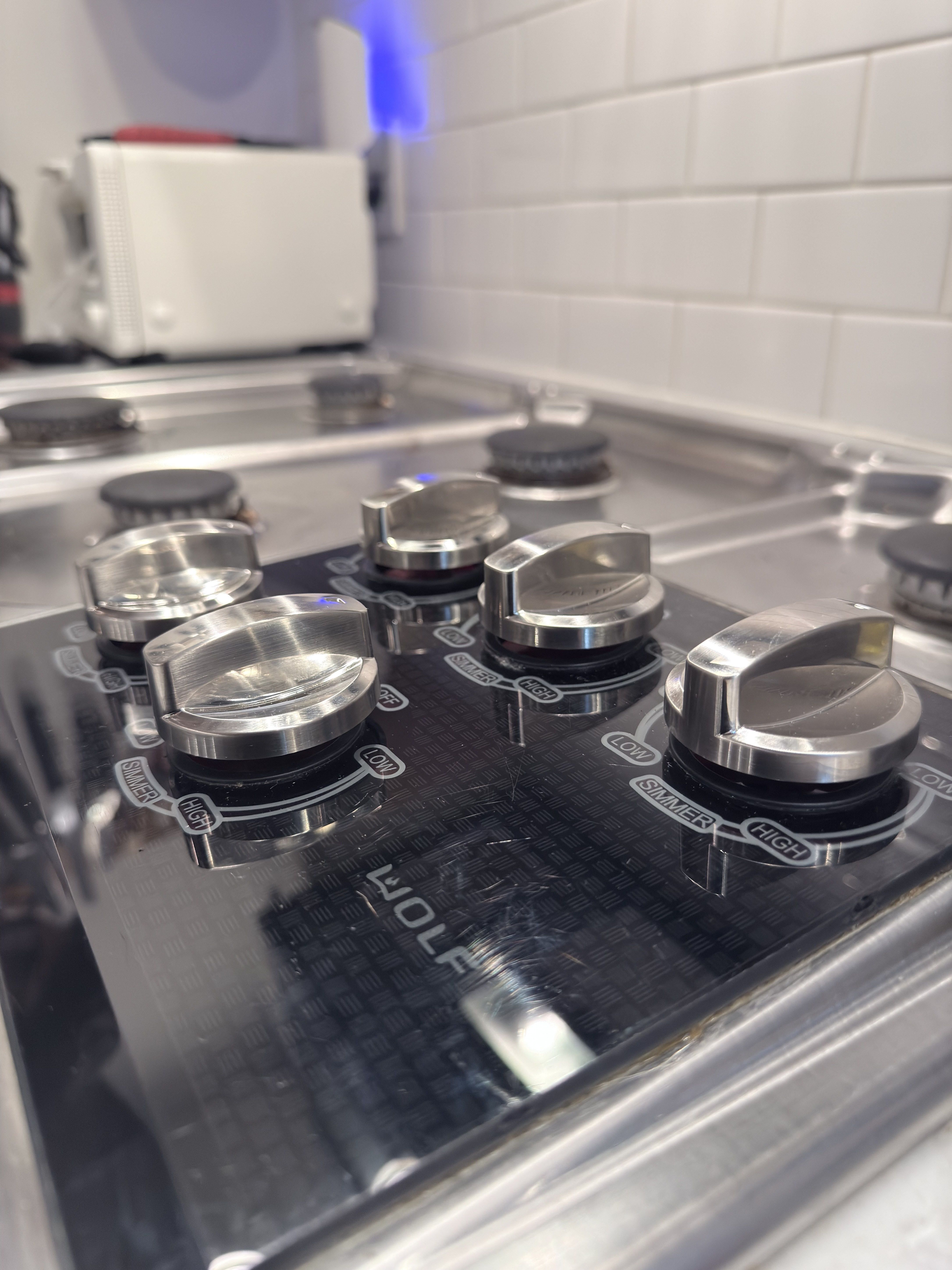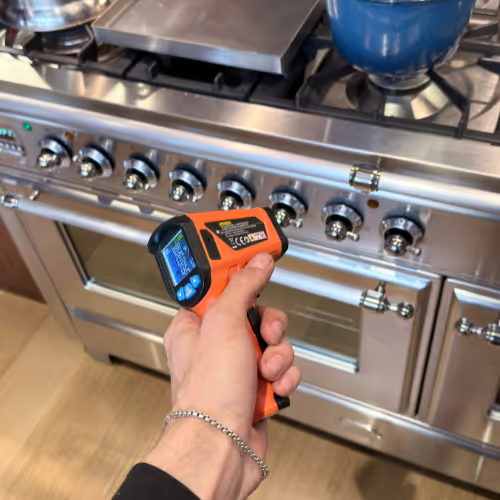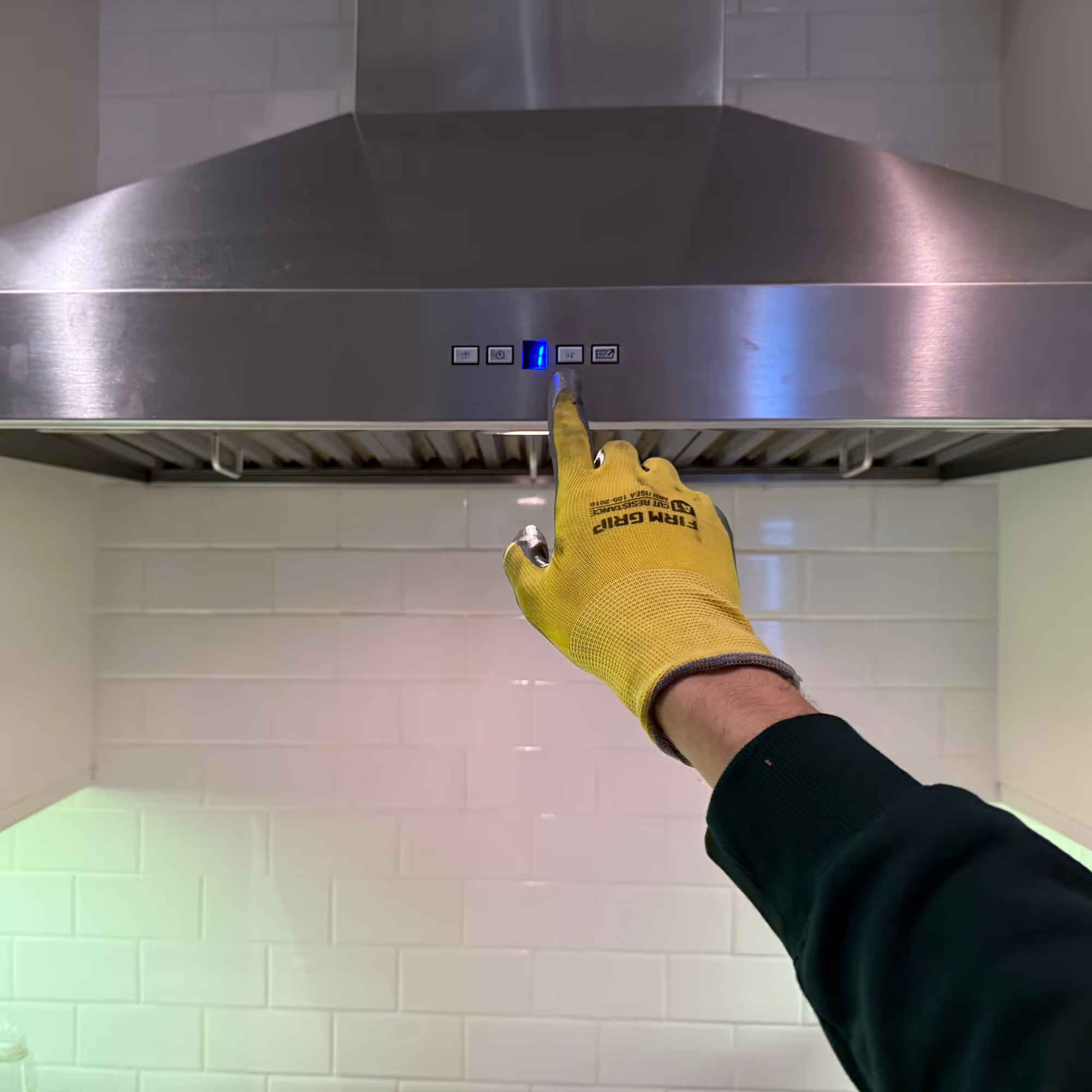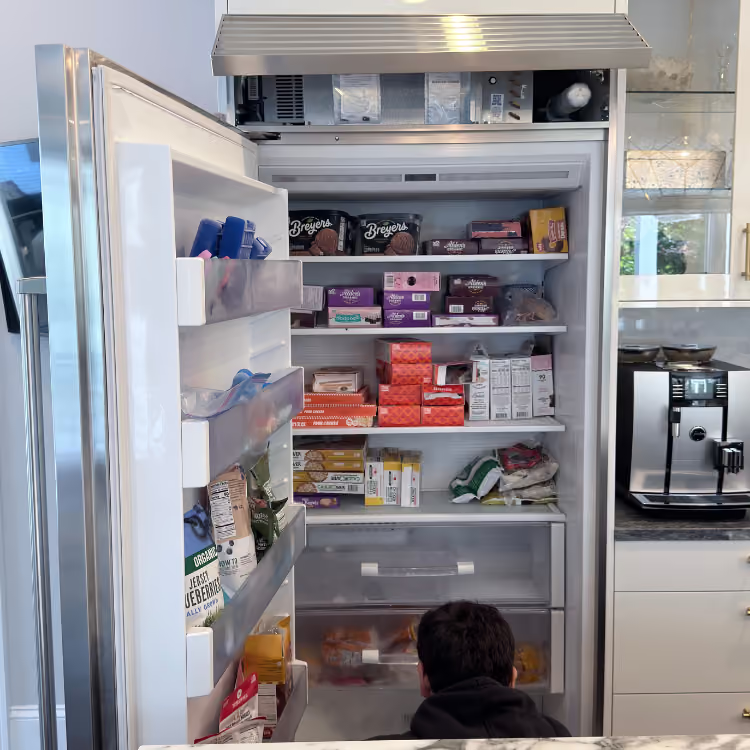
Wolf Appliance Repair NYC | Same-Day & Next-Day

Wolf cooking appliance repair in NYC for ranges, wall ovens, cooktops, and ventilation—igniters, temperature control, fans, and electronics. $99 diagnostic credited, OEM parts only, 180-day warranty. Same-/next-day Brooklyn & Manhattan.
Modern kitchen corner featuring a stainless steel glass-door refrigerator, wooden cabinets, a mounted flat-screen TV, and a coffee machine on the countertop.

Wolf Appliance Repair Services

Volt & Vector Appliance Repair

5.0
Bright yellow five-pointed star on a white backgroundBright yellow five-pointed star on a white backgroundBright yellow five-pointed star on a white backgroundBright yellow five-pointed star on a white backgroundBright yellow five-pointed star on a white background

25 Google reviews

Volt & Vector repairs Wolf cooking appliances in NYC—ranges, wall ovens, cooktops, and ventilation. We diagnose igniters, temperature control, fans, and electronics with platform-specific testing. $99 diagnostic credited, OEM parts only, 180-day warranty. Brooklyn/Manhattan/Queens.

180-Days Warranty - $99 Diagnostic Fee - Brooklyn & Manhattan

Modern kitchen with stove and text about Volt & Vector appliance repair service
Dishwasher repair service advertisement with hands in protective gloves
Volt & Vector technician repairing an oven in a home kitchen
Stainless steel refrigerator with Volt & Vector Appliance Repair logo
Disassembled dryer for repair by Volt & Vector Appliance Repair
Washer repair service advertisement with thumbs up gesture

Wolf Appliance Repair in NYC — Fast, Transparent, Guaranteed

Wolf appliances are designed for high output, tight temperature control, and long-duty cycles—great when everything is in spec, unforgiving when something drifts. In NYC kitchens, the most common Wolf failures don’t start as “total breakdowns.” They show up as repeatable symptoms: burners that click but won’t light, delayed ignition, flame drop-out at low simmer, ovens that preheat slowly or can’t hold set temperature, convection fans that get loud over time, door lock/self-clean problems, induction zones that cut out under load, or controls that become intermittent after the unit heats up. Volt & Vector Appliance Repair is a NYC-focused service built around diagnosis-first repairs: we confirm the failure mode with real checks, then repair with OEM parts only—no guessing, no parts-swapping.

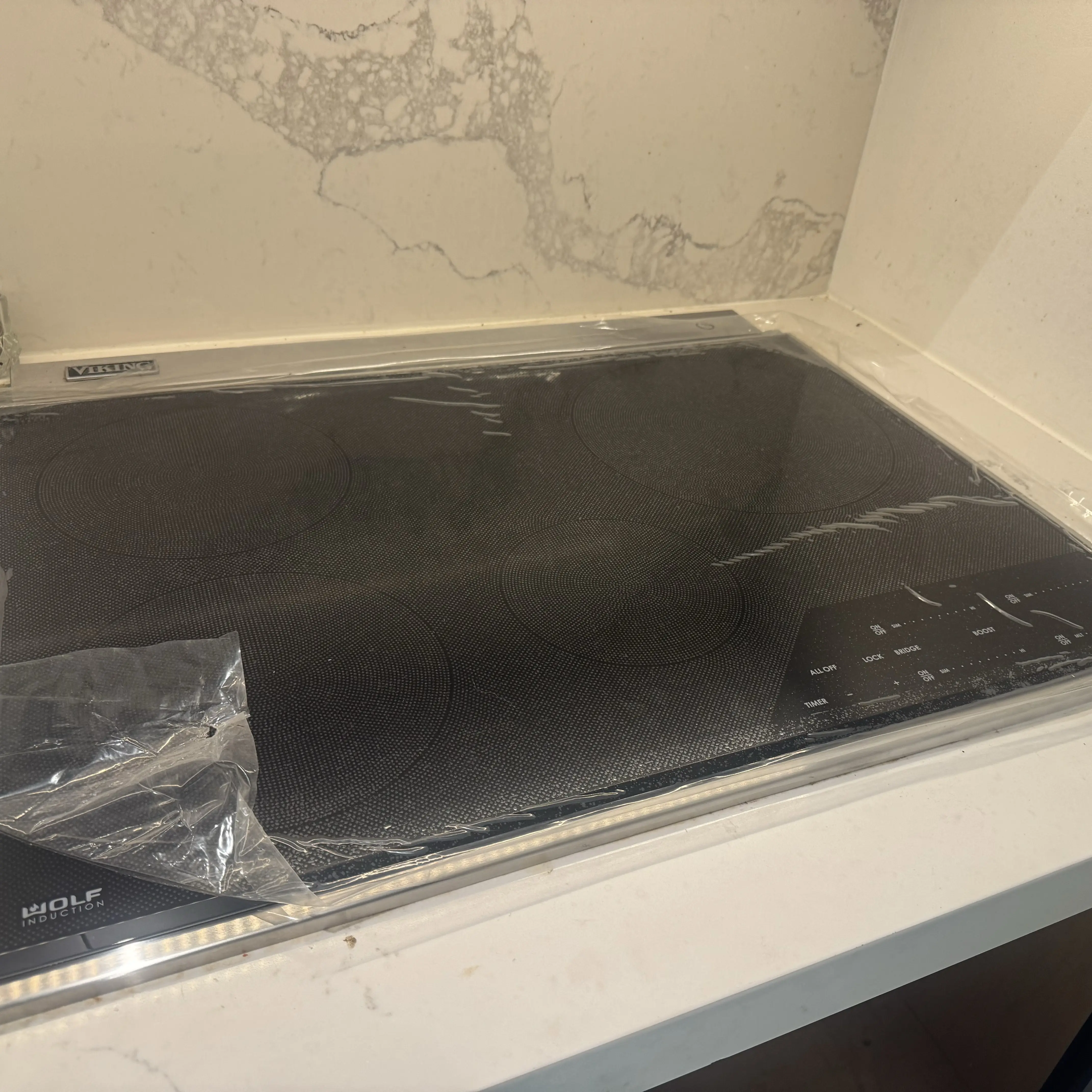
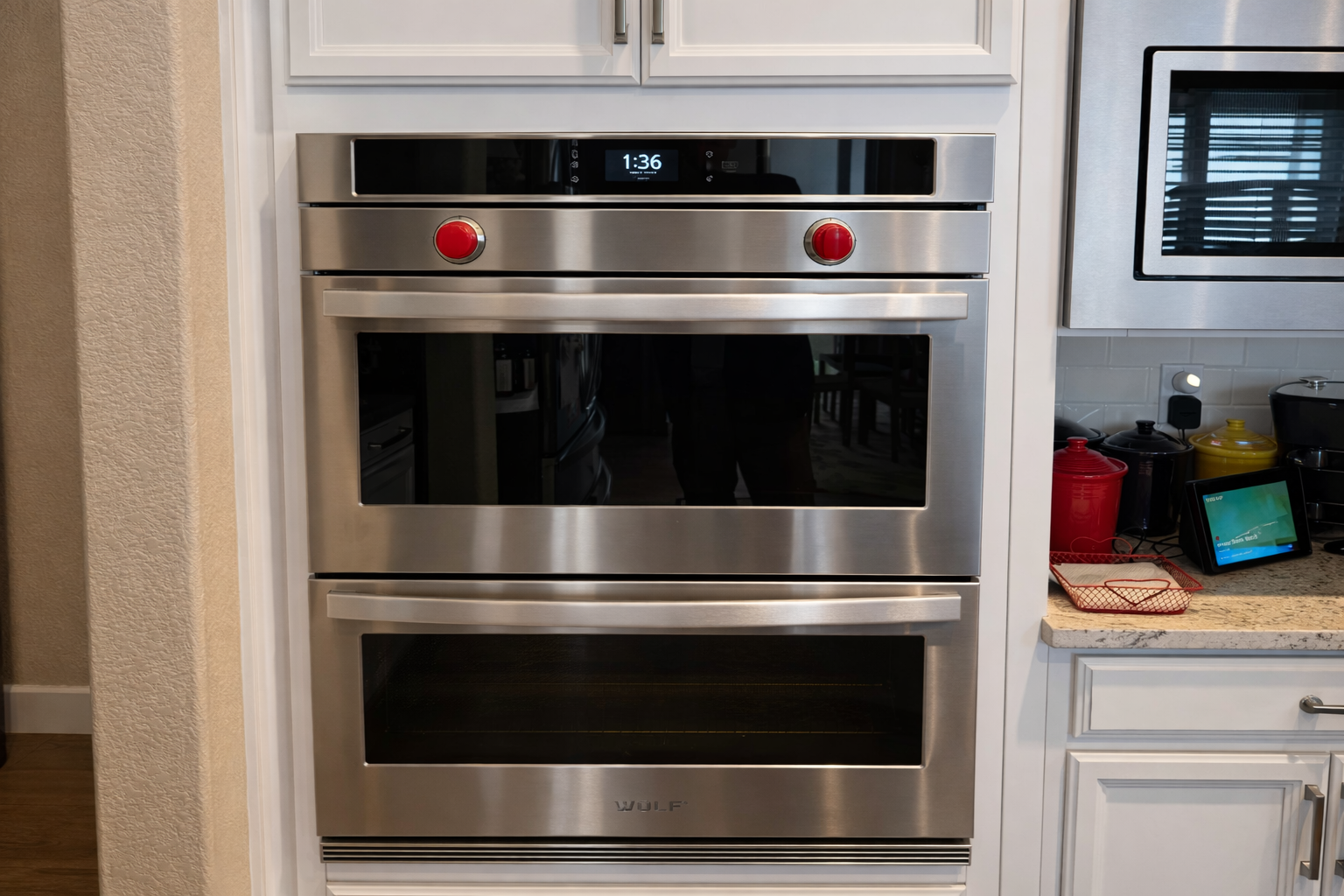
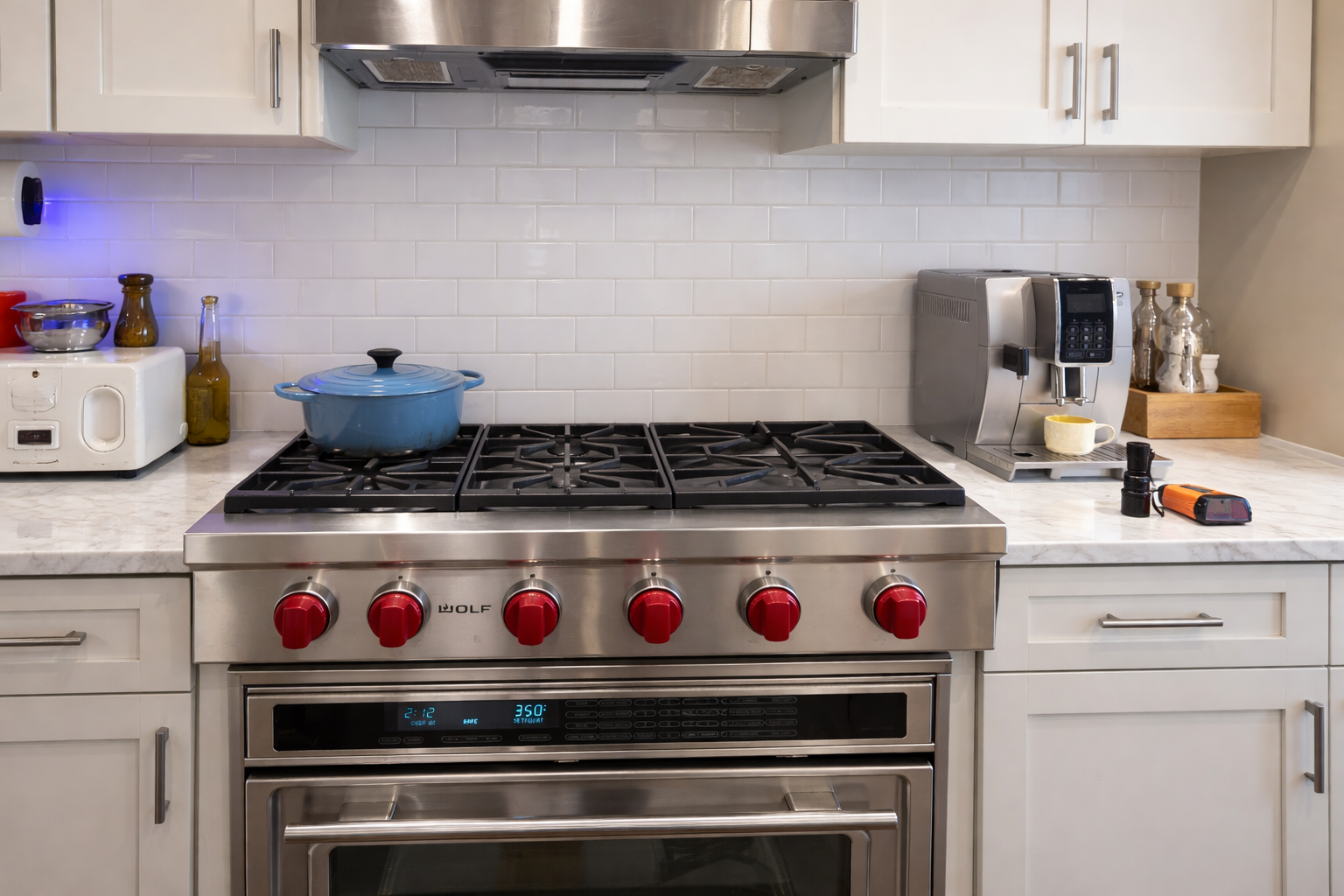
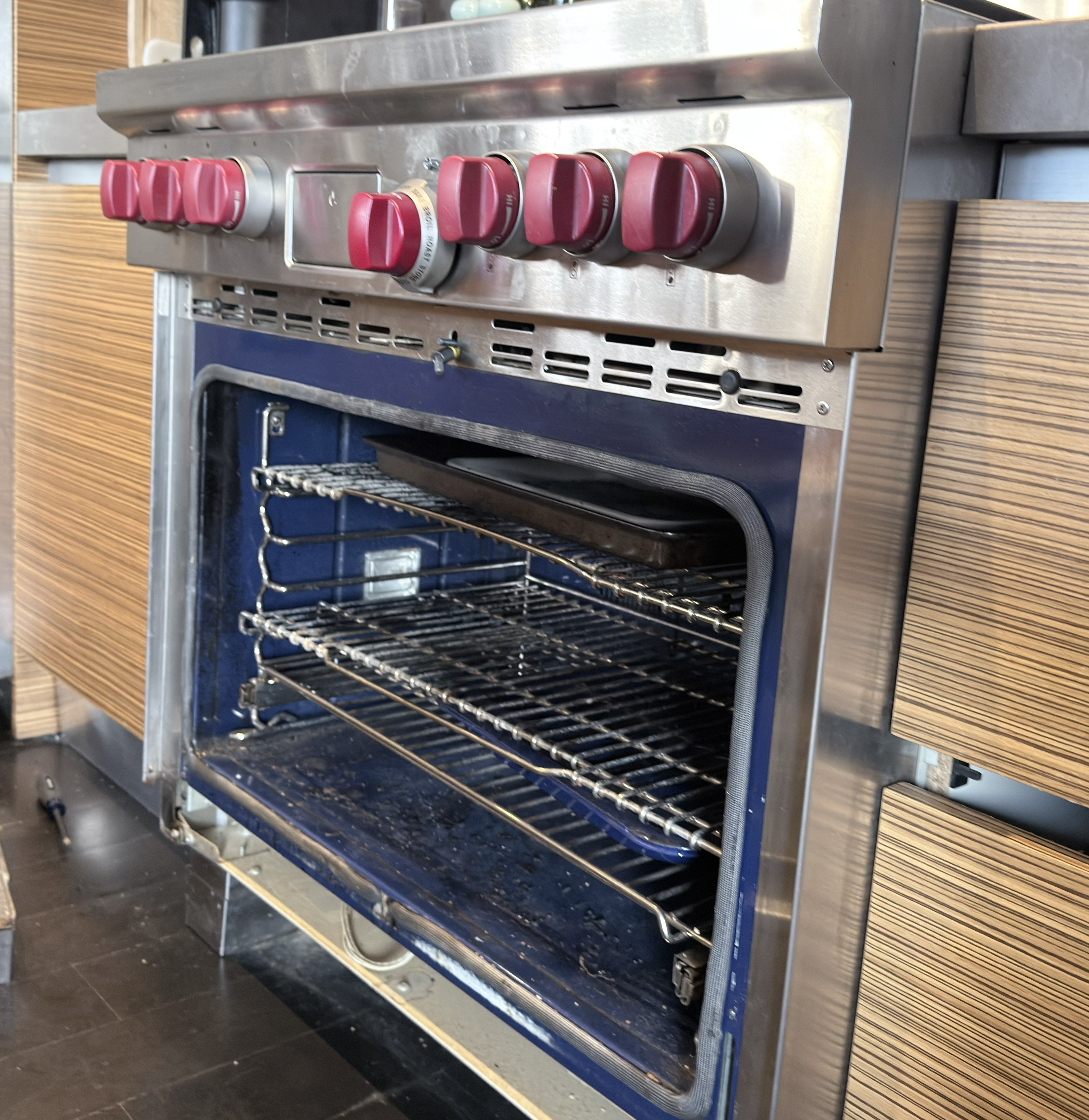
We service the full Wolf cooking lineup you actually see in NYC homes and condos: ranges (gas and dual fuel), rangetops, cooktops (gas, electric, induction), wall ovens (single/double, convection), speed ovens and microwaves, convection steam ovens (platform-dependent), ventilation hoods, warming drawers, and outdoor grills. Our approach is straightforward: identify what’s failing (ignition system, gas delivery/combustion stability, temperature sensing and regulation, airflow/cooling, door latch/lock logic, power modules on induction, or control/interface issues), explain the options in plain English, and move forward only with your approval.

Quick Facts (NYC-Ready)

  • $99 diagnostic fee — credited toward the repair if you proceed
  • 180-day parts & labor warranty
  • OEM parts only
  • Licensed & insured (COI available for building management)
  • Same-day / next-day availability in core areas when scheduling allows
  • Arrival windows: 9–11 / 11–1 / 1–3 / 3–5

Service Area
Brooklyn (Prospect Heights, Clinton Hill, Fort Greene, Park Slope, Carroll Gardens, Cobble Hill, Brooklyn Heights, DUMBO, Greenpoint, and more), Queens (Forest Hills, Rego Park, Whitestone, Flushing, and more), and Manhattan below 96th Street.

If your Wolf appliance is showing ignition issues, temperature instability, abnormal noise, error behavior, or performance drift, the fastest path is a diagnostic visit where we can test and confirm the root cause. Call or text (332) 333-1709 to schedule.

Volt & Vector is an independent repair service and is not affiliated with Sub-Zero Group, Inc. Wolf® is a registered trademark of its respective owner.
Common Wolf Stove Symptoms → Likely Causes

Wolf stoves are engineered systems: ignition, gas delivery, combustion, temperature regulation, airflow, and controls all interact. Below are the most common NYC Wolf stove symptoms we service and the most likely root causes we see in the field. The goal is to match the symptom to a failure mode that can be tested and confirmed—not to guess.

1) Burner won’t ignite / clicks but no flame

What you notice

  • Rapid clicking, no ignition
  • Ignites only after multiple attempts
  • Lights with a lighter but not with the igniter

Most likely causes

  • Ignition path issues: worn/dirty electrode tip, cracked ceramic, carbon tracking, weak spark to ground
  • Burner head/cap seating problems: cap not centered, head warped, misalignment after cleaning
  • Port restriction: grease/boilover residue blocking burner ports near the ignition point
  • Ignition module output weakness: inconsistent spark under heat or load
  • Grounding/wiring faults: poor ground path reduces spark intensity and causes intermittent ignition

2) Delayed ignition (“whoosh”), hard ignition, or mini-flare on light

What you notice

  • Gas smell right before it lights
  • Ignition happens late, then “pops”
  • Ignites fine cold, worse after cooking for a while

Most likely causes

  • Spark not landing where gas accumulates: electrode positioning/insulation issues
  • Partial port restriction: gas distribution uneven → delayed light-off
  • Weak spark under heat: module/electrode issues that degrade when components warm up
  • Incorrect burner assembly: cap/head mismatch or incorrect reassembly after cleaning

Why it matters

  • Delayed ignition is not “normal Wolf behavior.” It’s a sign the ignition event is not controlled and should be corrected.

3) Burner lights but won’t stay lit (flame drop-out), especially at simmer

What you notice

  • Flame ignites then dies when you release the knob
  • Low simmer won’t hold, but high flame is OK
  • Burner shuts off randomly with ventilation on high

Most likely causes

  • Flame stability / safety confirmation issues: the system is not seeing stable flame behavior consistently
  • Low-flow instability: partial restriction or valve behavior that can’t sustain a clean low flame
  • Draft / negative pressure: strong hood or lack of make-up air pulling the flame off the burner
  • Gas delivery under load: multiple burners on changes stability if supply/regulation is marginal

4) Weak flame, uneven flame ring, yellow/orange flame, soot

What you notice

  • Burner output is noticeably lower than others
  • Flame pattern has gaps or “leans”
  • Persistent yellow flames, soot on cookware, strong odor

Most likely causes

  • Burner port contamination: grease or debris distorting the flame pattern
  • Air–fuel mix problems: incorrect setup or restriction affecting combustion quality
  • Gas conversion mismatch (NG vs LP): wrong orifices/regulator configuration creates chronic poor combustion
  • Ventilation interaction: airflow patterns that disturb combustion (common in tight NYC kitchens with powerful hoods)

Safety note

  • Persistent yellow flame, soot, or odor warrants service—combustion quality matters.

5) Oven not heating, slow preheat, or uneven baking

What you notice

  • Long preheat times
  • Food browns unevenly
  • Oven struggles to recover temperature after opening door

Most likely causes

  • Heating circuit faults: element degradation, relay/control output issues, wiring/connectors affected by heat
  • Temperature sensing drift: sensor reads “close enough,” but regulation is off in real use
  • Convection airflow problems: fan motor wear, blocked airflow paths, or reduced convection effectiveness
  • Door seal / hinge alignment: heat loss causes longer preheat and uneven cavity behavior
  • Cabinet heat management issues: tight installs trap heat and can destabilize regulation

6) Temperature swings (display says one thing, results say another)

What you notice

  • “Too hot then too cool” cycles
  • Baking inconsistent from one day to the next
  • Temperature overshoot/undershoot around setpoint

Most likely causes

  • Sensor/control feedback issues: the control “hunts” because the feedback is noisy or drifting
  • Relay/control regulation faults: outputs that become intermittent under heat
  • Airflow and heat distribution issues: convection/cooling fans not moving heat correctly
  • Heat loss at the door: seal/hinge issues making the cavity unstable

Experience note

  • We treat this as a measurement problem first: confirm actual cavity behavior, then trace regulation.

7) Convection fan noise, vibration, or convection that feels ineffective

What you notice

  • New rattling/grinding
  • Fan pitch changes as the oven heats
  • Convection mode doesn’t improve baking

Most likely causes

  • Fan motor wear/bearing noise that worsens with temperature
  • Blade imbalance/contact: grease buildup, loose hardware, or minor deformation
  • Cabinet resonance: tight installations amplify vibration through panels and trim
  • Restricted airflow: convection running, but air path compromised

8) Door lock problems after self-clean (won’t unlock / errors)

What you notice

  • Door stays locked after cycle ends
  • Self-clean fails or aborts
  • Lock icon or alert repeats

Most likely causes

  • Latch/lock motor or switch feedback faults (position not confirming)
  • Heat-stressed connections revealed by high-temperature cycles
  • Cooling/heat-management issues causing protection behavior or lock logic errors

9) Induction zones cut out, pan not detected, or power throttles

What you notice

  • Zone starts then stops
  • “No pan” behavior with a pan on the surface
  • Power drops under high settings

Most likely causes

  • Cookware mismatch: not truly induction-ready, warped base, wrong diameter for zone
  • Thermal protection events: poor airflow under the cooktop (very common in tight cabinets)
  • Power module/inverter regulation issues causing dropouts under load
  • Sensor feedback faults misreading temperature/current and triggering shutdown

10) Control panel issues: unresponsive buttons, flickering display, intermittent operation

What you notice

  • Keypad doesn’t respond reliably
  • Display flickers or resets
  • Unit behaves differently after long cooking sessions

Most likely causes

  • Heat stress behind the control area: restricted ventilation accelerates failures
  • Ribbon cable / connector issues: intermittent contact with heat cycling
  • Control board faults: unstable outputs rather than total failure
  • Power quality problems: shared circuits, loose neutral, voltage fluctuation (NYC building reality)
No items found.
Check service availability
Enter a 5-digit NYC ZIP to see if you’re in coverage.

1. Schedule your visit

2. On-site diagnostic

3. Approve & repair

4. Done & covered

COI (Certificate of Insurance)

Available on request - usually not required in Brooklyn, but often asked for in Manhattan buildings and co-ops. Please remember that certain issues can come from incorrect use or installation, not from parts failure - our technicians will always point that out and show how to prevent it in the future.

Warranty & Compliance

Every repair is covered by a 180-day warranty on both parts and labor. If the appliance is older, keep in mind that some surrounding components can wear out over time — sometimes one repair leads to another part showing its age. We always explain options clearly before doing extra work.

Safety & Courtesy Protocol

We treat every visit like we’re guests in your home. Technicians wear shoe covers or remove footwear when entering, and we always clean up after the job. If you notice a little dust or debris left behind - our apologies - each tech handles 3-5 appointments per day and works to stay on schedule. If your window was 11-1, the technician usually arrives closer to 11; if running late, we’ll text you right away. Our goal is simple: work clean, stay safe, and respect your space and time.

Coverage

We cover Brooklyn—Downtown, Brooklyn Heights, Park Slope, Williamsburg, Greenpoint, Bed-Stuy, Carroll Gardens, Prospect Heights, and Flatbush—and Manhattan (below 96th Street)-FiDi, Battery Park, Tribeca, SoHo, Chelsea, Midtown, UES, UWS, Gramercy, and the Village. You’ll receive a text alert ~30 minutes before arrival.

Why Volt & Vector

We’ve spent years working inside large NYC repair companies - seeing how real technicians get buried under rushed schedules, fake “same-day” promises, and endless call-center noise. Volt & Vector grew out of that frustration. We wanted a place where diagnostics still matter, where techs can take time to do the job right and talk to people directly. We’re not calling ourselves perfect - far from it - but we’re building the kind of service we always wanted to work for: respectful, transparent, and run by people who actually fix things.

Pricing & Diagnostic Policy

Our diagnostic visit is always billed at the first appointment - that’s the starting point for every repair. After the visit, the technician sends full details to our service desk. Sometimes the tech can give a price range on-site, but we’re moving away from instant quotes - parts pricing changes like crypto these days, and we’d rather stay accurate than promise the wrong number.

Simple issues - like a clogged drain, loose wire, or minor reset - can often be fixed on the spot starting from $99. If a full repair with parts is needed, total cost varies by brand and model - just like in any NYC company, it can start around $320 and go up depending on parts and labor. We believe in clarity over surprises. You’ll always see the diagnostic results and estimate before any repair begins.

About Us & How it works

Transparent process, clear policies, and NYC building-ready service.

1–4: How it works
1
Schedule your visit
2
On-site diagnostic
3
Approve & repair
4
Done & covered
COI (Certificate of Insurance)

Available on request - usually not required in Brooklyn, but often asked for in Manhattan buildings and co-ops. Please remember that certain issues can come from incorrect use or installation, not from parts failure - our technicians will always point that out and show how to prevent it in the future.

Warranty & Compliance

Every repair is covered by a 180-day warranty on both parts and labor. If the appliance is older, keep in mind that some surrounding components can wear out over time — sometimes one repair leads to another part showing its age. We always explain options clearly before doing extra work.

Safety & Courtesy Protocol

We treat every visit like we’re guests in your home. Technicians wear shoe covers or remove footwear when entering, and we always clean up after the job. If you notice a little dust or debris left behind - our apologies - each tech handles 3-5 appointments per day and works to stay on schedule. If your window was 11-1, the technician usually arrives closer to 11; if running late, we’ll text you right away. Our goal is simple: work clean, stay safe, and respect your space and time.

Coverage
  • Brooklyn: Prospect Heights, Clinton Hill, Boerum Hill, Park Slope, Carroll Gardens, Cobble Hill, Kensington, Bushwick (West), Greenwood Heights, Prospect Lefferts Gardens, Windsor Terrace, Bedford–Stuyvesant, Crown Heights, Fort Greene, Brooklyn Heights, DUMBO, Greenpoint
  • Queens: Middle Village, Rego Park, Forest Hills, Fresh Meadows, Whitestone, North/Broadway Flushing, College Point
  • Manhattan: Below 96th Street (ZIP-based coverage)
  • You’ll receive a text alert ~30 minutes before arrival.
Why Volt & Vector

We’ve spent years working inside large NYC repair companies - seeing how real technicians get buried under rushed schedules, fake “same-day” promises, and endless call-center noise. Volt & Vector grew out of that frustration. We wanted a place where diagnostics still matter, where techs can take time to do the job right and talk to people directly. We’re not calling ourselves perfect - far from it - but we’re building the kind of service we always wanted to work for: respectful, transparent, and run by people who actually fix things.

Pricing & Diagnostic Policy

Our diagnostic visit is always billed at the first appointment - that’s the starting point for every repair. After the visit, the technician sends full details to our service desk. Sometimes the tech can give a price range on-site, but we’re moving away from instant quotes - parts pricing changes like crypto these days, and we’d rather stay accurate than promise the wrong number.

Simple issues - like a clogged drain, loose wire, or minor reset - can often be fixed on the spot starting from $99. If a full repair with parts is needed, total cost varies by brand and model - just like in any NYC company, it can start around $320 and go up depending on parts and labor. We believe in clarity over surprises. You’ll always see the diagnostic results and estimate before any repair begins.

1. Schedule your visit

2. On-site diagnostic

3. Approve & repair

4. Done & covered

COI (Certificate of Insurance)

Available on request - usually not required in Brooklyn, but often asked for in Manhattan buildings and co-ops. Please remember that certain issues can come from incorrect use or installation, not from parts failure - our technicians will always point that out and show how to prevent it in the future.

Warranty & Compliance

Every repair is covered by a 180-day warranty on both parts and labor. If the appliance is older, keep in mind that some surrounding components can wear out over time — sometimes one repair leads to another part showing its age. We always explain options clearly before doing extra work.

Safety & Courtesy Protocol

We treat every visit like we’re guests in your home. Technicians wear shoe covers or remove footwear when entering, and we always clean up after the job. If you notice a little dust or debris left behind - our apologies - each tech handles 3-5 appointments per day and works to stay on schedule. If your window was 11-1, the technician usually arrives closer to 11; if running late, we’ll text you right away. Our goal is simple: work clean, stay safe, and respect your space and time.

Coverage

We cover Brooklyn—Downtown, Brooklyn Heights, Park Slope, Williamsburg, Greenpoint, Bed-Stuy, Carroll Gardens, Prospect Heights, and Flatbush—and Manhattan (below 96th Street)-FiDi, Battery Park, Tribeca, SoHo, Chelsea, Midtown, UES, UWS, Gramercy, and the Village. You’ll receive a text alert ~30 minutes before arrival.

Why Volt & Vector

We’ve spent years working inside large NYC repair companies - seeing how real technicians get buried under rushed schedules, fake “same-day” promises, and endless call-center noise. Volt & Vector grew out of that frustration. We wanted a place where diagnostics still matter, where techs can take time to do the job right and talk to people directly. We’re not calling ourselves perfect - far from it - but we’re building the kind of service we always wanted to work for: respectful, transparent, and run by people who actually fix things.

Pricing & Diagnostic Policy

Our diagnostic visit is always billed at the first appointment - that’s the starting point for every repair. After the visit, the technician sends full details to our service desk. Sometimes the tech can give a price range on-site, but we’re moving away from instant quotes - parts pricing changes like crypto these days, and we’d rather stay accurate than promise the wrong number.

Simple issues - like a clogged drain, loose wire, or minor reset - can often be fixed on the spot starting from $99. If a full repair with parts is needed, total cost varies by brand and model - just like in any NYC company, it can start around $320 and go up depending on parts and labor. We believe in clarity over surprises. You’ll always see the diagnostic results and estimate before any repair begins.

Need help from our experts?

+1 (332) 333-1709

9:00 AM - 6:00 PM

Our service manager handles all calls personally. For short questions, text works best.

Google Business Profile

See live reviews, photos, and recent jobs. Booked with us? Please leave a review, thank you!

180-Days Warranty

Every completed repair includes a 180-day parts & labor warranty. OEM parts only. Warranty service is prioritized.

Local Service

Built by real NYC technicians - not marketers.

Volt & Vector is where clean design meets certified service.

Wolf Appliance Repair Services

No items found.

Wolf Error Codes (Ovens, Ranges, Induction Cooktops)

Wolf error codes are a signal from the control system, not a diagnosis by themselves. The code tells you the category of what the unit detected—most commonly: door lock/latch feedback, control/knob communication, relay/output faults, or overheating/temperature protection on induction. The same code can be triggered by a failed component, damaged wiring, a stuck mechanism, heat stress in tight cabinetry, or a one-time glitch.

The only “safe first move” most codes share

Wolf’s official guidance for many error codes is consistent: turn the home circuit breaker to the unit OFF for ~30 seconds, then ON, and retest. If the code comes back, Wolf typically states that no further customer troubleshooting is available and you should contact Factory Certified Service.

Here’s the simple rule:

  • Do one proper reset.
  • Retest once.
  • If the code returns: stop “trying things” and diagnose.

Safety stops (don’t troubleshoot these)

  • If you smell gas: shut the burner off, ventilate, and treat it as a safety event.
  • If the breaker trips repeatedly, you see burning smell, or the unit behaves erratically after reset: stop and schedule service.

The codes people actually see (and what they usually mean)

OPP (Legacy Dual Fuel) — lock/self-clean/door lock position problem

Wolf documents OPP as appearing when one oven is in self-clean or when the oven controller senses the motorized door lock is in the locked position. In normal use, OPP can show up as “the door won’t open” or “won’t fully close” behavior tied to the lock system.
Owner action: confirm you are not mid self-clean, make sure nothing is obstructing the door/lock area, then do one breaker reset and retest. If it returns, treat it as a real lock feedback fault.

01 (Legacy Dual Fuel) — door lock/unlock switches not sensed in time

Wolf lists Error Code 01 as: door lock or unlock switches not sensed within 60 seconds while driving the door lock motor.
Owner action: one breaker reset and retest. If it repeats, the repair is usually in the latch/lock assembly, switches, wiring, or the lock motor feedback path—not something you solve by repeating resets.

F1 (L Series Wall Oven) — service-level fault after reset/retest

Wolf’s L Series guidance is straightforward: reset power at the circuit breaker, test Bake again, and if the F1 returns, contact Factory Certified Service (no further consumer troubleshooting).
Owner action: exactly that—reset once, retest once, then stop.

ERR OC (Legacy Dual Fuel) — selector knob communication/contact issue (sometimes easy)

This is one of the few codes where Wolf publishes a specific “owner fix.” Wolf instructs you to: power off at the breaker, remove the oven selector knob that showed the error, ensure the metal contacts are clean and dry, reinsert firmly, restore power, and verify the error does not return.
Owner action: follow those steps carefully (dry/clean/seat). If it returns, it’s no longer an “easy contact fix” and needs diagnosis.

0E (Legacy Dual Fuel) — relay/element/drive circuitry fault

Wolf lists the likely causes for 0E as: power relay shorted (sensed closed when it should be open), failure of the element circuit, or failure of relay drive circuitry.
Owner action: reset once and retest. If it comes back, do not keep cycling power—this is an electrical control/output fault that requires proper testing.

Induction cooktop / induction range codes

E01 (Wolf Induction Range) — key error (left secondary)

Wolf describes E01 as a key error on the left secondary, with the standard breaker reset + retest, then service if unresolved.
Owner action: one reset, one retest. If it returns, schedule diagnosis (it’s not a “cookware” issue by default—this one is about control input).

E2 (Legacy IR Induction Range) — fault requiring reset/retest, service if persistent

Wolf’s official E2 guidance is: breaker reset, retest, and if not resolved, contact Factory Certified Service.
Plain-English meaning: E2 commonly shows up when the system is protecting itself (thermal/sensing/control). If it repeats, treat it as a real fault condition.

E07 (IR30450 / IR36550 Induction Range) — “TC Temperature Too High”

Wolf explicitly defines E07 as “Primary is too hot” and gives the standard reset/retest steps and then service if unresolved.
Owner action: let it cool, ensure ventilation is not blocked, reset once, retest. If it returns, this is usually not solved by “different pans.”

E8 (Wolf CT Induction Cooktop) — communication failure (boards/modules talking to each other)

Wolf defines CT induction cooktop E8 as Generator 1 communication error / communication failure between comm board and generator 1, with reset/retest then service.
Owner action: one reset, one retest. If it returns, it’s a service-level communication fault.

When the door won’t unlock

Wolf’s general guidance for an oven door that won’t unlock includes: address any error codes first, make sure the oven is turned off, then do a breaker reset and retest; if unresolved, service is necessary.

Bottom line (simple, honest)

  1. Write the code down.
  2. Reset once at the breaker.
  3. Retest once.
  4. If the code returns: stop guessing. The correct fix is the one confirmed by diagnosis—lock assembly feedback for 01/OPP, contact/knob communication for ERR OC, relay/output faults for 0E, and overheating/communication protection behavior for induction codes like E07/E8.

Common Wolf Appliance Problems We Service (NYC)

Wolf appliances are engineered to run hot, cycle precisely, and respond consistently. In NYC, most failures we see are not “mystery problems”—they fall into repeatable categories tied to ignition, temperature regulation, airflow/heat management, and electronics under heat stress. The key is matching your symptom to the correct failure mode and confirming it with real checks (not guesses), because one symptom can have multiple causes depending on the Wolf platform and installation conditions.

Ranges (Gas & Dual Fuel)

Burners won’t ignite / delayed ignition

  • What you notice: clicking but no flame, slow light-off, ignition only after multiple tries, occasional “whoosh.”
  • Most common causes: moisture/food debris around the igniter tip, clogged burner ports, burner cap/head not seated correctly, weakened ignition components, or a spark path/grounding issue.
  • Safe homeowner step: remove grates and caps, dry thoroughly, clean ports gently, and re-seat caps perfectly centered.
  • When it’s beyond DIY: repeated delayed ignition, ignition that worsens when the unit is hot, or multiple burners behaving the same way—those require testing and correction of the underlying ignition system behavior.

Igniter keeps clicking after the flame is lit

  • What you notice: flame is on, but the igniter continues to spark.
  • Most common causes: wet/dirty igniter area, misalignment of burner components, or ignition control behavior that’s no longer stable.
  • Safe homeowner step: power off the burner, allow to cool, dry/clean, reassemble precisely.
  • Service threshold: if it persists after cleaning/drying, the problem is typically not “normal operation”—it needs diagnosis.

Oven temperature inconsistency

  • What you notice: slow preheat, runs hot/cold, uneven baking, temperature swings.
  • Most common causes: temperature sensor drift, weakened heating output (gas ignition performance or electric element degradation), airflow/cooling fan constraints, or regulation/control output issues.
  • What we do differently (Experience / E-E-A-T): we verify actual heat behavior (not just the display), confirm regulation stability under load, and check airflow/cooling that protects electronics and keeps cycles stable—especially important in tight NYC cabinetry.

“OPP” and related door/lock behavior

  • What you notice: “OPP” or lock-related errors, self-clean won’t start, door lock won’t engage/disengage.
  • Most common causes: latch/lock mechanism feedback problem, lock motor issues, or control not seeing the correct door position.
  • First safe step: confirm the door is fully closed and the latch area is unobstructed, then do a breaker reset.
  • When to call: if the code returns or the lock is stuck—forcing the latch is a fast way to create a bigger repair.

Cooktops & Rangetops

Gas burners with uneven/weak flames

  • What you notice: weak flame, gaps in the flame ring, inconsistent burner output, yellow/orange flame that persists.
  • Most common causes: blocked ports/orifices, mis-seated caps, airflow disruption (large pans blocking adjacent airflow), or gas/air mixture issues.
  • Safe homeowner step: clean and re-seat burner parts carefully.
  • Service threshold: persistent yellow flames, soot, or odor—combustion quality should be verified rather than ignored.

Induction cooktop not heating cookware

  • What you notice: “no pan” behavior, zone starts then stops, heats inconsistently.
  • Most common causes: cookware not induction-compatible, pan not centered/incorrect diameter, power supply conditions, thermal protection from restricted airflow under the cooktop, or internal module/sensor faults.
  • Safe homeowner step: test with a known induction-ready pan (magnetic, flat bottom), ensure the cabinet below has ventilation.
  • NYC reality: tight cabinets often cause heat buildup that triggers protective shutdown—this is an installation/airflow constraint as much as a cooktop issue.

Induction buzzing/humming

  • What you notice: audible hum, especially at higher power.
  • Most common causes: normal induction operating noise and cookware resonance; sometimes worsened by thin or uneven cookware bases.
  • Safe homeowner step: try a heavier pan with a flat base; keep the cooktop surface clean and dry.

Wall Ovens, Speed Ovens & Microwaves

Oven won’t heat / slow heat / uneven baking

  • Most common causes: heating circuit failure (elements/relays), sensor drift, airflow constraints, door seal leakage, or control output instability.
  • What we check (Experience): sensor feedback vs real cavity behavior, stable power delivery to heat components, convection airflow performance, and door seal integrity—because “it gets hot” is not the same as “it regulates correctly.”

Speed oven/microwave symptoms

  • What you notice: no heat, stops mid-cycle, inconsistent performance, door-related faults.
  • Most common causes: door interlock and safety switch behavior, control issues, or component failure that requires model-specific testing.
  • Safety note: do not open a microwave chassis—high voltage risk. Diagnosis should be professional.

Ventilation Hoods

Poor venting / weak airflow

  • What you notice: smoke/odor not clearing, grease buildup faster than expected, loud operation with poor capture.
  • Most common causes: saturated grease filters, blocked ducting, improper duct sizing, backdraft issues, or restrictions at the termination.
  • Homeowner maintenance: clean filters on schedule; check that airflow paths aren’t obstructed.

“FG” indicator (V-Series hoods)

  • What you notice: FG light/indicator.
  • What it usually means: filter maintenance reminder (commonly triggered after a set number of hours).
  • Fix: clean the filters and reset per the hood’s instructions.

Warming Drawers

Not heating / “PF” code

  • What you notice: PF (power failure) or drawer not heating consistently.
  • Most common causes: power interruption, control reset requirement, or heating component issues.
  • First step: reset via power button (if applicable) or breaker reset.
  • Service threshold: repeated PF behavior or no-heat symptoms after reset—requires electrical/heating circuit diagnosis.

When to stop troubleshooting and call service

  • Gas odor, repeated delayed ignition, flame drop-out, persistent yellow flames/soot
  • Breaker trips, burning smell, repeated control failures after reset
  • Door lock stuck or self-clean lock errors that recur
    These aren’t “wait and see” problems—especially in NYC installs where heat management and power quality can amplify faults.

If you want, I can convert this into your exact Webflow “Block 2” rhythm (tight intro + appliance subcategories + short “Safe fix / When to call” bullets) while keeping it clean, human, and Google-friendly.

Q1: Why is my Wolf refrigerator not cooling? A1: Likely condenser coils, fan, or thermistor. | Q2: What does F6E4 mean on a Wolf dishwasher? A2: Float switch error. | Q3: Should I repair or replace my Wolf oven? A3: Repair is typically cheaper for sensors or igniters.

Repairing Wolf is usually more economical. Replacing pumps, igniters, fans, or sensors restores function at a fraction of replacement cost, extending lifespan significantly.

Wolf integrates high-end electronics with mechanics. Refrigerators use inverter compressors and thermistors, ovens use igniters and relays, washers employ pressure switches, and dryers depend on heaters and fuses.

Professional repair is required for Wolf when error codes persist, sealed systems or compressors fail, gas ignition malfunctions occur, or electrical burning odors are detected.

Need help from our experts?

+1 (332) 333-1709

9:00 AM - 6:00 PM

Our service manager handles all calls personally. For short questions, text works best.

Google Business Profile

See live reviews, photos, and recent jobs. Booked with us? Please leave a review, thank you!

180-Days Warranty

Every completed repair includes a 180-day parts & labor warranty. OEM parts only. Warranty service is prioritized.

Local Service

Built by real NYC technicians - not marketers.

Volt & Vector is where clean design meets certified service.

Frequently Asked Questions

Clear answers about scheduling, pricing, coverage, warranty, and what to expect on-site.

General & Company
What are your hours of operation?
Phone support is typically 9:00 AM–6:00 PM. Appointments are scheduled by arrival window, and you’ll get a text ~30 minutes before arrival.
What service areas do you cover?
We cover Brooklyn, Manhattan (below 96th Street), and selected Queens ZIPs. Use the ZIP checker on the page to confirm coverage for your address.
Are you licensed and insured?
We’re insured and can provide a COI (Certificate of Insurance) upon request for building management.
How long have you been in business?
Volt & Vector is built by NYC technicians with years of field experience in high-volume repair environments and premium residential service.
What training do your technicians have?
We diagnose using factory documentation, service-manual test procedures, and real-world NYC installation experience (tight cabinetry, airflow issues, building constraints). Sealed-system work is handled by certified technicians when applicable.
Why should I choose your company over a competitor?
We’re diagnostics-first, transparent about causes (including install/use issues), and focused on correct repairs with OEM parts and a 180-day parts & labor warranty.
Do you have customer references or testimonials I can review?
Yes—our Google Business Profile is the best place to see live reviews, photos, and recent jobs.
Services & Specialization
Which appliances can you repair?
Most common calls include refrigerators/freezers (including built-ins), ice makers, dishwashers, washers, dryers, ovens, ranges, cooktops, and ventilation where applicable.
What specific brands do you service?
We service many premium brands commonly installed in NYC, including Sub-Zero, Wolf, Miele, Thermador, Bosch, Gaggenau, ILVE, and others. If you don’t see your brand listed, ask—coverage varies by product line.
Do you service high-end or commercial appliances?
Our core focus is high-end residential. For light commercial environments (small offices, studios), we review brand/model first to confirm serviceability.
Can you install new appliances, or do you only repair them?
We’re primarily a repair service. If an installation or modification is required to complete a repair safely, we’ll explain options and what we can support.
Do you offer preventative maintenance?
Yes—maintenance is often the fastest way to prevent repeat failures (airflow/condenser cleaning, leak checks, drain/defrost maintenance, and performance verification).
Do you provide emergency or same-day repair services?
Same-day/next-day availability depends on scheduling and location. We’ll give you realistic timing and keep communication direct.
Pricing & Payment
How do you price your services?
We start with diagnostics, then provide a clear repair estimate based on parts required and labor scope. No repair begins without approval.
What is your service call / diagnostic fee?
$99 diagnostic (credited toward the repair if you approve the estimate).
Is the diagnostic fee waived if I proceed with the repair?
The diagnostic is credited toward the approved repair total.
Do you provide estimates in writing before starting work?
Yes. You’ll receive diagnostic findings and an estimate before any repair is performed (unless it’s a minor on-the-spot fix you explicitly approve).
What payment methods do you accept?
We support standard modern payment methods (card and electronic options). If your building requires a specific payment workflow, tell us during booking.
Warranty & Parts
What kind of warranty do you offer on parts and labor?
180-day warranty on both parts and labor for completed repairs.
Do you use genuine manufacturer parts?
Yes—OEM parts only.
Will using an unauthorized repair technician void my manufacturer’s warranty?
Manufacturer rules vary by brand and coverage type. If your unit is under a manufacturer warranty, the brand may require an authorized provider. We’ll tell you what we can verify on-site and what should go through the manufacturer.
Do you work with home warranty companies?
We typically work directly with the homeowner/building. If you have a home-warranty plan, you can often submit our invoice for reimbursement if your plan allows.
Preparation & Process
What should I check before calling a repair service?
Quick safe checks:
  • Power: breaker not tripped, outlet working, unit plugged in.
  • Settings: temperature setpoints not changed accidentally.
  • Water supply (ice makers/dishwashers): valve on, no kinked line.
  • Filters/vents: obvious airflow blockage or clogged filter where applicable.
  • Any error code/message shown on the display.
How should I prepare my home/appliance for the technician’s visit?
Clear access around the appliance, remove fragile items nearby, and (if possible) have model/serial info ready. If your building needs COI or a service elevator reservation, tell us in advance.
How long will the repair take?
Diagnostics typically take 30–90 minutes depending on appliance type and access. Some repairs can be completed the same visit if parts and scope are confirmed; others require a follow-up once parts arrive.
Will you need to order parts, and how long does that typically take?
Sometimes. Lead times vary by brand and stock status; many common OEM parts arrive in a few business days, but specialty items can take longer (especially during backorders).
Do I need to be home during the repair?
Yes—an adult must provide access and approve work. If your building has a super/doorman process, coordinate access ahead of time.
Post-Service
What follow-up support do you provide after a repair?
You’ll have a clear record of what was diagnosed, what was repaired, and what parts were used. If anything looks off, contact us and we’ll guide next steps.
What if the same problem occurs after the repair?
If it’s related to the completed repair and within the 180-day warranty window, warranty service is prioritized.
How can I leave a review or provide feedback?
Google reviews help us most. If you booked with us, we appreciate an honest review on our Google Business Profile.
Do you provide tips on how to properly maintain my appliances after the repair?
Yes—if we see install/use factors contributing to the failure (airflow restriction, drainage, loading habits, filter maintenance), we’ll show you exactly what to change to prevent repeats.
Safety & Environment
Do you have safety procedures for working in my home?
Yes. We work clean and controlled: shoe covers (or footwear removed), protected work areas, safe power shutoffs when required, and clear communication before testing anything that could affect your home.
How do you dispose of old parts or refrigerants safely?
Old parts are removed and handled responsibly. Refrigerant recovery and sealed-system handling are performed using compliant procedures by certified technicians where applicable.

Services

See the full catalog of our services—organized by brand and by appliance—right here.

Book your service

Choose a convenient time slot. Diagnostic $99 (credited toward repair).

Open Google Calendar

Available Mon–Sat, 9 AM–6 PM. Same-day slots often open.

Instant confirmation

Your slot is reserved immediately after booking.

180‑day warranty

Parts & labor covered. No questions asked.

OEM parts only

Original manufacturer components for every repair.

$99 diagnostic credit

Applied in full toward any approved repair.

Need help from our experts?

+1 (332) 333-1709

9:00 AM - 6:00 PM

Our service manager handles all calls personally. For short questions, text works best.

Google Business Profile

See live reviews, photos, and recent jobs. Booked with us? Please leave a review, thank you!

180-Days Warranty

Every completed repair includes a 180-day parts & labor warranty. OEM parts only. Warranty service is prioritized.

Local Service

Built by real NYC technicians - not marketers.

Volt & Vector is where clean design meets certified service.

Google Reviews

Bright yellow five-pointed star on a white backgroundBright yellow five-pointed star on a white backgroundBright yellow five-pointed star on a white backgroundBright yellow five-pointed star on a white backgroundBright yellow five-pointed star on a white background

Great people to deal with. Called and set up appointment right away. Mark came and fixed the issue right away. Very friendly and respectful. Will use again. Thanks guys.

Bright yellow five-pointed star on a white backgroundBright yellow five-pointed star on a white backgroundBright yellow five-pointed star on a white backgroundBright yellow five-pointed star on a white backgroundBright yellow five-pointed star on a white background

Excellent experience with Vlad! He came day of to help fix a laundry machine issue. He was on time, a clear communicator about the issue and fixed it with ease. He came back the following day (at no charge!) when I reached out with further information about how the machine was working to confirm everything was working properly/as intended. Excellent service and will absolutely be working with them again when we have future needs. Can’t recommend enough!

Bright yellow five-pointed star on a white backgroundBright yellow five-pointed star on a white backgroundBright yellow five-pointed star on a white backgroundBright yellow five-pointed star on a white backgroundBright yellow five-pointed star on a white background

Vlad has been an incredible asset. In the few months we've known him, he's already fixed a dryer, two washing machines, and an oven! He's always very upfront with the repairs needed and the associated costs with fixing an appliance. I wouldn't hesitate at all to hire him for any future appliances in need of repair

Bright yellow five-pointed star on a white backgroundBright yellow five-pointed star on a white backgroundBright yellow five-pointed star on a white backgroundBright yellow five-pointed star on a white backgroundBright yellow five-pointed star on a white background

I split my time between Italy and NYC and manage several Airbnb units. Scheduling used to take too much energy around guest check-ins and turnovers. With Volt & Vector Appliance Repair, the routine became predictable: clear 2-hour windows (9–11am or 12–2pm), a text with ETA, written pricing (diagnostic credited), before/after photos, and a short summary after each visit. Over ~30 repairs in two years: washers, dryers, dishwashers, ranges, a refrigerator seal. They’ve kept me informed and moved quickly on parts (usually 24–48 hours when ordered). Access and lockboxes are handled without drama, work areas are left clean, and my reviews stayed steady. Hosting from abroad is easier when maintenance is this consistent. Strong recommend for Brooklyn and Manhattan hosts.

Larry Lawson
Bright yellow five-pointed star on a white backgroundBright yellow five-pointed star on a white backgroundBright yellow five-pointed star on a white backgroundBright yellow five-pointed star on a white backgroundBright yellow five-pointed star on a white background

Amazing service every time! I work for a multi-use property in lower Manhattan and we have used Volt & Vector for at least 20+ jobs and I can honestly say they do incredible and reliable work. Vlad is a pleasure to work with, he is honest and his pricing is fair. Highly recommend!