Daikin outdoor air conditioning unit with a Mitsubishi Electric cardboard box on top, placed on a concrete surface near other cardboard boxes and equipment.
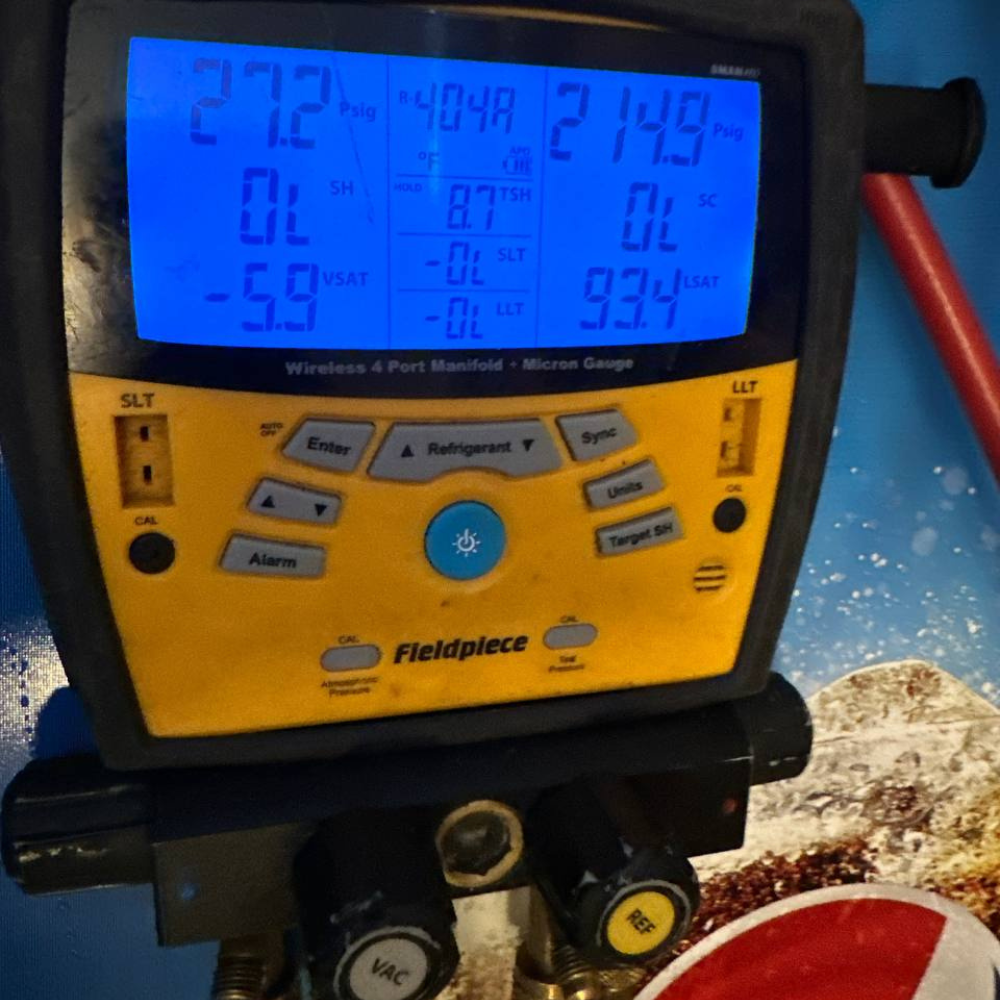
Refrigerant manifold gauge with blue, red, and yellow hoses connected to an air conditioning unit.
Person wearing a yellow work glove pressing a button on a stainless steel kitchen range hood control panel.
Person wearing gloves crouches while using a tool to repair or inspect the side of a large appliance or machine.
Hand holding red and blue hoses connected to HVAC gauge manifold kit with yellow hose coiled inside an equipment compartment.
Man in a gray long-sleeve shirt and black pants working inside a garage filled with shelves of household items and tools.
A hand holding a fortune cookie slip that reads, 'A light heart carries you through all the hard times.'
Hand holding an orange infrared thermometer pointed at a stainless steel gas stove with control knobs and a blue pot on a burner.
Tip: You can search by brand, model, or error code (e.g., Bosch E24, Miele W1, Sub-Zero 650).
Air Conditioner Repair in NYC

1. Schedule your visit

2. On-site diagnostic

3. Approve & repair

4. Done & covered

COI (Certificate of Insurance)

Available on request - usually not required in Brooklyn, but often asked for in Manhattan buildings and co-ops. Please remember that certain issues can come from incorrect use or installation, not from parts failure - our technicians will always point that out and show how to prevent it in the future.

Warranty & Compliance

Every repair is covered by a 180-day warranty on both parts and labor. If the appliance is older, keep in mind that some surrounding components can wear out over time — sometimes one repair leads to another part showing its age. We always explain options clearly before doing extra work.

Safety & Courtesy Protocol

We treat every visit like we’re guests in your home. Technicians wear shoe covers or remove footwear when entering, and we always clean up after the job. If you notice a little dust or debris left behind - our apologies - each tech handles 3-5 appointments per day and works to stay on schedule. If your window was 11-1, the technician usually arrives closer to 11; if running late, we’ll text you right away. Our goal is simple: work clean, stay safe, and respect your space and time.

Coverage

We cover Brooklyn—Downtown, Brooklyn Heights, Park Slope, Williamsburg, Greenpoint, Bed-Stuy, Carroll Gardens, Prospect Heights, and Flatbush—and Manhattan (below 96th Street)-FiDi, Battery Park, Tribeca, SoHo, Chelsea, Midtown, UES, UWS, Gramercy, and the Village. You’ll receive a text alert ~30 minutes before arrival.

Why Volt & Vector

We’ve spent years working inside large NYC repair companies - seeing how real technicians get buried under rushed schedules, fake “same-day” promises, and endless call-center noise. Volt & Vector grew out of that frustration. We wanted a place where diagnostics still matter, where techs can take time to do the job right and talk to people directly. We’re not calling ourselves perfect - far from it - but we’re building the kind of service we always wanted to work for: respectful, transparent, and run by people who actually fix things.

Pricing & Diagnostic Policy

Our diagnostic visit is always billed at the first appointment - that’s the starting point for every repair. After the visit, the technician sends full details to our service desk. Sometimes the tech can give a price range on-site, but we’re moving away from instant quotes - parts pricing changes like crypto these days, and we’d rather stay accurate than promise the wrong number.

Simple issues - like a clogged drain, loose wire, or minor reset - can often be fixed on the spot starting from $99. If a full repair with parts is needed, total cost varies by brand and model - just like in any NYC company, it can start around $320 and go up depending on parts and labor. We believe in clarity over surprises. You’ll always see the diagnostic results and estimate before any repair begins.

Volt & Vector provides diagnostics-first air conditioner repair for NYC apartments, condos, and townhomes. AC problems in the city are often installation-sensitive: limited ventilation, long runs, high-rise access constraints, and condensate routing issues can look like “bad parts” until you test the system under load.

We start by confirming the failure mode with measurable checks: temperature split, airflow, electrical load, control signals, condensate management, and (when applicable) refrigeration performance indicators. That avoids guesswork replacements and helps repairs hold up in real NYC use.

Schedule AC service
Call: +1 (332) 333-1709
Email: voltnvector@gmail.com

Quick Answers

  • Question: My AC runs but barely cools. What do you check first?
    Answer: We verify airflow and filter/coil condition, then measure temperature split and electrical load to separate “airflow/heat-exchange” problems from control or refrigeration-performance issues.
  • Question: The indoor unit is blowing air but the outdoor unit is silent. What does that usually mean?
    Answer: Most often it’s a control/power issue (disconnect, breaker, contactor/control signal, capacitor) rather than a “dead compressor,” so we confirm power and call signals before anything else.
  • Question: My AC turns on and off every few minutes. Is that low refrigerant?
    Answer: Not automatically. Short-cycling can be thermostat/control logic, airflow restriction, overheating at the condenser, or safety trips; we confirm by monitoring pressures/temps where accessible and checking controls and airflow.
  • Question: Water is leaking from the indoor unit. Is it always a clogged drain?
    Answer: Clogged drains are common, but we also check trap/venting, pitch, pump operation, pan overflow, and coil icing that melts into the pan faster than it can drain.
  • Question: The AC trips the breaker. Is it safe to keep resetting it?
    Answer: No. Repeated resets can worsen damage; we identify whether it’s a high-start draw, short, failing capacitor/motor, or wiring issue with load and insulation checks.
  • Question: Do you handle ductless mini-splits in NYC?
    Answer: Yes. We service common ductless configurations and focus on airflow, condensate routing, controls/communication, and performance verification under real operating conditions.
  • Question: Do you do AC installations or full replacements?
    Answer: Repairs and maintenance are the priority. If your situation is replacement-level, we will tell you early based on what we can verify on-site.

Air Conditioner Repair NYC At a Glance

  • Service: in-home AC diagnostics, repair, and maintenance-focused fixes
  • Coverage: Brooklyn, Manhattan below 96th St, selected Queens ZIPs
  • Systems: ductless mini-splits, split systems with air handlers, common apartment-unit configurations
  • Approach: diagnostics-first testing before parts or recommendations
  • Hours: Monday–Saturday, 9:00 AM–6:00 PM

What We Service

  • Ductless mini-split systems (indoor heads, controls, drainage, airflow/performance issues)
  • Split systems with air handlers (cooling performance, blower/controls/condensate problems)
  • Common NYC apartment configurations where access, drainage routing, and ventilation constraints affect performance

If you’re unsure what you have, send a photo of the indoor unit nameplate (or model/serial label), the thermostat, and any displayed error code. We will confirm scope before dispatch.

Clear Boundaries: What We Don’t Do

  • Full system installations, equipment changeouts, or new line-set runs as a primary offering
  • Ductwork installation or redesign
  • Cosmetic carpentry/cabinet modifications needed for access
  • Work that requires building modifications beyond standard service access

Before You Call: Safe, High-Value Checks

Stop and schedule service if you notice burning smell, repeated breaker trips, sparking, or active water leaking that could damage floors or walls.

  • Confirm the thermostat is set to Cool and the setpoint is below room temperature
  • Replace or clean the return-air filter if it’s accessible and clearly dirty
  • Check that supply/return vents are not blocked by furniture or rugs
  • Make sure doors/windows near the conditioned space are closed during testing
  • If you have an outdoor unit, confirm the disconnect is on and the breaker is not tripped (do not keep resetting)
  • Listen for the indoor blower and note whether airflow is weak vs normal
  • If there is visible water at the indoor unit, stop running cooling and note where the leak appears (front panel, underneath, near piping)
  • If the unit iced up, turn cooling off and run Fan (if available) to thaw, then book service rather than forcing operation
  • Take photos of any fault code or flashing pattern before power-cycling

Symptom to Diagnosis Map

  • Symptom: Runs constantly but never reaches set temperature
    Likely cause class: Airflow restriction, dirty coil, heat rejection constraints, or capacity mismatch
    How we confirm on-site: Temperature split, airflow assessment, coil condition, condenser/heat rejection evaluation, runtime behavior under steady load
  • Symptom: Indoor blower runs, outdoor unit does not
    Likely cause class: Power/control issue, failed contactor/capacitor, safety lockout
    How we confirm on-site: Verify line voltage, control signal, contactor engagement, capacitor health indicators, and protective trip conditions
  • Symptom: Outdoor runs, indoor airflow is weak
    Likely cause class: Blower motor/control, clogged filter/coil, duct restriction (if ducted)
    How we confirm on-site: Static/airflow indicators, blower draw behavior, filter/coil inspection, temperature split vs airflow
  • Symptom: Short-cycles every few minutes
    Likely cause class: Thermostat/control logic, overheating, airflow restriction, safety trip, sensor issues
    How we confirm on-site: Cycle timing, control inputs, coil temps, condenser conditions, and trip/lockout evidence
  • Symptom: Breaker trips on start
    Likely cause class: High start draw, failing capacitor, compressor/motor electrical fault, wiring issue
    How we confirm on-site: Inrush/load behavior, component inspection, continuity/insulation indicators where appropriate, circuit verification
  • Symptom: Icing on indoor coil or piping
    Likely cause class: Airflow restriction, low heat load, refrigeration-performance issue
    How we confirm on-site: Airflow verification, coil temperature behavior, operating conditions, and performance checks after thaw
  • Symptom: Water leaking from indoor unit
    Likely cause class: Drain blockage, poor pitch/trap, pump failure, pan overflow, ice melt overload
    How we confirm on-site: Drain test, pan inspection, trap/pitch evaluation, pump operation, and controlled run verification
  • Symptom: Musty odor when cooling starts
    Likely cause class: Biofilm/moisture in coil/drain system, stagnant condensate
    How we confirm on-site: Drain/coil inspection, moisture sources, and remediation path tied to the actual wet points
  • Symptom: Loud rattling or vibration
    Likely cause class: Fan imbalance, mounting/isolation issues, loose panels, blower wheel issues
    How we confirm on-site: Identify vibration source under operation, check mounts/panels, fan/blower behavior
  • Symptom: Remote/thermostat doesn’t respond reliably
    Likely cause class: Control power, communication fault, sensor drift, control board behavior
    How we confirm on-site: Control voltage checks, error history, sensor readings vs actual temps, response tests under commands
  • Symptom: Cooling is fine at night but poor mid-day
    Likely cause class: Heat rejection limits, sun load, ventilation constraints, condenser fouling
    How we confirm on-site: Performance under higher ambient, condenser airflow/cleanliness, and stability over a run period
  • Symptom: One room head cools, another doesn’t (multi-zone)
    Likely cause class: Zone control/valving behavior, sensor/control logic, airflow issue at the head
    How we confirm on-site: Compare zone responses, coil temps, control commands, and behavior under isolated operation

Common AC Problems We Repair (by Category)

Cooling performance problems

What you notice

  • Weak cooling even with long runtime
  • “Cold-ish” air but room stays warm
  • Big difference between rooms or zones

What we test

  • Temperature split across return/supply (or intake/discharge at the head)
  • Airflow and obvious restrictions (filter, coil condition, blocked returns)
  • Electrical load and control behavior under steady operation
  • Heat rejection constraints at the outdoor unit (where applicable)

What verification looks like

  • Stable temperature behavior over a run period, not just a short burst of cool air

No-cool / won’t start

What you notice

  • Thermostat calls for cooling but nothing happens
  • Indoor runs but outdoor is off, or vice versa
  • Starts then stops quickly

What we test

  • Power path: breakers/disconnects and safe voltage presence checks
  • Control signal chain: call for cooling, safety interlocks, and response
  • Start components and motor/compressor behavior indicators

What verification looks like

  • Consistent starts and stable operation without protective trips

Leaks and water management

What you notice

  • Water under the indoor unit
  • Intermittent leaks (often on humid days)
  • Musty smell near the unit

What we test

  • Drain flow, trap/pitch, pump operation (if present)
  • Pan condition and overflow evidence
  • Icing patterns that can melt into overflow

What verification looks like

  • Drain holds flow during a sustained run and no recurring water at the unit

Noise, vibration, and airflow complaints

What you notice

  • Rattling, buzzing, or whistling
  • New vibration through walls/ceilings
  • Airflow suddenly reduced

What we test

  • Fan/blower mechanical behavior and mounting
  • Panel fitment and vibration transfer points
  • Air path obstructions and coil condition

What verification looks like

  • Noise level and vibration source eliminated under normal operating speed

NYC Constraints That Matter for AC Repair

  • High-rise access affects outdoor unit inspection and rooftop/terrace permissions
  • Mechanical closets and soffits can restrict airflow and service access
  • Condensate routing to sinks, pumps, and building drains is a frequent real-world failure point
  • Noise rules and shared-wall conditions make vibration isolation and mounting details important
  • Power panel access and building shutdown rules can affect same-visit completion for electrical issues

How AC Service Works

  1. Pre-check by phone/text: system type, symptoms, photos of model/serial and thermostat, any code
  2. On-site diagnostics: confirm failure mode with measurements and controlled run checks
  3. Clear repair path: what failed, why it failed, and what’s required to restore stable operation
  4. Repair and verification: confirm performance under load and check for recurrence triggers
  5. Closeout notes: what to watch for, and any maintenance steps that prevent repeat failures

What to Send for Faster Scheduling

  • Photo of the indoor unit model/serial label or nameplate
  • Photo of thermostat (or mini-split display) and any error code
  • When the problem happens (on start, after 10–20 minutes, only mid-day, only in humidity)
  • Install context: ductless vs ducted, outdoor unit location, any known access limits
  • A brief note on breaker trips, leaks, or icing (if present)

Example Scenarios (NYC)

  • AC runs all day but never cools → checked airflow and coil condition, measured temperature split, verified heat rejection constraints → root cause class isolated to airflow/heat-exchange limits → repair path focused on restoring airflow and verifying sustained performance
  • Water leak under the indoor unit → tested drain flow, trap/pitch, and pump behavior → confirmed drain-side restriction/management issue → repair path focused on drainage correction and run verification
  • Breaker trips on startup → confirmed inrush behavior and start components → isolated electrical start fault class → repair path focused on correcting the start/load condition and verifying stable starts
  • Multi-zone ductless: one head cools, one doesn’t → compared zone response and control behavior → isolated zone-level airflow/control fault class → repair path focused on restoring that zone and verifying balanced operation

FAQ

Do you work on ductless mini-splits?
Yes. We handle common NYC ductless configurations and focus on measurable diagnostics: airflow, drainage, controls, and performance verification.

What should I do if I see ice on the unit?
Turn cooling off to thaw and avoid forcing operation. Icing usually indicates an airflow or performance problem that needs confirmation, not repeated resets.

Why is my AC worse during the hottest part of the day?
Mid-day performance drops often track heat rejection limits, sun load, and ventilation constraints. We confirm by testing under load and evaluating outdoor-unit conditions where accessible.

Is a leaking indoor unit dangerous?
It can damage floors and walls and may indicate icing or drainage failure. Stop cooling, contain water, and schedule service.

When should I stop DIY and call a technician?
If breakers trip, burning smell occurs, water leaks continue, icing returns after thaw, or the system short-cycles repeatedly, stop and book diagnostics.

Schedule Air Conditioner Repair (NYC)
Call +1 (332) 333-1709
Email voltnvector@gmail.com

Minor issues are often resolved on the first visit. If parts are required, we price the repair after confirming the root cause and matching the correct parts to your exact model. You get the findings and the estimate first. No surprises, no work begins without approval. The $99 diagnostic is credited toward an approved repair.

Check service availability
Enter a 5-digit NYC ZIP to see if you’re in coverage.

Need help from our experts?

+1 (332) 333-1709

9:00 AM - 6:00 PM

Our service manager handles all calls personally. For short questions, text works best.

Google Business Profile

See live reviews, photos, and recent jobs. Booked with us? Please leave a review, thank you!

180-Days Warranty

Every completed repair includes a 180-day parts & labor warranty. OEM parts only. Warranty service is prioritized.

Local Service

Built by real NYC technicians - not marketers.

Volt & Vector is where clean design meets certified service.

Book your service

Choose a convenient time slot. Diagnostic $99 (credited toward repair).
Blue and white phone icon on a square background

(332) 333-1709

Blue chat bubbles with three dots, representing messaging or communication

Text Us

Google logo in blue.

Book via Google Calendar

Telegram logo: a white paper airplane on a blue circular background

Direction

The diagnostic fee credit applies to the same job when you approve the repair. You will receive diagnostic results and an estimate before any repair begins.

Speak directly with a Volt & Vector dispatcher

voltnvector@gmail.com

Send your appliance details and preferred time window

Need help from our experts?

+1 (332) 333-1709

9:00 AM - 6:00 PM

Our service manager handles all calls personally. For short questions, text works best.

Google Business Profile

See live reviews, photos, and recent jobs. Booked with us? Please leave a review, thank you!

180-Days Warranty

Every completed repair includes a 180-day parts & labor warranty. OEM parts only. Warranty service is prioritized.

Local Service

Built by real NYC technicians - not marketers.

Volt & Vector is where clean design meets certified service.

Map highlighting various neighborhoods in New York City and nearby areas in teal.
Common problems

1. Schedule your visit

2. On-site diagnostic

3. Approve & repair

4. Done & covered

COI (Certificate of Insurance)

Available on request - usually not required in Brooklyn, but often asked for in Manhattan buildings and co-ops. Please remember that certain issues can come from incorrect use or installation, not from parts failure - our technicians will always point that out and show how to prevent it in the future.

Warranty & Compliance

Every repair is covered by a 180-day warranty on both parts and labor. If the appliance is older, keep in mind that some surrounding components can wear out over time — sometimes one repair leads to another part showing its age. We always explain options clearly before doing extra work.

Safety & Courtesy Protocol

We treat every visit like we’re guests in your home. Technicians wear shoe covers or remove footwear when entering, and we always clean up after the job. If you notice a little dust or debris left behind - our apologies - each tech handles 3-5 appointments per day and works to stay on schedule. If your window was 11-1, the technician usually arrives closer to 11; if running late, we’ll text you right away. Our goal is simple: work clean, stay safe, and respect your space and time.

Coverage

We cover Brooklyn—Downtown, Brooklyn Heights, Park Slope, Williamsburg, Greenpoint, Bed-Stuy, Carroll Gardens, Prospect Heights, and Flatbush—and Manhattan (below 96th Street)-FiDi, Battery Park, Tribeca, SoHo, Chelsea, Midtown, UES, UWS, Gramercy, and the Village. You’ll receive a text alert ~30 minutes before arrival.

Why Volt & Vector

We’ve spent years working inside large NYC repair companies - seeing how real technicians get buried under rushed schedules, fake “same-day” promises, and endless call-center noise. Volt & Vector grew out of that frustration. We wanted a place where diagnostics still matter, where techs can take time to do the job right and talk to people directly. We’re not calling ourselves perfect - far from it - but we’re building the kind of service we always wanted to work for: respectful, transparent, and run by people who actually fix things.

Pricing & Diagnostic Policy

Our diagnostic visit is always billed at the first appointment - that’s the starting point for every repair. After the visit, the technician sends full details to our service desk. Sometimes the tech can give a price range on-site, but we’re moving away from instant quotes - parts pricing changes like crypto these days, and we’d rather stay accurate than promise the wrong number.

Simple issues - like a clogged drain, loose wire, or minor reset - can often be fixed on the spot starting from $99. If a full repair with parts is needed, total cost varies by brand and model - just like in any NYC company, it can start around $320 and go up depending on parts and labor. We believe in clarity over surprises. You’ll always see the diagnostic results and estimate before any repair begins.

Most common AC problems in NYC (what we see most often)

  1. Dirty filters and restricted airflow
    Clogged filters, blocked returns, furniture over vents, and dust-loaded indoor coils cause weak cooling, coil icing, noise, and higher electric draw.
  2. Condensate drain failures and water leaks
    Clogged drain lines, bad pitch, dry or misconfigured traps, failed condensate pumps, and pan overflow are very common in high-rise and closet installs. Leaks often spike on humid days.
  3. Coil icing
    Usually triggered by airflow restriction, dirty coils, or low heat load. It can also show up with refrigerant-side performance problems. Ice leads to water leaks after thaw.
  4. Outdoor unit heat-rejection problems
    Rooftop/terrace condensers and tight outdoor placements can overheat: dirty condenser coils, blocked airflow, recirculating hot exhaust, or extreme sun exposure. Symptoms are “works at night, struggles mid-day” and short cycling.
  5. Electrical start and run component failures
    Capacitors, contactors/relays, loose connections, and failing fan motors cause hard starts, buzzing, intermittent operation, or breaker trips. Older panels and shared circuits make this worse.
  6. Breaker trips and power quality issues
    Overloaded circuits, worn breakers, voltage drop under load, and poor connections can mimic “bad compressor.” Repeated resets can escalate damage.
  7. Thermostat and control issues
    Misconfigured thermostats, bad sensors, short cycling from poor placement, or control board faults lead to erratic cooling, frequent cycling, or failure to start.
  8. Ductless mini-split specific problems
    Communication faults between indoor and outdoor units, drain routing/pump issues, dirty blower wheels, and sensor drift are frequent. Multi-zone setups may show one head underperforming while others look fine.
  9. PTAC / through-the-wall unit problems (common in co-ops/older buildings)
    Dirty coils, weak fan motors, failing capacitors, and condensate management issues. Also, sleeve/air leaks around the chassis reduce performance.
  10. Refrigerant leaks and performance drift
    Less common than “airflow + dirty coil” issues, but real. Symptoms are gradually declining cooling, longer runtimes, and sometimes ice. Proper diagnosis requires performance checks, not guesswork.
  11. Noise and vibration complaints
    Loose panels, fan imbalance, worn bearings, and vibration transfer through walls/ceilings are common in tight installations and shared-wall buildings.
  12. Odors and indoor air quality complaints
    Musty smells usually come from wet coils, drain pans, and biofilm in condensate pathways, especially when units run intermittently and stay damp.

Minor issues are often resolved on the first visit. If parts are required, we price the repair after confirming the root cause and matching the correct parts to your exact model. You get the findings and the estimate first. No surprises, no work begins without approval. The $99 diagnostic is credited toward an approved repair.

Check service availability
Enter a 5-digit NYC ZIP to see if you’re in coverage.

Need help from our experts?

+1 (332) 333-1709

9:00 AM - 6:00 PM

Our service manager handles all calls personally. For short questions, text works best.

Google Business Profile

See live reviews, photos, and recent jobs. Booked with us? Please leave a review, thank you!

180-Days Warranty

Every completed repair includes a 180-day parts & labor warranty. OEM parts only. Warranty service is prioritized.

Local Service

Built by real NYC technicians - not marketers.

Volt & Vector is where clean design meets certified service.

HVAC FAQs

Clear answers about HVAC scheduling, diagnostics, coverage, pricing, warranty, and what to expect on-site in NYC.

General & Company
What are your hours of operation?
Monday–Saturday, 9:00 AM–6:00 PM. Visits are scheduled by arrival window, and you’ll typically receive a text about 30 minutes before arrival.
How do I book an HVAC appointment?
Call or email us with your ZIP code and HVAC system type. Fastest booking is to text photos of the model label and the install.
  • Phone: +1 (332) 333-1709
  • Email: voltnvector@gmail.com
  • Speed up dispatch: send indoor/outdoor model label + any error code photo.
What NYC areas do you cover for HVAC service?
Brooklyn, Manhattan below 96th St, and selected Queens areas. If you’re unsure, send your ZIP and building type (walk-up vs elevator) and we’ll confirm coverage.
What arrival windows do you offer?
We schedule by arrival window (not an exact minute). Typical windows: 9–11, 11–1, 1–3, 3–5. You’ll usually get a heads-up text before we arrive.
Are you insured, and can you provide a COI?
Yes—licensed and insured, and we can provide a COI when required. If your building needs specific wording (certificate holder, address, additional insured), tell us before scheduling.
Do you do HVAC installations or replacements?
Repair and maintenance are the priority. Installation is offered selectively when scope, access, and compliance requirements are clear.
Where can I see reviews and recent work?
Our Google Business Profile is the best place for live reviews and recent activity. For platform fit, share your model label and we’ll confirm supportability before dispatch.
HVAC Systems We Service
Do you repair ductless mini-splits in NYC?
Yes—ductless mini-splits are a common NYC system type. We handle no cooling/no heat, leaks, icing, fan noise, and control faults with diagnostics-first testing.
Do you repair ducted air handlers and concealed ducted indoor units?
Yes. We service ducted indoor units in closets, soffits, and ceiling installs—airflow problems, condensate leaks, blower issues, and controls.
Do you work on heat pumps (cooling and heating)?
Yes. We diagnose no heat/weak heat, no cooling, defrost-related symptoms, short cycling, and control errors by verifying mode operation and performance under load.
Do you repair outdoor condenser units?
Yes—AC and heat pump outdoor units. We troubleshoot startup failures, noise/vibration, intermittent shutdowns, and performance issues tied to power, controls, and protection behavior.
Do you service thermostats and HVAC controls?
Yes. We diagnose thermostat and low-voltage control faults by verifying wiring, power, configuration, and command signals, then tracing the failure to the correct component or safety chain.
Do you handle condensate drains and leaks?
Yes. We trace the full condensate path, clear blockages or pump faults, correct pitch/trap issues where applicable, and confirm stable drainage under real humidity load.
Do you service central AC and split systems in NYC?
Yes, where applicable to the building setup. We diagnose performance, airflow, controls, drainage, and outdoor/indoor unit behavior before recommending parts or repair steps.
Cooling & Heating Problems
My AC runs but it’s not cooling. What do you check first?
We start with measured temperature split, airflow, and control signals. Many “not cooling” calls are airflow, coil loading, drainage safety shutoffs, or control faults—not automatically refrigerant.
My mini-split blows air but it’s not cold. Is it always low refrigerant?
Not always. Dirty coils, airflow restriction, sensor/control faults, or outdoor unit issues can mimic low refrigerant. We confirm the failure class before recommending a path.
Weak airflow from vents—what does that usually mean?
Common causes include blower problems, coil loading, filter/return restriction, or duct constraints. We verify airflow behavior and isolate whether the issue is mechanical, electrical, or restriction-related.
My heat pump runs but the apartment won’t warm up. What do you test?
We confirm heat mode operation, temperature rise, airflow, and stability under load. If performance drifts, we check controls, sensors, indoor airflow, and outdoor unit behavior.
Why does my system short-cycle (turn on and off quickly)?
Short cycling can be caused by controls, safety switches, airflow restriction, or equipment-side protection behavior. We confirm what is commanding shutdown and why.
Cooling or heating is uneven room-to-room. Can you diagnose that?
Yes. We verify airflow delivery, return restrictions, and obvious duct or distribution constraints, then document what is limiting performance and what can be corrected within practical NYC access limits.
I see an error code on my indoor unit or thermostat. Is that enough to diagnose?
It’s a strong clue, but we still verify signals and conditions on-site. Text us a photo of the code plus the model label so we can match the correct platform and service procedure.
Leaks, Drains & Ice
Water is leaking from my indoor unit or ceiling. What are the common causes?
Most often it’s a clogged drain, failed condensate pump, improper pitch, trap issues, or an overflow safety trip. We trace the full condensate path and confirm drainage under real load.
My mini-split is dripping water indoors. Is that “normal condensation”?
No. Condensation should exit through the drain path. Indoor dripping indicates drainage failure, installation routing issues, or icing-related runoff that needs diagnosis.
What is a condensate pump, and how do you diagnose pump failures?
A condensate pump moves water when gravity drainage isn’t possible. We verify pump activation, discharge flow, check valves, float behavior, and whether the system is shutting down due to overflow protection.
If my indoor unit ices up, can that cause leaks later?
Yes. When ice melts, it can overwhelm a marginal drain setup and trigger leaks. We diagnose the root cause of icing—often airflow restriction or coil loading—and confirm stable operation after thaw.
Should I keep running the system if it’s leaking?
No if water is spreading or reaching electrical components. Shut the system off and contact us. If safe to do so, take a photo of where the water originates to speed diagnosis.
Pricing & Warranty
What is your HVAC diagnostic fee?
$99 diagnostic fee. It covers on-site testing and documented findings for the most likely cause class and next steps.
Is the diagnostic fee credited toward the repair?
Yes—the $99 diagnostic is credited toward the approved repair total.
How do you price HVAC repairs?
Diagnostics first, then a quote based on confirmed parts and labor scope. No repair begins without approval. Minor on-the-spot fixes are only done with your explicit okay in real time.
What warranty do you provide on completed repairs?
180-day parts and labor warranty on the completed repair scope. Warranty applies to the repaired failure mode and documented work performed.
Preparation, Photos & Building Access
What should I check before calling an HVAC technician?
Do a few quick, safe checks first—then call with what you found.
  • Power: breaker not tripped, thermostat powered, system switch on.
  • Mode/settings: COOL vs HEAT, setpoint, fan mode.
  • Airflow: filter condition and obvious return/supply blockage where accessible.
  • Error code: take a clear photo if displayed.
What information helps you diagnose faster?
Model labels + photos + a short symptom description.
  • Indoor unit model label (photo).
  • Outdoor unit label if accessible (photo).
  • Photo of the install area (closet/soffit/ceiling access, drain path).
  • Symptom: “no cooling,” “leaking,” “weak airflow,” “no heat,” “error code.”
My building restricts roof or outdoor-unit access. Can you still service?
Often yes, but access rules matter. Tell us upfront whether the outdoor unit is on a roof, balcony, façade, or courtyard, and what permissions or scheduling is required so we can plan the visit correctly.
After Service & Maintenance
What follow-up support do you provide after a repair?
You get a clear record of what was diagnosed, what was repaired, and what was tested. If we see airflow, drainage, or control factors that contributed to the failure, we’ll show you what to change to prevent repeats.
How often should HVAC maintenance be done in NYC apartments?
At least seasonally for heavy-use systems. Drain service, coil and airflow checks, and performance baseline verification reduce leaks, icing, and “weak cooling/heating” drift.

Google Reviews

Bright yellow five-pointed star on a white backgroundBright yellow five-pointed star on a white backgroundBright yellow five-pointed star on a white backgroundBright yellow five-pointed star on a white backgroundBright yellow five-pointed star on a white background

My wife and I were having trouble with our Miele dryer and thought for sure we were in for a several hundred-dollar repair. I called Volt & Vector because they had such good reviews online. It was a Saturday and I was told someone could come out that day. We had a holiday gathering and so couldn’t do that, but they offered to come out first thing Monday morning. And so that’s what happened. Vlad appeared on time and promptly took responsibility for diagnosing the problem. It turned out that our three cats (which Vlad immediately befriended) had shed so much hair over the previous fifteen years that they’d clogged the drain of our condensing dryer. Vlad cleaned it out, charged us $99 dollars and it was only after he left that we felt ashamed we hadn’t tipped him more. The dryer was fine, he didn’t recommend replacing anything; he just solved the problem, humbly and honestly. We have several appliances that surely will develop problems in the future. As we told him when he left, he and his company are who we will be calling in the future. We can’t recommend Vlad and his company more strongly. (The three culprits are in the photo)

Bright yellow five-pointed star on a white backgroundBright yellow five-pointed star on a white backgroundBright yellow five-pointed star on a white backgroundBright yellow five-pointed star on a white backgroundBright yellow five-pointed star on a white background

Great people to deal with. Called and set up appointment right away. Mark came and fixed the issue right away. Very friendly and respectful. Will use again. Thanks guys.

Bright yellow five-pointed star on a white backgroundBright yellow five-pointed star on a white backgroundBright yellow five-pointed star on a white backgroundBright yellow five-pointed star on a white backgroundBright yellow five-pointed star on a white background

Vlad has been an incredible asset. In the few months we've known him, he's already fixed a dryer, two washing machines, and an oven! He's always very upfront with the repairs needed and the associated costs with fixing an appliance. I wouldn't hesitate at all to hire him for any future appliances in need of repair

Bright yellow five-pointed star on a white backgroundBright yellow five-pointed star on a white backgroundBright yellow five-pointed star on a white backgroundBright yellow five-pointed star on a white backgroundBright yellow five-pointed star on a white background

I split my time between Italy and NYC and manage several Airbnb units. Scheduling used to take too much energy around guest check-ins and turnovers. With Volt & Vector Appliance Repair, the routine became predictable: clear 2-hour windows (9–11am or 12–2pm), a text with ETA, written pricing (diagnostic credited), before/after photos, and a short summary after each visit. Over ~30 repairs in two years: washers, dryers, dishwashers, ranges, a refrigerator seal. They’ve kept me informed and moved quickly on parts (usually 24–48 hours when ordered). Access and lockboxes are handled without drama, work areas are left clean, and my reviews stayed steady. Hosting from abroad is easier when maintenance is this consistent. Strong recommend for Brooklyn and Manhattan hosts.

Larry Lawson
Bright yellow five-pointed star on a white backgroundBright yellow five-pointed star on a white backgroundBright yellow five-pointed star on a white backgroundBright yellow five-pointed star on a white backgroundBright yellow five-pointed star on a white background

Amazing service every time! I work for a multi-use property in lower Manhattan and we have used Volt & Vector for at least 20+ jobs and I can honestly say they do incredible and reliable work. Vlad is a pleasure to work with, he is honest and his pricing is fair. Highly recommend!

Bright yellow five-pointed star on a white backgroundBright yellow five-pointed star on a white backgroundBright yellow five-pointed star on a white backgroundBright yellow five-pointed star on a white backgroundBright yellow five-pointed star on a white background

Excellent experience with Vlad! He came day of to help fix a laundry machine issue. He was on time, a clear communicator about the issue and fixed it with ease. He came back the following day (at no charge!) when I reached out with further information about how the machine was working to confirm everything was working properly/as intended. Excellent service and will absolutely be working with them again when we have future needs. Can’t recommend enough!