Condensate Drain Repair in NYC
Volt & Vector Appliance Repair
Diagnostics first drain and leak resolution by tracing the full condensate path, clearing blockages or pump faults, correcting pitch or trap issues, and confirming no overflow or shutoff under real humidity load.
Located Downtown Brooklyn
OPEN
9:00 AM – 6:00 PM
Credit cards · Cash · Venmo · Zelle
Tip: You can search by brand, model, or error code (e.g., Bosch E24, Miele W1, Sub-Zero 650).
Condensate Drain Repair in NYC
Quick Answers
- Question: My AC is leaking water from the indoor unit. Is it always a cracked drain pan?
Answer: No. In NYC installs it is more often a restricted drain line, a blocked trap, or a pump/float issue that causes overflow. - Question: My system shuts off and I see “water” behavior (or a safety switch trips). What does that usually mean?
Answer: Many air handlers have a float switch that shuts the system down when water rises in the pan, most commonly from a clogged or improperly trapped drain. - Question: Can you service condensate pumps (mini-splits, air handlers in closets, basements)?
Answer: Yes. We diagnose pump power, float operation, check valves, discharge routing, and confirm reliable drainage under load. - Question: How do you confirm the drain is actually fixed, not “temporarily draining”?
Answer: We verify steady flow and no pan rise while the system is producing condensate, then re-check after cycling to ensure it does not re-back up. - Question: If I have a high-efficiency furnace, is that the same condensate drain?
Answer: It can be a different path. Condensing furnaces produce condensate from combustion and use traps, tubing, and sometimes neutralizers that require a different diagnostic approach. - Question: Do you handle condo/co-op jobs in NYC buildings?
Answer: Yes. If building management needs it, request a COI and share access constraints so we can plan the visit properly. - Question: What areas do you cover for condensate drain repair?
Answer: Brooklyn, Manhattan below 96th St, and selected Queens ZIP codes. - Question: What does the visit start with?
Answer: Diagnostics first. We isolate whether the failure is drain routing, trap/venting behavior, pump control, or an upstream issue like coil icing causing abnormal water load.
Condensate drain repair at a glance
- Service: condensate drain diagnosis, clearing, and repair for HVAC indoor units (air handlers, fan coils, mini-splits) and condensing furnaces
- Typical problems: clogs, improper trap/slope, pump failures, float switch trips, intermittent backups, ceiling stains from slow overflows
- Service area: Brooklyn, Manhattan below 96th St, selected Queens ZIPs
- Contact: Call +1 (332) 333-1709 or email voltnvector@gmail.com
What “condensate drain repair” covers
- Clearing restrictions in the primary drain line and trap
- Identifying and correcting improper slope, sagging tubing, kinks, or poor routing
- Diagnosing and repairing condensate pump problems (pump, float, check valve, discharge line issues)
- Verifying float switch function and why it is triggering
- Diagnosing upstream conditions that overload the drain (coil icing, airflow problems, low refrigerant symptoms that present as water)
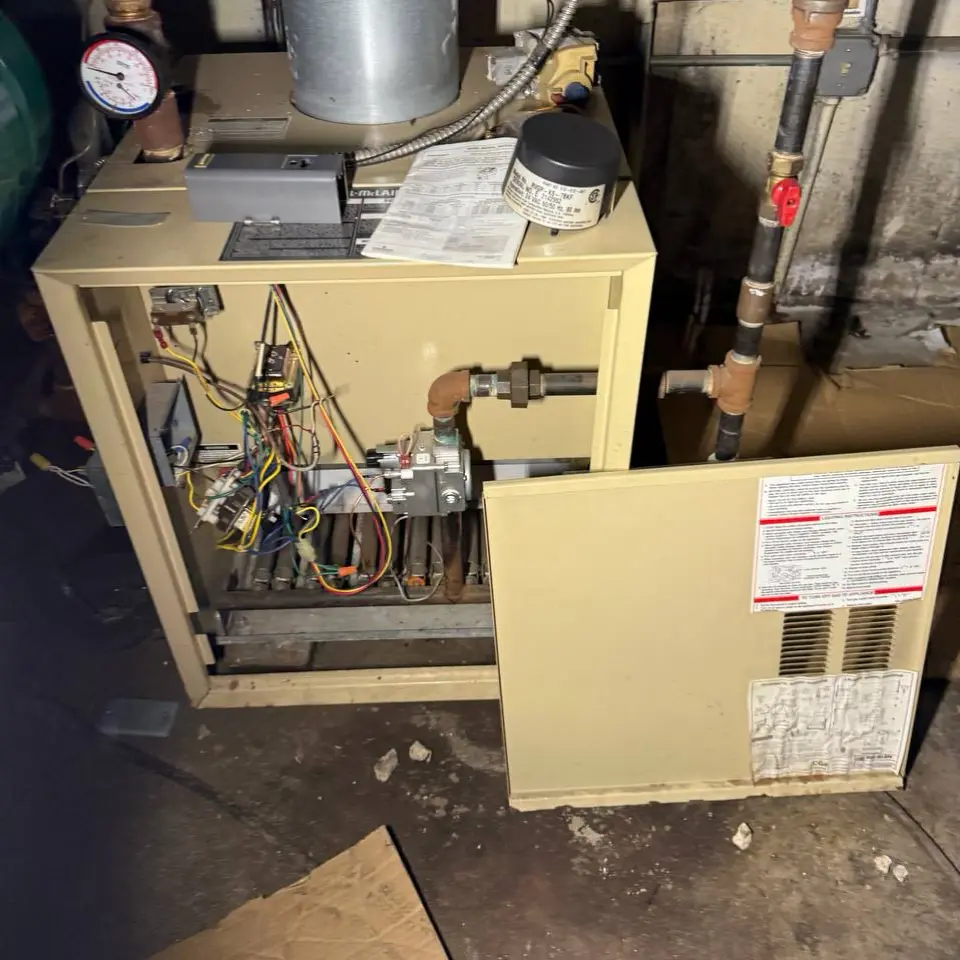
- Condensing furnace condensate issues (trap/tubing routing, intermittent backups, drain-related shutdowns)
Common condensate drain failures in NYC installs
- Tight mechanical closets where the drain line is sharply bent, kinked, or repeatedly disturbed
- Long horizontal runs through soffits that develop low spots and hold water/sludge
- Negative pressure air handlers where an incorrect or missing trap prevents consistent drainage
- Condensate pumps that run but do not move water due to a stuck check valve or blocked discharge
- Intermittent backups that only happen during high humidity days (the drain “almost” works until it can’t)
Symptom to Diagnosis Map
- Symptom: Water dripping from the air handler / fan coil cabinet
Likely cause class: Drain restriction or trap issue
How we confirm on-site: Inspect pan water level, test drain flow, check trap configuration and line pitch, verify no hidden low spots - Symptom: Ceiling stain below a soffit-mounted unit
Likely cause class: Slow intermittent backup in a concealed run
How we confirm on-site: Access available cleanouts/ends, flow test, check for sagging sections, verify sustained drainage while producing condensate - Symptom: System shuts off after running, then restarts later
Likely cause class: Float switch trip from rising pan water
How we confirm on-site: Inspect switch position/wiring, reproduce with condensate production, verify root cause is drainage not a faulty switch - Symptom: Condensate pump runs frequently but water still overflows
Likely cause class: Discharge restriction or failed check valve
How we confirm on-site: Measure actual pump discharge, inspect discharge line routing, test check valve behavior, verify flow to termination point - Symptom: Pump does not run and pan fills
Likely cause class: Power/control failure or failed float
How we confirm on-site: Verify outlet voltage, test float activation, confirm motor response, inspect for seized pump - Symptom: Gurgling sounds at the drain, inconsistent dripping
Likely cause class: Improper trap/venting behavior
How we confirm on-site: Evaluate trap geometry, negative pressure influence, confirm stable drain flow with blower running - Symptom: Water appears only when the system first starts
Likely cause class: Drain line holding water due to low spots
How we confirm on-site: Inspect pitch and supports, check for repeated sag points, verify drainage consistency across cycles - Symptom: “Water in pan” alarm persists even after clearing
Likely cause class: Float switch mispositioned or contaminated
How we confirm on-site: Clean/verify switch travel, check mounting height, confirm it resets only when pan is truly dry - Symptom: Unit leaks even though drain seems clear
Likely cause class: Coil icing melt-off or airflow issue causing excess water
How we confirm on-site: Inspect coil condition, airflow, filter status, temperature behavior, and verify whether icing is occurring - Symptom: Condensing furnace shuts down or shows drain-related fault behavior
Likely cause class: Furnace condensate trap/tubing restriction
How we confirm on-site: Inspect trap and tubing, verify consistent drain flow during heat call, confirm no backup into pressure switch system - Symptom: Water at the termination point backs up (sink tailpiece/standpipe area)
Likely cause class: Termination restriction or improper tie-in behavior
How we confirm on-site: Verify termination is accepting flow, check for backflow, confirm drain route is stable under peak condensate - Symptom: Repeated “temporary fixes” (works after a reset, fails again)
Likely cause class: Sludge buildup, biofilm, or poor slope causing re-clogging
How we confirm on-site: Inspect discharge water quality, identify low points, confirm long-run routing is corrected not just cleared
What we test on-site (diagnostics-first)
- Where the water is accumulating: primary pan, secondary pan, or a concealed section of the run
- Drain path integrity: trap presence/geometry, line pitch, hidden low spots, kinks, and termination behavior
- Flow under real conditions: not just “it drips,” but steady drainage while the system is actively condensing
- Pump performance (if present): float operation, pump start/stop, discharge flow, check valve function, discharge routing
- Safety behavior: float switch activation and whether it is reacting to water correctly
- Upstream causes: coil icing or airflow problems that overload the drain and mimic a “drain-only” failure
Example scenarios (NYC)
- Closet air handler leaks onto the floor → verified pan rising while running → found kinked tubing behind the unit → corrected routing and confirmed stable drainage through multiple cycles
- Soffit-mounted unit stains the ceiling below → confirmed intermittent backup during high humidity → found a sagging section creating a low spot → re-supported the run and verified sustained flow
- Condensate pump runs but water still overflows → confirmed little to no discharge at the termination → found blocked discharge/check valve behavior → cleared/replaced the failing section and verified reliable pump-out
- System shuts off after 20–40 minutes → float switch tripping due to slow drain → found incorrect trap behavior under blower operation → corrected trap configuration and confirmed no shutdowns under load
What we service / what we don’t
What we service
- Condensate drain issues for air handlers, fan coils, ducted mini-split air handlers, and typical residential HVAC indoor units
- Condensate pump diagnosis and repair
- Condensing furnace condensate drain and trap-related issues (when present)
What we don’t
- Full system replacement or new-system installation as the primary scope
- Mold remediation, ceiling repair, or restoration work
- Major plumbing re-pipes unrelated to the HVAC condensate path
NYC-specific constraints that matter for condensate drains
- Many indoor units sit in tight closets/soffits where access is limited and routing is prone to kinks and low spots
- Drain lines often run through finished areas; intermittent leaks can affect neighbors and building management requires fast containment
- Buildings may require documentation and clear access plans; request a COI if management asks
- Scheduling may need coordination with doormen, elevator rules, and access panels
Before You Call (Safe, High-Value Checks)
Stop and schedule service if you have active ceiling leakage, water near electrical components, burning smell, or repeated breaker trips.
- Turn the system off at the thermostat if water is actively overflowing
- If safe to access, check whether the air filter is severely clogged (restricted airflow can contribute to coil icing and heavy water melt-off)
- Look for obvious drain tubing kinks or a disconnected hose near the indoor unit
- If there is a condensate pump, confirm it has power and is plugged into a working outlet
- Do not keep resetting the system repeatedly if it keeps shutting off; that can mask useful diagnostic behavior
- If you can see the drain termination, note whether water ever exits while the system runs
- Take photos of where the leak appears and the indoor unit setup for faster triage
How service typically works
- Quick pre-check by phone/text: what’s leaking, where it shows up, unit type, and whether a pump is present
- On-site diagnostics: confirm where water is accumulating and why the drain path is failing
- Repair path: clear/re-route/repair the drain or pump issue, with a defined verification plan
- Verification: confirm stable drainage while producing condensate and after cycling
- Close-out notes: what failed, what was corrected, and what to watch for
What to send for faster scheduling
- Photo of the indoor unit (closet/soffit/mechanical space)
- Photo of the leak location (floor, ceiling stain, cabinet base, etc.)
- Photo of the drain tubing and/or condensate pump if present
- Any displayed fault code or alarm message
- Whether the issue happens only on very humid days or every time it runs
Schedule condensate drain repair (NYC)
Call +1 (332) 333-1709 or email voltnvector@gmail.com to book service in Brooklyn, Manhattan below 96th St, or selected Queens ZIP codes.
1. Schedule your visit
2. On-site diagnostic
3. Approve & repair
4. Done & covered
COI (Certificate of Insurance)
Available on request - usually not required in Brooklyn, but often asked for in Manhattan buildings and co-ops. Please remember that certain issues can come from incorrect use or installation, not from parts failure - our technicians will always point that out and show how to prevent it in the future.
Warranty & Compliance
Every repair is covered by a 180-day warranty on both parts and labor. If the appliance is older, keep in mind that some surrounding components can wear out over time — sometimes one repair leads to another part showing its age. We always explain options clearly before doing extra work.
Safety & Courtesy Protocol
We treat every visit like we’re guests in your home. Technicians wear shoe covers or remove footwear when entering, and we always clean up after the job. If you notice a little dust or debris left behind - our apologies - each tech handles 3-5 appointments per day and works to stay on schedule. If your window was 11-1, the technician usually arrives closer to 11; if running late, we’ll text you right away. Our goal is simple: work clean, stay safe, and respect your space and time.
Coverage
We cover Brooklyn—Downtown, Brooklyn Heights, Park Slope, Williamsburg, Greenpoint, Bed-Stuy, Carroll Gardens, Prospect Heights, and Flatbush—and Manhattan (below 96th Street)-FiDi, Battery Park, Tribeca, SoHo, Chelsea, Midtown, UES, UWS, Gramercy, and the Village. You’ll receive a text alert ~30 minutes before arrival.
Why Volt & Vector
We’ve spent years working inside large NYC repair companies - seeing how real technicians get buried under rushed schedules, fake “same-day” promises, and endless call-center noise. Volt & Vector grew out of that frustration. We wanted a place where diagnostics still matter, where techs can take time to do the job right and talk to people directly. We’re not calling ourselves perfect - far from it - but we’re building the kind of service we always wanted to work for: respectful, transparent, and run by people who actually fix things.
Pricing & Diagnostic Policy
Our diagnostic visit is always billed at the first appointment - that’s the starting point for every repair. After the visit, the technician sends full details to our service desk. Sometimes the tech can give a price range on-site, but we’re moving away from instant quotes - parts pricing changes like crypto these days, and we’d rather stay accurate than promise the wrong number.
Minor issues are often resolved on the first visit. If parts are required, we price the repair after confirming the root cause and matching the correct parts to your exact model. You get the findings and the estimate first. No surprises, no work begins without approval. The $99 diagnostic is credited toward an approved repair.
HVAC
Air Conditioner Repair in NYC
Read More

Diagnostics first service for ductless mini splits, split systems, and central AC, using measured temps, airflow, and control checks to isolate refrigeration, electrical, or airflow failures before recommending parts.
Condensate Drain Repair in NYC
Read More

Diagnostics first drain and leak resolution by tracing the full condensate path, clearing blockages or pump faults, correcting pitch or trap issues, and confirming no overflow or shutoff under real humidity load.
Thermostat Repair NYC
Read More

Diagnostics first thermostat and low voltage control troubleshooting by verifying wiring, power, configuration, and command signals, then tracing failures to the thermostat, control board, safeties, or outdoor unit enable.
Air Handler Repair in NYC
Read More

Diagnostics first airflow and air handler repair by testing blower performance, coils, drainage safeties, and controls, then verifying stable temperature split, amp draw, and condensate management.
Heat Pump Repair NYC
Read More

Diagnostics first heat pump troubleshooting by validating mode logic, reversing valve and defrost behavior, sensors, airflow, and inverter communications, then confirming stable operation in both heating and cooling.
Common problems
Common condensate drain problems (what you see, and what it usually means):
- Water dripping from the air handler/fan coil cabinet
- Primary drain clogged, drain pan overflowing, cracked pan, or failed internal connection at the drain stub
- Water pooling on the floor or in the ceiling below the unit
- Drain line blockage, sagging/incorrectly pitched line, disconnected line, or poor trap design causing slow/no drainage
- Condensate pump running constantly or cycling every few minutes
- Partially blocked drain, pump check valve sticking, kinked discharge line, or pump failing to move water efficiently
- Condensate pump not turning on (or hums but doesn’t move water)
- Failed pump motor, stuck float, power issue, or seized impeller; often leads to overflow or a float safety shutdown
- System shuts off “randomly,” then comes back later
- Float switch tripping due to rising water in the pan; clears temporarily as water drains slowly or evaporates
- Musty / sour odor when the system runs
- Biofilm/algae growth in the drain pan or line; stagnant water in a low spot; dirty coil feeding the problem
- Visible slime, black buildup, or “gunk” at the drain outlet
- Bio-growth and debris accumulation; common with long run times and high humidity
- Gurgling or bubbling noise at the drain / near the air handler
- Missing/incorrect trap, trap not primed, negative pressure pulling air through the line, or venting issues
- Water backs up into a secondary pan or overflow line starts dripping
- Primary drain restricted; secondary protection is doing its job and needs immediate service
- Drain clogs repeatedly even after cleaning
- Poor slope, too many elbows, undersized line, no cleanout access, chronic bio-growth source (dirty coil/pan), or construction debris in the line
- Rust stains around the pan or along the cabinet seam
- Long-term overflow, standing water, or a pan that’s deteriorating/corroding
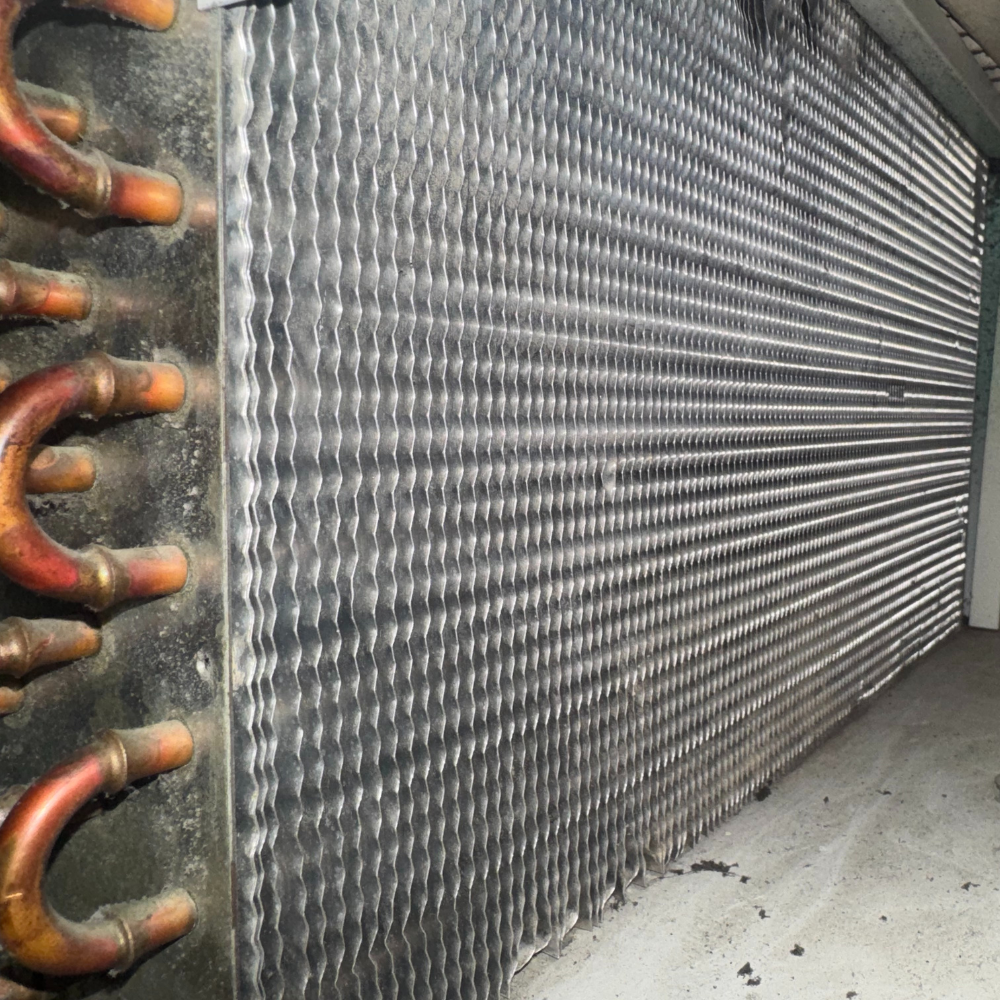
- Ice on the indoor coil followed by a sudden “flood” when it melts
- Often an airflow/refrigerant-side problem causing freeze-up; the melt overwhelms a marginal drain or pan
- Water leaking only in very humid weather or during long cooling runs
- Drain is marginal (slow), trap/venting not correct, or pan is partially restricted and can’t keep up at peak load


.avif)