


.avif)
Common Air Handler and Fan Coil Cleaning Requests
- Loaded filter or dusty grille: Confirm the correct filter type, fit, and accessible return condition before deeper cleaning.
- Gradual airflow decline: Visible buildup on the filter, blower, or coil may support cleaning, but a motor, control, return, or duct fault remains possible.
- Startup odor: Document the timing and visible moisture or debris without assuming mold or making a health claim.
- Cabinet or drain-pan debris: Cleaning can address accessible buildup; recurring standing water or overflow needs condensate drain repair.
- Pre-season indoor-unit cleaning: Address accessible filters, coil and blower areas, cabinet debris, and drain-pan condition before heavy use. Use HVAC maintenance in NYC for a whole-system scheduled check.
- Cleaning reveals an operating fault: A no-start, unstable blower, control failure, repeated shutdown, or mechanical noise needs air handler repair.
Air Handler and Fan Coil Cleaning in NYC
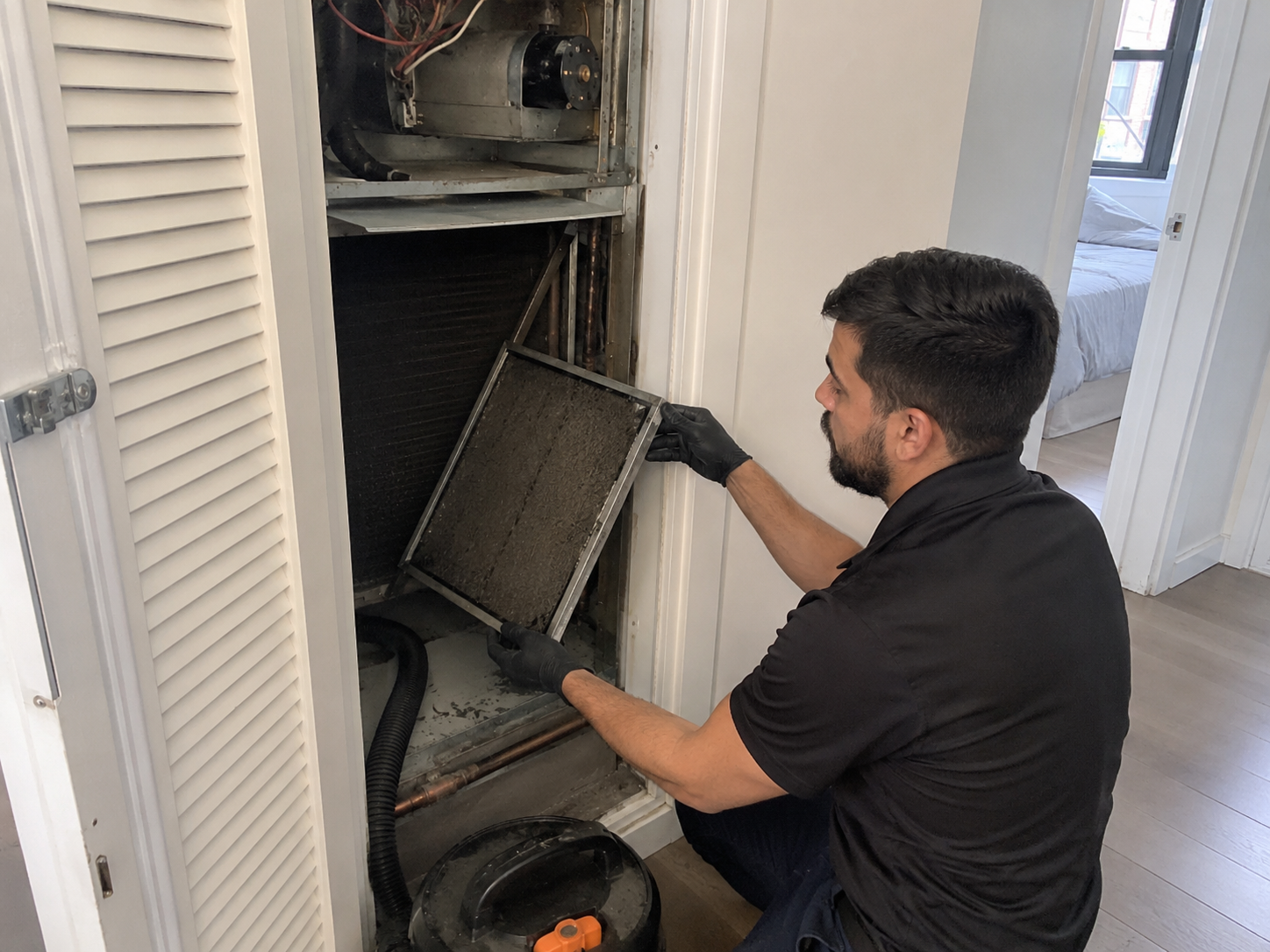
This service is for an air handler or fan coil that still operates but shows a visible contamination or cleaning problem: a loaded filter, visible dust, buildup on accessible equipment surfaces, stale odor when the fan starts, reduced airflow, or debris around the drain pan. The goal is to identify the equipment, confirm safe access, and clean the components included in the service.
If the blower will not run, the unit repeatedly shuts down, the controller does not produce a response, or there is scraping or electrical odor, use air handler repair. For a wall-mounted ductless head, choose mini-split cleaning. This service does not include whole-system duct cleaning.
When cleaning is the right request
- The unit runs but the filter or grille is visibly loaded: Send a photo of the filter location and note whether the filter is reusable or disposable if the label is visible.
- Airflow has declined gradually: Filter loading, blower-wheel buildup, coil-face debris, or a blocked return may contribute. Cleaning is appropriate when contamination is visible or maintenance is overdue, but it cannot confirm that buildup is the only cause.
- Dust or debris is visible inside an accessible cabinet: The equipment type and access panel must be confirmed before any cleaning is planned.
- Odor appears when the fan starts: Record when the odor begins and whether visible moisture or debris is present. Cleaning can address accessible contamination, but odor alone does not prove mold or establish a health claim.
- The drain pan area is dirty: Debris or staining can be documented during maintenance. Active overflow, a failed pump, recurring standing water, or water reaching finished areas requires a drainage diagnosis.
- Pre-season indoor-unit cleaning: Before heavy use, cleaning can address accessible filters, coil and blower areas, cabinet debris, and drain-pan condition. For a whole-system scheduled check, use HVAC maintenance in NYC.
What the cleaning visit can include
The exact work depends on the model, equipment type, contamination level, and safe access. After those are confirmed, the visit may include the filter and filter fit, return grille, accessible coil surfaces, blower wheel or housing, cabinet debris, drain-pan condition, visible condensate path, and a post-cleaning operating check. Components hidden behind building-controlled panels, finished ceilings, or custom millwork are not automatically accessible.
Cleaning should follow the equipment rather than a generic checklist. A ducted air handler, a hydronic fan coil, a ceiling fan coil, and a wall-mounted mini split do not have the same panels, drainage, controls, or cleaning limits. Photos and a model label are more useful than guessing the equipment name.
When cleaning is not enough
Choose cleaning when visible contamination is the main concern and the unit still operates. Choose repair when the blower will not start, its speed is unstable, the unit repeatedly trips or shuts down, a control fails, or there is mechanical scraping. If weak airflow remains after the filter, grilles, and accessible equipment surfaces are addressed, the next step is diagnostic air handler repair, not repeated cleaning.
If water is actively collecting or overflowing, use condensate drain repair. If the unit and blower run but the full system does not cool, use air conditioner repair. Those problems require different diagnostic checks.
NYC fan coil and building-access boundaries
Some apartment fan coils connect to building-provided hot or chilled water. Cleaning accessible filters, coils, blower areas, cabinets, and pans cannot correct a building-loop supply problem, a failed hydronic valve, or a control fault. A superintendent, property manager, or building engineer may need to confirm loop operation or provide access.
Units may be inside closets, soffits, ceiling cavities, under-window cabinets, or finished millwork. Send a wide photo before the visit and say whether a doorman, service elevator, building staff, or Certificate of Insurance is involved. Do not force open a grille, ceiling panel, valve enclosure, or built-in cabinet.
What this service does not cover
- Whole-building duct cleaning or a claim that routine duct cleaning improves health.
- Fogging fragrance, disinfectant, ozone, or an unapproved chemical into the unit or air path.
- Electrical testing, motor or control-board repair, refrigerant work, or hydronic valve repair as part of a basic cleaning.
- Building-loop balancing, shared mechanical-room work, or panels that building staff has not made accessible.
- Removal of wet or damaged insulation unless the material and removal method are reviewed separately.
For the practical difference between these services, see duct cleaning versus air handler cleaning.
Safe preparation before the visit
- Photograph the full unit, grille or cabinet, filter area if safely visible, thermostat or controller, and any dust, staining, or water.
- Clear movable furniture and storage from the access path without touching the equipment.
- Do not remove ceiling panels, electrical covers, blower guards, custom trim, or building-controlled access panels.
- Do not spray cleaner, disinfectant, fragrance, or water into the return, grille, coil, or cabinet.
- Do not reach into the blower area or try to scrape debris from coil fins.
Switch from cleaning to repair when
- The fan does not start or cannot maintain a steady speed.
- A breaker trips, the thermostat or controller goes blank, or the unit repeatedly shuts down.
- There is burning or electrical odor, smoke, unusual heat, or metal-on-metal noise.
- Ice is visible or water is actively leaking toward wiring, a ceiling, finished surfaces, or another apartment.
- Heating or cooling is absent because a building water loop, hydronic valve, refrigerant circuit, or control is not operating.
What to send when booking
- The equipment location: closet, ceiling, soffit, under-window cabinet, mechanical room, or another enclosure.
- The main concern: visible dust, a loaded filter, gradual airflow decline, startup odor, cabinet debris, drain-pan condition, or pre-season indoor-unit cleaning.
- The model label and filter label if each is safely visible.
- Photos of access, nearby finishes, and any water or staining.
- Building access and COI requirements.
For a broader scheduled system check, see HVAC maintenance in NYC. You can also review the NYC HVAC service hub or request service.
Quick answers
Is air handler cleaning the same as duct cleaning?
No. This service focuses on the indoor equipment and accessible components. It does not automatically include supply and return ductwork throughout the building.
Can cleaning fix weak airflow?
It can help when a loaded filter or buildup on accessible blower or coil surfaces is restricting airflow. Weak airflow can also come from a motor, speed command, duct, return, control, or building-system problem.
Does cleaning include hydronic valve repair?
No. A valve, actuator, controller, or building hot- or chilled-water problem is not included in basic cleaning.
Can a ceiling fan coil be cleaned?
Only after safe access is confirmed. Do not remove a ceiling panel or finished enclosure yourself; send photos and identify who controls access.
