


.avif)
Mini Split Cleaning Requests: Cleaning or Repair?
- Visible dust and reduced airflow: cleaning fits when the head still operates and buildup is visible at the filter, louver, coil face, or blower opening. A failed fan motor or control cannot be confirmed from dust alone.
- Stale odor when the fan starts: record the mode and timing, then inspect accessible filters, the indoor head, and drainage condition. Cleaning can address visible residue, but it should not be presented as a medical, mold-remediation, or air-purification service.
- Water below the indoor head: stop treating the issue as routine cleaning if leaking is active or recurring. Drain routing, pitch, pump operation, ice melt, or a damaged fitting may need condensate repair.
- Ice or no cooling: a dirty air path may contribute, but heavy ice or failed cooling needs diagnosis. Turn the unit off if operation is unsafe and do not chip or heat the ice.
- Debris around the outdoor unit: accessible leaves and obstructions can be addressed only when the unit is safely reachable. Roof or setback access must be coordinated with the building; the customer should not climb or enter restricted areas.
- Error code, burning odor, or repeated breaker trip: these are repair and safety signals, not cleaning symptoms. Record the code or light pattern, stop repeated resets, and request diagnostic service.
Mini Split Cleaning in NYC
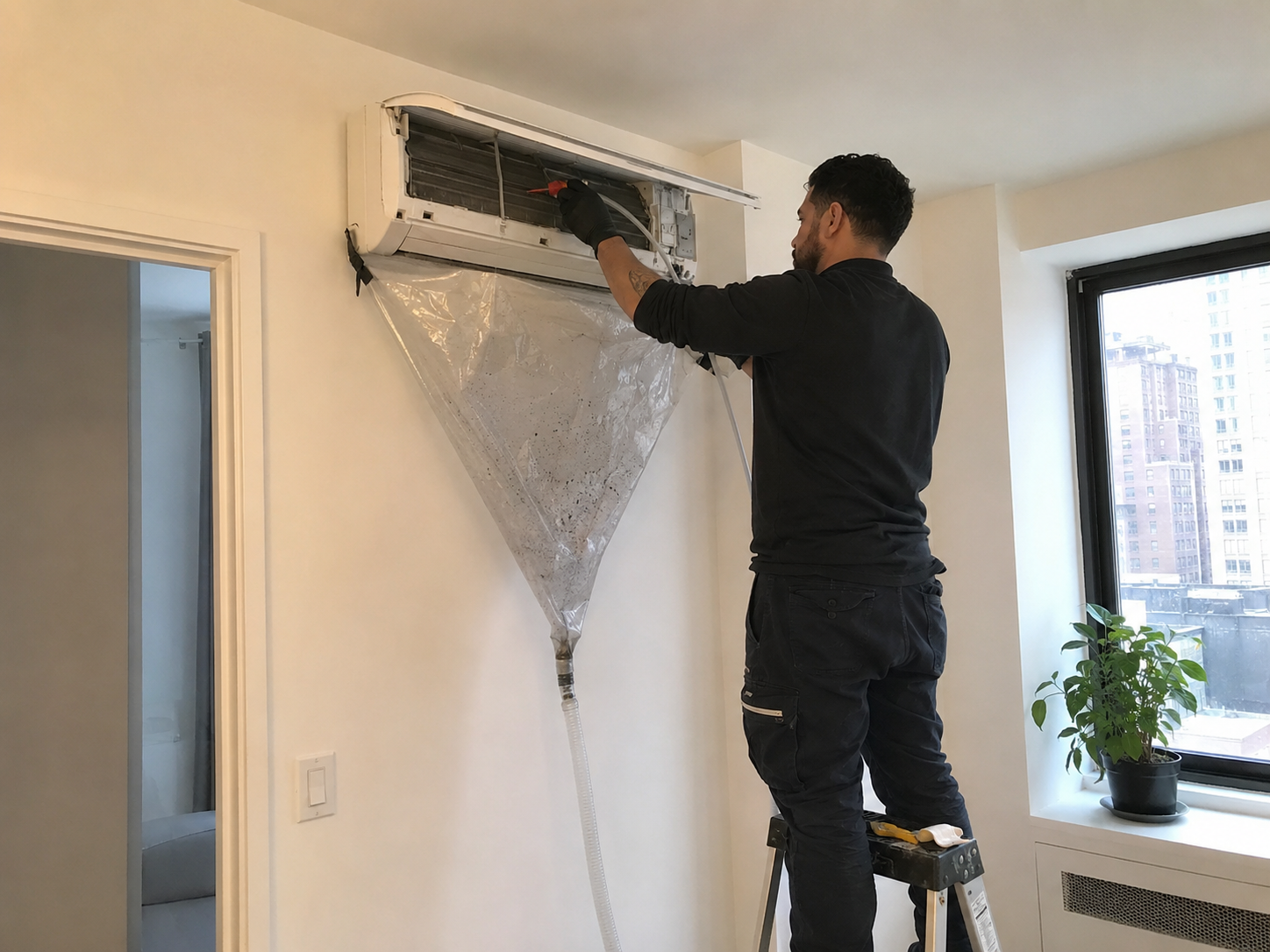
Mini split cleaning is the focused service for accessible ductless indoor heads and, when access permits, the connected outdoor unit. It fits a system that still operates but has visible dust, reduced airflow, stale odor, dirty filters, or a known cleaning need. The goal is to remove accessible buildup, protect the surrounding area, observe operation, and identify conditions that need repair instead of presenting cleaning as a cure for every heating or cooling problem.
A cleaning-only request is usually not the right starting point when the unit will not turn on, shows an error code, repeatedly trips a breaker, has heavy ice, leaks near wiring, or cannot heat or cool. Those symptoms may exist alongside dirt, but they need diagnosis. Separating cleaning from repair prevents a customer from booking the wrong scope.
What mini split cleaning can include
The exact method depends on the brand, model, indoor-head style, maintenance history, and safe access. Wall-mounted heads, ceiling cassettes, floor units, and multi-head systems do not have identical covers, filters, blower access, or drain arrangements. Before work begins, the scope should identify which components are accessible and whether the surrounding wall, floor, furniture, and electronics can be protected.
- Indoor cover and air outlet: visible dust on the cover, louvers, and accessible air path can be removed without forcing model-specific parts.
- Filters: reusable filters can be cleaned only according to the equipment instructions; damaged or disposable filters need the correct replacement path.
- Indoor coil and blower area: the technician can assess visible buildup and determine the cleaning depth that the unit design and access allow.
- Drain pan and visible condensate path: accessible residue and drainage condition can be reviewed, but a hidden blockage, failed pump, damaged pan, or poor drain pitch is a repair issue.
- Outdoor unit: when the condenser is safely reachable, the visit can include condition review and removal of accessible debris that blocks intake or discharge airflow. Roof, setback, and building-controlled access must be arranged in advance.
- Function check: after the cleaning scope is completed, basic airflow, startup response, unusual noise, and visible drainage can be observed in the mode available at the visit.
The phrase “deep cleaning” does not describe one universal procedure. Some indoor heads allow practical access to the blower wheel and coil; others require more disassembly or manufacturer-specific steps. Photos of the exact head and model label are needed before promising cleaning depth. Cleaning one component also does not authorize electrical work, refrigerant work, control-board testing, or replacement of a failed part.
When visible symptoms point to cleaning
Reduced airflow with a visibly loaded filter or dusty blower opening supports a cleaning request, especially when the unit still reaches the setpoint and has no fault message. The filter cleaning versus deep cleaning guide helps separate a homeowner-safe filter check from a service visit that requires deeper access.
A stale or musty odor can also justify an inspection and cleaning request when it appears as the indoor fan starts. The useful evidence is when the odor occurs, whether visible buildup is present, and whether water is draining normally. Cleaning should address observable equipment condition, not make unsupported mold-removal, health, or air-purification claims. See the mini split odor guide for details worth recording.
Where cleaning stops and repair begins
Water under the indoor head is not automatically a cleaning problem. Dirt in an accessible pan or drain area may contribute, but a blocked line, poor pitch, failed pump, damaged fitting, frozen coil, or installation condition can produce the same visible symptom. For an active or recurring leak, use condensate drain repair and record the leak pattern with the indoor mini split leak guide.
A unit that runs but does not cool may have restricted airflow, but it can also have an outdoor-unit, sensor, control, communication, or refrigerant-side fault. Start with the safe no-cooling checks. If cooling is the failed function, choose air conditioner repair. If a ductless heat pump is weak in heating mode, fails in both modes, or has defrost or outdoor-unit trouble, use heat pump repair.
Heavy ice, a burning odor, smoke, repeated breaker trips, water near electrical parts, severe mechanical noise, or a nonresponsive unit should not be booked as cleaning-only work. Stop using the equipment if it is safe to do so, record the displayed code or light pattern, and request diagnostic guidance. Do not melt ice with tools or heat, keep resetting the breaker, spray chemicals through the louvers, or open electrical compartments.
Safe information to collect before service
- Send a straight-on photo of every indoor head included in the request.
- Photograph visible dust, staining, water, or ice without removing service covers.
- Send the model label and controller or remote display when safely reachable.
- Note which operating mode produces the odor, weak airflow, noise, leak, or performance change.
- State how many indoor heads connect to the system and whether all heads have the same symptom.
- Photograph the outdoor unit only from a safe, permitted location.
A homeowner can inspect or clean an accessible filter only when the equipment instructions permit it and the normal access panel opens without force. Do not move a heavy indoor unit, use a ladder where footing is unsafe, reach through a moving fan, enter a roof or mechanical space without permission, or apply household cleaners inside the head.
NYC apartment and building access
Mini split cleaning in NYC often requires more preparation than the equipment photo suggests. A head may be above a bed, television, stone counter, built-in cabinet, artwork, or finished floor that needs protection. Ceiling cassettes may require safe working height and more clearance. Outdoor units may sit on balconies, roofs, setbacks, or rear extensions controlled by building management.
Send building access rules before scheduling, including any Certificate of Insurance requirement, approved work hours, freight-elevator instructions, roof or balcony permission, and restrictions on water handling. For multi-head systems, send a photo of each head rather than assuming every zone needs the same cleaning depth. Room use, pets, renovation dust, kitchen proximity, and run time can leave one unit much dirtier than another.
Mini split cleaning versus whole-system maintenance
Mini split cleaning covers ductless heads and accessible outdoor equipment. It does not replace a scheduled review of the connected system. If the request covers several equipment types, seasonal operating checks, controls, drainage, and overall condition, use HVAC maintenance in NYC. If the indoor equipment is a closet unit, ducted air handler, or fan coil cabinet rather than a ductless head, use air handler and fan coil cleaning.
What to expect from the visit
The visit should begin by confirming the included heads, symptoms, access, and agreed cleaning depth. The technician protects the work area, cleans the accessible components in scope, and then checks basic response, airflow, noise, and visible drainage. The closeout should state what was cleaned, what could not be accessed, whether the outdoor unit was included, and whether a repair condition was observed.
Cleaning can restore an obstructed air path or remove visible buildup, but it cannot guarantee that an electrical, refrigerant, control, installation, or component fault is absent. Any repair beyond cleaning should be explained and separately approved before repair work begins.
Choose the right next step
Use NYC HVAC repair for an active system failure, or browse the NYC HVAC service hub to compare service paths. When the unit photos, symptoms, head count, and access notes are ready, request a mini split service visit.
