


.avif)
Maintenance Findings That Change the Next Step
- Weak airflow across the system: accessible filters, returns, supply openings, blower condition, and visible coil condition belong in the maintenance review. If the complaint centers on a closet unit or fan coil, the apartment air-handler airflow guide explains what to record before service.
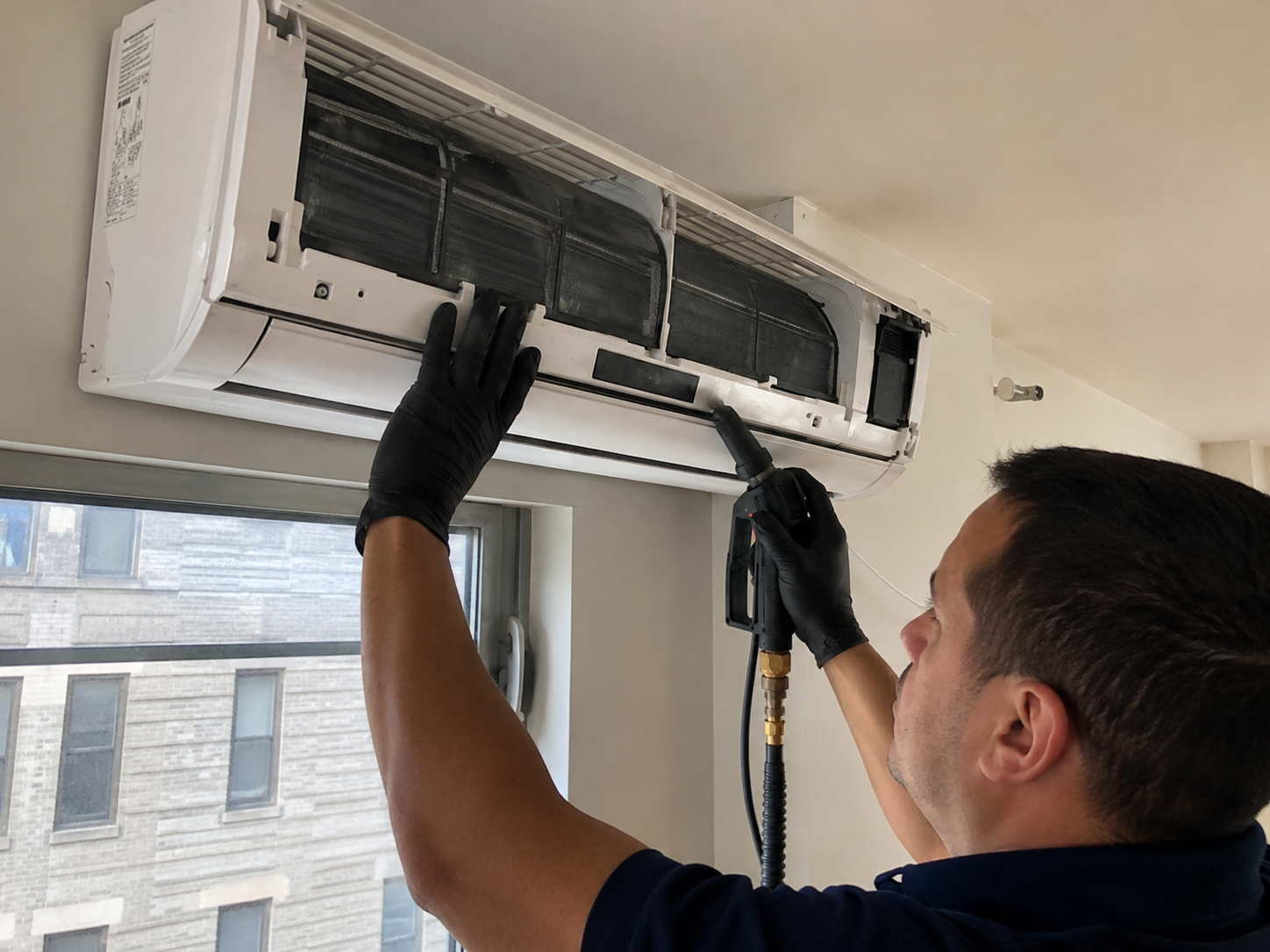
- One dirty ductless head: visible buildup, stale odor, or reduced airflow at a wall-mounted head is usually a focused cleaning request rather than a whole-system maintenance complaint. Compare filter cleaning with deeper mini-split cleaning.
- Water, staining, or a full drain pan: maintenance can document accessible residue and drainage condition, but active leaking, a pump or float-switch problem, or recurring overflow needs condensate diagnosis.
- Wrong temperature or unexpected cycling: confirm mode, setpoint, schedule, and controller response. A blank or unresponsive thermostat follows the thermostat repair path rather than routine maintenance.
- No cooling, no heat, heavy ice, or an error code: these symptoms require diagnostic repair even when the system also looks dirty. Cleaning may improve an obstructed air path, but it does not prove the cause of a performance failure.
- Burning odor, smoke, water near wiring, or repeated breaker trips: stop using the system if it is safe to do so and request repair guidance. Do not keep resetting the breaker or open energized equipment.
HVAC Maintenance in NYC
HVAC maintenance is the scheduled, system-wide visit for equipment that is operating but needs inspection, accessible cleaning, and a clear condition review. It is broader than cleaning one indoor unit. The visit should look at how the system starts, runs, moves air, manages condensate, responds to its controls, and whether any visible condition needs a separate repair visit.
Maintenance is the right starting point before heavy cooling or heating use, after a long idle period, or when the service history is unclear. It is not the right label for a system that will not start, repeatedly trips a breaker, shows an error code, has heavy ice, leaks near electrical components, or produces a burning smell. Those are repair or safety symptoms, not routine maintenance.
What an HVAC maintenance visit can cover
The exact checklist depends on the equipment type, model instructions, season, and safe access. A mini split, heat pump, air handler, fan coil, and central air system do not all open or drain the same way. The visit begins by identifying the equipment and the customer's concern, then checking the accessible parts that affect operation.
- Service history and operating complaint: record what changed, when it happens, which modes are affected, and whether the problem is limited to one room or one indoor unit.
- Air path: review accessible filters, return and supply openings, louvers, blower-area condition, and visible coil buildup without assuming that dirt is the only cause of weak airflow.
- Indoor and outdoor condition: check accessible indoor and outdoor components for debris, blocked airflow, staining, corrosion, unusual vibration, or other conditions that change the needed work.
- Condensate management: look for pan residue, staining, drain or pump concerns, and signs that water is not leaving the equipment as intended.
- Controls and operation: confirm the thermostat or controller settings and observe whether the system starts, operates, and shuts down normally in the available mode.
- Findings: separate maintenance work from cleaning, installation conditions, building-side limitations, and component failures that require diagnostic repair.
Filter care is part of maintenance, but there is no useful universal replacement interval for every NYC system. Filter type, equipment design, operating hours, pets, renovation dust, and manufacturer instructions all matter. A filter that is visibly loaded or damaged should be addressed with the correct reusable-cleaning or replacement method for that system; installing an arbitrary filter can create fit or airflow problems.
Maintenance, cleaning, and repair are different services
Scheduled maintenance reviews the connected system as a whole. Focused cleaning covers a narrower physical scope. If a wall-mounted ductless head has visible buildup, stale odor, or reduced airflow, see mini split cleaning in NYC. If the indoor equipment is a closet air handler, ceiling unit, or fan coil cabinet, see air handler and fan coil cleaning.
When water is the main complaint, begin with drainage rather than routine maintenance. A maintenance visit may identify residue or a dirty accessible pan, but an active overflow, recurring shutdown, failed pump, damaged pan, poor pitch, or hidden blockage belongs under condensate drain repair. If the thermostat is blank, loses power, reads incorrectly, or does not command the equipment as expected, use the thermostat repair path.
Cleaning also cannot confirm a refrigerant, compressor, inverter, motor, electrical, or communication failure. A cooling system that does not run or still cannot cool after the air path is addressed needs air conditioner repair. A heat pump with weak heating, mode-specific failure, defrost trouble, or an outdoor-unit fault needs heat pump repair.
NYC apartment and building access
In New York City, service scope depends on access as much as equipment type. An indoor unit may be above finished cabinetry, inside a narrow closet, behind a fan coil cover, or mounted in a ceiling. The outdoor unit may be on a balcony, roof, setback, rear yard, or building-controlled mechanical area. Building permission, a Certificate of Insurance requirement, freight-elevator rules, work-hour limits, and water-handling restrictions can determine what is safely reachable during the visit.
Before scheduling, send the system type, number of indoor units, main symptom, service address, access notes, and photos of the thermostat or controller, each accessible indoor unit, and the model label when it can be photographed without moving equipment. If outdoor access is controlled by the building, state who authorizes it. This prevents a scheduled maintenance visit from arriving without the access needed to inspect the connected system.
Safe checks before the visit
- Confirm the thermostat or controller mode, setpoint, and any displayed message.
- Note whether the concern occurs in heating, cooling, fan, or every mode.
- Photograph visible dust, water, ice, staining, or a blocked air opening.
- Check only an accessible filter when the model instructions allow it and the panel opens normally.
- Keep furniture and stored items away from accessible indoor equipment when it is safe to do so.
Do not remove electrical covers, force service panels, attach refrigerant gauges, spray chemicals into the equipment, climb to a roof, enter a restricted mechanical room, or keep resetting a tripped breaker. If there is smoke, a burning odor, water near wiring, exposed electrical damage, or repeated breaker trips, stop operating the system if that can be done safely and request repair guidance.
What happens during and after maintenance
The technician should verify the equipment identity, review the reported condition, inspect the accessible maintenance points, complete only the cleaning or adjustment that fits the agreed scope, and observe system response. The result should explain what was serviced, what could not be accessed, what condition remains, and whether a separate diagnostic or repair visit is needed. Any repair outside the maintenance scope should be explained and separately approved before that work begins.
Maintenance cannot guarantee that an aging component will not fail later. Its practical value is a documented condition review before peak use and a clearer distinction between normal care, a cleaning need, an access or installation issue, and an active failure.
Choose the right HVAC service
Use NYC HVAC repair when the main concern is a current heating, cooling, electrical, water, or control failure. Browse the NYC HVAC service hub when you need to compare the available HVAC services. When the equipment, symptoms, and access details are ready, request a diagnostic or maintenance visit.
