.avif)
Wolf Ranges Through the Years: What Changed and What Actually Breaks
How Wolf ranges evolved from early residential models to R, GR, legacy Dual Fuel, and DF50—and what each generation’s architecture means as it ages.
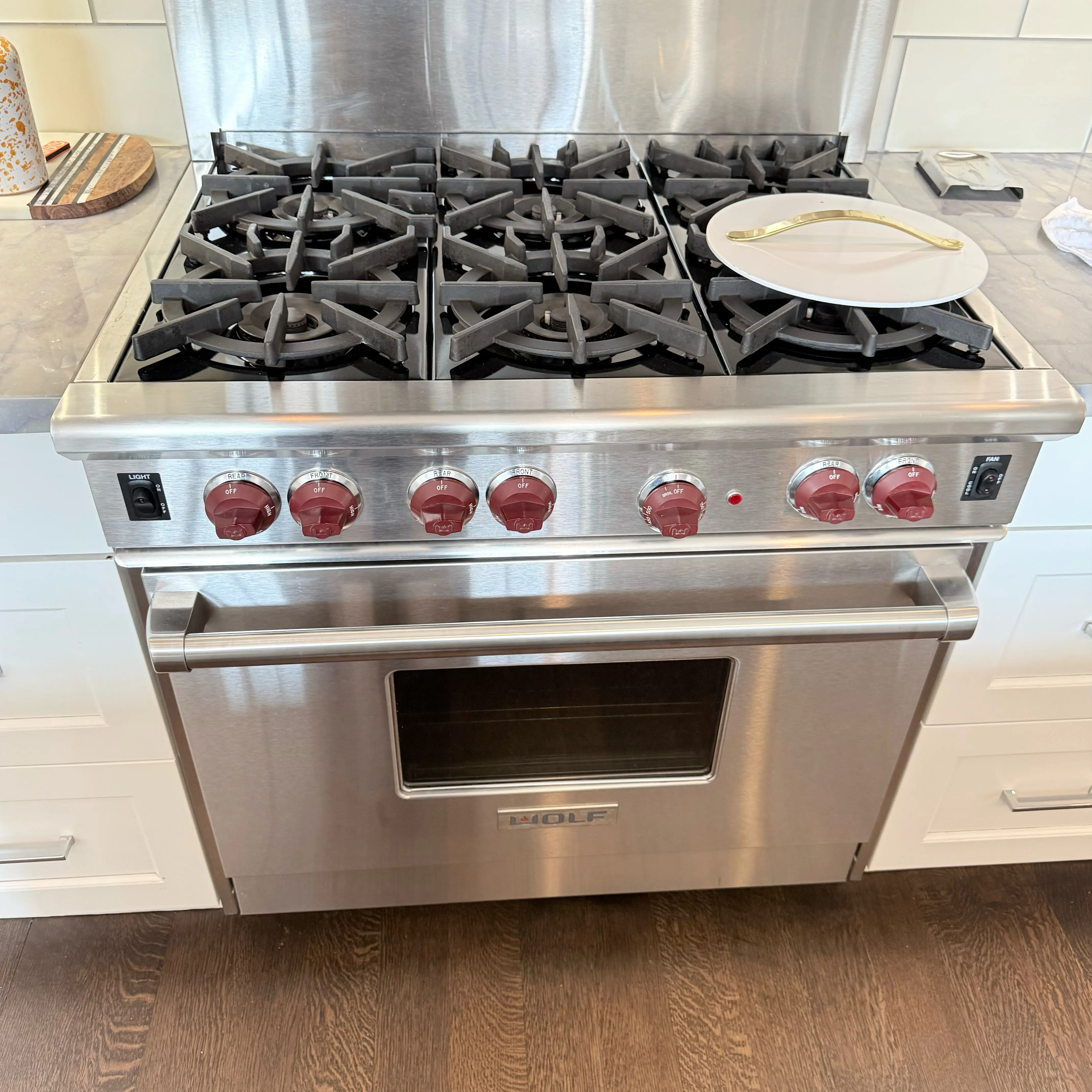
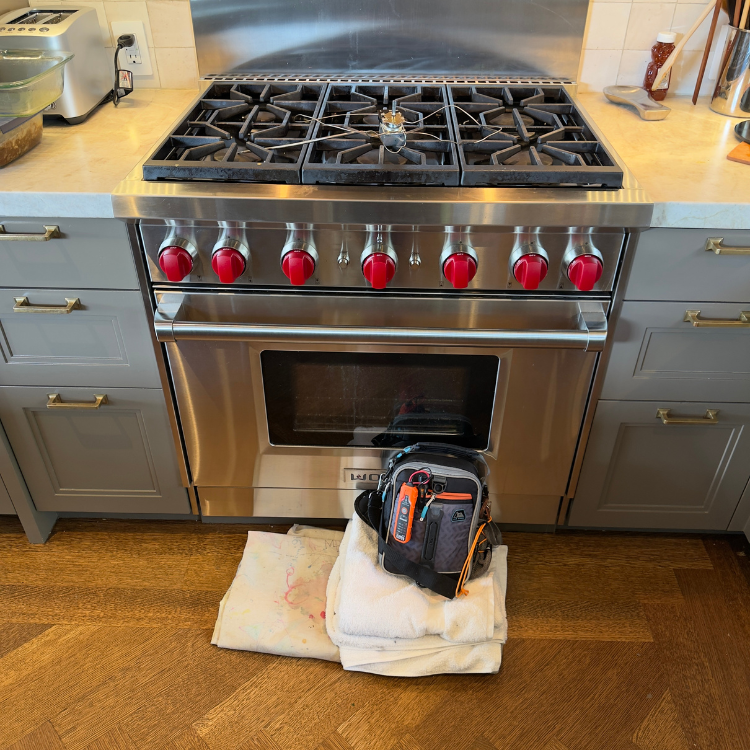
A Wolf range from 2003 and a Wolf range from 2025 may share the same stainless-steel presence, heavy knobs, and red branding, but mechanically they belong to different eras. Wolf did not simply make one great range for decades. The company moved from commercial-rooted residential machines to open-burner gas ranges, sophisticated dual-fuel platforms, sealed-burner gas models, and finally connected ranges with touchscreens and software. That distinction matters because the strengths, weaknesses, and aging patterns of each generation are different.
The Wolf Name Does Not Describe One Machine
Wolf’s reputation began in commercial kitchens, but an old Wolf installed in a home is not automatically the same product as a restaurant range. Wolf still treats commercial and residential equipment as separate product families. One quick visual distinction is the door: commercial ranges generally have solid doors, while residential models use glass. Very old residential products may also have a red wolf-head logo, while later products use a black logo and follow a different support path.
The modern residential Wolf story changed decisively in 2000, when Sub-Zero acquired the residential side of the Wolf brand. According to the company’s official history, the commercial heritage remained central to Wolf’s identity, but the residential cooking line began developing as part of Sub-Zero Group rather than as an extension of the commercial-equipment company.
That is why “old Wolf” is too broad a description. It can mean a pre-1997 residential product, a commercial unit placed in a home, a brief acquisition-era model, an R Series gas range, or an early Dual Fuel range. Those appliances may look related while sharing surprisingly little underneath the cooktop.
2000–2001: The Transitional Wolf Years
The first years after the acquisition produced several short-lived model families, including A, AS, B, P, PS, and S Series ranges. Some were manufactured for only one or two years. For example, Wolf’s official AS Series timeline places those models in 2000–2001, immediately before the longer-running R and Dual Fuel platforms appeared.
These transitional ranges are interesting because they sit between two companies and two product eras. They carry Wolf’s older professional-range vocabulary, but they also appear at the beginning of the modern Sub-Zero/Wolf residential organization.
For an owner or used-range buyer, the practical consequence is simple: the Wolf badge is not enough. A PS48 and a later R48 may resemble one another, but model-specific ignition systems, oven configurations, recall history, and parts requirements can differ. A listing that says only “older professional Wolf range” is missing the information that actually determines what the machine is.
2002–2014: The R Series and the Appeal of Mechanical Directness
The R Series became the defining all-gas Wolf range of the 2000s. Wolf lists the principal R models as being produced from 2002 through 2014.
Its construction explains why many owners remember this generation so strongly. R Series ranges use open surface burners, one spider-style grate per burner, removable burner pans, and a removable pressed-steel top. The oven is gas-fired and comparatively focused: Bake and Broil rather than the ten-mode electric-oven system used in the contemporary Dual Fuel range.
This does not make an R Series range crude. It makes the machine’s priorities unusually clear. The cooktop, burner box, ignition components, gas oven, infrared broiler, controls, and heavy door are the main event. There is less separation between what the cook sees and what the appliance is doing.
That directness has a real appeal. An open burner delivers a different cooking and cleaning experience from a sealed burner. The removable top also creates a fundamentally different service architecture. Wolf explicitly states that its open- and sealed-burner systems connect differently and cannot be converted into one another.
But simplicity should not be confused with immunity to age. On an R Series range, the meaningful questions involve burner condition, ignition, flame quality, contamination beneath the removable top, gas-oven ignition, thermostat behavior, door condition, and the history of any charbroiler, griddle, or French top.
Even the oven door must be judged by generation. Wolf says R Series ranges made before serial number 17000000 open more quickly by design. Later units received a damper system for a slower opening, and that later hinge cannot simply be retrofitted to the earlier range. A door that feels abrupt can therefore be normal for one serial range and a genuine defect on another.
2002–2020: Dual Fuel Splits the Wolf Story in Two
Wolf introduced its legacy Dual Fuel range alongside the R Series in 2002, but the two products were not the same range with different ovens. Wolf’s model timeline places the legacy DF generation in production from 2002 through 2020.
The legacy Dual Fuel platform combined sealed surface burners with an electric oven, ten cooking modes, dual convection, more rack positions, and a rotating touchpad control panel. Its continuous grates cover two burners at a time, unlike the individual spider grates of the R Series. The pressed-steel cooktop is also sealed into position rather than designed to be removed like the R top.
This generation established a pattern that still defines Wolf: traditional physical burner controls on top, increasingly sophisticated oven management underneath.
The advantage was genuine. A Dual Fuel owner gained more oven modes and a more controlled electric baking environment while retaining gas surface cooking. But the platform also created failure possibilities that did not exist on the simpler all-gas range.
Wolf’s own service information separates an unresponsive keypad, a control-panel opening problem, damaged cables, and electronic control housing issues from burner or gas-supply faults. This is important diagnostic logic. If the surface burners operate but the oven display or rotating control panel does not, the appliance is not experiencing one vague “Wolf range problem.” The fault is occurring inside the Dual Fuel control architecture.
That does not prove that legacy Dual Fuel ranges fail more often than R Series ranges. There is no useful public failure-rate dataset that compares those generations under equal age, usage, installation, and maintenance conditions. It only proves that the Dual Fuel platform contains more distinct systems—and therefore more distinct ways to age.
2013–Present: GR Changes the All-Gas Wolf
Wolf began producing the GR Series in 2013, overlapping briefly with the outgoing R Series. The GR remains Wolf’s current all-gas range platform.
The change from R to GR was not cosmetic. GR ranges use sealed burners, grates spanning two burners, and a stainless push-button light control. The older R range uses open burners, individual grates, and a black toggle switch. These visual details can identify the platform even before the model tag is located.
The sealed cooktop keeps normal spills out of the burner box, but it creates its own operating logic. Burner caps must be correctly seated, clean, and dry. Moisture after cleaning can produce continued clicking. Pan size and ventilation can affect flame behavior. Persistent clicking or failure to ignite can move the diagnosis toward the igniter, wiring, power supply, or burner-control system.
The GR gas oven also has a managed ignition sequence. Wolf identifies the electrode, solenoid, thermostat, wiring, gas and power supply, and direct-spark-ignition board as separate proof targets when the bake or broil burner does not light. The system can attempt ignition, purge gas, retry, and enter a safety lockout.
This is more controlled than the romantic image of a purely mechanical gas range, but it is still an all-gas cooking platform. The GR oven does not become equivalent to the electric Dual Fuel oven simply because both ranges wear the same Wolf styling.
2021–Present: DF50 Becomes a Connected Luxury Appliance
The current Dual Fuel generation—the models ending in “50,” such as DF30450 and DF36650—entered production in 2021.
Wolf retained the recognizable physical controls and burner performance, but changed the oven interface and management layer. The rotating legacy touchpad became a rotating full-color touchscreen. Wi-Fi connectivity was added. The cooking-mode list changed, with modes such as Gourmet and Warm appearing in the current platform. LED illumination around the controls and revised rack configurations further separate the DF50 from the legacy DF. Wolf’s official comparison documents these differences.
The interesting point is not that Wolf “added electronics.” Wolf Dual Fuel ranges already had electronic controls for many years. The deeper change is that the oven became a guided cooking system rather than a collection of modes selected through a concealed panel.
That creates a different ownership experience. A DF50 can coordinate settings and provide more information, but its identity now depends partly on displays, communication, sensors, control logic, and user-interface behavior. Those systems add capability, not automatically poor quality. They also mean that a current Wolf cannot be evaluated using only the standards applied to a 2005 R Series gas range.
What Actually Ages on a Wolf Range
There is no honest universal list of “the most common Wolf failures” covering every year. The useful breakdown follows the platform.
On an open-burner R Series range, attention belongs on the burner assemblies, igniters, removable burner area, flame behavior, gas-oven ignition, thermostat response, infrared broiler, door hardware, and the exact condition of any integrated cooking surface.
On a sealed-burner GR range, burner-cap position, moisture, contamination, spark behavior, flame sensing, and the oven’s DSI sequence matter more. Repeated clicking is not a diagnosis by itself: the visible cause may be a wet cap, while a persistent fault can involve an igniter, connection, control, or gas-delivery problem.
On a legacy Dual Fuel range, the surface burners and electric oven must be treated as related but distinct systems. A dead display, unresponsive keypad, or control panel that will not open has a different diagnostic path from an oven that powers up but does not heat.
On a DF50 range, the same principle extends to the touchscreen, connected functions, oven controls, and model-specific safety history. The fact that a range is newer does not make every problem electronic, but the electronics can no longer be treated as accessories.
This is the central mistake in most discussions about Wolf reliability: people compare brand names and ages when they should compare architectures.
Recalls Are Model Boundaries, Not Brand Verdicts
Wolf has had serious recalls, but they should be read precisely rather than used as proof that every old or new Wolf is unsafe.
In 2008, approximately 24,000 P48, PS48, and R48 gas ranges were recalled because delayed ignition in the smaller 18-inch oven could project flame when the door was opened. The recall did not apply to every Wolf range, and even on affected units the large oven and cooktop were outside the stated problem. The exact boundary and remedy remain available in the CPSC recall record.
In November 2024, Wolf recalled approximately 44,000 current Dual Fuel ranges equipped with infrared griddles. On affected model and serial ranges, liquid could cause a short circuit and activate the griddle unexpectedly. CPSC instructed owners to stop using the recalled ranges and arrange the specified repair. The 2024 recall notice lists the included models and serial ranges.
These cases reveal something more useful than a simple good-brand/bad-brand judgment. The 2008 issue followed a particular gas-oven design across several model prefixes. The 2024 issue involved a particular griddle and electrical-control interaction on selected DF50 configurations. Safety follows the model, serial number, and installed feature—not the color of the knobs.
Is an Older Wolf Better Than a New One?
An older Wolf can be more mechanically direct without being universally better. A current Wolf can be more capable without being universally more durable.
The R Series is appealing when the owner values an all-gas oven, open burners, removable cooktop construction, and a narrower set of systems. The legacy Dual Fuel generation is a middle era: traditional Wolf hardware combined with an advanced electric oven and an early electronic interface. The GR offers the current sealed-burner all-gas interpretation. The DF50 is the modern precision platform, with connected controls and a much more visible digital layer.
Condition still matters more than mythology. A carefully maintained 2008 range with documented repairs may be a more understandable machine than a neglected newer one. Conversely, an old range with uncertain gas type, missing identification, poor installation, damaged ignition, unavailable configuration-specific parts, or unresolved recall history is not automatically valuable because it is heavy and expensive.
Parts support also requires nuance. Sub-Zero, Wolf, and Cove say they attempt to stock parts for most products for 20 years, but they do not publish a formal guarantee, and supplier limitations can shorten availability. “Wolf supports old products” is directionally fair; “every part will always be available” is not.
The real Wolf story is not a decline from good old machines to bad new ones. It is a shift from mechanical concentration to managed performance. The brand kept its visual language while changing what happens behind the knobs. Understanding that evolution is the only meaningful way to judge what a particular Wolf range is—and what its age actually means.
What to Save Before Buying or Arranging Service
- Identification: photograph the complete model, serial, fuel and electrical information. On GR and Dual Fuel ranges the plate is generally below the control panel with the oven door open; on R Series it is beneath the left burner pan.
- Safe access: use the model's identification instructions and let the appliance cool. Do not pull the range out, remove gas connections or force access to obtain a photograph.
- Service and installation records: request records of ignition, keypad/control and hinge repairs, any fuel conversion, recall completion and installation changes.
- Original components: keep the original grates and cooking-surface components with the range. Similar-looking Wolf parts, griddles, charbroilers and burner arrangements are not interchangeable upgrades.
- Gas odor: leave the area immediately and call 911 or the gas utility from a safe location. Do not test ignition or operate electrical switches. Follow Con Edison's gas-leak instructions.
- Other stop-use signs: delayed ignition, soot, flame outside the intended burner area or unexpected heating requires qualified evaluation before further use.
A 2003 R Series, a 2018 Dual Fuel, and a current DF50 may look related. Under the stainless steel, they belong to different engineering eras.