

.avif)
KitchenAid Washer Repair
Request diagnosis for a KitchenAid washer that will not start, fill, drain or spin, leaks, or has a door, lid or odor problem. Send the model, symptom, address and installation photos for review. The appliance diagnostic visit is $150 in Brooklyn, Astoria, Long Island City, Scarsdale, Eastchester and Bronxville, or $265 in Manhattan below 96th Street. The fee is credited toward an approved repair on the same job; repair is quoted after diagnosis.
KitchenAid washer diagnostic visit and repair estimate
The appliance diagnostic visit is $150 in Brooklyn, Astoria, Long Island City, Scarsdale, Eastchester and Bronxville, and $265 in Manhattan below 96th Street. Other Queens addresses are reviewed separately before a visit is accepted. The applicable diagnostic fee is credited toward an approved repair on the same job; the diagnostic fee is not the total repair price.
A washer that leaves water in the tub does not establish a failed pump, and a door that will not close does not establish a failed lock. Repair pricing follows the confirmed problem, the full model and serial number, correct part identification, and installed access. We explain the repair scope and estimate before repair work is approved.
- Drain or fill work: the estimate distinguishes an accessible restriction or installation issue from a confirmed pump, inlet, or water-level component problem.
- Door, lid, hinge or seal work: the scope distinguishes alignment, damage, closure/locking and leakage instead of automatically combining replacements.
- Drive, control, bearing or tub work: the estimate identifies the confirmed fault, necessary parts and any access or labor implications before you compare repair with replacement.
For the current fee and approval policy, see diagnostic and repair pricing. Parts availability and the repair schedule are confirmed for the actual washer; they are not inferred from the brand name.
When can the repair be completed?
The manager confirms the arrival window before the visit. Completion depends on the diagnosed fault, safe access and availability of the correct part. If an approved repair needs a part order or a return visit, its expected timing is discussed with the estimate. A requested appointment time is not a promise that every repair will be completed that day.
Which KitchenAid washer do you have?
Volt & Vector reviews KitchenAid washer requests by the complete model, failed function and installation. Send the model and serial label, the cycle selected and the last stage completed normally. This is independent appliance service; manufacturer warranty or service-plan requirements should be raised before booking.
The official KitchenAid guide 3950451C covers KAWS700G, KAWS750G, KAWS800G and KAWS850G top-load washers. These use a lid and agitator; their manual is not a front-load door-lock or digital-code guide. On this family, brief cycle pauses can be normal, and the water level does not need to reach the top of the agitator. A pause or apparently low water level alone does not establish a failed control or inlet valve.
For a washer that stops, describe whether it filled, moved the load, drained and reached spin. For a top-loader, report the lid position and selected cycle. For a front-loader, include the door state, visible seal condition and any water remaining inside. Do not move a stacked or heavy washer to obtain a hidden label.
Use our KitchenAid appliance repair page for other household appliances. This page is for washing-machine service requests.
KitchenAid washer symptoms to include in your request
- The door or lid will not close, or the cycle will not start: tell us whether there is a visible obstruction, damage or sag, and photograph any message. Do not slam the door, force a latch or bypass a lid or door safety device. Closure, locking and control response need to be distinguished.
- Water remains after the cycle: note whether the machine attempted to drain and whether the problem occurs every time. A short existing recording of the sound can help. Stop using a leaking machine and do not force a locked door while water is inside. Drainage must be checked before blaming a spin or pump component.
- The washer fills slowly or does not fill: record the selected cycle and whether the issue affects one temperature selection or all selections. Look only at safely visible hose routing and supply-valve position. The service visit distinguishes the water supply and installation from an internal fill or sensing problem.
- Water leaks: photograph where water first appears without running another unsafe test. A front door area, supply connection and drain area are different starting points; the location does not by itself prove the failed part. Keep away from wet plugs, outlets and electrical equipment.
- Clothes remain wet or the washer shakes: record the load, chosen cycle, whether water remains and when the noise or movement starts. Stop the machine if it moves violently. Do not hold it in place, climb behind it or keep restarting the same load.
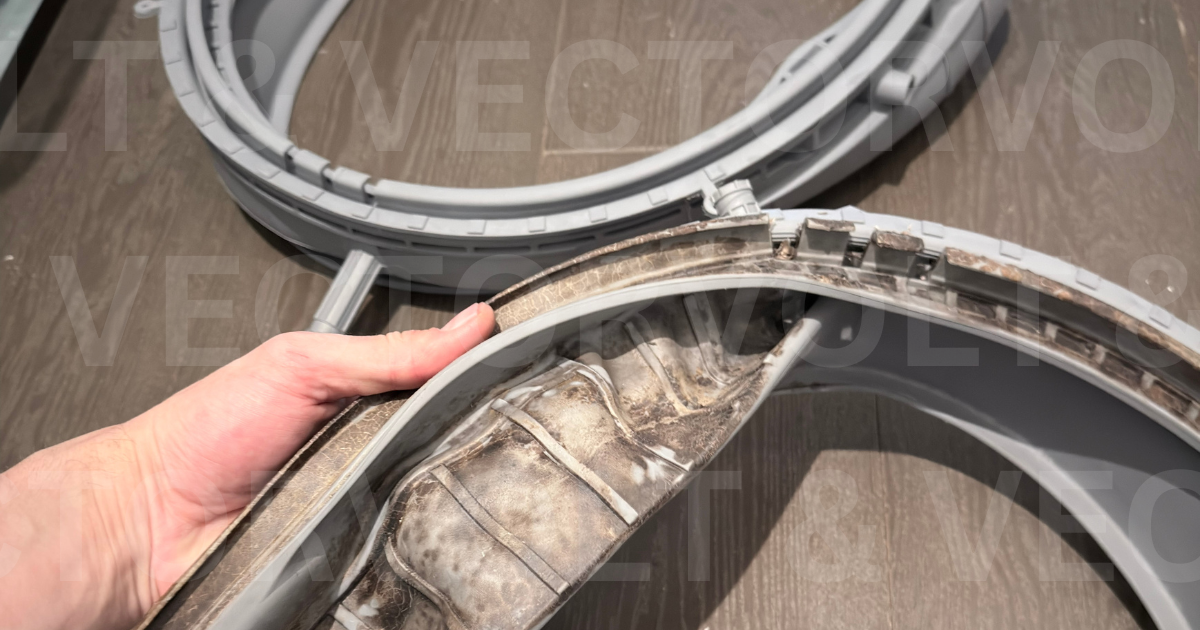
- Odor or visible seal deterioration: report visible residue, tears and where the odor is noticeable. Cleaning suitability and a damaged-seal repair are different decisions. Follow only the exact washer manual's cleaning instructions; avoid chemical mixtures and disassembly.
- The machine stops or loses power: tell us the cycle stage, the display state and whether a breaker has tripped. Do not repeatedly reset a breaker or continue using a washer with smoke, burning odor or water near electrical connections.
Error messages and washers without a code display
Send the entire displayed message, including all letters, numbers, spaces and alternating parts, together with the complete model and serial number. A photo is preferable to a remembered fragment. Also record the cycle stage and whether water remains in the washer. The meaning must be checked for that washer's control generation before a repair or part is recommended.
A code reported for a different Whirlpool or KitchenAid appliance is not sufficient evidence of the same meaning on your washer. The code identifies an investigation path only after its model applicability is confirmed; it does not prove that a pump, lock, sensor or control board has failed.
If the washer has no digital code display, describe the control position, indicator lights and the last completed function. The absence of a displayed code does not prevent you from requesting service. Keep photographs or an existing recording of the behavior, and do not reproduce a leak, electrical fault or violent spin just to collect evidence.
Do not enter an unfamiliar service mode, bypass a safety device, force a locked door or repeatedly reset the machine to clear a recurring problem. A locked washer containing water, an active leak, smoke, a burning smell or repeated breaker trips needs a safe stop rather than another test cycle.
What diagnosis needs to distinguish
The technician first matches the actual washer, the reported sequence and the installation. The complaint then directs the checks below. Internal access and electrical measurements belong to service personnel using the applicable documentation.
- Water remains in the tub: distinguish a restriction or drain arrangement from the pump's commanded response and the machine's water-level indication. A running sound alone does not establish useful drainage, and retained water alone does not identify the pump as the failed part.
- The door or lid prevents starting: distinguish physical closure and alignment from the interlock's response and the control's permission to continue. The actual mechanism determines whether a hinge, catch, lock, lid device or another part of the start sequence needs attention.
- Fill is slow, absent or apparently low: compare the supply and temperature selection, water entry and the washer's selected level or feedback. On the identified KAWS family, the normal water level can sit below the agitator top; that observation must be separated from a machine that fails to complete filling.
- The tub empties but clothes stay wet: compare the chosen cycle, load behavior, permission to spin and actual drive response. A drainage failure, a missed spin and an unstable load require different evidence before a motor, drive component or control is selected.
- The washer leaks or smells: locate the water or residue and assess the affected seal, dispenser, supply or drain connection. A damaged seal, accumulated residue and a leak from another connection lead to different work; odor alone does not establish which part to replace.
- The machine stops or loses power: preserve the stopped stage and display state, then distinguish the appliance's supply and control behavior from the system it was operating. Report breaker trips or a building power event rather than repeatedly resetting the machine.
The finding should explain the original complaint and the proposed repair. Correct part identification, any access limitation, the estimate and expected timing are discussed before repair approval. After the agreed work, the affected function is checked where safe operation and access permit, with remaining limitations documented.
Safe observations before the visit
Note the cycle and load, photograph the display and visible leak location, and obtain the model label only when safely accessible. If a visible garment prevents normal closure, stop instead of forcing the door or lid.
The KAWS models covered by guide 3950451C have a self-cleaning lint filter beneath the basket. That is different from the removable pump trap shown in many front-loader videos. For another model, check its own manual before attempting filter care. Do not remove a kick panel, open a pump housing or pull a stacked washer based on another machine's procedure.
For a fill complaint, report safely visible supply-valve positions and hose kinks. Leave hose disconnection, inlet-screen work and internal access to service when the permitted procedure, shutoff or access is uncertain. Use only the actual washer's approved seal, dispenser and tub cleaning method; never mix cleaning chemicals.
Lock, motor, pump, control-board and internal electrical work require diagnosis and safe access. Do not bypass an interlock, force a release, perform live-voltage tests or repeatedly reset a breaker. Stop using the washer for an active leak, violent movement, smoke or a burning smell, and keep clear of water near electrical connections.
Front-load gasket odor or mold-related replacement
If the actual washer has a front door gasket, send photographs of the visible condition and report whether there is leakage as well as odor. For an agreed gasket replacement, our washer gasket replacement service includes removal of accessible remaining residue where possible after replacement. This is not a promise of whole-machine deep cleaning or disinfection. A top-load KAWS washer does not use that front-door gasket route.
Access, finishes and parts preparation
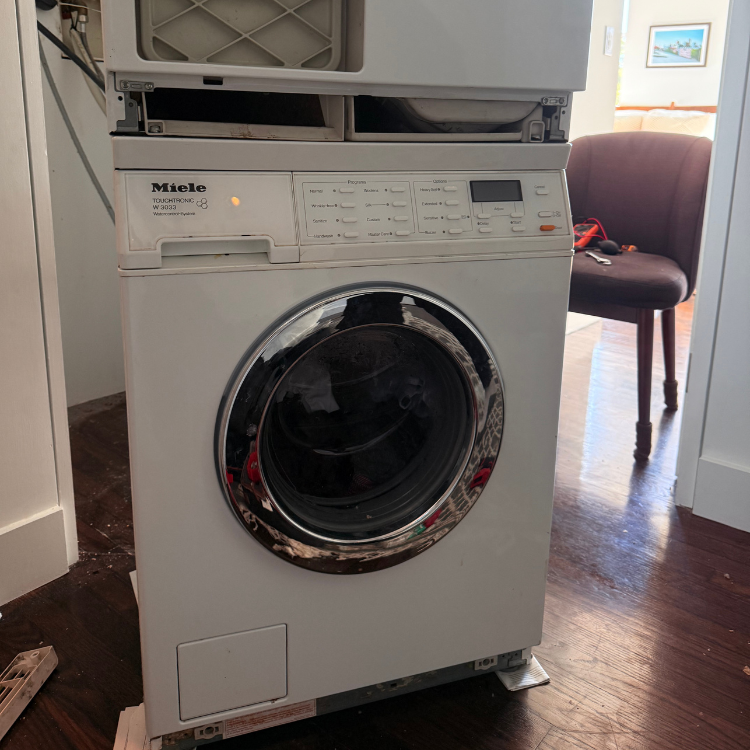
A washer under a counter, stacked with a dryer or fitted behind cabinetry needs an access plan before internal work. Include wide and close photographs of the opening, finished panels, cabinet edges and flooring. Agree any movement and surface-protection requirements with the service team; do not unstack the machines, disconnect utilities or pull the washer out to prepare for a visit.
For replacement parts, the complete model and serial information is used to check the correct component and revision. A part advertised for another Whirlpool or KitchenAid washer is not sufficient fitment evidence. Availability is checked for the proposed repair rather than assumed from a familiar brand or part description.
Volt & Vector provides independent, licensed and insured appliance service with an estimate before repair. A COI is available for buildings that require it. OEM parts are used when replacement is required and available; raise any manufacturer warranty or authorized-only service requirement before booking an independent visit.
What your diagnostic finding should explain
- Appliance identity: the KitchenAid model and serial information used to check documentation and part fit.
- Reported failure: the cycle stage, behavior and any display evidence associated with your complaint.
- Relevant observations: what was confirmed about the affected system and installation, rather than a list of unrelated checks.
- Repair scope: which work is proposed, which parts need confirmation or sourcing, and what access is required.
- Cost and approval: the diagnostic charge, its same-job repair credit and the estimate you must approve before repair work.
- Outcome and limits: the function checked after the agreed repair and any separate issue or access limitation that remains.
Not every washer has stored digital history, a user-accessible pump filter or connected features. The visit is directed by the actual machine and failure. A proposed component replacement needs evidence; the list above does not promise every possible test or maintenance service for one diagnostic fee.
Completed repairs carry a 180-day parts and labor warranty for the same repaired issue, subject to the work order and current warranty terms. A new symptom or unrelated component failure needs its own assessment.
Three repair decisions explained
These illustrations show what to clarify before approving the proposed work.
The door problem returns after lock work
Share the previous invoice and describe what changed after that repair. A door that cannot seat normally and a closed door that does not lock or start are different observations. The finding should explain alignment, damage or the locking response before a second lock or a combined hinge-and-lock repair is proposed.
The estimate proposes an inlet valve for slow filling
Record whether the complaint affects one temperature selection or every selection, and whether it followed building water work. The diagnosis should distinguish the supply and visible installation from the washer's internal water-entry response. The estimate should explain that finding and identify the correct part before a replacement is ordered.
Water remains after a recent pump replacement
Bring the repair record and note whether the original drainage complaint ever disappeared. The drain arrangement, a restriction and a confirmed component fault need to be separated before ordering another pump. Ask which finding explains the recurring symptom and how drainage will be checked after the agreed work.
Apartment, building and shared-laundry access
Include the full service address, apartment or unit, ZIP code and photographs of how the washer is installed. Tell us whether it is freestanding, stacked, under a counter or behind a closet door, and whether access to hoses, the label or a shutoff is restricted. Do not disconnect utilities or move heavy equipment to prepare photographs.
For a co-op, condo or managed building, mention COI requirements, permitted service hours, elevator reservations and entry instructions before scheduling. If building staff report water-supply, drain or electrical work, include when it happened and whether other appliances or units were affected. Provide the management contact when a shared-system access decision is needed.
For a shared washer, describe approximate use and whether different users report the same cycle-stage problem. Keep existing fault photographs and maintenance or repair records together. Heavy use is relevant background, but it does not establish a universal replacement interval or make a residential model suitable for every shared-use installation.
Requests are reviewed for Brooklyn, Manhattan below 96th Street, Astoria, Long Island City and the confirmed Westchester service areas, including Scarsdale, Eastchester and Bronxville. Other Queens addresses are checked separately. Service hours are Monday–Friday, 9:00 a.m.–6:00 p.m.; Saturday and Sunday are closed. We confirm the address, service scope and available appointment window before scheduling.