Brooklyn (DUMBO, Park Slope, Williamsburg, Carroll Gardens, Cobble Hill, Boerum Hill, Brooklyn Heights) and Manhattan (UES, UWS, Midtown, Financial District, Tribeca, Hell's Kitchen)
LG's Direct Drive motor platform is the most technically complex residential washer motor system in wide deployment. It requires understanding the interaction between four components — hall sensor, stator, rotor, and inverter board — to diagnose correctly. Any of these four can produce an LE code. A technician who replaces the stator assembly based on an LE code without testing the hall sensor first has charged the customer $330 to $450 for a repair that may not resolve the fault. We test in diagnostic sequence — hall sensor first, then stator, then inverter board — before recommending any parts.
LG ThinQ-connected washers log operational data — cycle completion rates, motor current draw history, fill times, spin RPM achievement — that's accessible through the LG ThinQ app and through service mode on the machine. This data tells us whether a fault is new or has been occurring intermittently for weeks. A fresh OE code and an OE code that has occurred 47 times over the past three months require different repair approaches. We review this data on every LG service call before making a diagnosis.
NYC-specific factors change the repair calculus in ways that general appliance knowledge doesn't account for. Hard water at 7.5 gpg blocks pump filters and inlet valve screens at 3x the rate of national averages. Pre-war building electrical panels introduce voltage variance that affects inverter board longevity. Laundry closet configurations — particularly tight spaces where the machine can't be fully leveled — create abnormal drum loading that accelerates suspension wear. A technician who hasn't serviced dozens of LG washers in NYC specifically is likely to underestimate the probability of these factors and misattribute the root cause.
Drum bearing replacement on LG front-loaders involves splitting the outer tub — a two-half assembly held by screws around its perimeter. Correct reassembly requires torquing the tub screws in the correct sequence to achieve proper tub seal compression. Too loose and the tub leaks. Too tight and the plastic tub deforms. LG's tub design is model-specific; a repair that's straightforward on a WM3900 differs in access sequence from a WM4500. We know the model-specific procedures for the machines we service most frequently in NYC.
Volt & Vector service calls are built around one principle: fix it right, explain what we found, and get out of your day.
When you book, you get a confirmed two-hour arrival window — no all-day waiting. Our technician arrives with a stocked van covering common parts for every brand we service. After diagnosis, we present a written flat-rate estimate. If approved, we complete the repair on the same visit in the majority of cases. For stackable laundry units in tight closets — common throughout Chelsea and Williamsburg apartments — we carry the tools and techniques to work in confined spaces without damaging cabinetry or flooring. All repairs include a 90-day labor warranty. We document the repair so your service history is on file for future calls. If we find that a second appliance in your laundry setup needs attention — such as a dryer in the same stack — we assess it at no extra trip charge.
The LG pump filter is designed to be owner-cleaned and is documented in the user manual. Locate the small access door at the lower front of the machine, place a tray and towel below it to catch water, turn the cap counterclockwise slowly, and clear any debris from the filter and its housing. Reinstall and tighten clockwise until snug — hand-tight is sufficient. In NYC households running daily loads, clean the filter every 4 to 6 weeks. Neglecting this is the single most common cause of OE drain faults we service.
Turn off both water supply valves before disconnecting the inlet hoses. The mesh screens sit in the inlet ports on the back of the machine and can be removed with needle-nose pliers and cleaned under running water or soaked in white vinegar to dissolve mineral deposits. Do not use metal tools that can deform the screen mesh. Reinstall screens before reconnecting hoses, and check for leaks at both connections after turning the supply back on. This clears IE faults caused by flow restriction without replacing the valve.
Replacing the LG door boot gasket requires removing the front panel, door assembly, and the spring clip that seats the gasket against the tub opening. The gasket routing — how the inner lip seats against the tub flange — is precise; an incorrectly seated gasket leaks during spin and can cause significant floor damage in NYC apartments. Additionally, the drain sump hose at the bottom of the gasket must be reconnected correctly. One misrouted hose or incorrectly seated spring clip causes a leak that won't appear until the first spin cycle after reinstallation. Unless you are experienced with front-load disassembly, this is a job for a technician.
On WM4000 and WM4500 models, the hall sensor is accessible after removing the rear panel — no drum removal required. However, correctly testing the hall sensor signal before replacing it requires a multimeter and knowledge of the expected output voltage range under rotation. Replacing the hall sensor without testing it first risks leaving an actual stator fault unresolved. If you are comfortable with multimeter diagnostics and rear panel access, this is a feasible repair. If not, misdiagnosis costs more than a professional visit.
LG ThinQ-connected models require SmartDiagnosis re-pairing after any control board replacement — a procedure that requires the LG service app or technician portal. Static discharge during handling destroys inverter boards; they must be handled with ESD wrist straps. Harness connectors on the LG main board are keyed but fragile — incorrect seating causes intermittent faults that are difficult to trace after reassembly. Drum bearing replacement requires a bearing press tool and torque specifications; without the press, the bearing will be seated off-axis and fail within weeks. These repairs require the correct tools and training to perform correctly.
Step 1 — Pre-arrival preparation (before we knock on your door): We confirm your LG model number from booking notes and load the vehicle with the most likely parts for that model: pump filter, pump assembly, hall sensor, door gasket, and inlet valve. For WM series models, all five are stocked on every truck. This eliminates the most common source of return visits — arriving without the right part.
Step 2 — Visual and installation inspection (5–8 minutes): We check leveling feet, drain hose routing (full run from machine to standpipe), supply hose condition at both ends, door gasket condition including inner fold, and cabinet exterior for signs of prior repairs or water damage. In NYC apartments, we also check whether the machine is stacked, whether the laundry closet has adequate ventilation clearance, and whether the electrical outlet is correctly grounded. These installation factors affect failure rates and inform our maintenance recommendations.
Step 3 — Service mode fault code retrieval (5–10 minutes): LG washers store active and historical fault codes in service mode, accessible through a button sequence on the control panel. The service menu shows more detail than the display code — including how many times each fault has occurred and under what conditions. We retrieve and document the full fault history before touching any component. This data directs the diagnostic sequence and confirms whether the current fault is new or a recurring pattern.
Step 4 — Drain system test (8–12 minutes): We run a manual drain cycle while monitoring pump amperage with a clamp meter. A pump motor drawing normal current and draining at full flow rate clears the pump from the fault list. A pump drawing high current with reduced flow confirms impeller obstruction. A pump that won't start confirms motor seizure. We also test standpipe height and confirm hose routing is within LG's specification before attributing OE to a pump fault.
Step 5 — Motor circuit test (8–12 minutes): For any LE or motor-related fault, we test hall sensor output signal at operating voltage, stator winding resistance (both cold and under load if accessible), and rotor magnet integrity by visual inspection and degaussing check. The inverter board output is tested if the hall sensor and stator both pass. This sequence takes 8 to 12 minutes and prevents replacing a functional stator based on an LE code that originates from a $55 hall sensor.
Step 6 — Water system and control board check (5–8 minutes): We test inlet valve solenoid resistance on both coils, check supply pressure at the valve inlet, and inspect the control board for physical damage — burn marks, swollen capacitors, corrosion at connector pins. In NYC apartments in pre-war buildings, control board corrosion from humidity and mineral air exposure is a real failure mode. We check the board visually on every visit regardless of the presenting symptom.
Step 7 — Repair and post-repair verification: When parts are available on the truck, the repair is completed same visit. After any repair, we run a full test cycle — including spin at maximum RPM — before signing off. For repairs that require ordered parts, we return within 24 to 48 hours. The 180-day warranty on all parts and labor starts from the repair completion date.
Machine failed to drain within the programmed timeout. Causes in order of frequency: blocked pump filter (most common in NYC hard water conditions), kinked drain hose, incorrect standpipe height, worn pump impeller, seized pump motor. Action: clean filter first; if OE persists, inspect hose routing, then test pump motor under load.
Motor circuit fault detected during spin ramp-up. LE at startup: hall sensor failure or rotor magnet chip. LE1 during cycle: stator winding thermal failure or inverter board fault. Action: 30-minute power reset first; if LE returns, test hall sensor signal with multimeter; replace hall sensor before considering stator assembly.
uE (lowercase): machine attempting auto-rebalance — do not interrupt. UE (uppercase): rebalance failed, cycle stopped. Load redistribution resolves true imbalance. Persistent UE on normal loads: replace front shock absorbers as a pair. On machines over 8 years old, also inspect rear suspension springs for metal fatigue.
Machine failed to reach fill level within the inlet timeout. Causes: low water pressure during NYC peak hours (7–9 AM), kinked supply hoses, closed shutoff valve, failed inlet valve solenoid, or clogged inlet valve mesh screens. Action: check supply pressure and hose condition; test solenoid resistance (hot and cold coils separately); clean or replace inlet valve.
Water level exceeded the maximum safe threshold. Primary cause: inlet valve solenoid stuck open, failing to close when the pressure switch signals full. Secondary cause: pressure switch fault misreading actual water level. Action: replace inlet valve; if FE persists, replace pressure switch. Do not run machine with FE active — overfill can damage control board and floor.
The water level sensor (pressure switch / pressostat) is reading out of range or has lost signal. Causes: blocked pressure hose connection at the tub, failed pressure sensor, control board communication fault. Action: inspect pressure hose for kinks or water blockage; test sensor output voltage; replace sensor if reading is non-linear.
dE: door lock not confirmed at cycle start — inspect latch mechanism and door strike alignment. dE1: door detected as open during running cycle — replace door lock actuator. dE2: secondary lock circuit failure (dual-lock models) — replace full door lock assembly. Never attempt to bypass door lock circuits in LG front-loaders — the wash drum pressure during high-spin can cause serious injury if the door opens unexpectedly.
tE / tE1: NTC inlet thermistor out of range — replace thermistor. tE2: outlet thermistor fault — replace thermistor (accessed from rear panel on most WM series). tE3: drum heater element failure — replace heater assembly. Note: tE errors do not always interrupt standard cold/warm cycles immediately, but will cause full lockout on models with integrated heater safety checks.
Motor failed to reach target RPM during spin cycle. Causes: worn drum bearings creating drag resistance, failed tub seal allowing water into bearing housing, damaged rotor magnets reducing motor torque, or inverter board output fault. Persistent SE on machines with audible bearing noise confirms bearing failure — delay increases damage scope to include tub seal and shaft.
Power was interrupted while a cycle was running. The machine stores cycle state in non-volatile memory — pressing Start resumes from the last stable point in most cases. If PF appears at every cycle start in a building with stable power, the control board's capacitor backup circuit has failed and the board needs replacement. In NYC pre-war buildings, a whole-outlet surge protector rated for appliance use reduces PF frequency significantly.
Not a fault code. Child lock was activated, preventing all panel inputs. To deactivate: hold the Child Lock button (or the designated button combination for your model — typically Temp + Option) for 3 seconds until the CL indicator clears. If CL cannot be cleared with the correct button sequence, the control panel button array has a stuck or failed switch.
Water detected in the machine base tray, triggering the AquaShield protection system. The machine will drain the drum and lock out new cycles until the base tray is dry and the leak source is resolved. Common causes in NYC apartments: failed door gasket dripping onto the base, cracked drum tub seal, split inlet hose at the solenoid connection. Do not restart the machine until the water source is identified and repaired — running with active base moisture will damage the control board and motor inverter.
LG front-load washers dominate NYC's renovation and laundry upgrade market for one primary reason: the WM series is stackable with matching DLGX and DLEX dryers, fitting the standard 27-inch laundry closet footprint found in Brooklyn brownstones, Manhattan high-rises, and pre-war co-ops. Approximately 35% of washer service calls Volt & Vector receives across Brooklyn and Manhattan involve LG WM series machines — making it by a significant margin the most common single platform we service.
NYC's hard water (averaging 7.5 grains per gallon citywide, with some Brooklyn neighborhoods running higher during infrastructure maintenance periods) affects LG washers in three specific ways: it accelerates pump filter clogging to 4 to 6 week intervals rather than the 3-month manufacturer recommendation; it leaves calcium deposits on inlet valve mesh screens that progressively reduce fill flow rate; and it causes mineral scaling on NTC thermistors that shifts their resistance curve and produces false tE faults without actual component failure. Our technicians clean inlet screens on every LG service visit regardless of the presenting fault.
Pre-war building electrical panels — particularly in Brooklyn Heights, Carroll Gardens, and Upper West Side brownstones — introduce voltage variance that shortens inverter board lifespan. LG's inverter boards are rated for standard 120V supply with a tolerance band; sustained undervoltage during high-demand periods reduces the board's design life. We recommend a whole-outlet surge protector with voltage regulation for any LG washer installed in a pre-war building. This is a $40 to $80 preventive measure that extends inverter board life measurably.
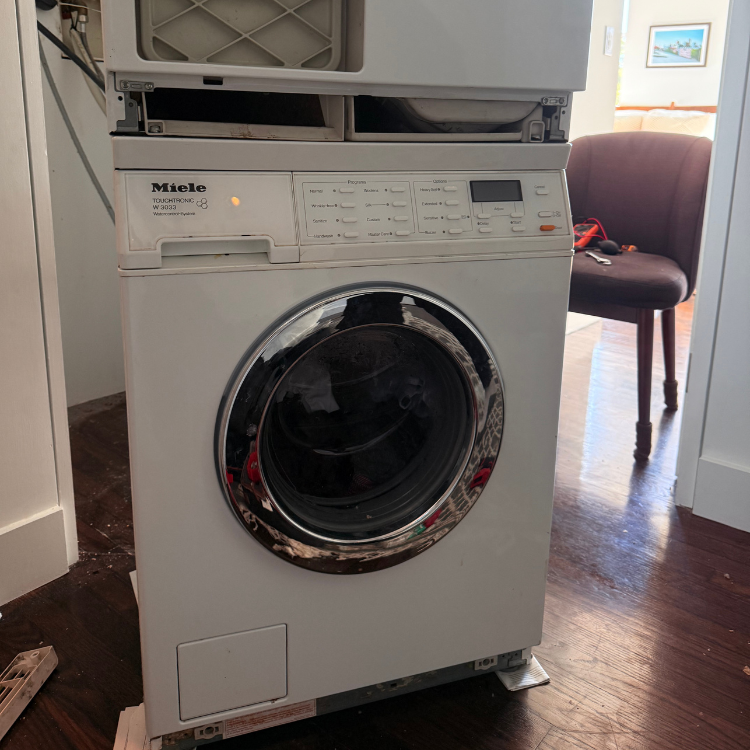
Stacked laundry configurations — LG washer below, LG or other brand dryer above — are the dominant installation type in NYC apartments. The combined weight of a stacked pair on a raised platform or direct floor mount creates specific leveling challenges; a machine that is level on initial installation may shift as the building settles or as vibration from high-spin cycles gradually moves the unit. We recheck leveling on every service call and adjust feet as needed at no additional charge. An unlevel LG washer generates UE faults, increases bearing wear, and shortens suspension component life.
LG front-load washers are the most common washer brand in NYC, accounting for roughly 35% of all washer service calls Volt & Vector handles across Brooklyn and Manhattan. The dominant model families in active service are the WM3900, WM4000, and WM4500 series — stackable front-loaders paired with DLEX or DLGX dryers in the laundry closets that define NYC apartment layouts. Their failure patterns are predictable enough that an experienced technician can narrow the diagnosis to two or three components before a single tool is picked up.
The OE drain error is the single most common LG washer fault in NYC. The root cause sits within one of three components: the pump filter, the drain hose routing, or the pump motor itself. NYC's hard water — averaging 7.5 grains per gallon — leaves mineral deposits in the pump filter at a rate requiring cleaning every 4 to 6 weeks in households running daily loads, significantly faster than the 3-month interval LG's user manual recommends for suburban installations. The pump filter sits behind a small access door at the lower front of the machine. Before opening it, place a shallow tray and towel below — there will be residual water. If the filter is clear, inspect the drain hose along its entire run. In NYC utility closets, drain hoses are frequently kinked at the bend behind the machine or pushed too deep into the standpipe, creating a siphon effect that partially drains the drum during the wash phase. LG specifies the drain hose end should sit between 18 and 96 inches above the floor — higher than that, and the pump can't generate enough head pressure to drain reliably. If hose routing is correct and the filter is clear, the pump motor impeller is likely worn or seized. A running pump that isn't moving water produces a distinctly different acoustic profile than normal pump operation — audible even through the access panel during a manual drain cycle.
The LE motor circuit error is among the most misdiagnosed appliance faults we see in NYC. LG's Direct Drive motor mounts directly to the drum shaft, eliminating belt and pulley wear — but the motor circuit includes four distinct failure points: the hall sensor (rotor position sensor), the stator winding, the rotor magnet assembly, and the inverter board. An LE code can originate from any of these. Testing the hall sensor first — a 10-minute step — eliminates the most common cause before any parts are ordered. On WM4000 and WM4500 series, the hall sensor is a standalone replaceable component accessible without removing the drum. Replacing the full rotor/stator assembly based solely on an LE code, without testing the hall sensor first, is the most common unnecessary expense in LG washer repair in NYC. We stock hall sensors for the five most common WM series models on every service vehicle.
The IE water inlet error is disproportionately common in NYC buildings relative to suburban installations. LG's inlet valve controller times out if the machine doesn't reach its fill level within approximately four minutes. Buildings where morning shower demand reduces cold water pressure during peak hours — roughly 7 to 9 AM — cause LG washers filling during that window to fail the inlet timeout and display IE. This is a building infrastructure issue, not a machine fault. If IE appears at all hours regardless of time of day, the inlet valve solenoid coil is failing. Solenoid resistance rises with age, progressively reducing flow rate until the fill timeout triggers consistently. We test both solenoid coils — hot and cold — during diagnostic.
The UE unbalance error requires distinguishing between a true load imbalance and a mechanical suspension failure. A single comforter or pair of jeans throwing UE is a load distribution issue — redistribute and retry. When UE appears consistently on small, evenly-distributed loads, the diagnosis shifts to worn suspension components. LG's front-loader suspension combines tension springs with hydraulic dampers. As dampers lose pressure over years of use, the drum can't maintain controlled movement at high spin RPM, and the balancing algorithm can't compensate. On machines in the 6 to 9 year range running high weekly cycle counts — typical of NYC households — this failure is predictable and confirms on inspection without further testing.
LG front-loaders have the highest door gasket mold incidence of any brand we service in NYC. The WM series gasket has a thick inner lip at the bottom of the door opening that retains water after every cycle. NYC's summer humidity from June through September, combined with poor air circulation inside most laundry closets, means the gasket inner fold never fully dries between washes. Mold is visible in LG door gaskets on roughly 40% of service calls on units over three years old. Surface mold cleans with diluted white vinegar and a firm brush. Mold that has penetrated the gasket rubber — visible as discoloration that doesn't wipe off — requires full gasket replacement. We install OEM LG door gaskets and provide a written post-installation maintenance protocol at no additional charge.
OE is the most frequent LG washer service call in NYC. The machine attempted to drain the drum and didn't complete drainage within the programmed timeout — typically around 3 minutes. Start with the pump filter behind the lower front access panel: coins, hair ties, lint, and small garment pieces accumulate there and restrict the pump impeller. In NYC apartments, hard water mineral buildup accelerates filter clogging to once every 4 to 6 weeks under active household use. After the filter, check the drain hose for kinks, particularly at the bend behind the machine in tight utility closets. Check the standpipe insertion depth — more than 6 inches into the pipe creates siphon pressure the pump fights against. If both filter and hose are clear, run a manual drain cycle and listen at the access panel: a pump motor that's running but not moving water indicates impeller wear or a foreign object inside the pump body. Pump replacement resolves this and takes approximately 45 minutes on WM series models.
LE on an LG Direct Drive washer indicates the motor controller detected an inconsistency in drum rotation that it could not resolve. The most common cause — by a significant margin — is a failed hall sensor, the small rotor position sensor mounted in the stator assembly. The hall sensor tracks drum position in real time; when it fails, the inverter board loses positional feedback and shuts the motor down as a protection measure. On WM4000 and WM4500 series, the hall sensor is a standalone part that doesn't require drum removal to access. If an LE appears immediately at startup and a 30-minute power reset doesn't resolve it, the hall sensor is the first part to test. LE appearing after 15 to 20 minutes into a cycle — rather than at startup — is more likely a thermally-related stator winding failure: the winding passes cold resistance tests but fails as it heats under load. These two scenarios require different diagnostic approaches and different parts.
The distinction between uE (lowercase) and UE (uppercase) on LG washers matters: uE is a first-level warning that the machine is attempting to redistribute the load automatically. The machine will pause, add water, and try several re-balance attempts. If it succeeds, the cycle continues without intervention. UE (uppercase) means those attempts failed and the machine has stopped. True load imbalance — a single heavy item, bedding, or towels bunched to one side — accounts for most UE events and resolves with manual redistribution. Persistent UE on varied loads in a machine over 6 years old points to degraded suspension. LG front-loaders use two front shock absorbers and two rear suspension springs. Shock absorber hydraulic seals fail first, causing the front of the drum to drop slightly under load — a failure mode that's visible as increased cabinet vibration before UE codes begin appearing. Both front shocks should be replaced as a pair; replacing only the failed one leaves a mismatched suspension.
LG door errors divide into three variants with distinct causes. dE indicates the door lock switch hasn't confirmed a sealed position at cycle start — most commonly a worn door latch that no longer depresses the lock actuator fully, or a door strike that's shifted out of alignment due to hinge wear. dE1 indicates the door was opened or detected as open during a running cycle — either a failed door lock actuator that released under vibration, or a door glass seal that's separating from the frame and triggering the door sensor. dE2 is specific to models with a dual-lock system and indicates a secondary lock circuit failure. All three codes prevent the machine from starting or continuing a cycle. Door latch assemblies on LG front-loaders are subject to accelerated wear in households where the door is closed quickly or pushed shut rather than latched deliberately. Replacement of the full latch assembly, rather than individual components, is standard practice — partial repairs fail within weeks.
The tE error on LG washers refers to the drum water heater circuit, used during high-temperature sanitize and allergen cycles. tE1 indicates the NTC thermistor (temperature sensor in the water path) is reading out of the expected range — either open circuit or shorted. tE2 indicates the outlet thermistor is at fault. tE3 indicates the heater element itself has failed. On machines primarily used for cold or warm washes, a tE fault may not interrupt daily operation for days or weeks — the error appears, the heater-dependent program is blocked, but standard wash cycles may continue running depending on model configuration. However, tE faults that are left unresolved progressively affect cycle behavior and will eventually trigger a full machine lockout on models where the heater circuit is integrated into the control board's safety check at startup.
Complete fault code retrieval via service mode: We pull active and historical fault codes, including the count and conditions of each fault event. This takes 5 minutes and prevents misdiagnosis by distinguishing a new fault from a pattern that has been building for weeks.
Pump filter inspection and cleaning: Cleaned on every visit regardless of presenting symptom. It takes 5 minutes and eliminates the most common drain fault source before any disassembly begins.
Drain system integrity check: Full hose run inspection, standpipe depth verification, and pump amperage test under manual drain cycle. Confirms or rules out drain system as the fault source.
Motor circuit assessment: Hall sensor signal test, stator winding resistance measurement, and rotor visual inspection. Completed on any LE fault or motor-related symptom before any parts are ordered.
Water inlet system test: Both solenoid coils tested for resistance, supply hose condition checked, inlet screens inspected for mineral blockage. Standard check on any IE fault or slow-fill complaint.
Door gasket inspection: Inner fold pulled back and examined for tears, mold penetration, and foreign object ingress. We note gasket condition in every service record and provide maintenance protocol if mold is present.
Control board visual inspection: Board examined for burn marks, swollen capacitors, and connector corrosion. Completed on every visit — control board degradation is a secondary risk factor in NYC pre-war buildings with voltage instability.
Suspension check: Manual drum push test confirms shock absorber damping capacity. On machines over 6 years old, we measure drum movement range and compare to specification.
Post-repair test cycle: Every repair is followed by a full operational cycle including spin at maximum RPM before we sign off. We do not leave until the machine has completed a cycle without fault.
180-day parts and labor warranty: All repairs carry a 180-day warranty from the completion date. If the same fault recurs within that period, we return and resolve it without additional charge.
Certificate of Insurance on request: Required by building management in many NYC co-ops and condominiums. We provide current COI documentation within hours of request and coordinate building access requirements as part of standard scheduling.
A Crown Heights resident called after their LG WM4000HWA began stopping mid-cycle with persistent OE errors. The pump filter had been cleaned two weeks prior and was clear. Running a manual drain cycle while listening at the access panel revealed the pump was running at normal amperage but producing significantly reduced output flow — audible as a higher-pitched, less forceful discharge sound compared to normal operation. We removed the pump assembly and found a 2-inch piece of underwire from a bra lodged in the pump housing, partially obstructing two of the three impeller vanes and bending one vane enough to reduce pump efficiency by roughly 40%. We replaced the pump assembly with an OEM LG unit, reinstalled, and ran three consecutive drain cycles to confirm full flow restoration before completing the visit. Total repair time: 55 minutes. We recommended a mesh laundry bag for underwire garments and a monthly filter check given the NYC hard water mineral accumulation rate.
An Astoria resident called after their LG WM3900HWA displayed LE at startup consistently for four days. The machine was 5 years old. On arrival we ran the service mode fault log: LE had occurred 23 times over a 5-day period, always at startup, never mid-cycle — a pattern consistent with hall sensor failure rather than a stator thermal fault. Cold stator winding resistance tested within LG specification on both windings. Hall sensor output signal tested with a multimeter: at standstill it produced the correct voltage, but during slow manual drum rotation it dropped to zero intermittently — a clear intermittent hall sensor fault. The hall sensor on the WM3900 is a standalone component accessible from the rear without drum removal. We replaced the sensor with an OEM part, reinstalled, and ran a complete test cycle including spin at 1200 RPM. No LE recurrence. Total repair time: 48 minutes. Replacing the full stator assembly would have cost three times more and left the actual fault component in place.
A Cobble Hill co-op resident reported a progressively worsening grinding sound during spin cycles that had started two months earlier. They had attributed it to the building's mechanical systems until the noise became clearly machine-specific and began vibrating through the kitchen floor above the laundry closet. On arrival, manual drum rotation confirmed roughness in the rear bearing — tactile resistance in specific arc positions that indicated flat spots on the bearing race. The outer tub required full disassembly: front panel, door assembly, counterweight, and tub front half removal. The rear bearing and tub seal were replaced as a set. The tub halves were reassembled with new tub seal gasket and torqued in sequence per LG specification. Post-assembly drum rotation was smooth across the full rotation range. Test cycle at maximum spin confirmed no audible bearing noise and no vibration. Total repair time: 3.5 hours. Had the bearing been replaced at first symptom two months earlier, the tub seal would not have required replacement, reducing repair time to approximately 2.5 hours and parts cost by $45.
If OE persists after cleaning the pump filter and confirming the hose is clear and correctly routed, work through this sequence. First, verify the standpipe insertion depth: if the drain hose is inserted more than 6 inches into the standpipe, the resulting siphon effect creates back-pressure that the pump fights against throughout the drain phase and triggers OE even with a functional pump. Pull the hose out to a maximum 6-inch insertion depth and run a test drain cycle. Second, run the machine on a drain-only program and listen at the lower front access panel with the door open slightly: a pump motor that's audibly running but producing weak or no water discharge has either a damaged impeller or a foreign object wrapped around the impeller shaft inside the pump body. This is a different sound than a seized motor — the seized motor makes a brief hum and stops; the damaged impeller motor runs continuously with reduced output. Third, if both checks pass, test the pressure sensor. A pressostat that's reading residual water in the drum (due to a blocked pressure hose or failed sensor) will tell the machine the drum isn't empty even after a successful drain, triggering OE as a false positive. We verify pressostat function as part of standard LG diagnostic.
LG Direct Drive eliminates the belt and pulley system by mounting the motor directly to the drum shaft. This removes belt stretch, belt slip, and pulley bearing wear from the failure equation entirely — which is why LG front-loaders rarely develop the belt-related squealing and slipping faults that are common on other brands. However, the Direct Drive motor circuit introduces its own diagnostic complexity. The motor's operation depends on four components working in sync: the stator (stationary electromagnet), the rotor (permanent magnet drum attached to the shaft), the hall sensor (position tracking sensor), and the inverter board (the electronics that sequence the stator's magnetic fields). A fault in any one of these four produces an LE code. The hall sensor is the most common failure point — it's a small electronic sensor subject to vibration stress and heat cycling — and it's also the least expensive component at $55 to $85. Testing the hall sensor first, before ordering the stator or inverter board, is the correct diagnostic sequence. A technician who skips the hall sensor test and replaces the stator based on LE alone will charge $330 to $450 for a repair that may not resolve the fault. This distinction is why brand-specific LG training matters.
Leaving the door open and using HE detergent are both correct practices, but neither addresses the primary mold source in LG front-loaders: the inner fold of the door gasket's lower lip. This section of the gasket has a thick ridge that retains water in a trough-like channel after every cycle. In NYC laundry closets — which typically have a single louvered door and minimal air circulation — this trough stays damp long enough between cycles to sustain mold growth, especially during the June through September high-humidity period. To address the source: after the last load of each day, pull back the inner gasket fold at the bottom of the door opening and dry it with a towel. This takes 30 seconds and removes the retained water before it sits overnight. Also remove the detergent dispenser drawer weekly and clean the back wall of the dispenser housing — this is a secondary mold site that most owners miss. If visible mold is already present in the gasket fold, clean with diluted white vinegar and a firm brush. If the mold has penetrated the rubber material — visible as discoloration that doesn't wipe off — the gasket needs replacement; surface cleaning will not stop recurrence once the rubber is colonized.
An LE code that appears consistently at the same point mid-cycle rather than at startup is a distinct failure pattern from a hall sensor fault. Hall sensors typically fail at startup — the machine tries to initialize the motor, can't confirm rotor position, and immediately displays LE. A fault that appears 15 to 25 minutes into a cycle is more consistent with a thermally-related stator winding failure: the winding passes resistance tests when cold but develops a partial short-circuit as it heats under load, eventually triggering the overcurrent protection at the point where winding temperature reaches failure threshold. Correctly diagnosing this requires both a cold winding resistance test and an operating current test under load — the cold test alone will not detect a thermal fault. The repair is a stator replacement rather than a hall sensor, and the cost difference is significant. If a prior service visit replaced the hall sensor but LE is recurring mid-cycle, the stator winding is the component that should have been tested. Bring that service record to your next appointment — it will direct the diagnostic immediately.
LG ThinQ SmartDiagnosis transmits a coded audio tone from the washer to the LG ThinQ app on your phone, which decodes it and displays a plain-language description of the fault along with basic troubleshooting steps. It works as a first-pass filter — it will correctly identify simple faults like a blocked filter, a closed water supply valve, or child lock being active, and give you a resolution path without a service call. Where it falls short is on mechanical and electronic failures that require component-level testing: it will display an LE error description but cannot tell you whether the root cause is the hall sensor, the stator, or the inverter board. For those failures, the plain-language description is a starting point, not a diagnosis. The more useful data for a technician is the detailed fault log accessible through LG's service mode on the machine itself — this includes fault occurrence count and the specific operating conditions under which each fault appeared, which is the data that distinguishes a chronic recurring problem from a first-time fault. When you book a service call, note what SmartDiagnosis reported — it's useful context even if it doesn't replace a full diagnostic.