Bosch Washer Repair

Why does my Bosch washer vibrate so much during spin even though it's level?

image of diy home project

Same/Next Day Availability!

9:00 AM - 6:00 PM
Response time
< 5 Minutes
Response rate
100%

Bosch Washer Repair NYC — Same-Day Service | Volt & Vector

Brooklyn (DUMBO, Brooklyn Heights, Park Slope, Cobble Hill, Carroll Gardens) and Manhattan (UES, UWS, Tribeca, Financial District, Midtown)

Bosch Washer Repair

Why Bosch Washer Repair Requires Specialist Knowledge in NYC

Bosch washers differ from American brand washers in several technically significant ways that require specialized knowledge and equipment to diagnose correctly. The most important difference for NYC service is the AquaStop system: a failure mode that appears to be a drain fault but may actually be a humidity-induced condensation issue requiring a completely different resolution. A technician who assumes every E:18 code means a failed pump will replace functioning pump components in a significant percentage of NYC Bosch service calls. Understanding AquaStop's trigger conditions, knowing how to inspect the base pan correctly, and recognizing the condensation false-trigger pattern is knowledge that comes specifically from Bosch service training.

The internal water heater is the second major differentiator. No American washer brand heats its own wash water. The diagnostic procedures for E:01 (heating fault) — testing a 2,000W immersion heater element, NTC thermistor resistance, and heater relay operation — require both Bosch-specific part knowledge and comfort with the high-current heating circuit. A technician who services only American brands encounters none of this in standard practice.

Control board diagnosis on Bosch machines requires the BSH service tool to access the full fault log and live sensor readings. Without this tool, the technician sees only the current displayed error — which may be a secondary code driven by a primary fault that has already cleared. The stored fault history accessible through the BSH tool frequently reveals the actual root cause when the presented code is ambiguous.

Volt & Vector technicians hold BSH factory service certification and use Bosch diagnostic equipment on every service call. Parts are sourced directly from BSH Home Appliances authorized distribution — not aftermarket alternatives that may not meet Bosch's tolerance specifications. Every Bosch repair includes a complete diagnostic cycle in service mode confirming all measured values before the call is closed.

What to Expect From Our Washing Machine Service

Volt & Vector service calls are built around one principle: fix it right, explain what we found, and get out of your day.

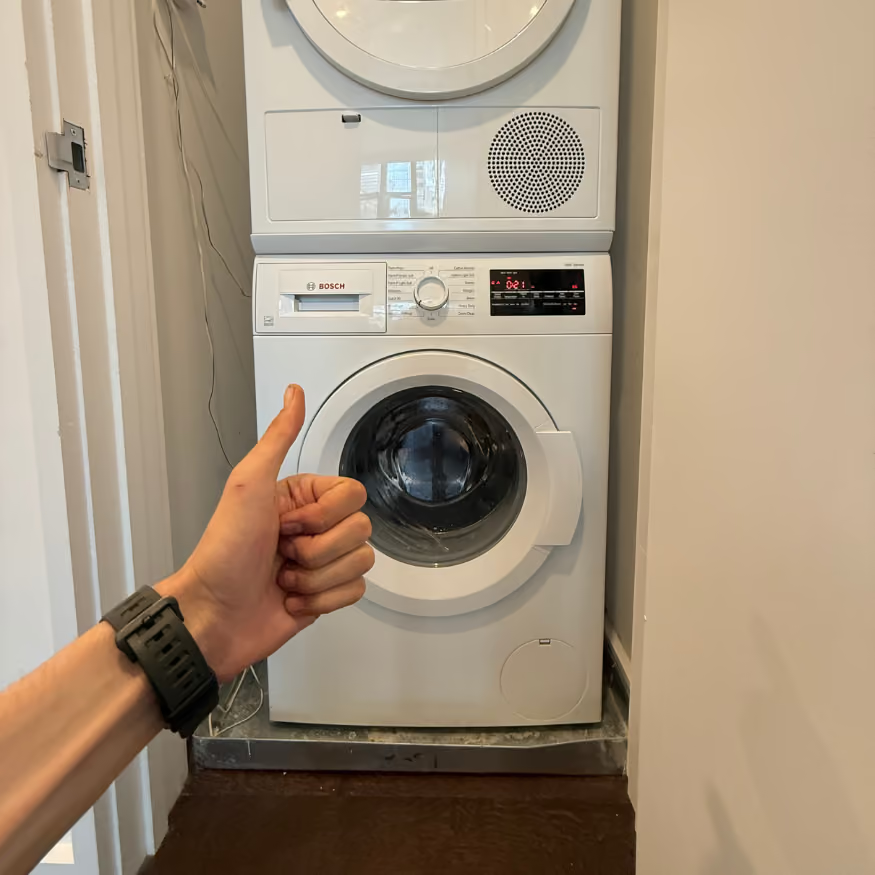
When you book, you get a confirmed two-hour arrival window — no all-day waiting. Our technician arrives with a stocked van covering common parts for every brand we service. After diagnosis, we present a written flat-rate estimate. If approved, we complete the repair on the same visit in the majority of cases. For stackable laundry units in tight closets — common throughout Chelsea and Williamsburg apartments — we carry the tools and techniques to work in confined spaces without damaging cabinetry or flooring. All repairs include a 90-day labor warranty. We document the repair so your service history is on file for future calls. If we find that a second appliance in your laundry setup needs attention — such as a dryer in the same stack — we assess it at no extra trip charge.

DIY vs Pro

Bosch Washer Repairs — What You Can Do vs. When to Call

Pump Filter Cleaning — DIY Safe

Bosch front-load models include a pump filter access port behind the lower front kick panel. Place towels and a shallow basin beneath the drain port, turn the cap counterclockwise slowly to drain residual water, and remove any accumulated debris from the filter and trap housing. Bosch's filter design is user-friendly and intended to be cleaned by the operator every 2 to 3 months. This resolves a significant percentage of E:18 drain errors in NYC building laundry rooms. Risk: None.

Inlet Screen Inspection — DIY Moderate (Annual Recommended)

Shut off both supply valves, disconnect fill hoses, and remove the mesh screens from the inlet valve ports using needle-nose pliers. In NYC's hard water, Bosch recommends inspecting these screens at 12-month intervals rather than the 24 to 36 month interval typical for American brands. Screen calcification visible as white coating can be soaked in white vinegar for 30 minutes. Replacement of the complete inlet valve is recommended if screen calcification has recurred within 12 months of the previous cleaning. Risk: Low.

Machine Leveling — DIY Moderate

Bosch washers require precise leveling for acceptable spin vibration. Using a precision bubble level on the top panel, adjust all four leveling feet (accessed from the front by tilting the machine slightly back) until the bubble is centered in both axes with the drum empty. Lock each foot by tightening its lock nut against the cabinet base after adjustment. An unlevel Bosch in spin mode in a NYC apartment building transmits structural vibration to neighboring units. Risk: Low. Requires two people for safe tilting.

AquaStop False Trigger Reset — DIY Moderate

If E:18 appears and the base pan inspection confirms no water (front kick panel removed, flashlight inspection), the float switch may need manual assistance to reset. With the machine unplugged, use a thin rod to gently press the float switch downward to its seated position. Allow the base pan area to air out for 30 minutes in a lower-humidity environment (open a window if possible). Reinstall the kick panel and power up. If E:18 does not return, condensation was the trigger. If E:18 returns, there is a real internal leak requiring professional diagnosis. Risk: Low if base pan is confirmed dry before attempting reset.

Internal Heater, Control Board, Motor, Boot Seal — Professional Only

Bosch internal heater replacement requires draining the machine, accessing the sump area, disconnecting the high-voltage heater circuit, and correctly resealing the heater port against the outer drum to prevent drum water loss. Board replacement requires serial-number-specific part matching and BSH diagnostic tool verification post-installation. Motor and hall sensor service requires Bosch-specific diagnostic equipment for motor inverter testing. Boot seal replacement on Bosch models uses a different retaining ring design than American brands and requires the correct technique to seat correctly. Risk: Very high without Bosch-specific training. Professional service required.

Diagnostic Process

How Volt & Vector Diagnoses a Bosch Washer in NYC

Bosch washers require Bosch-specific diagnostic equipment and knowledge of the BSH appliance architecture that is distinct from American brand platforms. Volt & Vector uses BSH diagnostic tools on every Bosch service call to access the full error log, read live sensor values, and exercise individual actuators in test mode — capabilities that are not available through the standard front-panel button sequences used on American brands.

Step 1 — BSH Diagnostic Mode Entry and Error History Retrieval. The technician connects the BSH service tool or enters the diagnostic mode through the Bosch-specific button sequence for the model series. This retrieves not just the current displayed error but the complete fault history stored in the board's non-volatile memory. A machine with 30 stored E:18 events over 6 months tells a very different story than a machine with a single E:18 event — the former indicates a chronic base pan condensation condition, the latter a possible actual AquaStop trigger event.

Step 2 — AquaStop and Base Pan Inspection. On any E:18 code, the front kick panel is removed and the base pan is inspected with a flashlight for water accumulation. The float switch position is confirmed (switch in seated position = no water detected; float elevated = water detection active). Internal components visible from the base pan inspection are checked for water staining or active dripping that would indicate the source of a real AquaStop trigger.

Step 3 — Water Supply Assessment. Water pressure is measured at the inlet (minimum 30 PSI for Bosch). Both inlet valve screens are inspected for calcification. Both solenoid coil resistances are measured (spec: 3.8 to 4.5kΩ per coil). The pressure sensor tube is inspected for blockage, cracking, or mold growth.

Step 4 — Heating System Assessment. Internal heater resistance is measured (spec: approximately 25–30Ω). NTC thermistor resistance is measured at room temperature. Heater relay operation is confirmed by energizing the heater circuit in diagnostic mode and measuring current draw. This step is unique to Bosch — it has no equivalent on American washer diagnostics.

Step 5 — Motor and Inverter Assessment. Hall sensor output is measured while the drum is manually rotated. Motor stator winding resistance is measured. The inverter's output waveform to the motor is evaluated in diagnostic mode. E:02 is traced to either the sensor, the motor windings, or the inverter section of the control board based on measured values.

Step 6 — Mechanical Inspection. Drum bearing condition is assessed by manually rotating the drum and listening for rumble or resistance. Shock absorber condition is evaluated. Door latch mechanism is tested through a full lock/unlock sequence in diagnostic mode. Boot seal is visually inspected.

Step 7 — Post-Repair Verification. A complete test cycle is run in Bosch's diagnostic mode, monitoring all measured parameters: fill rate, heating rate (for models with internal heating), motor speed through full spin acceleration to maximum RPM (typically 1,200 or 1,400 RPM depending on model), drain rate, and door lock cycle timing. All values are documented in the exit service report.

Error Code Reference

Bosch Washer Error Code Reference — NYC Diagnostic Guide

E:18 / F:18 — Drain Fault / AquaStop Trigger

The most frequent Bosch error code in NYC. E:18 can indicate a real drain obstruction (pump blocked, pump failed, drain hose kinked) or an AquaStop false trigger from condensation in the base pan. Diagnosis sequence: first, access the pump filter (lower front panel on most Bosch models) and check for blockage — clear the filter and test drain operation. If the pump is clear and draining normally but E:18 persists, inspect the base pan for condensation water. If the base pan is wet: identify the internal source of the water. If the base pan is dry: the float switch may have a lint obstruction preventing reset. Clear the float switch path and test. E:18 from a genuine pump failure requires pump replacement (Bosch-specific pump assembly, not interchangeable with American brand pumps).

E:09 / F:09 — Water Inlet Fault

The machine did not fill to the required water level within the programmed time. Check water pressure at the inlet (Bosch requires minimum 30 PSI — higher than most American brands). Inspect both inlet valve screens for calcification. On Bosch models, the inlet valve screens are accessed by turning the screen inserts counterclockwise from the valve ports — needle-nose pliers are required. Screen calcification is the primary cause in NYC. If screens are clear and pressure is adequate, the inlet valve solenoid resistance should be tested: both solenoid coils should read approximately 3.8 to 4.5kΩ (Bosch uses higher-resistance solenoids than American brands). An open or out-of-spec coil requires valve replacement. The pressure sensor and its connection tube should also be inspected — a kinked or mold-blocked tube generates false E:09 by misreporting water level.

E:02 / F:02 — Motor Fault

EcoSilence Drive motor stall or speed error. Diagnostic sequence: confirm the drive belt is intact (if the model uses a belt-drive EcoSilence system rather than direct drive), confirm the drum rotates freely by hand (bearing drag or pump obstruction can stall the motor), test hall sensor output voltage while the drum is manually rotated slowly (the sensor should produce a varying voltage signal as magnets on the rotor pass the sensor). If the hall sensor produces no signal variation, the sensor has failed. If the sensor produces correct signals and the motor still generates E:02, the inverter section of the control board may have failed. Bosch's BSH diagnostic tool is required to distinguish a motor fault from a board-level inverter fault in ambiguous cases.

E:01 / F:01 — Heating Fault

Internal water heater has not achieved the programmed wash temperature. Test the heating element resistance (spec: approximately 25–30Ω for a standard Bosch heater; OL = failed). Test the NTC thermistor resistance (spec: approximately 10–20kΩ at room temperature; OL or near-0Ω = failed). Also check the heater relay on the control board — a failed relay stuck open prevents the element from receiving power regardless of element condition. In NYC pre-war buildings, verify outlet voltage: Bosch heaters operate on the 240V circuit (on models with built-in electric heating), and 208V operation reduces heater wattage output, extending heat-up time. If heat-up time exceeds the control board's timeout threshold at 208V, E:01 may appear even with a functional heater and NTC.

E:13 / F:13 — Door Lock Fault

The door lock assembly has not confirmed latch engagement within the timeout. Test the door latch switch continuity with the door closed. Bosch door latches use a bimetal strip actuator (thermal latch) that requires approximately 30 seconds to fully engage on some older models — attempting to start a cycle before the thermal latch completes its warming cycle generates a false E:13. On newer models with solenoid latches, test the solenoid coil resistance (spec approximately 50–100Ω). Also inspect door hinge alignment — a door sitting even 2 to 3mm below center engagement causes intermittent E:13 that worsens as the hinge wear progresses.

E:17 / F:17 — NTC Sensor Fault

The NTC thermistor controlling the internal heater is reading outside its programmed range. Disconnect the NTC and measure resistance: spec is approximately 10kΩ to 20kΩ at room temperature. A reading of OL indicates an open sensor; near 0Ω indicates a shorted sensor. Both conditions prevent correct wash temperature regulation and generate E:17. The NTC is typically mounted directly on the heater element body or in the sump area depending on Bosch model generation. Replacement is a straightforward component swap after the machine is drained and the sump area is accessible.

E:27 / F:27 — Relay Fault / Control Board

A relay on the main control board has failed or is operating outside expected parameters. NYC-specific: E:27 appears more frequently after ConEd brownout events in July and August, when voltage transients stress control board power supply components. A board reset (unplug 10 minutes) clears a transient E:27 caused by a voltage spike. If E:27 returns immediately, the relay has failed permanently. Bosch control board replacement requires correct part matching by model and serial number — Bosch boards are more revision-sensitive than American brand equivalents, and installing a board from an incompatible software revision causes persistent fault codes after installation.

E:23 / F:23 — Pressure Sensor Fault

The water level pressure sensor is reading outside its expected range. Bosch uses a digital pressure sensor (transducer) on most models produced after 2010, which is more precise than the older air-dome pressure switch systems but also more sensitive to vibration damage and contamination. Inspect the thin plastic tube connecting the outer drum air dome to the pressure sensor for kinking, cracking, or mold growth. In NYC's humid basement laundry rooms, mold growth inside the pressure tube is a documented failure mode that generates false E:23 readings. The tube must be fully cleared and dried before the pressure sensor is replaced, since a blocked tube will re-generate E:23 with a new sensor.

New York City — What's Different

Why New York City Creates Unique Challenges for Bosch Washers

Bosch washers are designed to German quality standards for Central European operating conditions: moderately soft water, low ambient humidity, stable electrical supply, and residential-only use. New York City deviates from all four of these parameters, creating failure patterns that are more frequent and more complex than Bosch encounters in its primary European markets.

AquaStop and NYC Basement Humidity. Bosch's AquaStop flood protection system is one of the most sophisticated water safety systems in any home appliance. In the correct environment, it operates invisibly and provides genuine protection. In NYC's basement laundry rooms, the 65 to 80 percent relative humidity creates a condensation environment inside the machine's base pan that the AquaStop system cannot distinguish from a real water intrusion event. E:18 false triggers are Volt & Vector's most frequent Bosch service call type. The solution is environmental: a dehumidifier in the laundry room reduces condensation events dramatically and is a more cost-effective long-term solution than repeated service calls for false AquaStop triggers.

Hard Water and Fine Inlet Screens. Bosch's inlet valve screens are finer than American brand screens, providing better filtration but calcifying faster at NYC's 7.5 gpg mineral hardness. The recommended annual inspection interval for Bosch inlet screens in NYC is half the 24-month interval Bosch specifies for soft water regions. Building this inspection into annual maintenance prevents E:09 calls entirely.

Voltage Sensitivity and ConEd Grid Events. Bosch control board electronics are designed to European voltage tolerance standards that are tighter than those of American appliance electronics. NYC's summer ConEd brownout management events — which can cause voltage fluctuations of 10 to 15% below nominal — stress Bosch boards more severely than equivalent events stress American brand boards. Buildings with Bosch washers should consider surge protection at the outlet, particularly in buildings near high-demand commercial corridors where ConEd load management is most aggressive.

Compact Model NYC Fit. Bosch's 24-inch compact models (WAT28400UC, WGB14400UC, and similar) dominate the NYC market because they fit in apartment laundry closets and alcoves that cannot accommodate the 27-inch American standard. These compact models have somewhat tighter internal component clearances than their 27-inch counterparts, making pump filter accumulation and dispenser blockage slightly more likely. NYC operators of compact Bosch models should clean the pump filter monthly rather than at Bosch's recommended quarterly interval.

Symptoms

Bosch Washer Repair in NYC — European Engineering Meets New York City Reality

Bosch washers — the 24-inch compact Vision and 800 Series models that dominate NYC's premium apartment and condo market, and the 27-inch 500 Series models in larger homes — are European-engineered appliances designed to precise German quality standards. Their EcoSilence Drive brushless inverter motors, internal water heating, AquaStop flood protection, and sub-44dB operating noise make them the preferred choice for Manhattan laundry closets, where vibration transmission and noise affect neighbors. But the same precision engineering that makes Bosch washers excellent in standard European conditions makes them more sensitive to the specific deviations from those conditions that New York City imposes.

The AquaStop flood protection system is the most NYC-specific Bosch washer failure point. AquaStop consists of a double-wall supply hose with an embedded sensor and a float switch in the machine's base pan. If water is detected in the base pan (by the float switch) or in the outer hose wall (by the hose sensor), the system triggers an emergency drain cycle and locks out the machine, displaying E:18 (drain error/AquaStop trigger). In a residential laundry room with controlled humidity, this system operates exactly as designed. In NYC's basement laundry rooms, which maintain 65 to 80 percent ambient relative humidity year-round, condensation can accumulate in the base pan without any actual water leak from internal components. A condensation puddle of as little as 50ml can elevate the float switch enough to trigger AquaStop. The result is a machine displaying E:18 that appears to have a drain fault but is actually correctly detecting a small amount of base pan moisture that does not represent a real leak. Distinguishing a real AquaStop trigger from a false trigger requires removing the front kick panel, inspecting the base pan with a flashlight, and confirming or ruling out internal component leakage.

Internal water heating is both a Bosch advantage and a unique repair category. Unlike American washers that draw hot water from the building supply, Bosch washers heat their own wash water internally using an electric heating element (typically 1,800 to 2,000 watts) controlled by a precision NTC thermistor. This means Bosch washers perform identically regardless of the building's hot water supply temperature — an advantage in NYC pre-war buildings where hot water temperature is inconsistent. However, when the internal heater or its NTC control sensor fails, wash temperatures are incorrect and error codes E:01 (heating fault) or E:17 (NTC sensor fault) are displayed. This is a repair category that does not exist on American washer brands — it requires specific Bosch parts and diagnostic knowledge.

Hard water calcification affects Bosch washers more rapidly than American brands for a design-specific reason: Bosch's water inlet valve mesh screens are finer than the equivalent screens on Whirlpool, Samsung, or GE valves. The finer mesh provides better filtration, but at NYC's 7.5 grains per gallon of mineral hardness, the finer mesh clogs to less than 20% open area in as little as 18 months of operation — faster than the 24 to 36 months typical for American brand valves. The resulting fill restriction triggers E:09 (water inlet fault), manifesting as the machine pausing or aborting cycles during the fill phase.

Bosch's EcoSilence Drive brushless inverter motor is one of the most reliable washing machine motors manufactured, with a nominal 15-year service life under residential conditions. However, the hall sensor that provides rotor position feedback to the motor inverter can fail, producing E:02 (motor fault). Hall sensor failure prevents the inverter from correctly timing the motor's drive pulses, causing the motor to stall or operate erratically. In most cases, the hall sensor is serviceable without replacing the complete motor assembly, significantly reducing the repair cost compared to a full motor replacement.

Bosch control boards — which manage the entire machine through a BSH (BSH Home Appliances) proprietary software architecture — are more sensitive to NYC's summer voltage transients than American brand boards. Bosch's European voltage tolerance specifications are typically tighter than the broader tolerance ranges of American appliance electronics. During ConEd brownout events, when building voltage drops to 95 to 105V on 120V circuits, Bosch boards can develop E:27 (relay fault) or corrupt their operational software, requiring a full board replacement. Volt & Vector uses BSH service diagnostic tools to access Bosch's complete error log and distinguish genuine board failures from sensor-triggered codes that only appear to be board issues.

Top Symptoms

E:18 or F:18 — AquaStop Trigger (False or Real)

The Bosch washer enters emergency drain mode and locks out, displaying E:18. The AquaStop system has detected either base pan water accumulation (float switch trigger) or hose wall moisture (hose sensor trigger). In NYC basement and first-floor laundry rooms, E:18 is frequently a false trigger caused by condensation in the base pan rather than a real water leak. Diagnosis requires removing the front kick panel and inspecting the base pan with a flashlight — no visible water confirms a condensation false trigger. If the base pan is dry, the float switch mechanism may be elevated by lint accumulation and require manual clearing. If water is present in the base pan, the source must be identified: it could be the door boot seal, the drain pump seal, the dispenser assembly, a supply hose connection, or the internal drum bearing seal. A false AquaStop trigger typically clears after the base pan is confirmed dry and the machine is allowed to return to ambient temperature in a lower-humidity environment. Installing a small dehumidifier in the laundry space dramatically reduces false AquaStop trigger frequency in NYC conditions.

E:09 or F:09 — Water Inlet Fault, Slow Fill

The Bosch washer initiates a cycle but pauses or aborts during the fill phase, displaying E:09. Bosch's finer mesh inlet screens clog faster in NYC hard water than American brand screens — an 18-month calcification interval is typical for Bosch in NYC versus 24 to 36 months for American brands. Before accessing the inlet valve, the technician confirms water pressure at the appliance inlet (minimum 30 PSI required for Bosch — slightly higher than the 20 PSI American brands require), confirms supply shutoffs are fully open, and inspects both supply hoses. The inlet valve screens are removed and assessed for calcification. Bosch recommends annual screen inspection in hard water areas — a preventive maintenance step that prevents E:09 calls entirely when followed consistently.

E:02 or F:02 — Motor Fault (EcoSilence Drive)

The EcoSilence Drive motor has stalled, failed to reach programmed speed, or lost rotor position feedback. This error most commonly indicates hall sensor failure — the magnetic sensor that tracks rotor position for the inverter's timing. With an incorrect rotor position signal, the inverter cannot correctly time its switching pulses and the motor stalls or runs erratically. Hall sensor failure on Bosch's EcoSilence motors presents differently from catastrophic motor winding failure: the motor may attempt to start (audible attempt), then stop and display E:02, rather than simply not activating at all. Winding failure on the stator is a more definitive mechanical failure. The hall sensor is often serviceable as a component replacement without replacing the complete motor assembly, which significantly changes the repair economics.

E:01 or F:01 — Heating Fault (Internal Heater)

The Bosch washer has failed to heat wash water to the programmed temperature within the allowed time window. Bosch's internal heating element (typically 1,800 to 2,000W, part-specific by model) is tested by measuring resistance across the heater terminals: the element should read approximately 25 to 28Ω (for a 2,000W element at 240V, P=V²/R gives R = 28.8Ω). An open reading (OL) indicates a failed element. The NTC thermistor that controls the heater must also be tested — NTC spec at room temperature is approximately 10kΩ to 20kΩ depending on model. A failed NTC that reads incorrectly causes the board to terminate heating early or never initiate it, producing E:01 even with a functional element. This failure category does not exist on American washers that use building hot water — it requires Bosch-specific parts and diagnostic knowledge.

Vibration and Noise During Spin — NYC Apartment Considerations

A Bosch washer producing more vibration and noise than usual during spin is a significant concern in NYC apartments where spin vibration transmits through floors and walls to neighboring units. The primary mechanical causes of increased spin vibration are: worn drum bearings (which produce a characteristic progressive rumbling that intensifies at high spin speeds), worn shock absorbers (which allow excessive drum oscillation during spin), or incorrect leveling (particularly common in NYC apartments where floors are rarely perfectly level). Bosch washers require all four leveling feet to be precisely adjusted and locked before spin vibration is acceptable — a level check is a standard diagnostic step on any Bosch vibration call. The correct test: place a precision level on the top panel front-to-back and left-to-right with the drum empty, and adjust until the bubble is centered in both axes. Worn bearings and shock absorbers require professional repair; leveling can be performed by the operator with a wrench.

What's Included

What's Included in Every Bosch Washer Service Call

Every Bosch washer service call from Volt & Vector begins with BSH diagnostic mode entry and complete fault history retrieval. This history — stored in the control board's non-volatile memory — provides context that transforms the presented error code from a single data point into a pattern. A machine with 45 stored E:18 events over 8 months in a NYC basement laundry room is a condensation AquaStop problem, not a pump problem. That distinction is only visible through the fault history, not from the current error display.

AquaStop base pan inspection is standard on every E:18 or drain-related Bosch call. The front kick panel is removed and the base pan is inspected with a flashlight regardless of the technician's initial hypothesis. Finding even a small amount of water in the base pan changes the entire diagnostic path. Finding a dry base pan with an elevated float switch confirms a condensation false trigger and prevents unnecessary pump replacement.

Water supply assessment includes pressure measurement at the inlet, both supply hose inspections, both inlet valve screen extractions and evaluations, and both solenoid coil resistance measurements. The pressure sensor tube is inspected for mold, kinking, and cracking. On Bosch models, the minimum 30 PSI inlet pressure requirement is specifically confirmed — not assumed.

The heating system is assessed on every Bosch call: heater element resistance, NTC thermistor resistance, and heater relay continuity. This step takes 5 minutes and provides data that is unique to Bosch among all washer brands. Hall sensor output and motor winding resistance are tested on any E:02 code.

After any repair, a complete diagnostic cycle confirms fill rate, heating rate (for models with internal heating), motor speed through maximum RPM, drain rate, and door lock cycle timing. All values are documented. The exit service report is more detailed than any American brand service report because Bosch's diagnostic mode surfaces more measured parameters in standardized format.

Case Logs

Bosch Washer Repair — NYC Service Cases

Case 1 — West Village, Manhattan: E:18 AquaStop False Trigger, Condensation

A resident in a West Village co-op reported her Bosch WGB14400UC 800 Series front-load washer displaying E:18 and refusing to operate. The machine had been installed in a compact laundry closet adjacent to the kitchen for 3 years without any prior service issues. The technician retrieved the full fault history via BSH diagnostic mode and found 23 stored E:18 events — approximately one every 5 days over the preceding 4 months. This pattern, combined with the timing (events clustered in summer months when NYC ambient humidity peaks), strongly suggested a condensation false-trigger pattern rather than a real AquaStop event. The front kick panel was removed and the base pan was inspected with a flashlight: no water was visible. The float switch was found in the elevated position, held there by a small accumulation of lint around the switch housing base. The lint was cleared with a compressed air bulb, the float switch was manually pressed to its seated position, and the switch housing was wiped clean. The base pan and the laundry closet were allowed to air for 45 minutes with the door open. The machine was powered up — no E:18. A complete diagnostic cycle was run without fault. The technician recommended installing a compact dehumidifier in the laundry closet to reduce ambient humidity and prevent recurrence. Follow-up 6 months later: no further E:18 events.

Case 2 — Brooklyn Heights, Brooklyn: E:09, Inlet Valve Calcification, 3-Year Interval

The owner of a Brooklyn Heights townhouse reported her Bosch WAT28400UC front-load washer pausing repeatedly during the fill phase and eventually displaying E:09. The machine was 3 years old. Water pressure at the appliance inlet was measured: 48 PSI hot, 52 PSI cold — both well above Bosch's 30 PSI minimum. The inlet valve screens were removed for inspection. Both screens were white with calcium carbonate deposits, reduced to approximately 10% open area. On this Bosch model, the inlet screens are slightly finer than American brand equivalents — consistent with the 3-year calcification interval observed here versus the typical 2 to 3 year interval for American brands. The inlet valve assembly was replaced with a new BSH OEM part. Post-replacement fill rate was confirmed at 2.4 gallons per minute (within Bosch's specification). The technician provided written documentation of the annual screen inspection recommendation specific to NYC hard water conditions and offered a maintenance plan for the following year's inspection.

Case 3 — Murray Hill, Manhattan: E:02 Motor Fault, Hall Sensor Failure

A resident in a Murray Hill condominium reported his Bosch WAW285H2UC front-load washer displaying E:02 (motor fault) and stopping during the spin cycle. The machine was 7 years old. Using the BSH diagnostic tool, the technician entered motor test mode and measured hall sensor output while manually rotating the drum. The sensor produced zero voltage variation regardless of drum position — confirming hall sensor failure. The motor's stator winding resistance was measured and confirmed within specification (approximately 4–8Ω per phase), ruling out motor winding failure. The hall sensor (integrated into the motor assembly's end cap on this model) was identified as a serviceable component and replaced as a standalone part rather than requiring a complete motor replacement. Post-replacement, the hall sensor output in diagnostic mode showed correct voltage variation as the drum rotated — confirming correct sensor function. A complete spin cycle was run to maximum RPM (1,400 RPM on this model) with the BSH tool monitoring motor speed in real-time. Speed regulation was confirmed correct throughout the acceleration and steady-state phases. The repair significantly reduced the repair cost compared to a full motor replacement while achieving the same clinical outcome.

Bosch washer not draining, showing error codes, or triggering AquaStop? NYC technicians with BSH diagnostic tools and OEM parts. Same-day service.

Q1.

What is AquaStop on Bosch washers and what triggers it in NYC apartments?

The E:18 error code on a Bosch washer indicates the AquaStop flood protection system has been triggered, initiating an emergency drain cycle and locking out the machine. In New York City, E:18 is frequently a false trigger caused by condensation accumulating in the machine's base pan rather than a real internal water leak. To determine whether your E:18 is real or false: remove the lower front kick panel (typically two screws and a clip) and inspect the base pan with a flashlight. If the pan is completely dry but the machine shows E:18, the float switch has been triggered by condensation that has since evaporated, or a small amount of lint debris is keeping the float switch in the raised position. If you find actual water in the base pan, there is a real internal leak that requires professional diagnosis to identify the source. A false trigger can sometimes be resolved by clearing any debris from the float switch area and allowing the base pan to air dry in a lower-humidity environment. Repeated E:18 false triggers in an NYC basement or first-floor laundry room are best addressed by installing a compact dehumidifier in the laundry space — reducing ambient humidity prevents condensation from accumulating in the base pan and eliminates the false trigger condition.

Q2.

My Bosch washer is showing E18 but the filter is clean — what else should I check?

E18 on a Bosch front-load washer is a drain timeout fault — the machine could not evacuate the drum within the programmed drain window (typically 8 minutes). Before inspecting the pump, confirm the filter is completely clear. The pump protection filter on Bosch front-load washers sits behind the kick panel at floor level; a partially obstructed filter is the most common E18 cause in NYC building laundry rooms where coins, buttons, and small items accumulate daily. Remove the filter cap, clear all debris, and confirm the pump impeller spins freely by inserting a finger into the housing and rotating it manually. If the impeller is stiff or gritty, mineral scale from NYC's 7.5 gpg water has deposited on the impeller housing interior — citric acid descaling of the pump chamber resolves this without pump replacement.

After confirming the filter and impeller are clear, check drain hose geometry: the hose standpipe insertion depth must be 4 to 6 inches maximum — a hose pushed too far into the standpipe creates a siphon that fights the pump during drain. Standpipe height must be between 24 and 47 inches above floor level; too low allows drain water to re-enter the drum under gravity. If filter, impeller, and hose geometry are all correct, test pump motor winding continuity — Bosch drain pumps measure 6 to 9Ω across the motor windings when healthy. Open circuit indicates a failed motor winding requiring pump replacement. Volt & Vector carries Bosch drain pump assemblies for same-day replacement across Brooklyn and Manhattan.

Q3.

How often should I clean the pump filter on a Bosch washer in NYC?

The pump filter on a Bosch front-load washer should be cleaned monthly in NYC building laundry rooms and every 3 months in residential use. NYC's combination of hard water mineral debris, shared-facility lint volume, and daily coin and pocket-item intrusions loads Bosch filters 6 to 9 times faster than Bosch's published residential maintenance schedule assumes. A filter that is more than 50% obstructed degrades pump performance below the threshold required to pass the drain cycle timer, producing E18 codes even when the pump motor itself is fully functional.

The procedure: place a shallow basin and towels under the kick panel access point, slowly rotate the filter cap counterclockwise while tilting it to control drainage (a full drum holds 13 to 15 liters), extract the filter and rinse under running water, use a small brush to clear debris from the filter housing threads and impeller chamber, and verify the impeller spins freely before reinstalling. Apply a thin film of silicone grease to the filter O-ring to prevent calcium seizing of the threads — NYC hard water deposits calcium on plastic threads over 6 to 8 months of accumulation, making filter removal increasingly difficult without lubrication. Volt & Vector documents filter condition at every Bosch service visit regardless of the presenting complaint, since progressive filter obstruction is the most common overlooked maintenance item in building laundry rooms.

Q4.

Why does my Bosch washer vibrate so much during spin even though it's level?

Vibration during spin on a Bosch 500 or 800 series front-load washer typically originates from one of three mechanical sources. First, confirm the load is balanced — a single heavy item like a comforter or a tightly balled bath towel produces asymmetric drum loading that forces the suspension system to its limits, causing the machine to walk across the floor even with functioning hardware. Redistribute the load and re-run the spin cycle before investigating components. If vibration occurs with normally distributed loads, the shock absorbers are the primary suspect. Bosch front-load washers use two telescoping hydraulic absorbers that control drum lateral motion during spin. In NYC building laundry rooms running 10 to 16 loads per day, absorbers reach wear threshold within 18 to 24 months versus the 7 to 10 year residential norm. Failed absorbers allow the drum to contact the cabinet walls during spin, producing sharp banging rather than continuous vibration.

The third source is drum bearing failure. Bosch's main drum bearing supports the rear shaft under the full rotational load of wet laundry at spin speeds up to 1,400 RPM. Bearing wear produces a deep metallic grinding that increases with spin RPM and load weight — distinguishable from absorber banging by its continuous rumble character and its correlation with speed rather than drum position. Confirm bearing condition by rotating the drum manually with the door open: a healthy bearing is silent and smooth, a degraded bearing produces grinding or roughness at specific rotational positions. Volt & Vector replaces Bosch 500/800 series drum bearings without full tub removal on most configurations, significantly reducing the labor component of this repair.

Q5.

Why does my Bosch washer keep triggering Aquastop and locking out?

Recurring AquaStop activation on a Bosch front-load washer after the initial trigger has been cleared indicates a persistent internal leak that the AquaStop system is correctly detecting on each cycle. The AquaStop float switch in the base tray rises every time water accumulates — if it triggers repeatedly, water is actively entering the tray on each use. The diagnostic step is removing the kick panel after a failed cycle and identifying the leak source with a flashlight: common origins are the door boot seal (tear or incorrect seating producing a weep during drum rotation), the pump housing outlet connection (a loose clamp allows spray during drain), and the water inlet valve seat (a weeping valve that allows trickle flow between cycles, accumulating in the base tray over multiple loads rather than during a single fill).

NYC's basement humidity (65 to 80% RH) adds a second failure mode: condensation accumulation in the base tray triggers the float switch without any actual internal leak. This condensation-triggered AquaStop presents identically to a genuine leak AquaStop from the control board's perspective — F17 or F21 code, machine locked out. The diagnostic distinction requires physical inspection: condensation produces generalized moisture across the tray floor with no identifiable drip point; a genuine leak produces moisture concentrated at the leak origin. If condensation is the cause, the float switch can be reset (accessible with kick panel removed) and the laundry space requires dehumidification — not component repair. Volt & Vector identifies the cause correctly on the first visit to prevent unnecessary parts replacement on condensation-triggered AquaStop lockouts.