.avif)
Insured HVAC Service in NYC & Brooklyn
VOLT & VECTOR LLC carries Commercial General Liability insurance through Hiscox Insurance Company Inc. Coverage is effective June 6, 2026 – June 6, 2027, with $1,000,000 per occurrence and $2,000,000 general aggregate limits.COI available upon request for homeowners, landlords, property managers, co-op/condo boards, commercial clients, and general contractors.
NYC DCWP License No. 2135266-DCWP
HVAC Maintenance in NYC
HVAC maintenance in NYC should work like a routing system, not a generic tune-up pitch. The useful first question is whether the equipment is dirty, blocked, mis-set, leaking water, losing airflow, short cycling, or showing a repair symptom that maintenance alone will not solve. Volt & Vector uses this HVAC maintenance hub for apartment mini splits, air handlers, fan coils, heat pumps, condensate paths, filters, coils, drains, airflow complaints, thermostat behavior, and seasonal cleaning needs.
The process is built for a lead-first request model. A customer submits equipment details, photos, ZIP code, symptoms, access notes, and COI requirements. The request is then routed into the correct path: mini split cleaning, fan coil and air handler cleaning, condensate maintenance, thermostat/control review, AC or heat pump diagnostic, or a repair handoff. The request becomes an accepted job only after scope and access are clear.
New York buildings make HVAC maintenance different from a suburban checklist. Indoor equipment may be inside a closet, hallway ceiling, soffit, wall-mounted ductless head, fan coil cabinet, PTAC sleeve, or mechanical room. Outdoor access may involve a balcony, roof, rear yard, setback, building staff, or no safe customer access at all. Co-ops, condos, and property managers may require COI paperwork before work begins. The request should help the customer classify the job before anyone guesses at parts or sells the wrong visit.
Which maintenance path fits
Not every HVAC request belongs on the same page. A wall-mounted ductless head with odor and weak airflow belongs under mini split cleaning. A closet unit, fan coil, or air handler with dusty filters, weak airflow, or drain pan evidence belongs under fan coil and air handler cleaning. Water around the unit may need condensate drain service. A blank thermostat or control issue belongs under thermostat repair. A system that still performs poorly after cleaning may need AC or heat pump diagnostics.
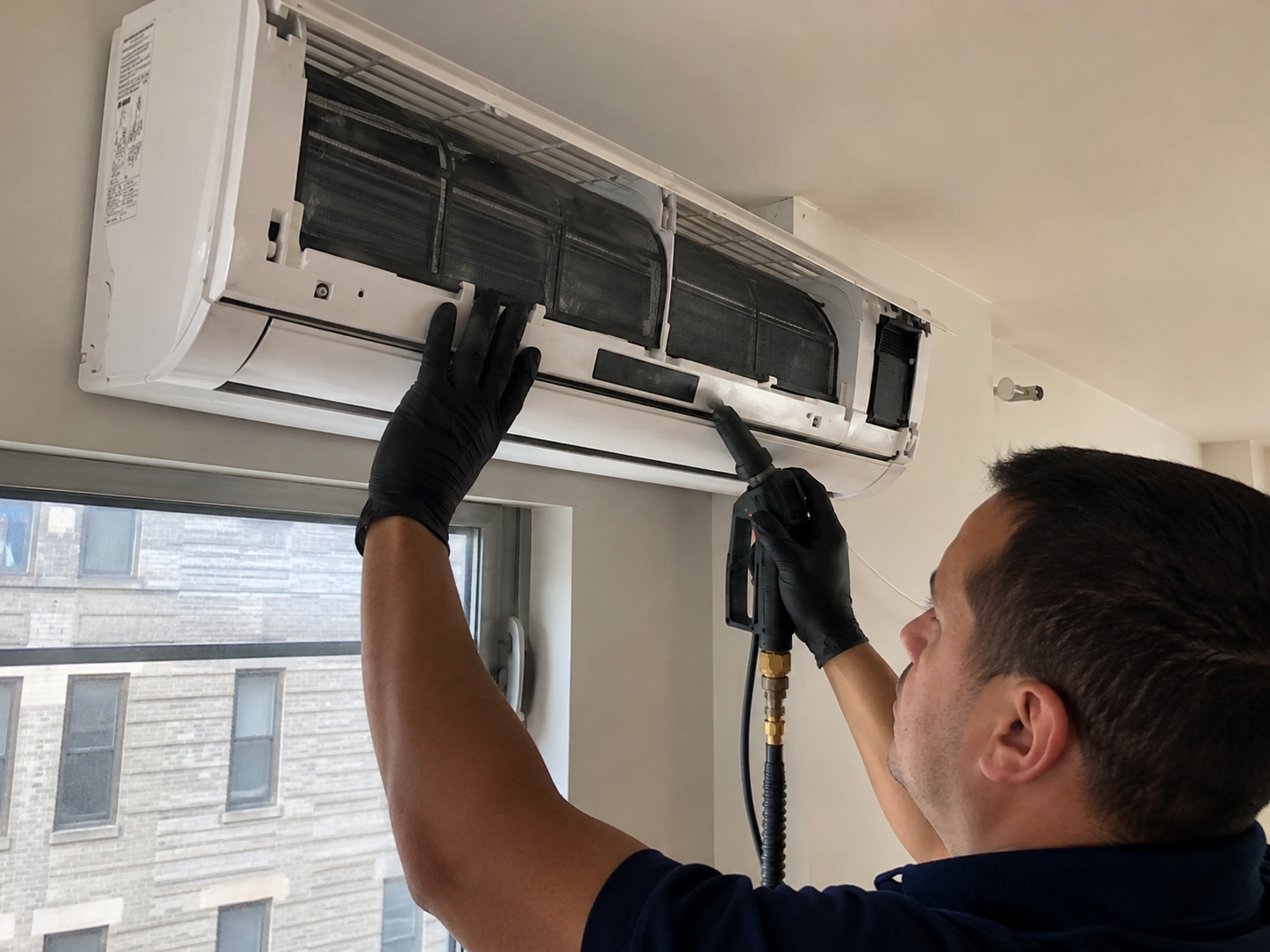
- Mini split cleaning: best for ductless indoor heads with odor, visible buildup, weak airflow, dirty filters, blower wheel debris, or seasonal cleaning requests.
- Air handler or fan coil cleaning: best for indoor cabinets, closet units, fan coils, filter racks, coil sections, blower areas, and drain pan concerns where access is safe.
- Condensate maintenance: best when the concern is water, pan buildup, pump behavior, float switch shutdown, drain routing, or recurring wet spots.
- Thermostat and control review: best when the unit responds incorrectly, cycles too often, does not call for cooling or heat, or shows controller confusion.
- Repair handoff: needed when cleaning reveals ice, electrical symptoms, outdoor-unit failure, severe noise, control failure, or possible refrigerant-side trouble.
What maintenance can check
Maintenance can check visible and accessible conditions: filters, return obstructions, indoor coil condition, blower area, louvers, drain pan signs, condensate path, pump reservoir condition where accessible, thermostat setting, controller behavior, basic airflow response, and signs that the system needs repair rather than cleaning. The exact work depends on equipment design, access, building rules, and whether the customer has sent enough photos to classify the job.
Official guidance supports the maintenance logic without turning it into a one-size-fits-all claim. The Department of Energy explains that dirty filters reduce airflow and that dirt on evaporator coils can reduce performance. Manufacturer guidance for split systems treats filter cleaning as routine owner maintenance but leaves exact intervals and access to the model manual. NYC split-system maintenance guidance identifies filter, fan coil, outdoor fin, odor, leak, thermostat, and performance complaints as maintenance concerns. The useful public claim is simple: clean, accessible components help the system move air and manage heat exchange, but maintenance does not replace diagnosis.
What maintenance should not promise
HVAC maintenance is not a promise to recharge refrigerant, open sealed lines, solve a compressor issue, repair hidden wiring, replace a control board, fix a hydronic valve, or correct a building-loop problem. If a system has ice, water near wiring, repeated breaker trips, burning odor, harsh mechanical noise, error codes, or no response from the unit, the request should be routed as diagnostic repair or reviewed before being accepted as cleaning.
Maintenance also should not rely on broad air-quality claims. EPA guidance around duct cleaning warns consumers to be careful with unsupported contamination and health claims. Volt & Vector should document visible buildup, equipment condition, and what was cleaned or not accessible. If a customer is worried about indoor air quality, the page should stay practical: send photos, identify the equipment, describe the symptom, and avoid treating cleaning as a medical or health claim.
Photos that make the request useful
A strong HVAC maintenance request includes a photo of the equipment, the thermostat or controller, the filter area if accessible, visible buildup, water or staining if present, the brand/model label when visible, and any outdoor unit photo that can be taken safely. For noise, airflow changes, or intermittent operation, a short video can help. The customer should not climb to a roof, open unsafe panels, enter a mechanical room without permission, test live electrical parts, attach gauges, or force a locked access panel.
NYC access and COI notes
Maintenance in Brooklyn and Manhattan often depends on access more than the equipment itself. Finished floors, tight closets, built-ins, ceiling units, elevator rules, freight access, doorman instructions, building staff, and water handling all affect the visit. If the building requires a certificate of insurance, that should be disclosed in the request. If outdoor access is controlled by management, the page should ask for that before scheduling is discussed.
How the request is routed
The request form should ask for the equipment type, symptoms, photos, unit count, ZIP code, building access, COI requirement, and desired windows. After review, the request can be routed into a cleaning path, a maintenance path, a condensate/drain path, a thermostat/control path, or repair diagnostics. If the information is not enough, the next step should be a request for photos or clarification, not a generic sales response.
Page routing for organic search
This maintenance hub routes maintenance queries. It routes to mini split cleaning when the customer has a ductless indoor head. It routes to fan coil and air handler cleaning when the equipment is a closet unit, fan coil, or indoor cabinet. It routes to condensate drain repair when water is the main issue, and to thermostat repair when the complaint is command or control behavior. Broader cooling or heat pump failures should route to AC or heat pump repair.
Quick answers
Is HVAC maintenance the same as repair? No. Maintenance checks accessible conditions and cleaning needs. Repair starts when a component, control, refrigerant-side condition, electrical issue, drain failure, or access limitation must be diagnosed separately.
Can a dirty filter cause weak airflow? Yes. Dirty or clogged filters can restrict airflow. A dirty coil or blower area can also affect performance, but the exact cause still needs equipment-specific review.
Can maintenance fix water around the unit? Sometimes. If the issue is dirty pan buildup or a visible restriction, maintenance may help. Pump, float switch, drain pitch, ice melt, or hidden routing problems may need condensate repair.
What makes this NYC-specific? Access, COI needs, equipment location, outdoor-unit access, finished apartments, and building rules can change what is possible during a visit.
Examples of correct maintenance routing
A customer with a ductless head that smells stale and has visible dust should be routed to mini split cleaning. A customer with a closet air handler, dusty filter rack, and weak airflow should be routed to air handler or fan coil cleaning. A customer with water on the floor, a pump reservoir, or a float switch shutdown should be routed toward condensate review. A customer with a blank thermostat, confusing schedules, or no call for cooling should be routed toward thermostat or control troubleshooting. This routing prevents a maintenance page from becoming a vague promise to fix every HVAC complaint.
The hub should also explain what the customer can safely do before submitting a request: confirm thermostat mode, photograph the unit, photograph the controller, check an accessible filter if the manual allows it, note whether water or ice is present, and describe who controls access. The customer should not open sealed equipment sections, force panels, enter roofs or mechanical rooms without permission, perform energized testing, or attach gauges. Those boundaries make the page safer and more useful.
What the request should capture
A useful maintenance request captures service data, not only a visitor's question. Each request should identify the equipment type, symptom, building type, ZIP code, photo quality, access limitation, and whether the visitor is ready to pay for cleaning or only asking a question. Those fields help decide which maintenance pages are working. If most requests are ductless heads with odor or weak airflow, mini split cleaning should get more internal links and photos. If requests are mostly closet units, fan coils, or drain pans, the air handler and fan coil page should become the stronger child page.
Source-backed maintenance notes
This maintenance hub uses official guidance as guardrails: DOE air conditioner maintenance guidance supports the focus on filters, coils, airflow, and dirt control; NYC HPD split-system maintenance guidance supports routing around filters, fan coils, outdoor fins, leaks, odor, thermostat setup, and performance; Trane ductless maintenance guidance, Fujitsu support manuals, and Daikin owner manuals keep filter care model-specific; and EPA duct-cleaning guidance limits broad air-quality and health claims.
HVAC Maintenance Decision Matrix
- Weak airflow: check filter fit, return obstruction, blower buildup, indoor coil condition, and fan response before assuming a failed motor.
- Warm air or weak cooling: separate dirty coils, blocked outdoor airflow, thermostat mode, fan operation, and refrigerant-side symptoms before repair approval.
- Water near the unit: inspect drain pan, trap, condensate line, pump, float switch, pitch, and ice-melt evidence before calling it simple cleaning.
- Odor or visible debris: start with the indoor head, filter, blower area, and drain pan condition, then document what is accessible.
- Control confusion: verify thermostat mode, schedule, controller response, and equipment reaction before replacing controls.
- Repair handoff: route ice, electrical symptoms, harsh noise, error codes, or no-response complaints outside basic maintenance.