

.png)

A Bosch ice maker that is not making ice should be checked as a sequence, not as one part. Bosch support says to check whether the ice maker is switched on, whether the water supply is connected and open, and to allow time after the ice maker has just been switched on. Bosch refrigerator manuals also point to water pressure, blocked or old filters, low ice production after recent connection, freezer door opening, and ice bin or dispenser conditions. The ice maker cannot produce cubes unless every step in that chain works.
Start with the basics: is the freezer cold, is the ice maker enabled, is the bin seated, is the water supply available, and did anything change recently such as filter replacement, water shutoff, door-left-open event, new installation, or power outage? Those facts usually narrow the complaint before any ice maker assembly is blamed.
Read the ice maker sequence
An ice maker needs water fill, freezing time, temperature feedback, harvest, and a bin that is not signaling full. If there is no water in the mold, the branch points toward water supply, filter, inlet, fill tube, or control permission. If water fills but never freezes, freezer temperature or airflow is the first branch. If cubes freeze but do not eject, harvest or mechanical ice-maker behavior becomes more likely. If cubes are made but do not dispense, that is a dispenser/bin/chute branch, not a no-production branch.
Do not skip to the part name. A blocked filter and a disabled ice maker can look identical from the outside. A freezer that is too warm can leave production low or stopped. A bin not seated can prevent production on models that sense bin position. A new filter can introduce air and temporarily change water behavior.
Safe owner checks
- Confirm the ice maker is switched on by the control panel or model-specific setting.
- Check the freezer setpoint and actual temperature if you have a thermometer.
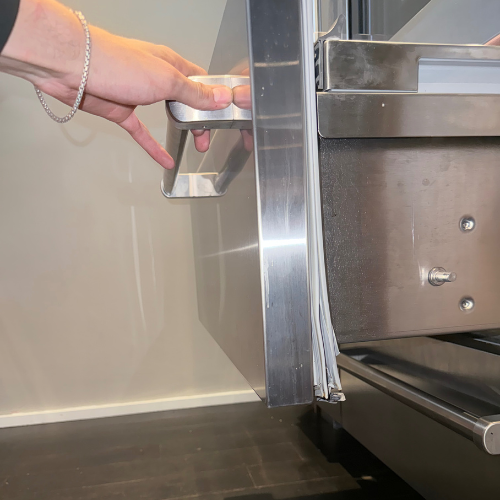
- Confirm the freezer door closes fully and the gasket is not obstructed.
- Make sure the ice bin is inserted and aligned correctly.
- Check when the water filter was last replaced and whether water flow is reduced.
- Confirm the water supply valve is open if it is safely accessible.
- If the unit was recently installed or ice maker was just enabled, allow the manual's production time before judging.
Do not pull a built-in refrigerator forward, thaw hidden lines with a heat gun, remove freezer panels, force the ice maker arm, or test the water valve electrically. If water supply access is behind a heavy unit or inside cabinetry, stop and plan service access.
What no ice does not prove
No ice does not prove the ice maker assembly failed. It does not prove the valve failed. It does not prove the control board is bad. The appliance may be off, waiting after restart, too warm, starved by water pressure, restricted by filter, sensing a full bin, blocked by ice in the chute, affected by door openings, or not getting water because of an installation issue.
Another false assumption is that the water dispenser and ice maker always fail together. Some refrigerators share supply and filter conditions, but the dispenser branch and ice-maker branch can separate. A dispenser may work while ice production is low if the freezer temperature or ice maker setting is the issue. An ice maker may stop after a filter change if air or flow restriction affects filling.
Filter and water supply clues
Bosch support and manuals repeatedly point to water supply and filter conditions. If water output is reduced, check the supply, pressure, external filtration, and water filter by the manual. A blocked or old filter can reduce flow enough to slow or stop ice production. A reverse-osmosis system can lower pressure if not installed according to appliance requirements. A closed saddle valve or kinked line can mimic an ice maker failure.
If the refrigerator was moved, a water line can kink. If a filter was changed, it may not be seated. If plumbing work was done, air may be in the line. If the home water supply was shut off, the ice maker may need time to refill and cycle. Record the event rather than only the final symptom.
Temperature and door clues
Ice production depends on the freezer being cold enough and recovering normally. Bosch FAQ guidance recommends a freezer temperature around 0 F. If the freezer is warmer, ice production may slow or stop. Frequent door openings, a leaking gasket, a bin not seated, food blocking airflow, or a recent large grocery load can delay production even when the ice maker is healthy.
If the freezer is also softening food, this is no longer an ice-maker-only page. Protect food and use the warm-freezer or cooling branch. An ice maker is often the first feature people notice, but it is not the most important if freezer temperature is out of range.
One useful observation cycle
After safe checks, avoid repeated resets. Instead, write down the state: ice maker on, freezer temperature, water filter age, dispenser water flow if present, bin seated, door closing, and whether any cubes are in the mold or bin. Then allow a normal production window. If the freezer is cold and the ice maker is enabled but the mold stays dry, the water-fill branch is stronger. If the mold contains ice but never dumps, the harvest branch is stronger.
If cubes form as one fused block, note that separately. That can point toward fill, temperature, door-open, or harvest timing issues. Do not chip at the mold with metal tools.
When to stop
- Stop if the freezer is warming or food safety is at risk.
- Stop if there is water leaking from the filter, supply line, ice maker area, or floor.
- Stop if access requires pulling a built-in or heavy refrigerator forward.
- Stop if the ice maker is jammed and cannot move freely without force.
- Stop if the water filter will not seat correctly or leaks under pressure.
- Stop if no ice returns after safe on/off, bin, temperature, filter, and supply checks.
Evidence to save
Save the model tag, freezer setpoint and actual temperature, ice maker on/off state, bin photo, filter part and replacement date, dispenser water flow behavior, water supply valve photo if safely visible, and a photo of the ice mold or bin. Write down recent events: new installation, filter change, water shutoff, door left open, power outage, app setting change, or refrigerator movement.
That evidence lets service separate a settings issue, filter flow issue, water-supply problem, temperature problem, bin-sensor issue, fill-tube restriction, harvest issue, or ice maker assembly fault. It also avoids unsafe thawing and panel removal.
Production speed versus no production
Low ice production is not the same as no production. Low production after a new connection, recent door openings, or filter change may need time and water-flow proof. No production with a dry mold points toward water fill or permission. No production with frozen cubes stuck in the mold points toward harvest. No production with a warm freezer is a cooling problem first. Keep these states separate when describing the issue.
If the refrigerator recently started making smaller or hollow cubes, the water-flow branch is stronger than an ice-maker motor branch. If cubes are normal but the bin stays nearly empty, production rate, door opening, freezer temperature, and bin sensing become more important. If cubes fuse together, temperature swing or fill/harvest behavior should be documented.
Smart controls and hidden settings
Some Bosch refrigerators can have control-panel or connected settings that affect ice making. Do not rely only on memory that the ice maker was on last week. Confirm the setting at the appliance and note any app or display state if available. If the issue began after a power outage, app change, filter reset, or child-lock change, record that event.
Do not perform service-menu resets from forum instructions. A normal on/off check and one power reset only if the manual allows it is different from changing hidden settings. Preserve the original state before clearing anything.
Water dispenser comparison
If the refrigerator has a water dispenser, compare dispenser flow to ice production. Strong dispenser flow with no ice does not eliminate every water issue, but it makes total supply loss less likely. Weak or sputtering dispenser flow after a filter change keeps filter seating, air in the line, and supply pressure in play. No dispenser on the model means the ice maker may be the only visible water-use test, so the filter and supply history become more important.
If the dispenser drips or water appears near the filter, stop treating the problem as only "no ice." A water leak changes the risk and moves the branch toward filter, line, or connection evidence. Photograph the leak before turning the ice maker back on.
Door and bin details
Ice production can stop when the appliance thinks the bin is full, misaligned, or not present. Remove and reseat the bin only as the manual allows. Check for a fused block of cubes that holds the arm or sensing area in a full position. Do not chip at plastic parts. If the bin was recently washed and reinstalled, make that part of the timeline.
Useful next branches
If the issue is a different brand ice maker, compare Miele ice maker not working. If water and ice dispensing are disabled by a lock state, use water/ice dispenser locked or not working. If water appears around the refrigerator after filter or dispenser use, see refrigerator leaking water. If the freezer is cold but the fresh-food section is warm, use freezer cold but fridge warm for the airflow branch.
Common questions
Should I replace the ice maker first?
No. Confirm on/off state, freezer temperature, bin seating, water supply, and filter flow before naming the ice maker.
How long should I wait after turning it on?
Follow the model manual. Ice production is not immediate after installation, restart, or switching the ice maker on.
Can a filter stop ice production?
Yes. A blocked, old, incorrectly seated, or incompatible filter can reduce water flow enough to affect ice.
Is a warm freezer an ice maker problem?
No. If freezer temperature is not safe, treat it as a cooling problem first.
.jpeg)