


Bosch Dryer E01/E02 Error Code: Lint Filter or E02 Fault?
Bosch dryer E01 or E02 usually points to the lint filter, but E02 can be model-specific. Learn what to clean safely, what not to do, and when service diagnosis is needed.
Bosch dryer E01 or E02 usually points to the lint filter, but E02 can be model-specific. Learn what to clean safely, what not to do, and when service diagnosis is needed.
.avif)
A Bosch dryer E01 or E02 code usually points first to the lint filter: remove lint, rinse the filter if residue is blocking it, dry it completely, and reinstall it before restarting. E02 needs one extra guard because Bosch also lists a separate E02 relay/control fault in its broader dryer code table, so use the E-Nr and exact display before assuming a board problem. Stop if the code returns after safe visible checks, the filter is damaged or missing, there is a burning/electrical smell, water near power, or a repeated breaker trip.
Bosch's exact E01/E02 dryer guidance points to the lint filter first. Treat that as the first answer, then use the model label and exact display to decide whether E02 needs a separate electronic-fault diagnosis.
Keep this page on E01/E02. Bosch dryer codes that look adjacent can point to different systems.
A clean-looking filter does not prove the whole airflow or code-recognition route is clear.
Use the exact symptom when the displayed code is not the whole problem.
Stop homeowner checks if E01 or E02 returns after the lint filter is clean, dry, and seated and any model-allowed condenser or visible airflow check is done. Stop immediately if there is a burning or electrical smell, smoke, scorch marks, water near electrical areas, a damaged cord, repeated breaker trip, a missing or damaged lint filter, or unstable access to a stacked or built-in dryer.
Do not run the dryer without the lint filter, puncture the filter, bypass a switch or thermal device, reset internal thermostats, test live voltage, open the control area, or keep restarting the dryer to finish a load. Those actions can turn a filter or airflow warning into a fire, electrical, or component-damage risk.
Service diagnosis should start with the E-Nr, exact display, and which Bosch source applies to that model. For the lint-filter route, diagnosis should confirm filter airflow, filter seating, filter housing condition, condenser or heat-exchanger condition where applicable, air inlet or vent restriction, temperature behavior, and whether the dryer recognizes corrected airflow.
For a persistent model-specific E02, diagnosis should confirm the service-data route before naming a board or relay. That can include relay/control output, wiring, sensor input, fault history, and whether an airflow or filter issue is being misread as an electronic fault.
They often share the lint-filter route on Bosch's exact E01/E02 guidance, but E02 needs an extra model check because Bosch also lists a separate E02 relay/control fault row in the broader dryer code table. Treat lint-filter cleaning as the first safe action, then use the E-Nr and manual if E02 returns.
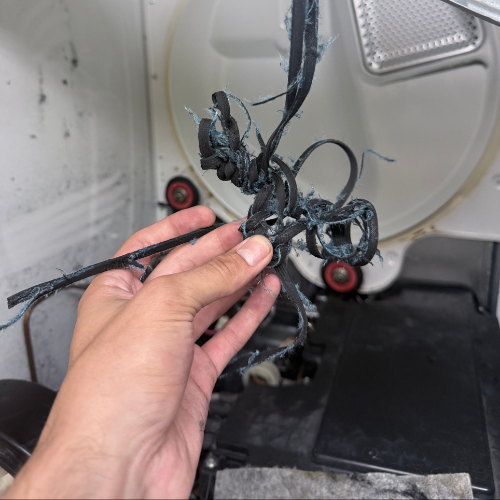
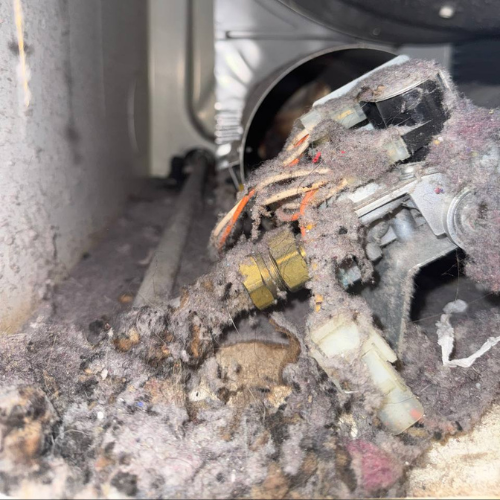
The filter may still be wet, residue-coated, damaged, missing, or mis-seated. The restriction can also be in the owner-accessible filter opening, condenser or heat exchanger on some models, blocked room air, or a downstream vent/airflow route. If the code returns after safe visible checks, diagnosis has to prove airflow and sensing instead of guessing a part.
No. Do not run the dryer without the lint filter, and do not puncture or modify the filter. The filter is part of lint control and airflow management; bypassing it can move lint into unsafe areas and can damage the dryer.
No. E12 is the Bosch restricted-airflow or overheating neighbor, so it can point to a related airflow family, but it is a different displayed code. Photograph the exact code before choosing the repair route.
Not from the code alone. Bosch has an official E01/E02 lint-filter route and also a broader E02 relay/control row. If E02 persists after correct filter and airflow checks, the model-specific control diagnosis needs technician diagnosis; it is not a homeowner board-replacement instruction.
Bosch requests are considered in Brooklyn, Manhattan below 96th Street, and selected Queens routes including Astoria and Long Island City when the exact address and route availability are confirmed.
.jpeg)


Technician experience standard: 4+ years of hands-on appliance repair per technician; senior technicians bring 8 and 16 years. Bosch intake starts with the complete E-Nr, failed cycle stage, display, and installation access. Independent service; no current manufacturer authorization implied.

