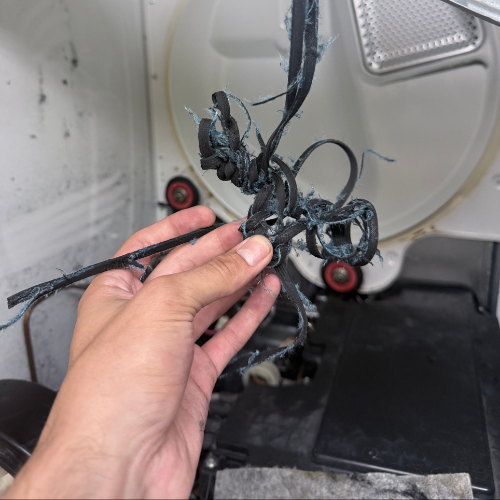
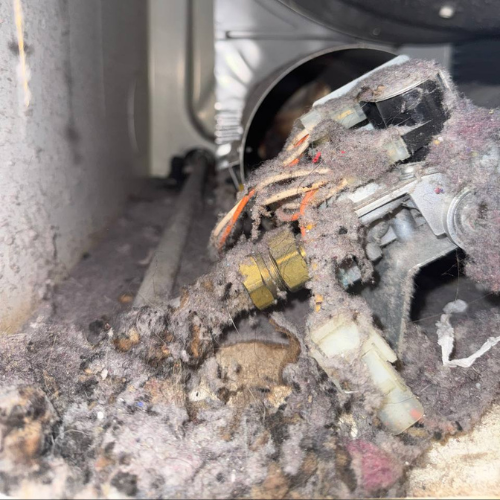
Most Common Reasons a Bosch Dryer Is Leaking Water
Use the row that matches where water first appears before naming a part.
- The direct drain hose is kinked, loose, blocked, sealed, submerged, or routed too high: Bosch drain instructions require water to flow freely, the hose to stay secured, and the hose to avoid kinks, crimps, standing water, and blocked drains. If condensate cannot leave the dryer, it can back up or leak around the rear hose, standpipe, sink, floor drain, or shared washer drain. The useful service confirmation is hose routing, drain acceptance, backflow risk, height, and pump discharge, not a blind pump replacement.
- The condensation container is full, not seated, or set up incorrectly: Bosch tank-mode dryers collect condensate in a container, and the container must be emptied, kept upright during removal, and pushed fully back into position. Some direct-drain setups still require the tank to remain seated even when the tank does not need routine emptying. Water at the drawer or tank area points first to tank seating, filter or plug setup, overfill, crack, or sensor response.
- The dryer is not level: Bosch troubleshooting names an unlevel dryer as a water-leak cause. In a compact closet, drain pan, or stacked installation, a small tilt can send water toward one front corner or make the cabinet look like the origin. The confirmation is level front-to-back and side-to-side, all feet touching, and whether correction changes the leak.
- The heat exchanger, condenser area, seal, or lint route is dirty or not seated: Bosch manuals list a dirty heat-exchanger seal as a water-leak cause, and Bosch cleaning guidance separates owner-safe condenser and lint-filter cleaning from internal repair. Water at the lower maintenance flap, after condenser cleaning, or around a poorly seated cap belongs in this case. Do not scrape the heat exchanger with hard or sharp tools.
- The drain hose itself leaks or is not clamped securely at the dryer: Bosch troubleshooting tells users to check the whole drain hose for leaks and confirm the hose is clamped securely on the hose barb. Water tracking along the hose or starting at the back after the dryer was moved is different from water appearing at the tank or lower front.
- The shared standpipe, sink, wall drain, or adjacent washer is backing up: Bosch drain guidance requires a free-flowing, ventilated drain. If the dryer shares a drain point with a washer, a building drain restriction can look like a dryer leak. If the washer is the active water origin, use the washer leaking water from the bottom page instead of treating the Bosch dryer as the failed appliance.
- A hidden condensate pump, sump, sensor, internal hose, or cabinet seal is failing: This becomes more likely only after the visible hose, tank, level, heat-exchanger, and drain-acceptance checks are separated. The homeowner-safe answer is to preserve the evidence, not open the cabinet.
Match the Water Location to the Bosch System
- Rear hose, wall drain, standpipe, sink, or floor drain: Start with direct drain routing. Look for a kinked hose, crushed hose, hose end sitting in standing water, loose rear connection, sealed drain opening, drain height problem, or a house drain that backs up.
- Condensation drawer, tank, or front container area: Start with the tank. Empty it, keep it level, check for obvious damage, and reseat it fully if the manual allows owner access.
- Lower front heat-exchanger or condenser flap: Start with heat-exchanger seating, cap/seal condition, lint buildup, and whether the owner-accessible parts were cleaned and dried correctly. If water is pooling behind owner-accessible parts, stop before internal sump or pump work.
- One front corner or a dryer that rocks: Start with leveling and installation position. A leak from one corner after a move, stack shift, or pan change does not prove a pump.
- Water plus DR, Check Drain, or E03 wording: Treat the warning as a drainage clue. Bosch identifies E03 as a blocked or kinked condensation drainage hose, and Bosch manuals tie DR/check-drain behavior to incomplete drainage or blocked drain hose conditions.
- Water plus warm wet laundry or long dry time: A leak complaint can overlap with moisture-removal problems. If water is not on the floor and the main complaint is hot clothes that stay wet, compare Bosch dryer hot but clothes wet.
- Water appears when the washer runs: Separate the adjacent appliance and drain. A shared standpipe, washer hose, washer pump, or drain pan can put water under the laundry pair while the dryer is only nearby.
What You Can Check Safely
- Photograph the first water location: Take a photo before cleanup. Rear hose water, front tank water, lower flap water, and one-corner water point to different systems.
- Turn the dryer off before checking water: Do not continue cycles while water is reaching the outlet, plug, cord, controls, washer base, cabinet, or drain pan.
- Find the model and E-Nr: Bosch dryer water routing varies by model. Record whether the dryer is condenser, heat pump, ventless, vented, stacked, built in, direct drain, or tank collection.
- Check the condensation container if your model uses one: Empty it, keep it upright, look for obvious cracks, and push it fully back until seated. Do not force a stuck container.
- Check only the visible drain hose: Look for kinks, crimps, crushed routing behind the dryer, a loose visible connection, the hose end sitting in standing water, or a drain that backs up. Do not disconnect the hose from an internal pump or sump connection.
- Clean only owner-accessible filter and condenser parts: Let parts cool, follow the model manual, dry parts before reinstalling where required, and avoid sharp tools, scraping, or spraying water into the cabinet.
- Check visible leveling only if access is safe: If the dryer rocks and is not stacked or wedged in cabinetry, record the condition. Do not pull out a stacked or built-in dryer to reach hidden feet.
- Record shared-drain clues: Note whether the washer was running, whether the standpipe gurgled or overflowed, and whether water appears with the dryer off.
When to Stop
- Water is near power: Stop for water at the outlet, plug, cord, control area, powered washer base, or appliance base.
- The dryer must be moved for access: Stop if the unit is stacked, built in, gas-connected, tightly wedged, or likely to strain hoses, cords, or drain lines.
- The leak returns after visible checks: Repeating cycles only adds more water to the same unresolved route.
- DR, Check Drain, or E03 returns with water present: The warning may be a drain clue, but repeated operation is not a repair.
- Water appears from inside the cabinet or lower base: Hidden pump, sump, internal hose, or seal diagnosis belongs to service.
- There is electrical smell, burning smell, breaker trip, or damaged cord: Do not keep testing the dryer.
- The next step requires panels, live testing, bypasses, or internal hose work: Those are not homeowner checks.
What Diagnosis Must Confirm
A useful Bosch dryer diagnosis should separate where condensate is supposed to go from where it is escaping. The visit should confirm tank mode versus direct drain, rear hose routing, hose condition, clamp and barb connection, drain height, free-flowing drain acceptance, level, heat-exchanger cap and seal condition, lint bypass, condensate sump pickup, pump movement, sensor response, and whether the washer or building drain is the real water origin.
That separation matters because the same puddle can come from a setup problem, a maintenance problem, an installation problem, a building drain problem, or a hidden dryer component. A pump, sensor, control, seal, or internal hose should be named only after the visible Bosch water route is proven.
What to Record Before Service
- Model details: Model number, E-Nr, serial label, and whether the dryer is ventless, condenser, heat pump, direct drain, tank collection, stacked, or built in.
- Water start point: Rear hose, tank/drawer, lower heat-exchanger flap, one front corner, drain pan, wall drain, or adjacent washer area.
- Timing: During the cycle, after shutdown, when the tank is removed, after the washer runs, or after the dryer was moved.
- Display wording: DR, Check Drain, E03, tank/container light, filter/condenser warning, shutdown, or no warning.
- Recent change: New install, hose moved, dryer pushed back, tank cleaned, condenser cleaned, washer drain work, building plumbing work, or stack/closet changes.
- Load clue: Whether laundry was unusually wet from the washer, whether this happens only with bulky loads, and whether the paired symptom is a drying problem rather than a floor leak.
- Access clue: Photos of the stack, closet, rear hose if visible, drain point, floor pan, and nearby washer connections.
FAQ
Is water inside a Bosch ventless dryer normal?
Some water is normal inside the condensate system because condenser and heat-pump dryers remove moisture from laundry as liquid condensate. Water on the floor, around the rear hose, under the lower flap, or near power is not the normal result.
Does Bosch E03 mean my dryer is leaking?
Not by itself. Bosch identifies E03 as a blocked or kinked condensation drainage hose. That can explain water backing up or a drain-related leak, but it does not prove a failed pump, sensor, or control board without the hose, drain, tank, and level checks.
Why is the tank filling when a drain hose is connected?
Bosch models and drain setups vary. Some manuals describe direct drain mode where the tank does not need routine emptying, while the tank still must remain installed and seated. If the tank fills, leaks, or triggers a warning after a drain-hose setup change, the setup, plug/filter arrangement, hose routing, and model-specific tank route need confirmation.
Can a washer or shared drain make it look like the Bosch dryer leaks?
Yes. If water starts near a shared standpipe, sink, drain pan, or washer hose, the building drain or washer can be the origin. The dryer case is strongest when water starts at the dryer tank, rear dryer hose, lower heat-exchanger area, or dryer corner during dryer operation.
Should I replace the condensate pump first?
No. A Bosch dryer leak does not start with a pump verdict. The safer order is water location, tank setup, visible hose routing, drain acceptance, leveling, heat-exchanger/seal condition, and then hidden pump, sump, sensor, or internal hose diagnosis.

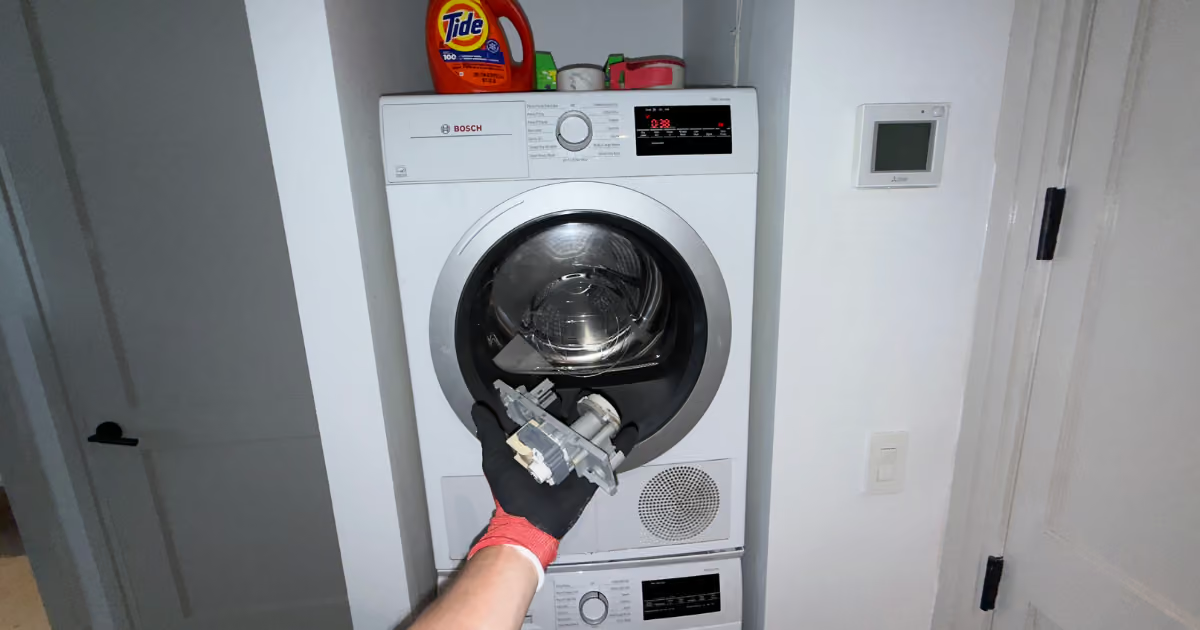

.jpeg)