Most Common Reasons a Bosch Dryer Keeps Stopping Mid-Cycle
A Bosch dryer that stops before the cycle is finished needs a stop-pattern read first. The useful clue is not only "it stopped"; it is when it stopped, what the display showed, whether the clothes were hot or damp, and whether the dryer is vented, condenser, heat-pump, or ventless.
- Door opens, the latch signal drops, E16 appears, or DR is door-side on that model: Bosch identifies E16 as a door-open event during drying, and current Bosch DR guidance points to the door not being fully closed or the door switch not being recognized. Safe evidence is laundry caught at the seal, a door that does not click shut, a loose latch feel, E16, DR, a door symbol, or a stop when the load bumps the door. Diagnosis must separate latch alignment, switch signal, harness, and control recognition without bypassing the door switch.
- Condensate tank, visible drain hose, pump route, or Check drain interruption: On condenser, heat-pump, and ventless Bosch dryers, water handling can stop or cancel drying. Bosch manuals say a full condensate container can cancel the next program, and Check drain points to incomplete draining or a blocked/kinked hose. Safe evidence is a tank, drain, or water symbol, E03, a full container, a kinked visible hose, water that is not leaving normally, or a DR warning on a model manual that uses DR for drain behavior. Diagnosis must confirm container seating, hose routing, drain height, backflow, pump output, sump restriction, water-level sensing, wiring, and control recognition.
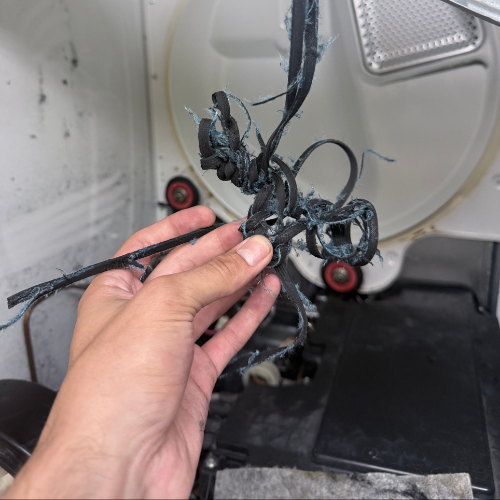
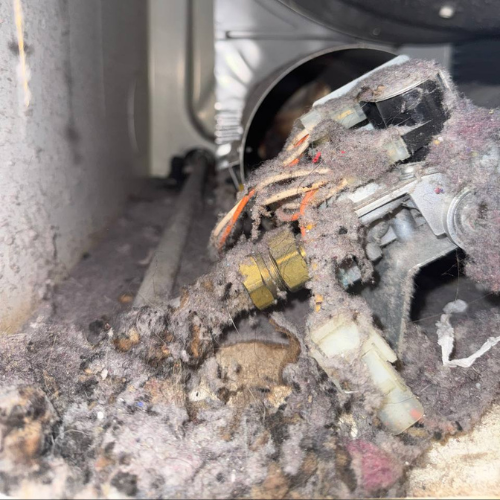
- Lint filter, heat exchanger, condenser, vent, air inlet, or E12 airflow/overheat diagnosis: Bosch says lint, vent blockage, and restricted airflow can make a dryer stop or fail to dry correctly. E01/E02 points to lint-filter blockage, and E12 can point to overheating from restricted airflow. Safe evidence is a filter or condenser indicator, E01/E02, E12, long drying before the stop, a hotter-than-normal load, a blocked exterior vent on vented models, a dirty heat exchanger, or poor room airflow around a ventless dryer. Diagnosis must measure airflow, temperature behavior, blower route, condenser condition, thermal protection, and stored faults.
- Moisture sensor residue, load size, wrong program, or maximum drying time: Bosch connects early stopping or damp results with program choice, load size, sensor residue, and maximum drying time. Safe evidence is a very small load, overloaded drum, mixed heavy/light fabrics, a sensor program ending early, damp clothes at normal end, or moisture sensor bars that look coated near the lint filter area. Diagnosis must confirm sensor feedback, dryness-level calibration, load response, airflow influence, and control interpretation.
- Power cut, breaker, outlet, cord, or control reset: Bosch tells owners to check power and breaker, and Bosch manuals say a drying program is interrupted by a power cut and must be restarted. Safe evidence is a dark display, a control reset, a tripped breaker, a stop after another high-load appliance runs, or a cycle that does not continue after power returns. Diagnosis must prove the electrical circuit, receptacle, cord, terminal condition, control power, and fault memory.
- Hidden motor, drive, fan, thermal device, sensor, wiring, relay, or control fault: If the visible Bosch checks do not explain the stop, the failure moves into service diagnosis. Safe evidence is a hum, click, restart only after cooling, stop at the same minute, no code, an electronics code, or the same warning returning after the visible correction. Diagnosis must test the motor and drive load, blower or fan route, thermal protection, wiring, sensor feedback, relay/control output, and stored diagnostics.
Match the Stop Pattern Before You Restart
- Stops immediately after Start/Pause: Check door closure, laundry caught at the seal, program selection, Start/Pause response, E16, DR, key symbol, or delay setting.
- Stops after 5 to 15 minutes: Look for tank, drain, water-container, DR, E03, overheating, airflow, motor, or control clues. Record the exact minute and display before clearing it.
- Stops near the end with damp clothes: Check whether the dryer ended normally, hit maximum drying time, misread a sensor load, used the wrong program, or ran with restricted airflow.
- Stops with E01/E02, filter, or condenser indicator: Clean only the owner-accessible lint filter, condenser, heat exchanger, or filter area that the model manual allows.
- Stops with E03, tank, drain, or water symbol: Empty the container if the model has one and inspect only the visible drain hose for kinks, crushing, loose connection, or standing-water backflow.
- Stops with E12 or hot-load behavior: Treat airflow and overheating as the first diagnosis. Do not keep restarting to finish the load.
- Stops with E16, DR, or door symbol: Treat door recognition as the first visible diagnosis unless the exact model manual points DR to drain behavior.
- Stops with a dark display or tripped breaker: Check power once only if there is no odor, heat mark, water, or visible damage. If the breaker trips again, stop.
Safe Checks Before Service
- Model label: Photograph the Bosch E-Nr, FD, model, and serial label before searching instructions or booking service.
- Display: Photograph the exact code or symbol before unplugging, resetting, or clearing it.
- Door interruption: Clear any fabric caught at the opening, close the door normally, and note whether the cycle stops when the door or cabinet is touched.
- Lint filter: Clean the lint or fluff filter before the next test cycle and reinsert it fully dry if the manual requires drying after rinsing.
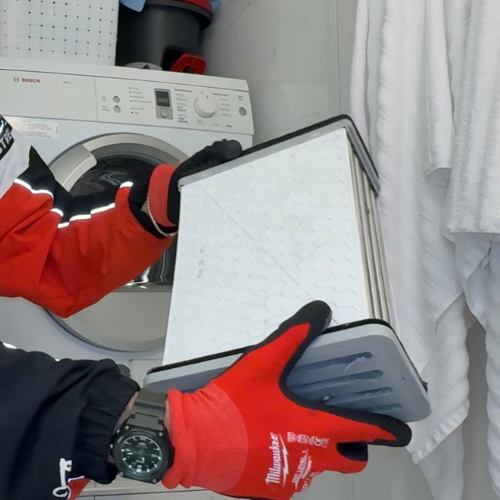
- Condenser or heat exchanger: Clean only the owner-accessible part shown in the model manual. Do not force panels or sharp tools into the dryer.
- Moisture sensor: Wipe the sensor bars only by the model-approved method, usually a cloth and a little white vinegar near the lint filter area.
- Condensate container: Empty it on models that use a container and push it back until it locks into place.
- Visible drain hose: Look for kinks, crushing, loose connection, sharp bends, or a hose end sitting where water can flow back.
- Load and program: Reduce overload, separate mixed heavy/light items, choose the correct program, and use a timed program only when the manual points to a small-load or still-damp diagnosis.
- Stacked or closet access: Leave the installation in place so the power, drain, and airflow connections are not disturbed while the intermittent stop is being documented.
When Another Bosch Dryer Page Is the Better Fit
- It will not start at all: Use Bosch dryer won't start. That page starts with dead display, live display, lock, delay, and start-permission problems.
- It runs but does not heat: Use Bosch dryer not heating. The dominant question changes to heat generation and heat control.
- It runs but clothes stay damp: Use Bosch dryer not drying clothes. That page focuses on drying result after the machine can complete or nearly complete a cycle.
- It gets hot but clothes stay wet: Use Bosch dryer hot but clothes wet. Heat is present, so airflow, moisture removal, and load behavior move up.
- Water is under or around the dryer: Use Bosch dryer leaking water. A leak changes the safety and diagnosis boundary.
- DR is the main warning: Use Bosch dryer DR problem. DR needs model-specific door-versus-drain separation.
When to Stop Using the Dryer
- Breaker trips again: Leave the dryer off and do not reset the breaker repeatedly.
- Smoke, burning smell, or electrical odor appears: Do not run another test cycle.
- Cord, plug, or outlet feels hot or looks damaged: Keep the dryer off and avoid touching damaged areas.
- Water is near the power area: Do not press controls or restart the cycle.
- Gas odor on a gas-supplied installation: Leave the area and use the local emergency gas procedure; cycle-stop diagnosis comes only after the gas hazard is cleared.
- A hot cycle was canceled or interrupted: Remove the laundry only if it is safe, then spread it out so heat can disperse.
- E12, electronics codes, or the same warning returns: Save the display and stop visible checks.
- The dryer hums, clicks, or restarts only after cooling: Stop repeated starts before the motor, drive, or control route is damaged further.
- Access is unstable: A stacked, built-in, or tight laundry-room dryer should not be moved without safe access planning.
What Diagnosis Must Confirm
The service visit should start with the E-Nr/model label, stop timing, and display state. The first task is to prove which system interrupted the cycle: door recognition, condensate handling, airflow/overheat protection, sensor/load logic, power supply, motor/drive load, or control output.
For a condensate or drain diagnosis, diagnosis should confirm the container, visible hose routing, backflow risk, pump output, sump restriction, water-level sensing, wiring, and control recognition. For an airflow or overheating diagnosis, it should confirm lint route, condenser or heat exchanger, vent or air inlet, blower route, temperature behavior, and thermal protection. For a door diagnosis, it should confirm latch engagement, switch signal, harness, and control recognition. The part should come after the failed signal is proven.
What to Record Before Service
- Model data: Bosch E-Nr, FD, model, and serial photo.
- Stop timing: Immediate stop, 5 to 15 minutes, near end, after heating, after moving the dryer, or after a power event.
- Display: DR, E16, E03, E01/E02, E04, E12, E56, tank, drain, filter, condenser, key symbol, or electronics code.
- Cycle type: Sensor/AutoDry, timed dry, delicate, cotton, mixed load, low heat, or another selected program.
- Load: Small load, overloaded drum, heavy towels, mixed fabric weights, very wet clothes from washer, or dry items.
- Door clue: Whether the door clicks, whether the drum light changes, and whether clothing was caught.
- Water clue: Full container, visible hose kink, water around the dryer, or drain connection change.
- Sound clue: Silence, beep, click, hum, buzz, scrape, fan noise, pump noise, or stop after cooling.
- Recent history: Cleaning, stacking, moving, power outage, breaker trip, leak, burning smell, previous DR, previous no-heat, or repeated reset.
FAQ
Why does my Bosch dryer stop after a few minutes?
A stop after a few minutes often points to the first signal the dryer checks under load: door recognition, tank or drain feedback, airflow/overheat protection, sensor reading, motor load, or power stability. Photograph the display and record whether it happens on timed dry as well as sensor programs.
Can a full condensate container stop a Bosch dryer?
Yes, on models that use a condensate container. Bosch manuals say a full container can cancel the next drying program. Empty the container, lock it back into place, and inspect the visible drain hose if the machine is connected to a drain.
Why does it stop and leave clothes damp?
That can be a true interruption or a sensor/program problem. Bosch points to program choice, load size, moisture sensor residue, lint/airflow restriction, full condensate handling, and maximum drying time. The clue is whether the display shows a warning or the dryer behaves like the cycle ended normally.
Does E16 mean the dryer is broken?
Not by itself. Bosch defines E16 as the door being opened during a drying cycle. Close the door securely and restart according to the controls. If E16 returns when the door is closed, diagnosis needs to check latch alignment, switch signal, wiring, and control recognition.
Should I keep restarting a Bosch dryer that stops mid-cycle?
No. One restart after a safe visible correction is different from repeated restarts. Stop if the same warning returns, the dryer trips a breaker, smells hot, shows smoke or electrical odor, has water near power, or restarts only after cooling.


.avif)
.jpeg)