Refrigerator Door Gasket Not Sealing: Fix, Replace, Cost, Heat
Volt & Vector Appliance Repair
Refrigerator door gasket not sealing? Use a diagnostics-first decision tree: visual checks, paper test, cleaning, obstructions, hinge sag, leveling, and ice patterns. Learn what a gasket is, why it goes bad, when to replace it, how to safely reshape it, why it can feel warm from anti-sweat heaters, and why replacement gaskets can be expensive.
Quick FAQ
Refrigerator Door Gasket Not Sealing

If your refrigerator door gasket (the flexible magnetic seal around the door) isn’t sealing, the #1 causes are dirt or grease on the sealing surfaces, a deformed gasket from heat and time (compression set), or door alignment issues (hinge sag or an out-of-level cabinet) that prevent uniform contact; replace the gasket when you have tears, permanently flattened sections, corners that won’t stay retained, or you cannot restore an even seal after cleaning, reshaping, and correcting alignment. A gasket can feel warm because many refrigerators use an anti-sweat (mullion/door-frame) heater or warm refrigerant routing to prevent condensation around the door opening, and that heat can transfer into the gasket area. Replacement gaskets can be expensive because they’re model-specific profiles with molded corners, integrated magnets, tight fit tolerances, and shipping/packaging constraints that prevent deformation, plus the risk of returns and rework when the fit is wrong.
What a refrigerator door gasket is (and how it seals)
A refrigerator gasket is a flexible perimeter seal attached to the door. Inside the gasket is a magnetic strip that pulls the gasket toward the steel cabinet flange (the front face/frame of the refrigerator opening). The outer portion of the gasket acts like a soft bellows: it compresses slightly when the door closes, creating consistent contact pressure around the full perimeter.
A good seal depends on three things working together:
- The gasket’s magnetic strip pulling the gasket toward the cabinet flange
- The gasket’s flexible bellows compressing evenly (not flattened, twisted, or kinked)
- The door being square and aligned so the gasket meets the flange uniformly
Door alignment matters more than most people think. A gasket can be new and clean and still leak if the door is sagging, the hinges are loose, the refrigerator is out of level, or the cabinet/door is slightly warped. The gasket can only compensate for small irregularities. Large gaps require alignment correction, not a stronger magnet and not glue.
Why is my fridge gasket not sealing? (diagnostic decision tree)
Use this flow in order. You’re trying to answer one question: is the gasket itself the problem, or is something preventing the door from closing squarely?
Step 1: Visual check with the door open
Look for obvious defects and where the failure is localized.
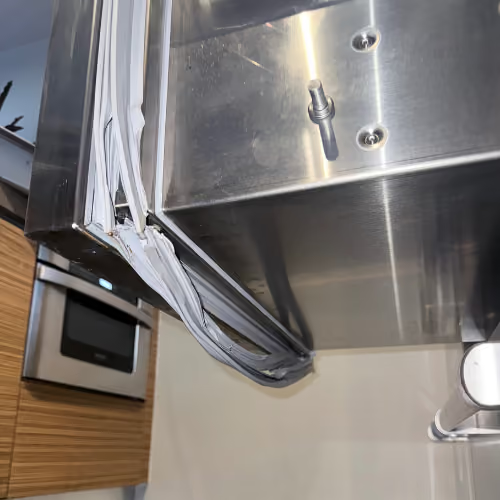
- Tears, splits, missing chunks, or corners pulled away from the door liner
- Areas that are shiny, hard, or permanently flattened (compression set)
- Gaps that only appear on one side (often hinge sag or level)
- Mold/black buildup that can stiffen the sealing lip
- Twists, waves, or a “rolled” bellows that prevents flat contact
If you see a rip through the sealing surface or a corner that won’t stay retained, you’re already leaning toward replacement.
Step 2: Clean and re-check the sealing surfaces
A thin film of grease, cooking aerosol, or sugary residue can prevent the gasket lip from gripping and can create micro-gaps that leak humid air. Use a flashlight and wipe both surfaces: the gasket face and the cabinet flange it touches. Then close the door and re-check for visible gaps.
Step 3: Do the paper test (dollar bill test) around the full perimeter
This tells you where the seal is weak. Place a strip of paper between the gasket and cabinet flange, close the door on it, then pull the paper out slowly.
Interpretation:
- Strong drag and the paper tears or resists: seal is likely good at that spot
- Light drag or paper slips out easily: weak seal at that spot
- No drag at all: the gasket isn’t contacting the flange there (gap or misalignment)
Do the test every few inches around the entire door, especially corners. Mark weak spots with painter’s tape so you can correlate them to hinge sag, level, or deformation.
Step 4: Confirm nothing is physically preventing closure
Interior bins, shelves, tall containers, or a mis-seated drawer can stop the door from fully closing even when it looks closed.
Common culprits:
- A door bin shifted upward or cracked and sticking out
- A crisper/deli drawer not fully seated
- A large item pushing the door outward
- A liner lip or trim piece catching the gasket
If removing the obstruction restores the paper-test drag, the gasket wasn’t the root cause.
Step 5: Check door level, hinge sag, and hinge screw tightness
Most top-corner gap problems are alignment, not gasket failure.
What to look for:
- The door looks slightly lower on the handle side than the hinge side
- The door rubs, swings oddly, or doesn’t close smoothly
- The gap fails primarily at a top corner
- The paper test is weak along one vertical edge but okay on the opposite edge
Homeowner-safe checks:
- Confirm hinge screws are snug (do not overtighten into plastic)
- Verify the refrigerator is level front-to-back and side-to-side
- Confirm the door closes smoothly and does not bounce open
If leveling the refrigerator improves the seal immediately, you’ve found the dominant factor.
Step 6: Consider warped door or cabinet out-of-square
If the paper test is weak in a broad “arc” pattern (for example, weak across the entire top edge but strong on both sides), the door may be slightly warped or the refrigerator cabinet may be twisted in its space (common on uneven floors).
Signs:
- Weak seal across a broad continuous section, not just a corner
- The door looks aligned but still leaks evenly along a whole edge
- Gaps change when you push lightly on different corners
A twisted cabinet can shift the opening shape enough that the gasket cannot compensate uniformly.
Step 7: Check for debris/grease on the flange and gasket face
Even small debris (crumbs, hardened syrup, pet hair) can hold the gasket off the flange and create frost patterns. Clean again, then repeat the paper test.
Step 8: Check for frozen condensation/ice buildup affecting closure
If humid air is leaking, it can freeze and build up along the inner edge, which then forces the door open further, creating a feedback loop.
Signs:
- Frost line near the door opening
- Ice buildup on the gasket folds or on the cabinet liner near the seal
- The door becomes harder to close over time
Defrosting the affected area and restoring the seal stops the cycle.
Step 9: Magnet strip weak or damaged (how to infer without special tools)
Magnet strips rarely “wear out” like a battery. More common is the magnetic insert being kinked, broken, missing in a section, or the gasket being the wrong profile/revision so it doesn’t mate correctly.
How to infer:
- The paper test stays weak in one short section even after cleaning and alignment correction
- You feel noticeably less magnetic pull as the gasket approaches the flange in that area
- That section looks wavy or has a hard kink that won’t relax with gentle reshaping
- The gasket face doesn’t sit flat against the flange even when pressed
If the weakness is localized and consistent, suspect physical damage to the magnetic insert or a wrong/defective gasket.
Symptoms → likely cause (plain-language logic checks)
If the seal is weak mostly at a top corner on the handle side, hinge sag or leveling is more likely than a bad gasket; verify by leveling the refrigerator and confirming hinge fasteners are snug, then re-run the paper test at that corner. If the paper test is weak only where there’s visible grime, stickiness, or mold, contamination is likely; verify by cleaning both surfaces and seeing if drag improves immediately. If you see persistent condensation at the door edge and a frost pattern near the opening, active air leakage is likely; verify by mapping weak paper-test zones and correcting alignment or replacing torn/permanently flattened sections. If the door closes but pops open slightly, an interior obstruction or cabinet twist is likely; verify by temporarily clearing door bins and checking level and stability.
Stop and call a pro if any of these are true
- You smell electrical burning, see melted plastic near the door frame, or the gasket area is too hot to touch comfortably
- You smell refrigerant or oil, or you see oily residue that appears unrelated to food spills
- The door-frame/mullion heater wiring looks damaged, pinched, or exposed
- The inner door liner is cracked or separating (gasket retention failure and air leaks often follow)
- The cabinet liner near the seal is cracked, bowed, or deformed
- Heavy frost/ice returns quickly after defrosting (may indicate deeper airflow/defrost faults beyond the gasket)
Why do refrigerator gaskets go bad?
Gaskets fail in predictable ways. Most failures are gradual and often accelerated by alignment problems and cleaning habits.
Heat, time hardening, and compression set
The gasket bellows is designed to stay flexible. Over years, heat and oxygen exposure harden the material. Once hardened, the gasket can’t conform to small irregularities and can take a permanent flattened shape where it contacts the flange (compression set). A gasket with compression set can look intact but still leak.
Tearing from force and cleaning tools
Pulling hard at a stuck corner, using abrasive pads, or scraping with sharp tools can cut the sealing lip. Small tears become significant leaks because humid air migrates through the damaged spot and creates frost/condensation patterns.
Mold/biogrowth damaging material
Mold isn’t just cosmetic. It can stiffen the surface, create micro-cracks, and prevent the gasket lip from seating. It also signals chronic moisture from leakage or high humidity.
Misalignment wearing one edge
A sagging door can cause one section of the gasket to rub and roll instead of compressing. Over time, that edge wears, thins, or tears, and the gasket deforms in the direction of the misalignment.
Chemical damage from harsh cleaners
Strong solvents, high-alkaline cleaners, and some degreasers can dry out or swell gasket material, reducing flexibility and changing shape.
Pets/kids pulling at corners
Corners are high-stress points and common failure spots. Repeated pulling can stretch the gasket, loosen retention, or tear the corner fold.
When to replace a refrigerator gasket
Replace a gasket when you have a clear, persistent sealing failure that cannot be corrected by cleaning, reshaping, and alignment.
Practical replacement thresholds
If cleaning and alignment restore uniform paper-test drag everywhere, you typically do not need a new gasket. If you cannot get uniform contact after correcting the easy variables, replacement becomes the practical next step.
Common replace indicators:
- Visible tears, holes, or missing material on the sealing face
- Corners that will not stay seated or retained in the door channel
- Permanently flattened sections that do not rebound after gentle reshaping
- Persistent condensation near the door edge or recurring frost patterns around the opening
- Repeated door-ajar alarms despite correct closure and no obstructions
- Longer than normal compressor run time or difficulty stabilizing temperature after normal use (generic operational clue, not a measurement)
Replace vs repair checklist
- Replace if: the gasket has a tear through the sealing lip, a corner is ripped, or a section is permanently flattened and still fails the paper test after cleaning and reshaping
- Replace if: you’ve leveled the refrigerator, confirmed hinges are secure, removed obstructions, and you still have the same consistent weak zones on the paper test
- Repair/correct first if: the gasket is intact but dirty, tacky, mildly deformed, or the failure is localized to an area that improves when you push the door closed
- Repair/correct first if: the seal failure pattern points to alignment (weak along one vertical edge, top-corner gap, or changes after leveling)
How to seal a refrigerator gasket (safe fixes first)
The goal is to restore uniform contact without damaging the gasket or the door liner. Avoid creative adhesives. Most sealing problems resolve with cleanliness, shape correction, and alignment.
Safe cleaning method (and what NOT to use)
Use mild soap and warm water on a soft cloth. For stubborn grime, use a small soft brush to clean folds, then wipe dry.
Avoid:
- Abrasive pads that shred the sealing lip
- Strong solvents or harsh degreasers that dry out or swell gasket material
- Bleach solutions left sitting on rubber (can accelerate cracking/stiffness)
- Oil-based lubricants (they attract dirt and can degrade rubber over time)
Warming and reshaping minor deformation
A gasket can deform from being held open, heat exposure, or compression set at corners. Gentle warming can help it relax.
Safe guidance:
- Use a hair dryer on low/medium heat, keep it moving, and warm the deformed area gradually
- Warm the gasket until it becomes more pliable, then close the door and hold it closed for a few minutes to train the shape
- Never use open flame
- Do not overheat the liner or gasket, since excessive heat can warp plastics or damage the magnetic insert
Seating corners and ensuring the gasket is fully retained
Many gaskets are retained in a channel around the door liner. If a corner is partially unseated, it will leak.
What to do:
- Press along the gasket perimeter to ensure it is fully seated in its retention channel
- Pay extra attention to corners and the hinge-side edge where twisting is common
- Re-run the paper test at the repaired area to verify improved drag
Tightening hinges and correcting sag (high level)
If hinge sag is the pattern, tightening loose fasteners may restore the seal. Beyond basic tightening, hinge adjustment becomes model-specific and can crack liners if done incorrectly.
Homeowner-safe actions:
- Verify hinge fasteners are snug and not stripped
- Do not force alignment by bending hinges or prying the door
- If the door is visibly dropping or a hinge is damaged, stop and use a technician
Leveling the refrigerator
Leveling changes how the door hangs and closes.
Basic approach:
- Confirm the refrigerator is stable and not rocking
- Level side-to-side so the door isn’t pulled into a twist
- After leveling, repeat the paper test at the weak zones you marked
Temporary mitigation (only if safe)
If you need short-term improvement while waiting on parts, focus on removing obstructions, correcting deformation, and keeping sealing surfaces clean and dry.
Warnings:
- Do not glue the gasket to the cabinet flange, since it must remain flexible and removable
- Avoid caulk, tape, or adhesives on the sealing face, since they can damage plastics, trap moisture, and interfere with correct compression
- If anything changes how the door closes or causes the door to sit proud, stop and remove it
Why is my refrigerator gasket hot?
A warm gasket area is often normal because many refrigerators use anti-sweat (mullion/door-frame) heaters to prevent condensation around the opening. The heater may be an electric element in the frame/mullion or a hot-gas loop that routes warm tubing near the door frame. Heat from the condenser area can also migrate through the cabinet, especially during long run times.
Warm vs hot: what’s normal and what’s not
Warm to the touch around the door frame or center mullion can be normal, especially in humid weather or during heavy use. Hot that feels excessive, causes plastic odor, or is localized to a small spot can indicate a heater staying on too long, airflow/condenser issues, or an electrical fault.
Quick checklist for heat and airflow
- Confirm the condenser area has airflow (rear/bottom grille not blocked by dust, bags, or tight cabinetry)
- Clean accessible condenser coils if your model allows safe access
- Ensure the condenser fan (if present) runs during compressor operation
- Re-check door seal integrity (air leaks increase run time and can increase frame heating)
- If heat is accompanied by burning smell, buzzing, or discoloration, stop and call a technician
Call a tech if the gasket area becomes extremely hot, you smell electrical burning, the frame heater seems stuck on, or you see damaged wiring near the mullion/hinge area.
Why are refrigerator door gaskets so expensive?
Gaskets cost more than most people expect for practical manufacturing and fit reasons.
Model-specific extrusion profiles and molded corners
Gaskets are not generic strips. They’re extruded profiles matched to the door geometry and cabinet flange shape, and many use molded corners to maintain consistent compression and magnet placement.
Integrated magnets and tolerance requirements
A functional gasket relies on magnetic strength and precise placement of the magnetic strip inside the profile. Small dimensional differences can create persistent leaks. Some designs also integrate retention features that must match the door liner channel precisely.
OEM vs aftermarket fit risk
Aftermarket gaskets sometimes work, but the risk is incorrect magnet placement, incorrect profile depth, or corners that don’t sit right. A gasket that is close can still leak and lead you down the wrong troubleshooting path.
Shipping and packaging constraints
Gaskets must ship without permanent deformation. Packaging that prevents kinks and compression adds handling complexity. A kinked magnetic insert can create a permanent weak spot.
Labor and return risk when fit is wrong
When the gasket is incorrect, you can waste time reseating, reshaping, and troubleshooting what looks like alignment but is actually a mismatch. Returns are often complicated once a gasket has been installed and flexed.
Common mistakes that waste time
- Buying the wrong gasket revision or a similar-looking gasket without confirming exact model compatibility
- Ignoring hinge sag and trying to fix everything with cleaning or reshaping
- Using harsh chemicals that harden or swell gasket material
- Trying to glue a seal that should be replaced or properly retained in the door channel
- Skipping the paper test and guessing where the leak is
- Not addressing frost/ice buildup that is physically forcing the door open
- Overheating the gasket during reshaping and warping the liner or damaging the magnetic insert
FAQ
What is a gasket on a refrigerator?
A refrigerator gasket is the flexible magnetic seal around the door that keeps cold air in and humid air out. It seals by magnetically attaching to the cabinet flange and compressing slightly to maintain uniform contact. When it fails, you get air leaks that cause condensation, frost near the opening, and longer run time.
Why is my fridge gasket not sealing?
Most non-sealing gaskets are caused by contamination on the sealing surfaces, gasket deformation (compression set), or door alignment issues like hinge sag or an out-of-level cabinet. Verify with a paper test around the full perimeter to locate weak zones. If weak zones change after leveling or hinge tightening, alignment is your root cause.
How do I do the paper test (dollar bill test) correctly?
Close the door on a strip of paper and pull it out slowly at multiple points around the perimeter. A good seal produces consistent drag, while a weak seal lets the paper slip easily. Mark weak spots so you can connect them to hinge side, corners, or visible deformation.
Why do refrigerator gaskets go bad?
They harden and flatten over time from heat and constant compression, and they can tear from force or abrasive cleaning. Mold and chemical exposure can degrade the material and reduce flexibility. Misalignment can also wear one edge and deform the gasket unevenly.
When should I replace a refrigerator gasket?
Replace it when you have tears, missing material, corners that won’t stay retained, or permanently flattened sections that still fail the paper test after cleaning, reshaping, and alignment correction. Replace also makes sense when condensation or frost patterns near the door keep returning despite correct closure. If the gasket is intact and the seal improves after leveling or hinge correction, replacement may not be necessary.
Can I repair a torn gasket corner?
Usually not in a durable way. A torn corner is a direct air-leak path and tends to worsen because corners flex every time the door opens. Patches often stiffen the area and interfere with compression, so replacement is typically the correct fix.
How do I seal a refrigerator gasket without replacing it?
Start by cleaning the gasket and cabinet flange, then gently warm and reshape minor deformation using safe low heat (hair dryer on low/medium, kept moving). Ensure the gasket is fully seated in its retention channel and correct door alignment by leveling the refrigerator and confirming hinges are secure. Re-run the paper test to confirm uniform drag.
Is it normal for the refrigerator gasket area to feel warm?
Often yes. Many refrigerators use an anti-sweat (mullion/door-frame) heater or hot-gas routing to prevent condensation, and that warmth can transfer into the gasket area. Warm is normal; excessively hot with odor, discoloration, or localized hotspots is not.
Why is my refrigerator gasket hot to the touch?
A hot feel can occur when the frame heater is running heavily due to high humidity, long run times, or poor condenser airflow. It can also indicate a heater stuck on or an electrical issue near the mullion/hinge wiring. If it’s uncomfortably hot, smells like burning, or seems abnormal, stop and call a technician.
Why are refrigerator door gaskets so expensive?
They’re model-specific profiles with integrated magnets and tight fit tolerances, often with molded corners that must match the door geometry. Packaging and shipping must prevent deformation, and wrong-fit risk drives returns and rework. OEM gaskets reduce fit uncertainty compared to many generic options.
Why do I have condensation or water near the door seal?
Condensation near the door opening usually means humid room air is leaking past the gasket and condensing on cold surfaces. Confirm by mapping weak seal zones with the paper test and inspecting for dirt, deformation, and alignment issues. Correct the seal and remove any frost/ice that is forcing the door open.
Why is there frost or ice along the edge of the freezer door?
Frost at the edge typically indicates ongoing air leakage at the gasket. Humid air freezes near the opening and can build up enough to push the door open further, worsening the leak. Defrost the affected area, restore uniform sealing, and verify door closure with the paper test.
Can a weak magnet cause a gasket to leak?
Yes, but it’s less common than dirt or alignment issues. More often, the magnetic insert is kinked, damaged, or missing in a section, or the gasket profile is wrong for the model. If a localized spot consistently fails the paper test after cleaning and alignment correction, suspect magnet damage or a wrong gasket.
If you want a technician (NYC)
If you want this diagnosed quickly, we handle door-seal problems diagnostics-first: paper-test mapping, alignment verification (hinge sag and level), and confirmation of heater and airflow conditions before recommending parts. We can provide insurance and COI for building management, we follow an OEM parts policy when the job requires it, and we provide a 180-day parts & labor warranty on completed repairs. Call +1 (332) 333-1709 or email voltnvector@gmail.com.


.avif)


.png)