
Dryer Drum Not Turning: Safe Checks
Dryer drum not turning? Check power, door, start response, belt clues, drum resistance, motor hum, jammed load, stop-use signs, and service evidence.
Dryer drum not turning? Check power, door, start response, belt clues, drum resistance, motor hum, jammed load, stop-use signs, and service evidence.
If a dryer drum will not turn, separate a no-start or door/control condition from a motor that runs without transferring rotation and a drum that is mechanically binding. Stop using it if heat appears without tumbling, the drum is seized, or scraping and burning odor occur.
With power disconnected, the combination of motor sound and drum feel is more useful than a parts guess: free movement, unusual looseness, and a hard mechanical bind point to different failures.
A dryer drum that will not turn is not the same as a dryer that has no heat. The heat system may be fine, but the load cannot tumble. Official dryer support across brands separates door-open safety, drum movement, belt or drive behavior, motor response, and power state. LG support, for example, notes that opening the door during operation stops the drum for safety. Technical references and manuals also point to belts, rollers, idlers, motor, and door switch possibilities. The homeowner-safe job is to observe, not open the cabinet.
Start with what happens when you press Start. Does the display turn on? Does the dryer click? Does the motor hum? Does the drum try to move? Does the light go off when the door closes? Does the drum turn freely by hand when the dryer is off and cool? These observations separate a power/no-start diagnosis from a mechanical drum diagnosis.
Do not remove the front panel, reach into the belt path, hold the door switch closed, or run the dryer with the drum not turning. A dryer that heats without tumbling can overheat clothing and damage drive parts.
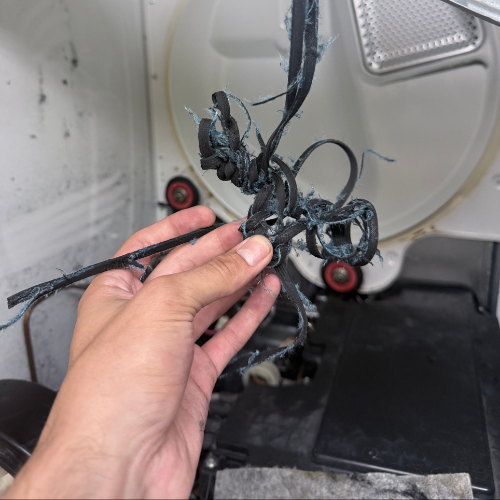
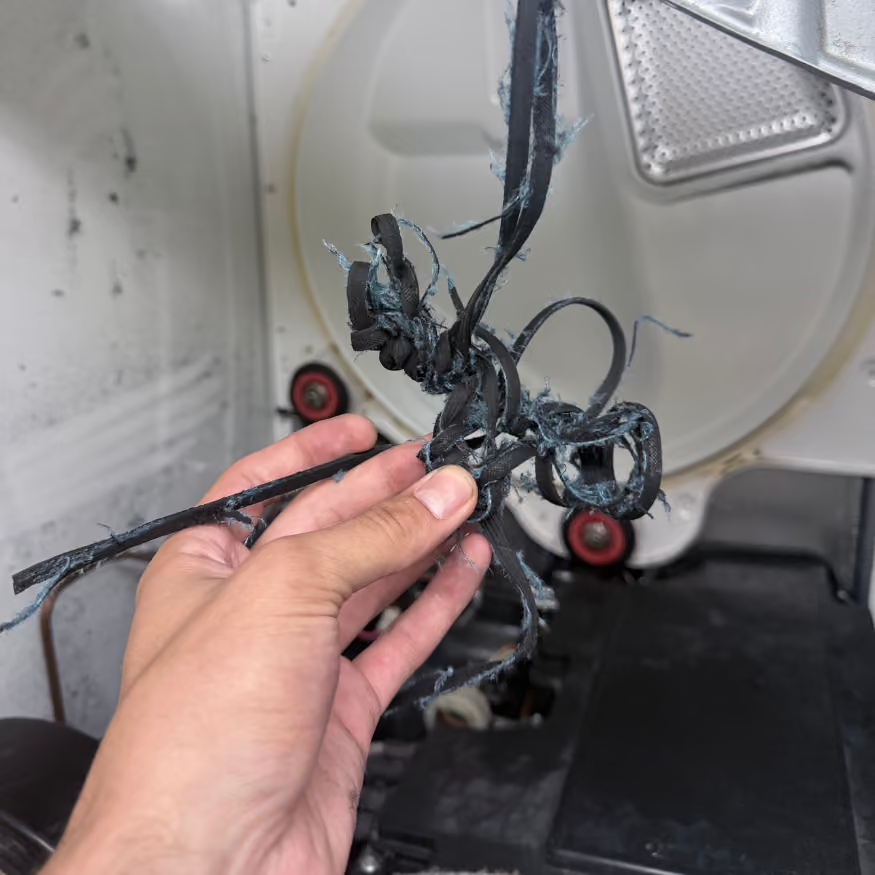
If the drum spins very freely by hand with little resistance, a broken or slipped belt is a strong clue. If the drum is hard to turn, something may be binding: roller, idler, felt, object caught in the drum, blower obstruction, or motor issue. If the motor hums but the drum does not move, drive-system or motor trouble becomes more likely. If nothing happens at all, door switch, start switch, thermal safety, power, or control permission may be involved.
These are clues, not instructions to open the dryer. The value is in reporting the behavior accurately. A technician can use the hand-feel and sound to decide where to start once the appliance is safely opened.
A drum that does not turn does not prove the motor is bad. It does not prove the belt is broken. It does not prove the door switch failed. A jammed item, overloaded drum, worn roller, seized idler, broken belt, door switch, start switch, motor, blower obstruction, or thermal safety can all create a no-tumble symptom. The start response, sound, and drum resistance are the evidence.
Another false assumption is that a dryer can be tested for heat while the drum is stuck. Do not do that. Tumble is part of safe drying. Heat without drum movement can overheat one spot of fabric and create a safety issue.
If the display is dark, use a power diagnosis first: outlet, breaker, plug, and control response. If the display works but Start does nothing, the door switch or start/control permission may be relevant. If the drum light stays on when the door appears closed, record that. If the dryer starts only when the door is pressed a certain way, stop and report that as a door/contact clue.
Do not tape the door switch or press it with a tool to run the dryer open. Door interlocks exist because the drum, heat, and moving parts are unsafe when exposed.
A squeal, thump, scrape, or rumble before the drum stopped is useful. Squeal can point toward idler or roller wear. Thumping can point toward a belt or drum-support issue. Scraping can suggest felt, glide, or object contact. A loud hum followed by shutdown can point toward motor strain or binding. Save the timeline instead of only reporting the final no-turn state.
Save the model tag, display state, door-light behavior, start sound, whether the drum turns by hand, whether it feels loose or stuck, load size, and any noise before failure. If safe, record a short video showing the control response and sound after pressing Start. Do not keep holding the button while a motor hums.
A good service note says: dryer display works, Start produces motor hum, drum does not move, drum turns very freely by hand, burning smell absent; or dryer display works but door light stays on and drum never starts. Those statements are better than "dryer broke."
If the machine does not begin a cycle at all, treat that as a no-start problem rather than a drum-motion diagnosis. If the drum is hard to turn, hums without moving, or stops again after cooling, keep the unit off and preserve those observations for service. Use the repair-versus-replace guide only after the drive failure and access cost are known.
Only gently with the dryer off, cool, and empty. Do not force it. The feel is evidence, not a repair.
Some faults can allow heat or partial operation without proper tumble. Do not run it that way.
No. A belt is common, but rollers, idler, motor, door switch, jammed load, and control permission can also be involved.
Start sound, drum hand-feel, door-light behavior, pre-failure noise, smell, and model tag.
If the control panel is dark, the dryer is not starting. If the panel works and the motor hums while the drum stays still, the complaint is no tumble. If the dryer clicks and stops, door or control permission may be involved. If the drum turns by hand but not under power, drive or motor faults become more likely. These distinctions keep the diagnosis from drifting into heat parts.
A broken belt often makes the drum feel unusually loose or easy to spin by hand. Some dryers also use a belt switch that prevents the motor from running when the belt breaks. That means no sound and a loose drum can still be a belt-related clue. Do not open the cabinet to confirm; report the hand-feel.
A drum that is hard to turn, scrapes, or stops abruptly suggests binding. Worn rollers, idler, glides, felt, objects, or blower issues can all resist movement. Running the dryer in that state can overheat the motor or damage the belt. Stop and save the sound.
Sometimes the drum is not the failed part. A blanket, shoe, zipper pull, or object can wedge near the front seal and stop movement. Remove the load after the dryer is off and cool, then gently inspect the visible drum edge. Do not reach into hidden spaces.
If the dryer is stacked above a washer, diagnosis may require unstacking or two-person access. Tell service before the appointment. A belt or roller job can fail operationally if the technician cannot safely access the dryer.
A click with no motor sound, a hum with no movement, and a completely dead response are different. A click may be relay or start command. A hum may be a motor trying against a stuck drum or failed start winding. No response may be door, control, power, or safety. The homeowner does not diagnose those parts but can record the response.
A non-turning drum should not be used to test heat. Tumbling distributes heat through the load. If the dryer heats while the drum is still, fabric can overheat in one place. Stop the test once no tumble is confirmed.
The week before the drum stopped often contains the clue: squealing, scraping, rumbling, thumping, or intermittent starting. Write that down. A sudden belt break is different from a gradually seized roller or motor strain.
If the drum light stays on with the door closed, or the dryer starts only when the door is pressed, that is important. Do not tape the switch. Just photograph or video the behavior safely.
If the dryer is stacked, in a closet, or gas-connected, say so. Belt, roller, idler, or motor work may require movement and workspace. The best diagnosis still fails if the appliance cannot be accessed safely.
A drum that stopped mid-cycle gives more evidence than a drum that simply will not start. Was the load still hot? Did the motor hum? Did the timer continue? Did the dryer restart after cooling? A mid-cycle stop can involve a belt event, motor overload, roller binding, or safety interruption. Let the dryer cool and do not keep pressing Start through a hum.
If the drum stopped with a heavy wet load, remove the load after the dryer is off and cool. Overloading can strain the drive system and hide a binding problem. A normal-size proof should be attempted only after service-level safety is clear if the dryer hummed, smelled hot, or scraped.
Dryer drums ride on supports that vary by model: rollers, glides, bearings, felt seals, idler and belt path. When these wear, the motor may still try to run but the drum resists. That is why sound before failure and hand-feel are so useful. They are not repair steps; they are a map for service.
An intermittent no-tumble complaint should still be treated seriously. A belt can slip before breaking, a motor can restart after cooling, and a roller can bind only under load. If the drum turns once after cooling and then stops again, save that timing. Intermittent movement is evidence, not proof the dryer is fine.
It makes the drive path important but does not prove the belt alone; the pulley, motor, supports, blower, and a seized drum can produce overlapping evidence.
Some faults can leave heat present without normal tumbling. Stop the cycle because heat can concentrate in the load and damage clothing or components.