
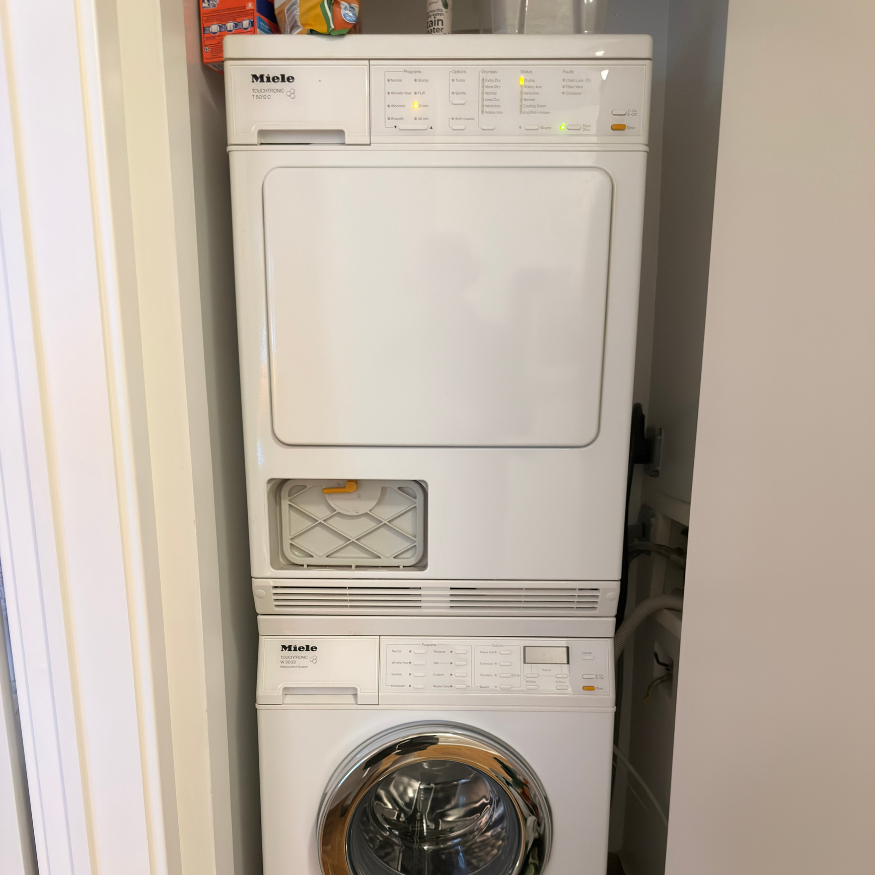

Most Common Reasons a Miele Dryer Is Leaking Water
For a Miele dryer using external condensate drainage, Miele's generic guidance names three causes. The order below follows the visible drain route; it is not a published failure-rate ranking.
- Drain hose connected incorrectly at the sink outlet: Condensate can escape where the dryer hose meets the sink drain instead of entering the drain. The strongest clue is that the first wet point is at that accessible connection, especially when the leak began after installation. With the dryer stopped, inspect only the connection and hose route that are already visible. Technician proof target: connection versus cabinet.
- Non-return valve missing, installed incorrectly, or clogged: Where the exact model and drain arrangement use this valve, failed backflow protection can let drain water return through the dryer hose. Do not disassemble, clean, substitute, or bypass the valve. Technician proof target: valve applicability and backflow.
- Washer and dryer share the same drain: If both machines discharge into one drain, washer water can return toward the dryer when backflow protection is absent, incorrect, or clogged. Leakage that appears while the washer drains supports this cause without identifying which installation detail is wrong. Technician proof target: washer discharge versus dryer condensate.
When These External-Drain Causes Do Not Fit
- Leak began immediately after heat-exchanger cleaning: If you have not yet completed one correct check from the exact model instructions, use the separate Miele dryer leaking after heat-exchanger cleaning guide. If water continues after that closure check, continue with the external-drain and unlocated-leak decisions on this page.
- "Empty out container" appears with no puddle: Use the separate Empty Container warning diagnosis. A container message without escaped water does not establish a visible-water leak.
- Water is traced to another source: If the wet path leads to the washer, sink, a standpipe overflow, or the building drain rather than the dryer or its drain connection, the dryer is not the confirmed source. Have the appliance or plumbing source where the water begins checked instead.
- The dryer uses container collection, or every accessible external point stays dry: Miele's external-drain guidance does not prove a hidden pump, sump, float, seal, tray, hose, or control fault. Leave panels closed and arrange exact-model leak localization.
Model Boundaries That Change the Drain Advice
- TXD160WP and TXI680WP: Their manuals document both container collection and an external rear-hose option. With the dryer off, inspect only the already-visible hose for pulling, stretching, kinking, or damage and confirm that it remains secured at the standpipe. These model instructions do not establish one non-return-valve requirement for every Miele dryer.
- Retired T8012C/T8013C: The combined manual documents a model-specific external-drain and non-return-valve arrangement. Do not transfer its valve or removable-condenser procedure to another model.
- Any other or unknown model: The rating label and exact manual decide whether external drainage, a non-return valve, or a shared-drain arrangement applies.
When to Stop Using the Dryer
Leave the dryer off when water creates an electrical risk or the leak remains active.
- Electrical wetness: Water is near the cord, plug, outlet, controls, or another electrical area. Disconnect only if it can be done without entering water.
- Electrical warning: The breaker trips, smoke, burning odor, sparking, or visible electrical damage appears. Do not reset the breaker repeatedly.
- Active water: Water continues appearing during operation. Stop the cycle and do not run another test to reproduce the leak.
- Inaccessible installation: Do not move, tilt, pull out, or unstack a stacked, built-in, or otherwise inaccessible dryer to look for the leak. Use only already-visible evidence and arrange service or qualified installer access.
Do not open the cabinet or attempt to inspect a pump, sump, float, sensor, seal, hidden hose, wiring, or control.




.avif)