
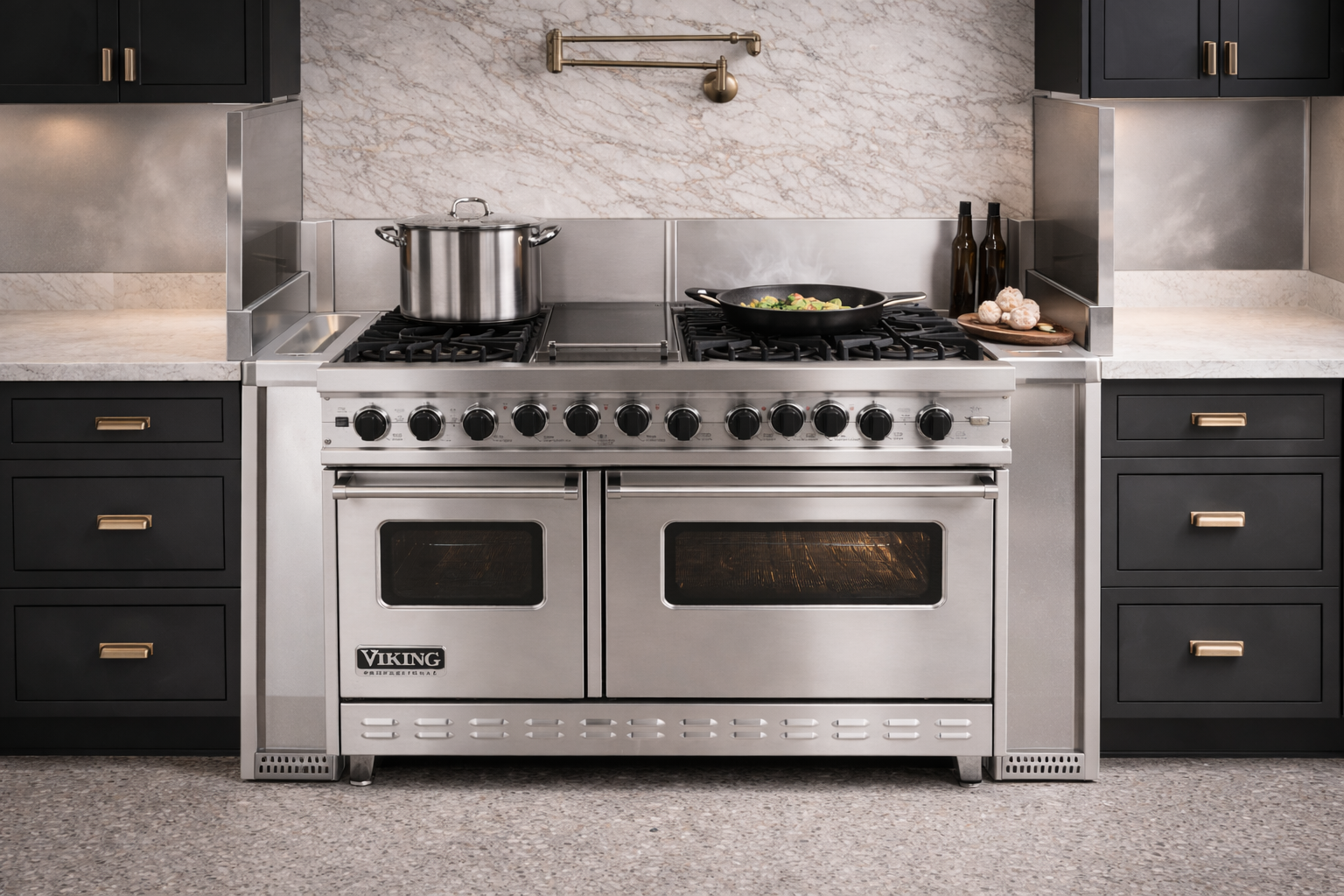

Viking Gas Oven Not Heating: Safe Ignition Checks
If a Viking gas oven does not heat, use a gas-odor safety gate, confirm model/recall status, power, settings, known gas supply, and bake-versus-broil behavior.
If a Viking gas oven does not heat, use a gas-odor safety gate, confirm model/recall status, power, settings, known gas supply, and bake-versus-broil behavior.
If a Viking gas oven is not heating, do not assume the igniter has failed just because you cannot see a glow; ignition design and visibility vary by model. Stop for any gas odor or delayed ignition, record the model and serial, check Viking’s applicable recall information, then confirm power, settings, the known external gas-shutoff position, and whether Bake and Broil behave differently during one normal attempt. If neither mode heats—or ignition is delayed, noisy, unstable, or accompanied by odor—leave the oven off and arrange model-specific diagnosis.
If you smell gas, hear gas flowing without immediate ignition, hear a “whoosh” after a delay, or see flame where it should not be:
Do not repeatedly restart a gas oven that failed to ignite. Do not remove the oven floor, flame spreader, burner covers, kick plate, back panel, or control panel. Do not test an igniter, valve, or electrical circuit with the appliance energized.
Viking maintains an official recall and safety-information page. Some specific Viking freestanding gas ranges have been subject to safety recalls; that does not mean every Viking gas range is recalled. Record the complete model and serial number and compare them only with Viking’s current official lookup/instructions.
If the exact unit is included, follow the recall remedy rather than continuing the ordinary troubleshooting path. Do not infer recall status from appearance, age, or a partial model family.
A gas oven needs several stages to succeed:
The symptom “does not heat” does not identify which stage stopped. A surface burner that works can show that gas reaches the range, but it does not prove that the oven branch, ignition system, valve command, sensor, or control is correct. A lit display shows some electrical power, but not necessarily correct power and output to every oven function.
The original query often mentions “igniter glow.” That clue is not universal. Some igniters may not be clearly visible in normal use, and Viking platforms differ. Opening panels or burner covers just to look can create gas, electrical, and burn hazards. The safe evidence is whether the oven begins heating normally, whether a warning or odor occurs, and whether Bake and Broil behave differently.
Record:
Do not use a long preheat or repeated cycles as proof. One normal controlled attempt in each relevant mode is enough if there is no gas odor or abnormal ignition.
Low effort: controls, power, and evidence
Why it works: An incomplete command, timer/delay state, control lock, Sabbath feature, or another model-specific setting can prevent expected heating without a failed gas part.
Tools/materials: Exact Viking use-and-care manual and phone camera.
What to do:
Common mistakes:
Why it works: Modern Viking gas ovens use electrical ignition and controls; they do not rely on a standing pilot. A power interruption can leave gas available while electronic ignition cannot operate.
Tools/materials: Clearly labeled breaker panel.
What to do:
Common mistakes:
Why it works: Model/serial determines ignition design, control procedure, gas type, parts, and recall applicability.
Tools/materials: Phone camera and Viking’s official safety-information page.
What to do:
Common mistakes:
Medium effort: external gas and mode comparison
Why it works: A shut or interrupted external supply can prevent oven heat. This check is safe only when the correct range valve is already documented, visible, and reachable without moving the appliance.
Tools/materials: Viking installation instructions; gas professional if identification or condition is uncertain.
What to do:
Common mistakes:
Why it works: Normal surface burners provide limited evidence that the building supply is present. A total loss of both surface and oven gas after a known shutoff event suggests a different starting point from oven-only failure.
Tools/materials: None.
What to do:
Common mistakes:
Why it works: Bake-only, Broil-only, and both-modes failure are different patterns. The comparison helps service isolate mode-specific ignition/burner behavior from shared power, gas, sensing, or control problems.
Tools/materials: Cycle notes; the exact manual.
What to do:
Common mistakes:
High effort: define the service-level question
Why it works: A completely silent failure, repeated clicking, delayed ignition, and flame that starts then goes out involve different risks and diagnostic stages.
Tools/materials: Notes and a safe-distance audio/video only if no gas odor is present.
Record:
Common mistakes:
Why it works: Service may need to confirm the igniter’s electrical behavior, valve safety sequence, burner condition, gas pressure and conversion, temperature sensor feedback, wiring, and control output. These cannot be proven by a visual glow assumption.
Tools/materials: Model/serial, recall result, mode comparison, power/gas history, code photos, and ignition description.
Common mistakes:
No. Ignition design and visibility vary, and safe diagnosis requires more than visual glow. Do not remove oven panels or burner covers to look.
No. Current electronic-ignition ovens are not standing-pilot appliances, and manual flame testing can create a gas emergency.
That shows limited gas and power availability to the range, not correct oven ignition. The oven has its own command, safety, valve, burner, sensing, and control stages.
It is a useful mode-specific pattern, but it does not prove one part. Service must confirm the bake ignition/burner command and shared systems.
Shared power, gas supply, control state, safety, sensing, or control-output stages move higher on the list. Stop after external safe checks.
Yes. Electronic ignition and controls require power. Restore power only normally; never attempt manual oven ignition during an outage.
No. Delayed ignition can accumulate gas. Turn the oven off, stop use, and arrange urgent evaluation.
Use the complete model and serial number with Viking’s official recall/safety page. Appearance and partial model names are not enough.
No. Gas pressure, valve, regulator, orifice, and ignition-safety tests require qualified procedures and equipment.
Provide model/serial, recall result, exact mode/settings, Bake-versus-Broil result, display behavior, breaker/gas-supply history, ignition sounds/odor, and when the failure began.
Viking kitchen requests are considered in Brooklyn, Manhattan below 96th Street, and selected Queens routes; gas, electrical, ventilation, and building-access details affect route planning.

.jpeg)
Technician experience standard: 4+ years of hands-on appliance repair per technician; senior technicians bring 8 and 16 years. Viking intake starts with Model and Serial, product and fuel, failed mode, code or flash pattern, and access. Independent service; no current manufacturer authorization implied.

