icon
See what happens on a diagnostic visit, how quotes and parts work, why some repairs need multiple visits, and when replacing an appliance makes more sense than repairing it.

Miele Dryer Overheating or Shutting Off Mid-Cycle — Condenser, Airflow, or Thermal Cutout?

Miele dryer stopping mid-cycle is thermal overload protection activating. Blocked condenser, restricted airflow, or a failing thermal overload protector — here's the NYC diagnosis.

Diagnostic fee: $99, credited toward the repair if you move forward
Warranty: 180-day parts and labor warranty on completed repairs
Arrival windows: 9 to 11, 11 to 1, 1 to 3, 3 to 5
Google Business Profile
Open 9:00 AM - 6:00 PM

Miele Dryer Overheating or Shutting Off Mid-Cycle — Condenser, Airflow, or Thermal Cutout?

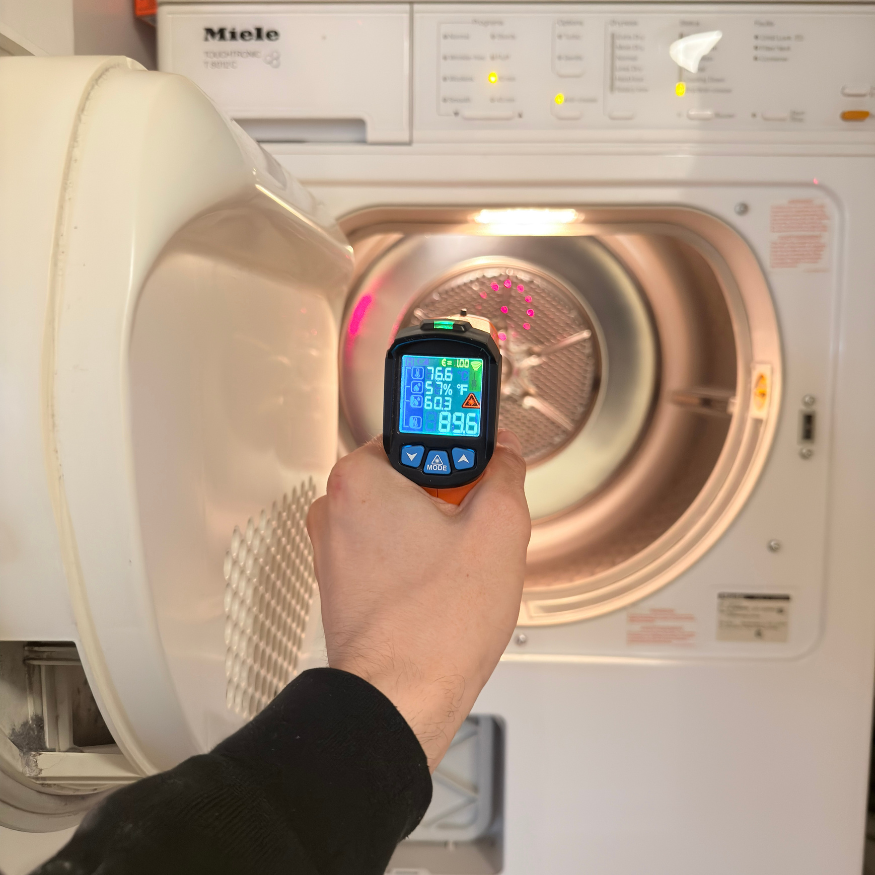
A Miele dryer that stops mid-cycle, pauses for several minutes, then attempts to restart is activating its thermal overload protection — a deliberate safety response to excessive internal temperature. The three most common causes are a blocked heat exchanger on condenser models, restricted airflow around the machine in enclosed NYC apartment installations, and a degraded thermal overload protector that trips at a lower temperature threshold than intended.

What this means?

The machine is not malfunctioning — it is protecting itself correctly. However, repeated thermal overload events accelerate wear on the thermal overload protector itself, which is a one-shot device on older Miele TCE models and a resettable protector on newer T1 and TWF variants. If the underlying cause of overheating is not addressed, the protector will eventually fail permanently, causing the dryer to stop starting entirely. The F51 fault code appears on some Miele TCE models to indicate a thermal overload event has been logged in the control board's history.

What to do now

Clean the heat exchanger immediately — this is an owner-accessible maintenance task on all Miele condenser models and takes approximately ten minutes. Rinse the exchanger under lukewarm running water and allow it to dry fully before reinstalling. Do not run the dryer while the heat exchanger is removed. If the machine is in an enclosed cabinet, open cabinet doors during drying cycles temporarily to improve air circulation while the underlying cause is being assessed.

What NOT to do

Do not use a vacuum cleaner alone to clean the heat exchanger fins — lint compacts between the fins and must be rinsed out with water to be fully removed. Do not run the dryer repeatedly after it shuts off mid-cycle, hoping it will complete the cycle — each thermal overload event stresses the protector and shortens its remaining service life. Do not ignore F51 fault history codes; they indicate the machine has already experienced multiple overload events.

Why this happens

Miele TCE condenser dryers pass moisture-laden air through a heat exchanger where it is cooled and the water is collected in a condensate drawer. If the heat exchanger fins become coated with lint that has bypassed the fluff filter, heat cannot dissipate effectively and internal temperature rises until the thermal overload protector cuts power to the heating circuit. Miele TWF heat pump dryers use a compressor-based system with a separate evaporator — blocked evaporator airflow produces the same shutdown behavior. NYC apartments present a specific aggravating factor: machines installed in enclosed kitchen cabinet bays with minimal clearance around the sides and rear accumulate heat in the surrounding cabinet space, raising the ambient temperature around the appliance well above design limits even when the machine itself is clean.

How to narrow it down

Locate the heat exchanger access panel — on most Miele TCE models it is behind the lower kick plate at the front base of the machine. Remove the heat exchanger and inspect the fins: if they are coated in a gray lint film, cleaning the heat exchanger will likely resolve the shutdown behavior. Reinstall and run a test cycle. If the machine completes a full cycle without shutting off, the heat exchanger was the cause. If the machine still shuts off with a clean heat exchanger, check the installation clearance: Miele requires a minimum of 20mm (approximately three-quarters of an inch) at the rear and 15mm at each side for adequate air circulation. In enclosed cabinet installations common across Manhattan co-ops and Brooklyn brownstones, these clearances are frequently not met. If clearances are adequate and the heat exchanger is clean, the thermal overload protector itself needs electrical testing.

When to stop using it

Stop using the dryer if it shuts off within the first ten minutes of a cycle even after the heat exchanger has been cleaned — this indicates the thermal overload protector is failing below its rated threshold and needs replacement before the machine is returned to normal use. Continued operation risks a permanent no-start condition.

What to do next

If heat exchanger cleaning does not resolve the mid-cycle shutdowns, Volt & Vector can test the thermal overload protector, inspect airflow paths, and evaluate whether the installation clearances meet Miele's requirements. We serve Manhattan and Brooklyn. Book at voltnvector.com/booking or call +1 (332) 333-1709. Mention that the machine is shutting off mid-cycle so we can bring the correct replacement parts.

Related guides: Miele Dryer Smells Like Burning — When to Stop Immediately · Miele Dryer F13 or F18 Error Code — NTC Temperature Sensor Fault · Miele Dryer Won't Start — Door Switch, Thermal Cutout, or Control Board? · Miele Dryer Not Heating — Expert Diagnosis NYC

Booking

Appliance Repair in NYC

Choose a time that works for you. Share the appliance type, address, and the issue you are seeing. We review the request and confirm the appointment details before the visit is finalized.

$99 diagnostic

Credited toward repair after approval

180 day warranty

Parts and labor on completed repair

OEM parts

Used when applicable and available

Licensed and insured

COI available if building requires it

What Happens Next

You send the request with the appliance type, location, and symptom.

We review the details and confirm service area, timing, and access notes.

If needed, we may ask for a model and serial photo before the visit.

Before You Book

If you smell gas, see sparks, notice a burning odor, or have an active water leak near electrical parts, stop using the appliance and handle the safety issue first.