
GE GUD24/GUD27 Laundry Center Problems
Separate normal sensing sounds, washer faults, dryer faults, and shared supply issues on GE GUD24/GUD27 unitized laundry centers.
Separate normal sensing sounds, washer faults, dryer faults, and shared supply issues on GE GUD24/GUD27 unitized laundry centers.
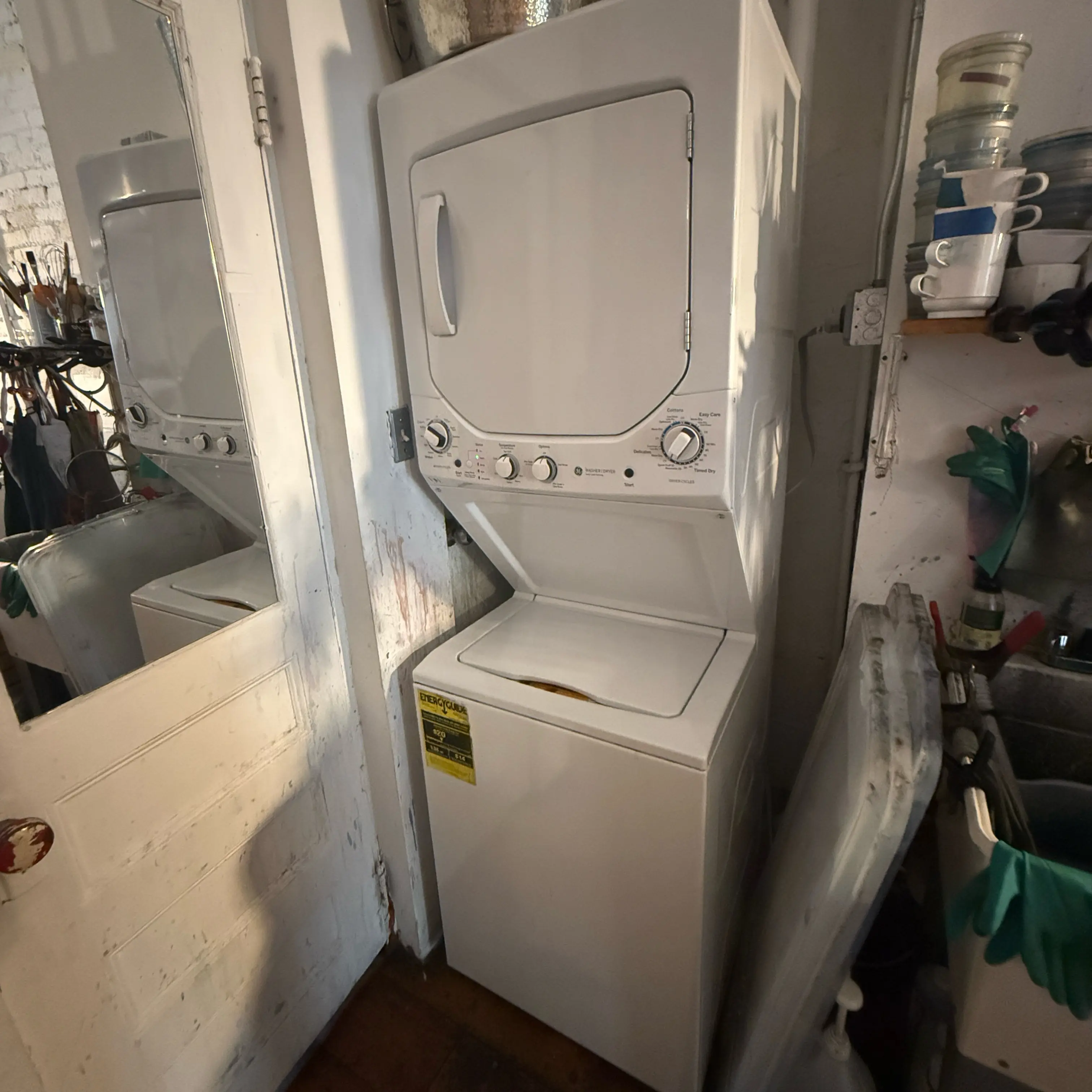
For a GE GUD24/GUD27 laundry center, first identify whether the washer, dryer, or both are affected and record the first stage that fails. Several washer sounds—including lid-lock clicks, initial sprays, load-sensing coast-down, drain hum, and mode-shift clanks—can be normal when they occur at the documented stage, but a new sound with a stalled cycle, leak, violent movement, odor, or heat is different. Use the complete model suffix for fuel and control instructions, and do not move or open the unitized cabinet.
GUD24 and GUD27 units combine a top-load washer and dryer in one tall cabinet. Water and drainage operate close to electrical, heating, exhaust, and—in gas variants—fuel systems, so the first task is to make the condition safe.
Stop use when:
Do not hold the washer down during spin, bypass the lid or dryer-door switch, repeat breaker resets, perform energized electrical measurements, disconnect gas, or run the dryer into the room. If gas odor is present, leave and contact emergency services and the gas utility from outside.
“GUD24/GUD27 problem” describes a platform family, not a symptom. The washer and dryer have different operating sequences, while model suffixes identify details such as electric versus gas configuration. The complete tag is more useful than cabinet width alone.
Use the Half–Stage–Sound map:
GE documents normal stage-specific sounds on unitized washers:
These descriptions have limits. A normal label applies when the sound occurs at the expected stage, lasts as expected, and the washer continues. It does not cover violent motion, scraping, burning odor, water on the floor, a stalled basket, or a cycle that never advances.
For the upper dryer, separate a control that does not accept Start from a drum that does not turn, a cold-tumbling load, a warm-damp load, and an excessively hot load. The same statement—“dryer is not working”—can otherwise point to power, door recognition, drive, heat supply, exhaust, load, or sensing.
If the washer runs normally but the dryer is dark, the evidence differs from both halves being dark. If the dryer works while the washer never fills, water supply, lid/sensing, and washer sequence move forward. This is routing evidence, not proof of a particular control or component.
Low effort: classify the observable behavior
Why it works: GUD24 or GUD27 alone omits suffix information needed to choose the exact fuel, control, manual, and installation instructions.
Tools/materials: Phone camera, flashlight, owner documentation, and notes.
What to do:
Common mistakes:
Why it works: A stage-linked sound plus successful action is stronger evidence of normal operation than sound wording alone.
Tools/materials: Phone clock, short video, load description, and exact manual.
What to do:
Common mistakes:
Why it works: No power, no Start acceptance, no tumble, no heat, poor moisture removal, and overheat require different diagnostic paths.
Tools/materials: Notes, clean lint filter, and careful stopped-load temperature observation.
What to do:
Common mistakes:
Medium effort: separate shared and side-specific resources
Why it works: A washer can stop before spin when water does not enter or leave correctly, even though the dryer is fully functional.
Tools/materials: Flashlight, towels, dry paper towels, and building contact.
What to do:
Common mistakes:
Why it works: Shared power loss, dryer heat-supply loss, and exhaust restriction produce different combinations of control, tumble, heat, and airflow evidence.
Tools/materials: Breaker label, flashlight, lint-screen brush, and installation record.
What to do:
Common mistakes:
High effort: prepare exact diagnosis and access
Why it works: Recording what still works provides the next decision and prevents a broad “unit dead” report from sending diagnosis into the wrong half.
Tools/materials: One-page notes, control photos, short videos, and service history.
What to do:
Common mistakes:
Why it works: Unitized cabinets may block hoses, venting, power, gas, and service areas. Safe removal can be a separate operation.
Tools/materials: Cutout photos, measurements, shutoff map, building rules, and floor-protection plan.
What to do:
Common mistakes:
No. They are different size families, and complete suffixes further distinguish configuration. Choose instructions from the exact tag rather than cabinet size.
A click can be the lid locking. It is reassuring only when it occurs at the expected stage and the cycle proceeds without leakage, odor, or abnormal movement.
GE documents initial sprays and Precise Fill sensing behavior on GUD24/GUD27 models. Record whether normal fill follows.
Not by itself. GE identifies hum, water flow, slurp, and gurgle as possible drain-stage sounds. Decide from the resulting water level and cycle progress; standing water or a stalled cycle changes the path.
The dryer can tumble while its heat path is unavailable. Confirm the full model/fuel and a heated setting, then route cold tumble separately from airflow.
Heat is present, so moisture removal, load, washer extraction, sensing, and exhaust become more relevant than complete no heat.
No. Do not vent heat, moisture, lint, or combustion products into the residence.
Not without a safe movement plan for its weight and every hidden connection. Tight apartments may require building coordination and multiple people.
It proves only that some operation is available. The dryer heat supply, gas supply, branch connection, and internal controls can still follow different paths.
Provide full model/serial, affected half, first failed stage, control state, washer water state, dryer temperature, exact sound timing, visible connections, recent changes, and access photos.