


.jpeg)
.avif)
Sub-Zero Refrigeration Through the Years: What Changed and What Owners Need to Know
How Sub-Zero refrigeration evolved through the 200/300, 500, 600, 700, BI, Classic, Designer, and PRO eras—and what each generation means for owners.
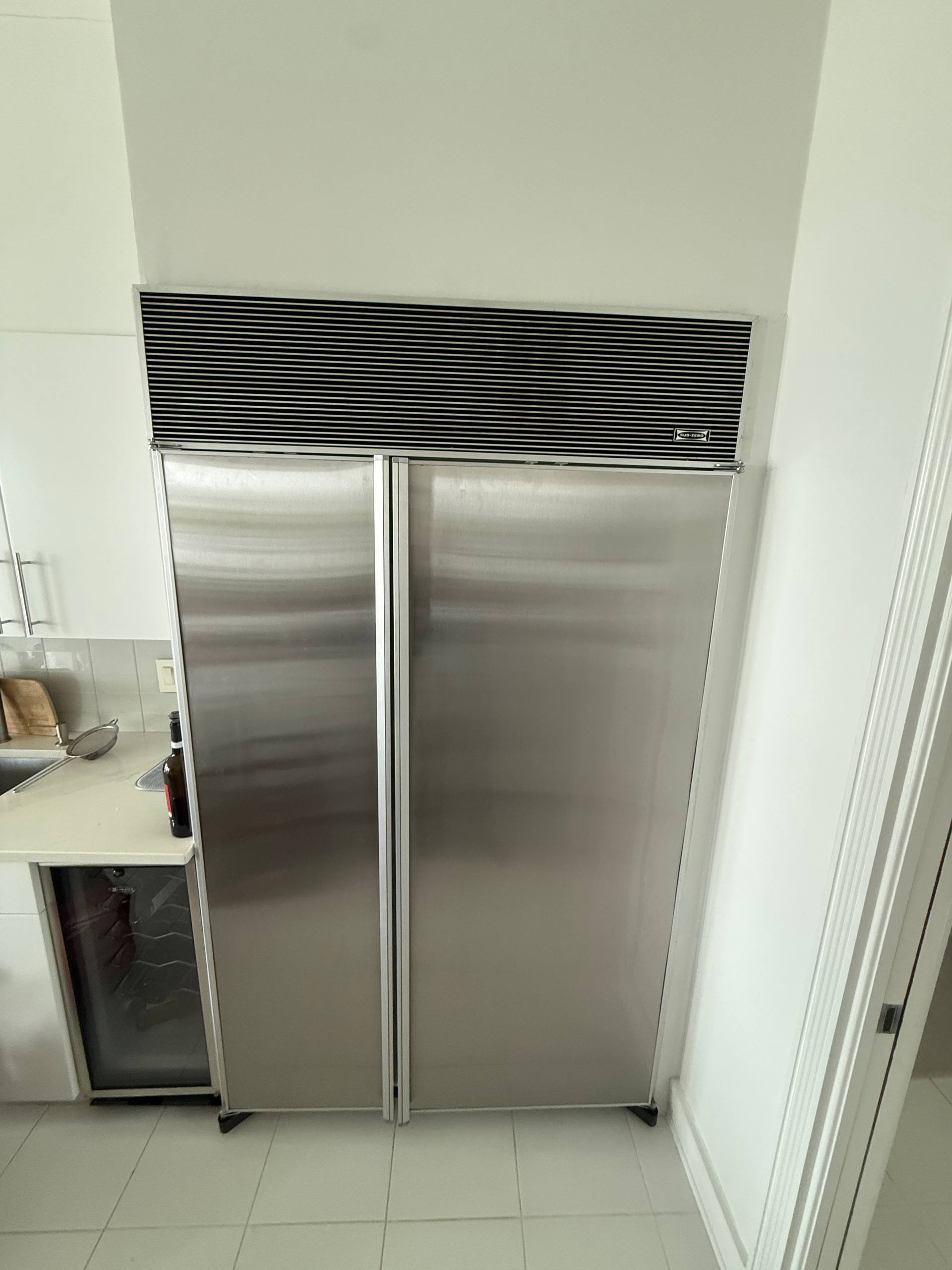
A Sub-Zero from 1990 and a Sub-Zero from 2026 can occupy the same kind of custom kitchen opening and still be fundamentally different machines. The older unit may use dial controls, an early refrigerant, a framed door, and a service language built around switches and electromechanical behavior. The newer one may be panel-hidden, connected, touch-controlled, sensor-managed, and divided into independently controlled zones. The grille, badge, and heavy door make them look related. The model prefix tells you how closely related they actually are.
That is the useful way to read Sub-Zero history. It is not a contest between an indestructible past and an overcomplicated present. Sub-Zero kept the same central idea—purpose-built refrigeration integrated into the kitchen—while changing how the cabinet fits, how compartments are separated, how temperature is controlled, how the owner interacts with the machine, and how a service problem has to be interpreted.
It also means there is no honest brand-wide answer to “How old is my Sub-Zero?”, “Does it have two compressors?”, “Can it connect to the app?”, “Are parts still available?”, or “What normally goes wrong?” Those answers depend on the complete model and often the serial number. This guide explains the generations first, then shows which evidence matters when an older or newer unit begins to behave differently.
1945–1959: The Sub-Zero Idea Comes Before the Familiar Refrigerator
Sub-Zero began with a preservation problem, not a luxury-kitchen category. Company founder Westye F. Bakke worked on reliable low-temperature storage after his family needed dependable refrigeration for his son's insulin. The company was formally established in Madison, Wisconsin, in 1945. According to Sub-Zero's official 75-year history, the next decisive steps were dual refrigeration in 1955 and built-in designs that could sit flush with cabinetry in the late 1950s.
Those two ideas still define the brand. Dual refrigeration separated the fresh-food and frozen-food environments instead of treating them as two doors on one shared air path. Built-in design made the appliance part of the room rather than an object parked in it. Every later generation is a variation on those decisions: how independent should the zones be, and how completely should the machine disappear into—or deliberately stand out from—the kitchen?
This is also why a Sub-Zero problem is often more compartment-specific than an owner expects. On a combination model, a cold freezer does not prove that the refrigerator side is healthy, and a refrigerator complaint does not automatically condemn the entire machine. Separate controls, fans, evaporator paths, sensors, and sealed-system architecture change the meaning of “it is running.”
1972–1987: The 200 and 300 Series Establish the Long-Lived Built-In Pattern
Sub-Zero's official production timeline places the 200 and 300 Series between 1972 and 1987. These are now genuinely vintage appliances, not simply “older Sub-Zeros.” They belong to a dial-control era and predate many of the display messages, electronic interfaces, air-purification features, and connectivity assumptions found in current troubleshooting.
Their age creates two opposite mistakes. One is to assume that a machine still cooling after several decades must be healthy in every respect. The other is to assume that age alone explains any new noise, temperature change, moisture pattern, or door problem. Neither conclusion uses enough evidence. A cabinet can remain structurally impressive while hinges, gaskets, fan motors, controls, wiring, insulation performance, or sealed-system components have very different histories.
On these generations, the tag matters more than appearance. Several cabinets and panel treatments can look similar, and a remodeled kitchen can hide the visual clues. The model identifies the platform; the serial and date information establish the individual unit. Without both, advice intended for a later 500 or 600 Series can be mechanically wrong.
1987–2003: The 500 Series Becomes the Vintage Sub-Zero Many Owners Recognize
The 500 Series arrived in 1987. Sub-Zero's 500 Series timeline shows that the main family spans 1987–2003, but that does not mean every 500 model was produced for that entire period. Many well-known versions ended in the mid-1990s, while specific 561 variants continued into the early 2000s.
This generation matters because it created much of today's “old Sub-Zero” reputation: substantial built-in cabinets, top machinery compartments on familiar full-size models, separate refrigerator and freezer controls on combination units, and an installation intended to remain in place through more than one kitchen update. Many 500 Series units still encountered in New York apartments are older than the cabinetry now surrounding them.
The 500 era also crosses an important service boundary. Sub-Zero states that products made before 1994 used R-12 refrigerant, while production beginning in 1994 generally moved to R-134a. The official refrigerant guide makes the production date relevant to sealed-system work, recovery equipment, refrigerant availability, and the information a qualified refrigeration technician needs before opening the system. It is not a homeowner procedure, and the family name alone is not precise enough near the transition.
The most useful question about a 500 Series unit is therefore not “Are 500s good?” It is “Which 500, produced when, installed how, and with what service history?” A well-aligned door and a clean heat-rejection path tell a different story from a cabinet with a sagging panel, damaged closer, heat buildup above the grille, and no documented sealed-system history—even if both are still cold on the day they are inspected.
1994–2015: The 700 Series Creates a Separate Integrated Branch
Sub-Zero history is often summarized as if the 700 Series followed the 600 Series. The dates show otherwise. The 700 Series timeline begins in 1994, two years before the 600 Series, and the line continued in various forms through 2013, with some combinations and related models extending to 2015.
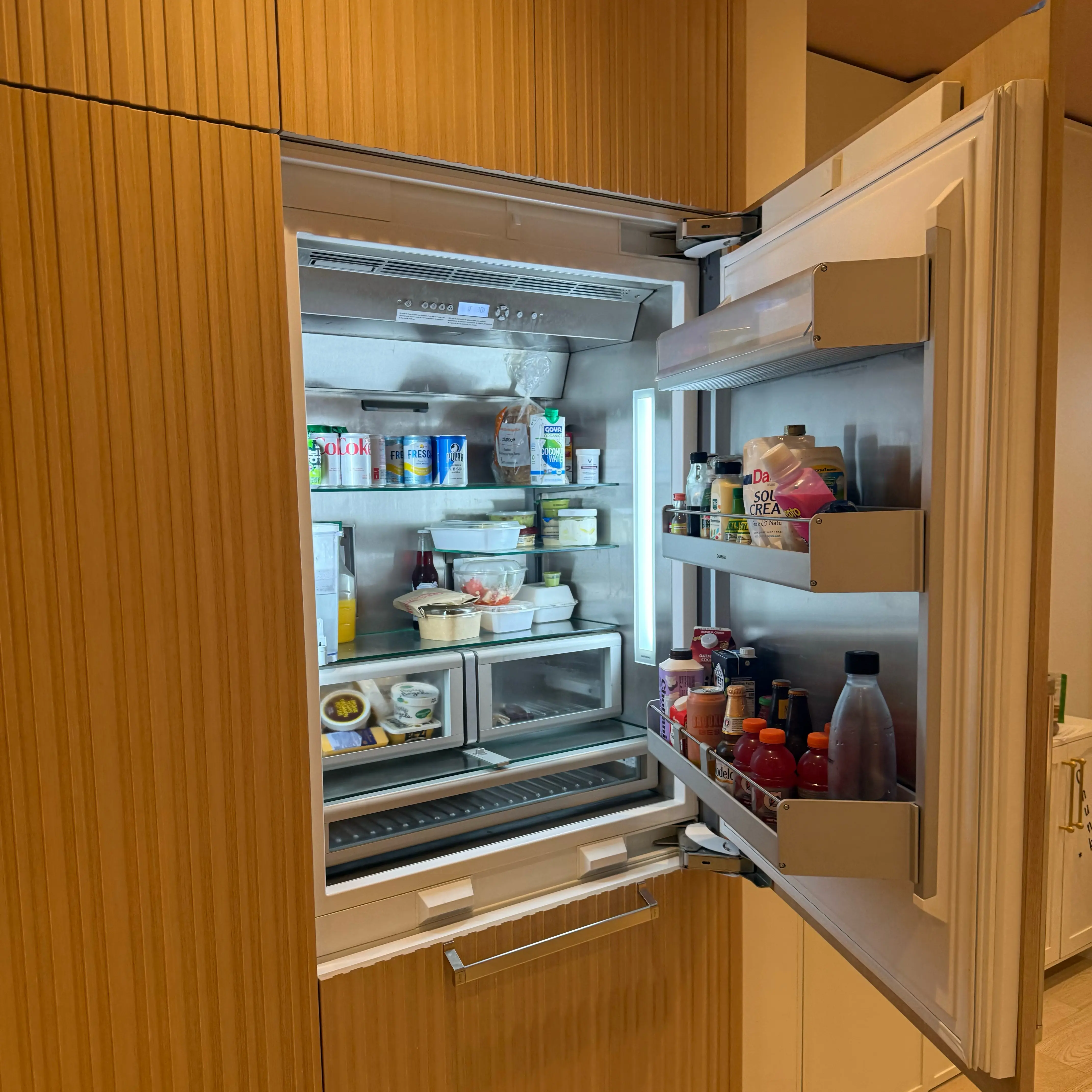
The difference was architectural rather than merely chronological. The 700 family pursued integrated refrigeration: narrower columns, tall units, and drawer configurations that could accept custom panels and align more completely with surrounding cabinetry. While the 600 line preserved the recognizable full-size built-in silhouette, the 700 line made refrigeration more modular and less visually obvious.
That parallel history prevents a common identification error. A panel-ready unit from the 2000s is not automatically a 600 or BI model. It may belong to the 700 integrated family, with different condenser access, controls, zone-disable procedures, panel geometry, and component layout. Width and exterior styling are not enough; use the tag.
The 700 Series also teaches a larger Sub-Zero lesson: “integrated” describes how the product relates to cabinetry, not simply how expensive or new it is. A machine hidden behind a furniture panel may be older than a stainless 600 Series standing beside it. Visual modernity is not a production date.
1996–2009: The 600 Series Refines the Recognizable Full-Size Built-In
The 600 Series production record runs from 1996 to 2009. Models such as 611, 650, 642, and 632 carried forward the full-height built-in format while adding electronic control and a clearer service-display language than the dial-controlled generations.
That electronic layer is why owners should record the literal display rather than translate every message into “the refrigerator says service.” The exact words, symbols, and serial boundary matter. For example, Volt & Vector's separate Vacuum Condenser message guide explains that specific display message; it should not be generalized to every 600 Series warning or treated as proof that the condenser itself has failed.
The 600 Series also sits in a transitional place in many kitchens. It looks and feels like the classic older Sub-Zero, yet its control behavior is not the same as a 500 Series dial model. Advice to turn a dial, read a code, disable a compartment, remove a grille, or reset a message must match the exact platform and serial range. “Old built-in” is still too broad.
2005–Present: PRO Makes the Machine the Visual Centerpiece
The PRO line took the opposite design position from the 700 Series. Instead of disappearing, the appliance became an industrial-looking stainless focal point. The original 648PRO/PRO48 family was produced from 2005 through 2019. The current PRO3650 and PRO4850 generation began in 2019, according to Sub-Zero's Professional refrigeration timeline.
The shared PRO name does not make those generations interchangeable. The current PRO 36 and PRO 48 models use R-600a refrigerant and are connected-ready; the older 648PRO uses R-134a and is excluded from the current connected-ready PRO group. Current PRO units also divide control among refrigerator, freezer, and drawer zones in ways that make “the fridge temperature” an incomplete observation.
PRO is therefore a product family, not a single oversized refrigerator. An owner should record which compartment changed, what the display shows, whether the issue is cooling or connectivity, and the complete PRO model. Advice for a 648PRO can be wrong for a PRO4850 even though both have the same visual intention.
2008–2022: BI Bridges the Older Built-In Line and Today's Classic Series
The BI generation began in 2008 and continued across most major configurations through 2022. Sub-Zero now calls it legacy Classic, but many tags, manuals, and parts references still use BI. That naming transition matters: “Classic” can refer to a current CL product or an older BI product, and those are not the same control or installation platform.
BI preserved the iconic grille and built-in presence while moving further into electronic sensing, displays, air purification on applicable models, and later connectivity capability. Even within BI, serial number can change the answer. Sub-Zero's connected-ready inventory shows defined BI serial boundaries and kit possibilities rather than declaring every BI connected or every BI permanently offline.
The BI era also exposes why “same width” does not guarantee a direct cabinet or panel transition. Sub-Zero publishes model-specific compatibility pages for particular old-to-new combinations because opening height, grille treatment, door clearance, side panels, water location, and retrofit hardware can differ. A custom panel may transfer in one documented pairing and fail in another. The old model, target model, panel type, and installation drawing must be compared as a set.
2014–2022: IT and IC Designer Continue the Integrated Path
The IT tall and IC column products arrived in 2014 as a newer Designer generation, while ID drawer models followed their own continuing timeline. These units pushed refrigeration further behind custom panels and placed more owner interaction inside the cabinet. Their identity is closer to the integrated logic of the 700 Series than to the grille-forward 600 or BI lines, but the control, lighting, filtration, connectivity, and installation details are generation-specific.
This is the point where a kitchen can hide almost every useful visual clue. Two adjacent cabinet panels may conceal a refrigerator column and freezer column, a tall combination unit, or independent drawers. If only one side warms, makes noise, or shows an alert, the owner must identify which appliance and zone is involved before treating the pair as one system.
Sub-Zero's legacy Designer timeline places IT and IC production mainly between 2014 and 2022, while certain ID drawers remain current. “Legacy Designer” therefore does not mean that every product with an I-prefix was discontinued on the same date.
2022–Present: CL Classic and DET/DEC Designer Become the Current Generation
Sub-Zero launched the current Classic and Designer generation in 2022. The official timelines place both Classic CL and Designer DET/DEC at that boundary. Classic CL keeps the visible upper grille and is offered in column, over-and-under, French-door, and side-by-side forms. Designer DET tall units and DEC columns focus on a fully integrated, panel-hidden installation. The two lines share current technology without serving the same visual purpose.
Current product material identifies Split Climate temperature management, ClearSight LED lighting, touch controls, air purification on applicable configurations, and connected operation among the major changes. The current Classic overview and current refrigeration catalog show why these features must still be read by model. A column refrigerator, column freezer, side-by-side combination, and over-and-under unit do not have the same compartments, water features, ice system, or control decisions simply because all are CL or DET/DEC.
The refrigerant boundary changed again as well. Sub-Zero says all newly introduced refrigeration products after January 2021 use R-600a hydrocarbon refrigerant. Current Sub-Zero use-and-care safety guidance identifies the refrigerant as flammable and restricts sealed-system handling to trained personnel with the correct equipment. Owners should never use a piercing valve, generic recharge kit, heat source, or improvised leak test on these machines.
Connectivity is another layer, not the core cooling system. All current CL, DET, DEC, and current PRO 36/48 products are listed as connected-ready, but legacy BI and IT/IC/ID capability depends on serial number or an applicable kit. An app that will not pair does not prove the refrigerator is not cooling. A successful app connection does not prove the temperatures are correct. Treat network status and refrigeration performance as separate questions.
How to Identify the Sub-Zero You Actually Own
Start with the full rating tag, not the door style. Sub-Zero's model-number key turns the model into a compact architecture description:
- The prefix identifies the family: CL is current Classic; BI is legacy Classic/Built-In; DET and DEC are current Designer; IT, IC, and ID identify legacy Designer tall, column, and drawer families; PRO identifies Professional refrigeration.
- The number usually carries width and configuration information: it helps separate a 30-inch column from a 42- or 48-inch combination, but it does not give the exact manufacture date.
- The following letters identify the cabinet logic: R and F distinguish refrigerator and freezer roles; C can identify a combination; FD marks French-door architecture; ID can indicate an internal dispenser; suffixes can identify stainless, overlay, handle, or other finish details.
Then photograph the serial number and date code. Sub-Zero's age-identification guidance says the manufacture date may appear on the tag as a Date Code; its exact position changed around April 2020. If no date is printed, the serial number is the correct route to Customer Care. The model family's production range can narrow the era, but it cannot date an individual unit precisely.
Finally, photograph the installation. Include the entire front, grille or toe-kick area, panel edges, adjacent cabinetry, and any visible airflow opening. On an integrated unit, those images can explain access and alignment questions that the rating plate cannot.
How Long Should a Sub-Zero Last?
Sub-Zero says its products are designed to last about 20 years on average. The same official statement says actual life varies widely with use, ambient temperature, maintenance, repair history, and individual component failures. Twenty years is therefore a manufacturer's design target, not an expiration date, warranty, or promise for a particular cabinet.
That distinction explains why age alone is weak evidence. A 22-year-old unit with stable measured temperatures, clean heat rejection, square doors, intact gaskets, documented service, and an undisturbed installation is not equivalent to a 12-year-old unit that has operated in a hot enclosure with blocked airflow and recurring moisture damage. Calendar age matters, but operating history determines what that age has done to the machine.
Parts support has a similar boundary. Sub-Zero says it attempts to keep replacement parts for 20 years for most products, while explicitly stating that no formal availability guideline exists and suppliers can make some parts unavailable sooner. That is useful evidence of a support intention, not a guarantee that every board, trim piece, sealed-system component, drawer, hinge, or panel part exists for every old model.
The only defensible parts question is exact: Is the required component, approved substitute, or documented kit available for this full model and serial range now? A general claim that “Sub-Zero parts are always available” is no more reliable than a general claim that “old Sub-Zero parts are impossible to find.”
What Actually Changes as a Sub-Zero Ages
There is no evidence-based list of one or two parts that “all Sub-Zeros eventually need.” The meaningful aging map follows the systems that create and preserve the cabinet environment.
Door, hinge, closer, and panel geometry
The door is part of the refrigeration system. Gasket condition, hinge wear, closer action, panel weight, cabinet alignment, and shelf or drawer interference determine whether the opening seals consistently. A torn gasket is visible evidence. So is a door that rebounds, opens by itself, drags, or needs lifting. A strong temporary vacuum just after closing can be normal; a misaligned panel or damaged closer is a different observation. The separate Sub-Zero door-seal guide explains the safe checks for that symptom.
Condenser and heat rejection
The condenser must release the heat removed from the cabinet. Dust, pet hair, greasy buildup, a blocked grille, high room temperature, or restricted installation airflow can increase run time without proving that the compressor has failed. Access and cleaning direction vary by model.
Sub-Zero's general maintenance page says condenser cleaning every three to six months, while its condenser-cleaning page says six to twelve months and more often with pets. That difference is a reason to use the exact model's current use-and-care instructions, not to invent one universal interval. Power the unit off as the model instructions direct, use a vacuum and soft-brush attachment only where permitted, protect the fins, and do not spray water, degreaser, or compressed air into the machinery compartment.
Internal airflow, fans, and defrost
Cold surfaces do not cool food evenly without controlled airflow. Frost can obstruct an evaporator path; packaging can block an outlet; a fan can become noisy or fail to move air; a defrost problem can allow an ice pattern to grow. The evidence is timing and location: which compartment changed first, whether frost is visible, whether the sound changes when a particular door opens, and whether actual food temperature is rising.
On a standard refrigerator/freezer combination, Sub-Zero's official noise procedure uses door-open behavior to separate a possible evaporator-fan branch from noises that continue with doors open. That observation narrows a branch; it does not identify a part by itself, and it must be adapted for all-refrigerator columns, all-freezer columns, wine storage, and drawers.
Sensors, controls, displays, and connectivity
Dial-control 200/300 and 500 Series products present a different evidence set from a 600, BI, Designer, CL, or PRO display. A worn dial control, a stored service condition, a nonresponsive touch panel, and a failed app pairing are not interchangeable complaints. Record the literal display, symbol, behavior, and timing before power is interrupted. Repeated resets can erase useful context without changing the underlying condition.
Water, ice, drains, and moisture
Ice production depends on the exact freezer temperature, ice setting, bin position, water supply, filter state where applicable, fill path, and ice-maker mechanism. Water under a crisper can follow a different path from water under the cabinet. Frost at a door edge is different evidence from frost on an interior back wall. Brand-level history cannot collapse those into one “Sub-Zero leak” or “Sub-Zero ice” answer; use the specific symptom path, such as the ice-maker no-ice guide.
Sealed system and refrigerant generation
A sealed system includes more than a compressor. Refrigerant circuit, evaporator, condenser, tubing, restrictions, valves where used, and compressor performance must be evaluated as a system. One warm compartment on a dual-system combination can carry different evidence from both sections warming together. The pre-1994 R-12 boundary, later R-134a generations, and post-2021 R-600a introductions also change equipment, handling, and parts questions. None of this is safe DIY work.
Were Older Sub-Zero Refrigerators Better Than New Ones?
Older Sub-Zero machines can be easier to understand because their control layers are more visible. A dial has fewer interpretations than a touch display, app, sensor network, and software-managed mode. Heavy older cabinets can also survive long enough to make longevity feel like a universal property of the generation.
But survivorship is not the same as proof that every old unit was better. The old units still visible are the ones that survived, were maintained, or were repaired; the failed examples are less likely to remain in a kitchen. The survivors may also carry decades of hinge wear, refrigerant history, undocumented wiring changes, discontinued cosmetic parts, cabinet modifications, or heat exposure. Simplicity reduces the number of feature branches, but it does not stop materials and components from aging.
Newer Sub-Zero generations offer more precise zone control, better interior visibility, more flexible configurations, connected alerts, modern refrigerants, and deeper architectural integration. Those capabilities are real. They also create more sensors, boards, displays, fans, communication modules, and model-specific decisions. Complexity is neither automatic fragility nor automatic progress; it is useful only when the added system solves a problem the owner values and remains correctly identified.
The fairest comparison is not old versus new. It is known condition versus assumed condition, exact platform versus brand mythology, and useful architecture versus features that do not matter to the household.
A Historical Safety Boundary Owners of Some 500 Series Units Should Know
The US Consumer Product Safety Commission records a 1994 inspection program for certain Sub-Zero model 550 and 501 refrigerator/freezers installed between June 1989 and December 1992. The CPSC notice concerned units that could tip forward when they were not properly secured during installation; it reported 30 tip-over incidents and nine injuries at the time.
This is a narrow model, installation, and date boundary—not a verdict on every 500 Series cabinet. It is also a useful reminder that a built-in refrigerator's installation hardware is part of its safety system. An older unit should not be pulled forward, climbed on, used as leverage, or assumed to be anchored because it appears trapped by cabinetry. If a qualifying model's installation status is unknown, verify it through the official notice and qualified installation support before the appliance is moved.
Sub-Zero's current recall page does not list a broad current refrigeration recall. That does not erase historical CPSC records or eliminate the need to check by exact model and serial when ownership changes.
Questions Owners Usually Ask Before They Know the Model
Does every Sub-Zero have two compressors?
No universal compressor count should be inferred from the badge. Sub-Zero's dual-refrigeration principle separates refrigerator and freezer environments on applicable combination products, but columns, all-refrigerator units, all-freezer units, drawers, wine storage, and different generations do not all have the same configuration. Look up the exact model before turning “dual refrigeration” into a parts count.
Can the model number tell me the exact age?
It gives a production family and often a date range. The serial tag and Date Code identify the individual appliance more precisely. A long-running model can span important control or refrigerant boundaries, so the family range is not enough.
Is 20 years the end of a Sub-Zero's useful life?
No. It is Sub-Zero's stated average design target, with wide variation acknowledged by the manufacturer. Measured performance, installation, maintenance, repair history, exact parts need, and physical condition are stronger evidence than the birthday alone.
Does a Vacuum Condenser message mean the compressor is bad?
No. A message can indicate excessive run time or inefficient cooling and must be interpreted by exact platform, temperature, airflow, door condition, and whether it returns after the permitted checks. The literal 600 Series message has its own serial boundary and should not be confused with EC50 or every Service display.
Can old custom panels be reused on a current model?
Sometimes a documented model-to-model path and retrofit kit exist. Sometimes the panels, side panels, grille, opening, hinge clearance, water position, or reveal do not transfer. Compare the exact old and proposed models in the official design and installation documents; width alone does not answer the question.
Why is the displayed temperature different from a thermometer reading?
On electronic models, the display may show the setpoint rather than a live air-temperature measurement. Sub-Zero's temperature-measurement method uses a thermometer immersed in water in the refrigerator or oil in the freezer, positioned near the center and left for 12 hours. That produces a more useful food-temperature trend than a quick air reading after the door opens.
What information makes a Sub-Zero symptom easier to understand?
Record the full model, serial, and Date Code; actual temperature by compartment; literal display or app alert; first time the behavior appeared; recent outage, cleaning, loading, or door event; visible frost or moisture location; and whether a sound changes when a specific door opens. Those observations do not diagnose the machine, but they prevent a 500 Series answer from being applied to a CL column and keep one-zone evidence from being lost inside “not cooling.”
The Useful Way to Think About Sub-Zero
Sub-Zero did not spend eight decades building one refrigerator. It built several overlapping answers to the same two questions: how should fresh and frozen environments be separated, and how should serious refrigeration live inside a designed kitchen?
The 200/300 and 500 generations established the durable built-in pattern. The 700 line made integration a separate branch while the 600 Series refined the visible full-size machine. PRO turned the appliance into architecture. BI carried the grille-forward Classic idea into electronic control. IT and IC deepened panel-hidden refrigeration. CL, DET, and DEC now combine those two design traditions with current temperature management, lighting, controls, refrigerants, and connectivity.
That history does not tell an owner that an old unit is automatically superior or that a new unit is automatically delicate. It tells the owner what to identify. Once the platform, date, compartment, installation, and observed behavior are known, the Sub-Zero badge stops being a reputation and becomes a useful engineering map.
Keep Identification Safe and Useful
- Photographs: capture the rating tag, full front, grille or toe-kick, door swing, panel edges and adjacent cabinetry.
- Safe access: do not pull out a built-in refrigerator or force a grille to identify or clean it. Stop if a heavy panel, wiring, damaged fixing, unsafe reach or cabinetry blocks the permitted access. Do not bend, lubricate or force a door or hinge as an improvised cure.
- Messages and timing: keep network symptoms separate from compartment temperatures. Record the literal display and the first change, including cleaning, a door event or loss of power. Use the detailed Vacuum Condenser guide for that actual message; it does not identify a failed compressor by itself.
- Stop-use signs: smoke, sparking, burning odor, repeated breaker trips, water near electrical parts, a hot or damaged connection or an unsecured cabinet requires stopping use and qualified help. Disconnect power only when it can be done safely.
- Food protection: rising food temperature requires prompt action. Do not keep food in unsafe conditions while collecting a long temperature trend.
Older and newer Sub-Zero units share a built-in philosophy, but their controls, integration, maintenance, and service boundaries are not the same.

.jpeg)