

.avif)
Wolf Gas Range Repair in NYC: Diagnosis by Cooking System
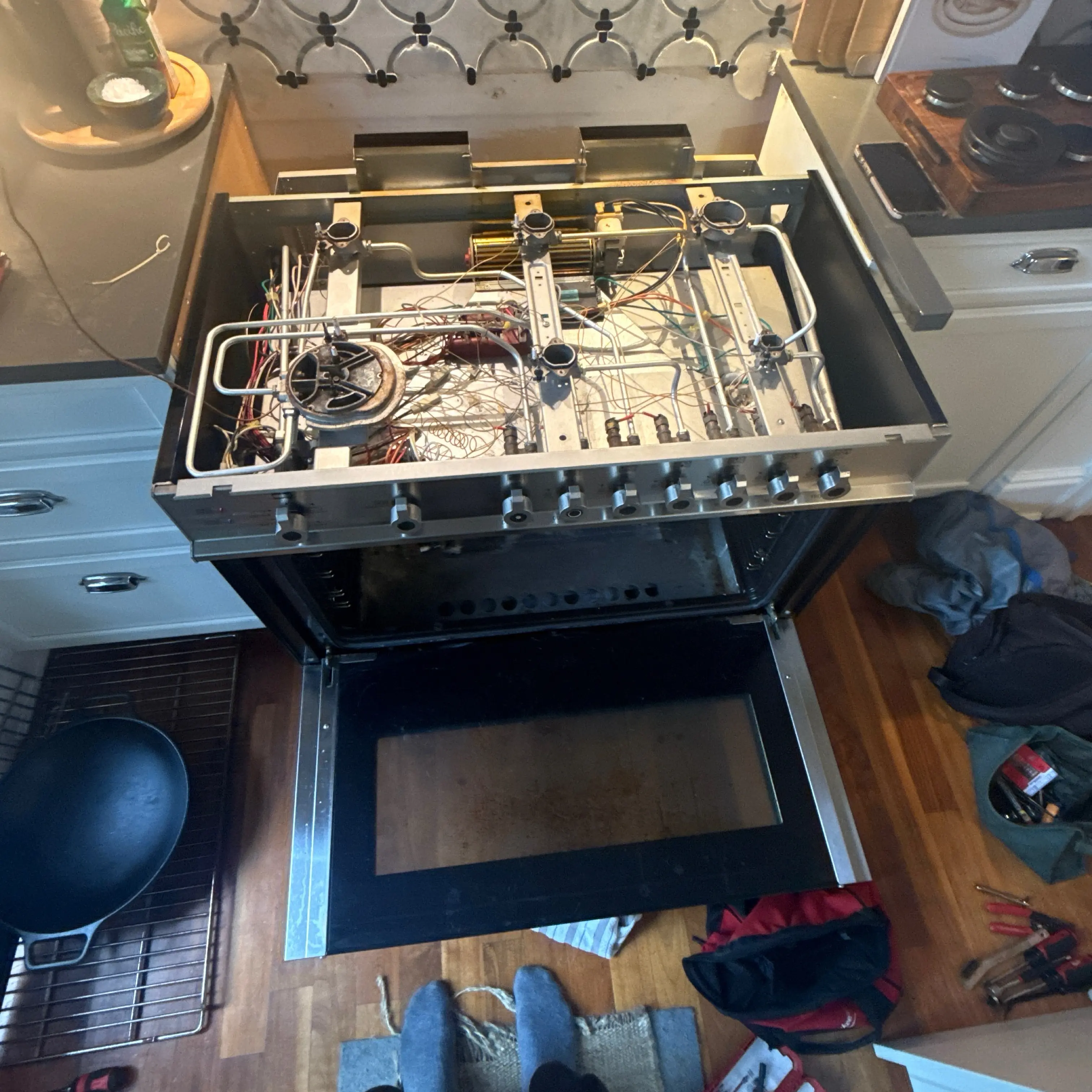
Wolf gas range repair requires separating the failed function from the installed platform. We trace surface ignition, flame quality, gas-oven ignition, temperature, controls, and shutoff behavior without unsafe gas-line work. We compare what still works with what fails, preserve any display message, verify the installed supply and access, then prove command, action, and sensor feedback before recommending a repair. Stop use for gas odor, delayed or unstable ignition, flame that will not shut off, smoke, arcing, uncontrolled heat, or a repeated protection trip.
What we repair on a Wolf Gas Range
We repair surface cooking, oven heat, ignition, temperature control, convection, door and latch behavior, displays, cooling, and the power or gas path that supplies those functions. The goal is to identify the failed system from the observed cooking result, not to replace a familiar part by guess.
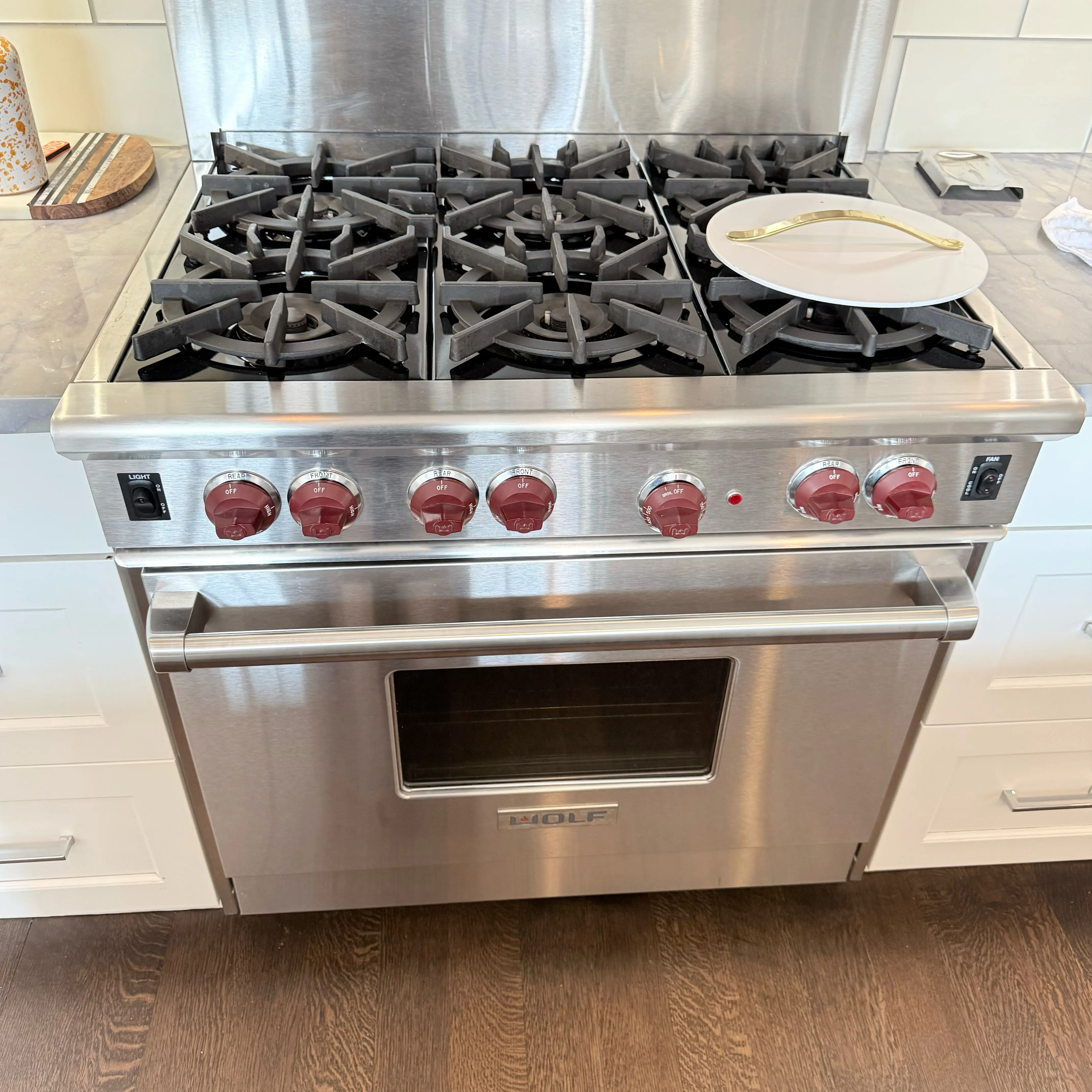
A Wolf gas range has separate surface-burner and oven-burner ignition paths. Wet or displaced surface caps, missing spark, gas delivery, delayed oven ignition, flame confirmation, airflow, and control output must be distinguished before a repair is proposed.
- Surface ignition: verify burner-cap position, spark, gas delivery, flame establishment, stability, and normal shutoff.
- Oven ignition and heat: follow bake and broil command, ignition, gas release, flame confirmation, temperature feedback, and recovery.
- Electrical support: confirm the supply used by ignition, sensors, fans, displays, valves, and controls even though the cooking heat is gas.
- Doors, airflow, and controls: separate latch, sensor, fan, vent, interface, and control-output symptoms.
- Installation: inspect the gas shutoff boundary, electrical connection, anti-tip device, ventilation, and cabinet access.
Common Wolf Gas Range problems and what they point to
Surface burner clicks but does not light
What you see: The spark is audible, but flame never establishes or lights only after several attempts.
What changes the diagnosis: A cool, removable cap that is wet, dirty, or out of position can interrupt the spark path. If every burner is affected, the shared power or gas supply matters more; if only one burner fails, the local cap, electrode, lead, or valve path moves higher on the list.
What the technician proves: We confirm cap and electrode condition, ignition output, gas delivery, flame carryover, and whether the failure is local or shared before naming a repair.
Flame is weak, uneven, yellow, or will not stay stable
What you see: The burner lights but the flame pattern is distorted, lifts, pulses, or drops out.
What changes the diagnosis: A misplaced cap or blocked visible burner port can imitate a gas-delivery problem. A pattern across all burners points away from one burner head and toward installation, supply, regulator, or fuel-configuration questions.
What the technician proves: The technician compares the flame at controlled settings, checks the burner assembly and air-fuel path, and verifies the appliance's specified gas configuration without adjusting hidden components by guess.
Gas oven clicks or attempts ignition but does not light
What you see: Bake or broil is selected, yet flame does not establish, ignition repeats, or the cavity remains cool.
What changes the diagnosis: Surface burners working does not prove the oven branch is healthy. The oven uses its own command, ignition, gas-release, flame-confirmation, and airflow sequence.
What the technician proves: We confirm the requested mode, ignition output, safe gas release, burner condition, flame sensing, and control response. The range stays out of use if ignition is delayed or gas odor is present.
Bake works but broil does not, or the reverse
What you see: One gas-oven mode establishes heat while the other does not.
What changes the diagnosis: Bake and broil can use separate burners, igniters, valves, and control outputs. The working mode proves only the shared portions of the system, not the failed branch.
What the technician proves: We reproduce the modes individually and compare command, ignition, flame establishment, sensor feedback, and shutdown behavior.
Controls are blank, locked, unresponsive, or showing a message
What you see: The panel may have no display, accept no input, remain in a lock or demo state, or show a persistent code.
What changes the diagnosis: A blank panel and a live panel that rejects commands are different paths. The first begins with supply and protection; the second begins with lock state, mode, door feedback, cooling, communication, and the exact displayed message.
What the technician proves: We preserve the code, identify the exact platform, verify incoming supply and communication, then isolate the failing input, board, cooling, or connected load.
The range trips power or shuts down during cooking
What you see: The appliance starts and then loses power, trips protection, or resets when a particular element, oven mode, fan, or self-clean cycle is selected.
What changes the diagnosis: Timing matters: an immediate trip differs from a trip after heat builds. A failure tied to one function points toward that load or its wiring; a whole-appliance loss can involve supply, terminal, protection, or control-power faults.
What the technician proves: We inspect the connection and heat damage, measure the circuit and loads with the appliance safely isolated, and reproduce only the conditions that can be tested without creating additional risk.
Platform and model differences that change the repair path
Wolf publishes platform-specific operating and troubleshooting boundaries. The Wolf gas surface-burner ignition guidance helps separate documented operating behavior and safe visible checks from a condition that needs internal diagnosis; the exact model instructions still control.
Surface-burner ignition
Each surface burner has a mechanical gas path and an electrical spark path. Cap position, moisture, electrode condition, spark, gas delivery, and flame carryover are checked in that order before hidden parts are considered.
Gas bake and broil ignition
The oven control must call for heat, the correct igniter or spark system must operate, gas must be released at the proper point, and stable flame must be confirmed. Failure at any stage can look like a general no-heat complaint.
Electrical support systems on a gas range
A gas range still uses electrical power for ignition, displays, sensors, valves, fans, and controls. A dead panel, no spark, and no gas delivery are separate observations even when they occur on the same appliance.
Safe checks before service
These checks preserve useful evidence without opening the gas range or exposing energized circuits, hot surfaces, gas, spring-loaded door and lock hardware.
- Write down which function fails: one surface burner, all surface burners, bake, broil, convection, one cavity, or the entire range.
- Confirm the selected cooking mode, setpoint, timer, control lock, and any demo or showroom indication shown by the exact model.
- When the appliance is cool, verify the oven door closes fully and that foil, cookware, or a rack is not obstructing the door or visible vent.
- For a gas surface only, and only when the exact manual permits it, make sure the cool removable burner cap is dry and seated in its intended position.
- Photograph the full display and note whether the fault appears immediately, during preheat, after heat builds, or during cooling.
- If a breaker has tripped, do not reset it repeatedly. A second trip means the range remains off for diagnosis.
What not to take apart or test yourself
- Do not remove rear, side, bottom, control, or junction-box panels and do not test energized wiring.
- Do not bridge or defeat door, lock, temperature, ignition, flame-safety, or other protective inputs to make the appliance run.
- Do not keep running a high-heat or self-clean cycle to reproduce smoke, arcing, uncontrolled heat, or a returning fault.
- Do not loosen gas fittings, adjust a regulator or valve, clean inside a manifold, or attempt a fuel conversion.
- Do not force a locked oven door, dismantle hinges under spring tension, or bypass a latch to start a cycle.
Stop using the Wolf Gas Range when
Gas odor is an emergency. Con Edison instructs occupants to leave immediately, avoid switches and electronics inside, and call 911 and the gas utility from a safe location.
CPSC cooking-appliance safety guidance supports treating fire, uncontrolled heat, damaged range stability, and unsafe ignition or door behavior as safety events rather than continued troubleshooting.
- Leave immediately if you smell gas. Do not operate switches, phones, plugs, lighters, or the appliance inside the space. From a safe location, call 911 and the gas utility.
- Stop if ignition keeps clicking without a stable flame, if flame appears outside the burner pattern, or if a control does not shut the burner down normally.
- Do not remove gas valves, regulators, manifolds, igniters, or supply fittings, and do not attempt a fuel conversion.
- Stop using the appliance if you see arcing, smoke, melting, a scorched connection, a cracked glass surface, or heat that continues after the control is turned off.
- Do not remove panels, probe energized circuits, bridge a switch, defeat a lock, or keep resetting a breaker that trips again.
- If one safe power reset is permitted by the exact model manual, do it only once. A repeated trip or immediate return of the fault needs service.
- Keep the oven door closed if food or grease ignites inside, turn the oven off only if it is safe to reach the control, leave the area, and call 911 if the fire does not go out promptly.
- Do not force a locked door, defeat a door switch, run self-clean through an unresolved fault, or touch a damaged heating element or broken inner glass.
- Stop using the cavity when it heats without command, will not shut down, produces electrical arcing, or has loose or shattered door glass.
How we diagnose Wolf Gas Range problems
1. Reproduce the exact failed function
We start with the homeowner's observation and reproduce only the affected gas range function under controlled conditions. A symptom tied to one surface burner or zone, one oven mode, one cavity, temperature, or point in the cycle is more useful than a broad part guess.
2. Verify the shared supply and installation boundary
Before condemning a Wolf component, we confirm the electrical supply, terminal condition, gas-delivery boundary, ventilation, anti-tip installation, cabinet clearances, and signs of heat, liquid, or movement at the installation.
3. Follow command, action, and feedback
For each failed function we compare what the control requests, what the load actually does, and what the sensors report back. That separates a bad input from a missing output, a failed load, or inaccurate feedback. On gas functions, command, spark or igniter action, gas release, flame establishment, and flame confirmation are verified as separate steps.
4. Compare related functions
A working surface burner or zone, another oven mode, or a second cavity can prove parts of a shared path. We use that contrast carefully because shared components can still affect more than one function.
5. Confirm the repair under the original condition
After the approved repair, the same mode and load are tested again for normal ignition or surface heat, oven heat, temperature response, cooling, door behavior, and shutdown, with no return of the original message.
Wolf Gas Range error codes and display messages
The Wolf GR gas-oven ignition guidance is used to bind a message to its documented model or platform. A code is a condition or circuit clue; it is not automatic proof that a named part should be replaced.
No flame with continuing ignition attempts
This is a symptom path rather than a universal code. Wolf guidance treats a gas oven that fails to ignite as a discontinue-use condition. Safe response: Turn the control off. If gas odor is present, leave immediately and call 911 and the utility from outside.
Displayed oven error
A persistent error must be matched to the exact range model and cycle; it does not justify replacing an igniter, valve, sensor, or control without testing. Safe response: Photograph the display and note whether bake, broil, or both were affected.
NYC installation and access details that affect the visit
Cabinet, countertop, and removal access
A range may be constrained by counters, flooring, an anti-tip device, a backsplash, a hood, or an island layout. We plan how it can be moved and restored without damaging finished surfaces or defeating the anti-tip installation.
Building rules, elevator time, and COI
NYC buildings may require advance access authorization, service-elevator reservations, floor protection, or a certificate of insurance. Sharing those requirements before the visit prevents a completed diagnosis from being blocked by building logistics.
Shutoffs, panels, ventilation, and neighboring finishes
The gas shutoff and electrical disconnect need to be reachable without dismantling unrelated cabinetry. We also note ventilation, hood interaction, combustible clearances, stone edges, and any sign that installation pressure or movement is affecting the appliance.
What to prepare for the appointment
- A short description of the exact failed gas range function and whether it is constant or intermittent.
- A photo of the complete display and the control settings when the symptom appears.
- The timing: immediately after START, during preheat, after sustained heat, while cooling, or during a cleaning cycle.
- Which surface burners or zones, oven modes, and cavities still work normally and which do not.
- Photos of the installed appliance, adjacent cabinetry or countertop, visible shutoff or disconnect area, and the access route.
- Any recent power event, installation work, spill, cleaning, cabinet change, or ventilation change that preceded the symptom.
- Building access rules, elevator reservation, floor protection, or COI requirements for the appointment.
Related cooking-appliance repair pages
Why can the Wolf gas range display work while the appliance does not heat?
The interface can receive control power while a heating supply, element, igniter, valve, inverter, relay, safety device, sensor, or connected load is interrupted. A live display therefore narrows the problem but does not prove the heat path is healthy.
Is repeated clicking from my Wolf gas range safe to ignore?
No. A brief ignition sequence can be normal, but clicking without stable flame, delayed ignition, flame outside the burner pattern, or any gas odor requires the control to be turned off. If gas is smelled, leave immediately and call 911 and the utility from a safe location.
Does a Wolf error code tell me which part to replace?
No. A code identifies a monitored condition or narrows a circuit on a defined model family. The full code, affected function, timing, supply, connected loads, and sensor feedback still have to be confirmed before a repair is selected.
What is safe to check before Wolf gas range service?
Check which surface or oven function fails, the selected mode, lock or demo state, door closure, visible vents, and the exact display. On a cool gas surface, verify only removable burner-cap position if the manual permits it. Do not open panels, gas fittings, wiring, locks, or power modules.
What does the technician confirm during Wolf gas range diagnosis?
The technician reproduces the affected surface or oven function, verifies the installed gas, electric, or dual-fuel platform and shared services, then tests the applicable ignition or surface heat, oven heat, sensing, doors, controls, cooling, and safe shutdown before recommending a repair.
Insured Appliance Repair Service in NYC & Brooklyn
VOLT & VECTOR LLC carries Commercial General Liability insurance through Hiscox Insurance Company Inc. Coverage is effective June 6, 2026 – June 6, 2027, with $1,000,000 per occurrence and $2,000,000 general aggregate limits.COI available upon request for homeowners, landlords, property managers, co-op/condo boards, commercial clients, and general contractors.