

.avif)
How to Protect Cabinets Near Your Stove or Range
Protect cabinets near a stove or range with correct clearances, hood maintenance and moisture control. Know when heat damage needs an installation review.
Protect Cabinets Near the Range: What Comes First
Correct appliance clearances and effective cooking ventilation come before protective panels or a new finish. If a cabinet is scorching, melting or repeatedly developing heat damage, stop using the affected cooking appliance and have the installation assessed before cooking again.
Once clearances are confirmed, compare a wipe-clean stainless wall splash plate with a tiled renovation finish. Specify cabinet-side protection separately: a backsplash product is not automatically a heat-shield assembly. Compare the complete installation quote, rather than a panel or tile price alone.
- Sticky cabinet faces: clean with the cabinet maker's approved method and check the hood's grease filters.
- Condensation or peeling above the range: establish whether the hood exhausts outdoors or recirculates; a recirculating filter does not remove humidity from the room.
- Damage close to a burner or oven vent: compare the exact range installation drawing with the kitchen layout. Keep vents clear.
- Door or handle hits cabinetry: stop forcing it. Have the clearance and appliance position checked; do not add an improvised door stop.
Take photos of the range model label, full installation and damaged area. An installer needs the whole layout, not only a close-up of the peeling paint.
Why a Tight Kitchen Needs an Installation Check
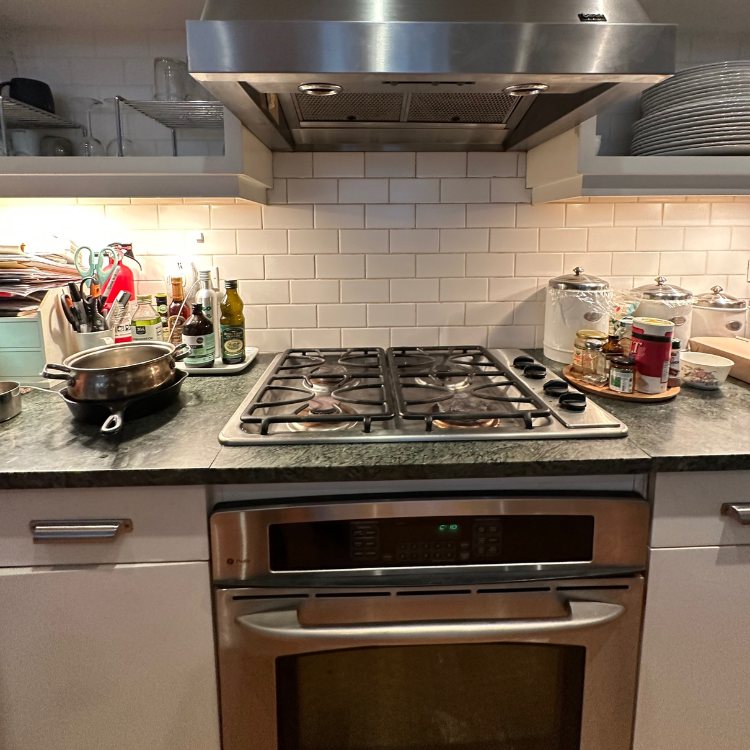
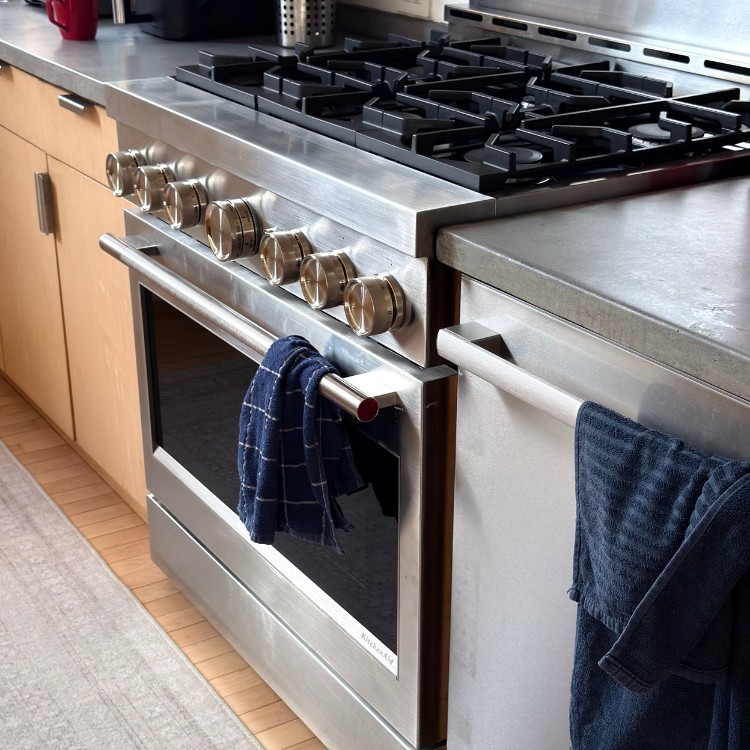
In a compact kitchen, an upper cabinet, projecting side panel or deep counter edge may sit close to the cooking surface. That makes the exact arrangement important. Room size alone does not establish a fault, and a professional-style range does not automatically damage surrounding cabinetry.
Before selecting a coating or shield, identify the appliance and obtain its installation drawing. Check the cabinet material and finish guidance as well. The stove, hood and cabinets each have requirements; changing one can affect the others.
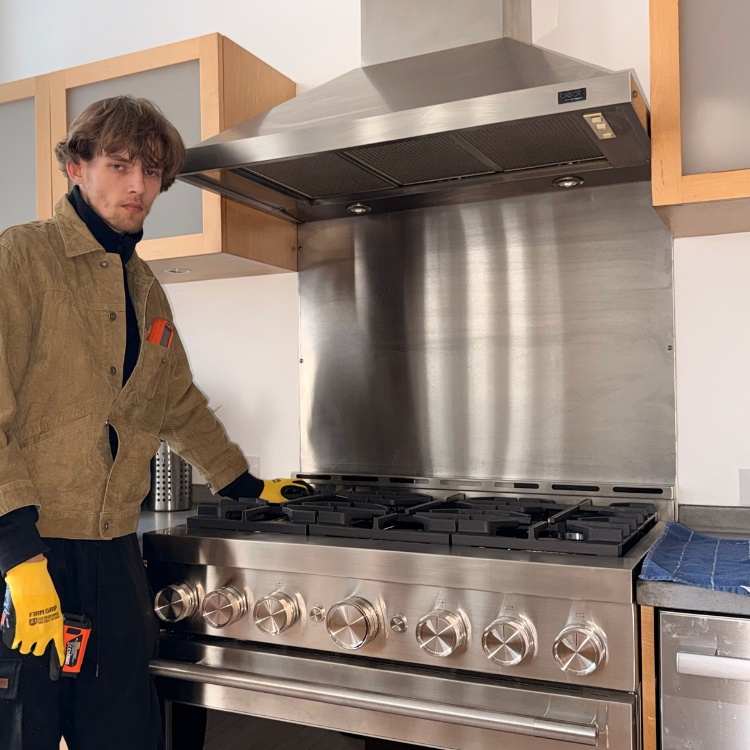
A Volt & Vector technician's years of service in NYC apartment kitchens include first-hand observations of warped cabinet doors, peeling finishes on upper cabinets near gas burners, and discolored cabinet interiors.
The Four Damage Patterns
Heat: discoloration, blistering or scorching concentrated near a cooking zone or vent warrants inspection of placement and clearances. Do not use your hand to judge whether a hot cabinet is safe. Photograph the area once everything has cooled.
Steam and condensation: moisture on upper cabinets can accompany cooking, particularly when vapor is not captured effectively. Watch for damp edges, lifting seams and swelling. Ventilation should address the source before the finish is repaired.
Grease deposits: a sticky coating that develops around the cooking area points toward cleaning and capture needs. Use the cabinet maker's approved cleaner; a strong oven degreaser can be unsuitable for painted or wood finishes. Avoid soaking seams.
Physical contact: repeated marks where a door, handle or drawer touches another surface require a fit check. Treat this as a clearance problem rather than evidence that normal oven-door operation is loosening the cabinets.
Range Hood Ventilation: Know Where the Air Goes
A ducted hood carries captured air outside. A recirculating hood filters and returns it to the kitchen, so heat and humidity remain. Broan-NuTone explains this distinction. Replacing a charcoal filter will not turn a recirculating system into moisture exhaust.
Follow the hood's instructions for operation and maintenance. Metal grease filters and charcoal filters have different roles: clean a washable grease filter as directed, and replace a non-washable carbon filter with the specified part. The schedule depends on the model and cooking use; do not apply one interval to every hood.
If capture remains poor with the correct clean filters, ask an installer to assess the hood, mounting height, duct route and appliance pairing. In an apartment, involve management before proposing a new exhaust route or connection. An existing shaft is not permission to connect a kitchen hood to it.
For planning a retrofit, our earlier guide used $600–$1,200 for a professional-style range hood unit, with installation separate. That is a historical budgeting example, not a current NYC price average. Get a quote for the specified hood, duct route and installation work after the appliance and building requirements are checked.
Heat Shields and Side Panel Protection
A decorative sheet of stainless steel or a layer of tile is not proof that the material behind it has an acceptable clearance. A shield may be part of a specified installation, but its design, spacing, fixing and surrounding materials matter.
Do not attach adhesive-backed metal, cement board or tiles beside a burner as a general repair for scorching. Have the appliance installer and cabinet professional establish an appropriate solution. The work must preserve appliance ventilation and service access. Repeated heat damage needs its cause corrected before a new surface hides it.
Stainless steel: a smooth wall splash plate suits the area behind a range when the installation already meets the appliance requirements and easier splatter cleanup is the goal. Broan's SP3004 is a nominal 30 × 24-inch stainless plate listed at $64 on October 7, 2026; its specification uses corner screw holes. This wall product is not a cabinet-side clearance-reduction shield.
Ceramic or porcelain tile: consider tile when the backsplash or cabinet surround is already part of a renovation, rather than covering existing damaged material. Daltile's wall-tile guidance calls for a sound, clean, dry substrate and repair of damaged areas. The installer must select the backing and setting materials for the actual location. One ceramic backsplash example, Daltile LuxeCraft White LC15312HD1P2 (3 × 12 inches), was listed by Home Depot at $3.97 per square foot or $47.64 per 12-square-foot case on October 7, 2026.
Our earlier guide used $80–$180 for standard stainless side panels. That figure is a historical product-budget example, not a quote for a compatible shield or an installed repair. For either approach, quote substrate repairs, mounting or setting materials, trim, delivery and labor separately; retailer prices and local availability can differ.
Upper Cabinets Above the Range
Compare the position of the upper cabinets and hood with the range instructions. Overhead clearances are different from the opening required between lower cabinets. A protective hood liner may belong to a specified hood installation; an improvised metal underside does not substitute for that design.
Once the arrangement is confirmed, remove grease using a finish-compatible method and dry visible condensation. Ask the cabinet maker about repair of peeling laminate or damaged finish. Do not assume polyurethane, thermofoil or any other coating makes a cabinet suitable for closer placement above a cooking surface.
The Backsplash and Cabinet Junction
Look at the joint where the backsplash meets the cabinet after the area cools. An open joint, stained seam or damaged edge gives a cabinet professional a location to investigate. A sealant repair may be appropriate, but the material and preparation depend on the surfaces and source of moisture.
A neat new bead over wet or loose material does not resolve the underlying damage. Avoid a fixed annual caulking rule: inspect condition and repair the actual defect. Take a before photo so you can tell whether the stain or gap returns.
When Range Positioning Matters
Use the exact model's drawing, rather than a universal side gap. For example, the Wolf dual-fuel design guide distinguishes the lower opening from restrictions on combustible surfaces above the counter. Those measurements serve different purposes and should not be exchanged.
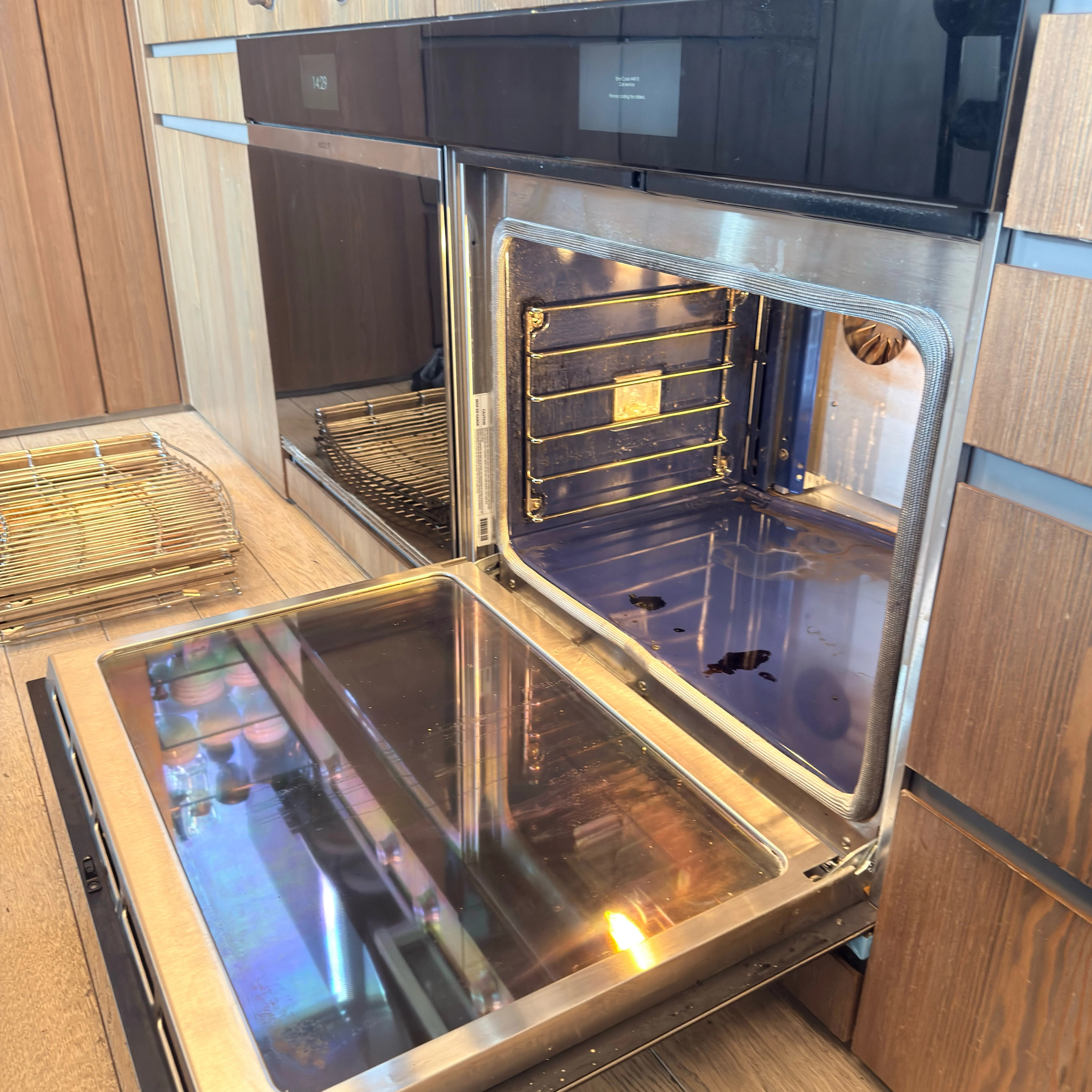
Do not slide a connected range away from the wall yourself to create more space. Have its position, connections, anti-tip arrangement and required clearances checked together. If the door hits a cabinet, identify the obstruction instead of limiting its travel with an added stop.
If the door movement itself has changed, see the Wolf oven-door behavior guide. If you are deciding to change the cooking appliance as part of a renovation, the cooktop repair-or-replace guide helps separate appliance costs from the work around it.