.avif)
Dryer Taking Longer: Compare the Right Things
If similar loads now need much longer than before, check airflow, starting wetness, load size and the selected program. Heat or control faults remain possible, and ventless dryers also depend on condensation and room ventilation. A single time limit cannot diagnose every dryer.
- Every cycle is longer: clean the accessible filters and note any visible obstruction or recent dryer movement.
- Automatic cycles end early, then need restarting: check dryness level and fabric mix; timed finishing helping does not prove a bad sensor.
- Clothes entered unusually wet: review the washer's spin result before increasing dryer heat.
- Heat-pump or condenser model: follow its filter, container and room-air instructions; it may have no exterior vent.
- Recently cleaned but still slow: identify which duct sections were actually checked.
Burning odor, scorching, unusual heat, breaker trips or repeated shutdowns mean stop using the dryer. Do not run further cycles to reproduce those symptoms.
What Makes Dryer Cycles Take Longer
Longer drying can come from restricted airflow, an unsuitable load or program, clothes entering unusually wet, reduced heat output, or a ventless dryer's condensation system. If automatic drying stops early and you keep restarting it, sensing or the selected dryness target may be adding time across several runs. The first useful comparison is with the same dryer, similar laundry and the same program before the problem began.
There is no single normal cycle time for every dryer. Heat-pump, gas and conventional electric models differ; towels, bedding, low-spin loads and energy-saving programs also differ. A cycle lasting more than 75 minutes does not by itself prove a fault. A repeated change in performance, damp result or new warning is more useful than an arbitrary time limit.
Vented Dryers: Exhaust Restriction
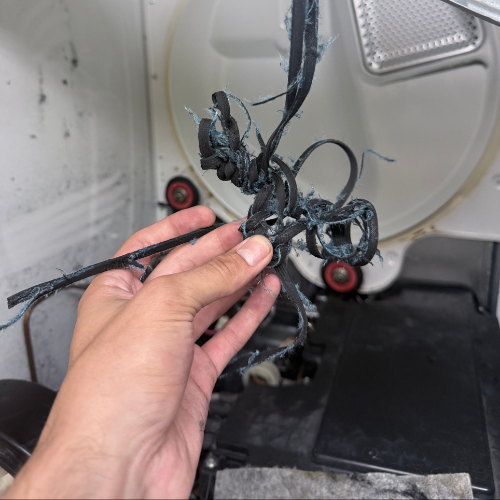
A vented dryer must move moist air out of the machine. Lint inside the duct, a stuck exterior damper, an unsuitable run or a crushed connector can restrict that process even when the drum gets warm. The CPSC's dryer safety guidance identifies longer drying and damp laundry as possible signs of restricted exhaust; lint cleaning is also a fire-prevention task.
Distinguish the lint screen, connector behind the dryer, concealed duct and exterior termination. Cleaning the screen does not clear the rest. A receipt for vent cleaning is useful only with its scope: which sections were reached, whether the termination was checked and whether airflow was verified afterward. Recent cleaning and a moving flap do not conclusively rule out restriction.
Sudden slow drying after the dryer was pushed back can point the investigation toward a crushed transition duct. Do not reach behind or pull a stacked or gas-connected unit to inspect it. A technician can check the connector while avoiding strain on gas, power and stacked equipment.
Reduced Heat Output
A dryer that feels warm may still have inadequate or interrupted heat, but the cause cannot be read from door temperature. On conventional electric equipment, the specified supply, heater circuit, protective devices and controls need to be separated. On gas equipment, the burner must establish and sustain the model's normal heat sequence. A heat-pump dryer needs a different assessment of compressor operation and moisture removal.
A heater fault can be part of this picture, but “a hairline crack makes every element weak” is not a reliable rule. Some designs have more than one heater circuit; an open circuit, wiring issue or supply problem may change output. A grounded element can create unsafe heating rather than simply slower drying. Diagnosis must compare measured operation with the exact technical specifications.
For applicable electric models, 208 V can give different drying performance from 240 V while remaining within the rating. That is distinct from a damaged connection or out-of-specification supply. Do not infer a voltage defect from an apartment's age. If the drum turns but the load stays cold, use the dryer-not-heating guide.
Internal Airflow and the Blower
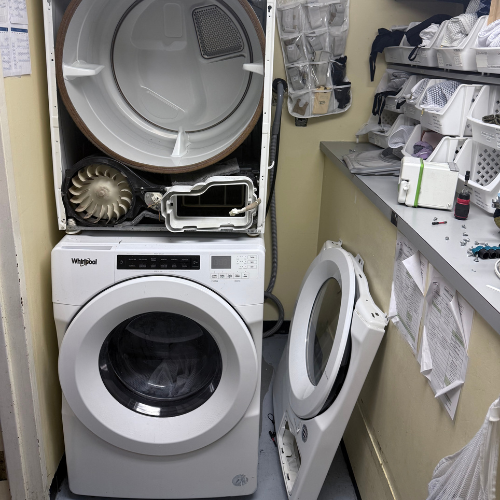
External vent cleaning cannot repair a damaged blower wheel or clear every internal lint accumulation. If the full exhaust route has been checked but airflow remains inadequate, the technician should assess the blower, internal passages and applicable drum seals. New rattling or rubbing can help locate the investigation, but it does not prove a particular wheel, bearing or seal has failed.
Internal cleaning requires the right access and reassembly. Do not operate with a panel, filter or duct removed to compare drying times. That changes the conditions the appliance was designed to use. If a noise developed along with the longer cycles, the guide to changing appliance noises provides context for describing the change.
Automatic Cycles, Sensors and the Load
A moisture-sensing program depends on the selected dryness level and representative contact with the laundry. Tiny loads, mixed fabric weights or sensor residue can contribute to an unsatisfactory automatic finish. Other automatic dryers use temperature-based control; not every model has the same two sensor bars. An automatic timer moving intermittently can be normal on the GE designs described in its timer guidance.
A better timed-drying result is a comparison rather than a sensor verdict. Extra time can finish laundry affected by load choice or reduced performance elsewhere. The hot-but-wet guide covers early endings, sensing and condensation in more detail.
Check the starting load as well. Heavy towels mixed with thin shirts, tangled bedding, combining wash loads or unusually wet clothes can prolong drying. Use the program's capacity and fabric-care limits. If laundry leaves the correct washer spin program dripping, a washer problem may be adding water-removal work the dryer did not previously have.
Heat-Pump and Condenser Dryers
These machines need attention to filters, heat exchange, condensate and room conditions rather than an exterior vent check. A heat-pump program may normally take longer than a conventional dryer program. What matters is whether the same suitable load now takes substantially longer or remains damp, especially with a filter, container or temperature message.
On applicable Miele models, both the door filters and toe-kick filter need the specified care; a warm room can also impair drying. On Bosch, the E-Nr identifies whether the machine is a conventional condenser or heat-pump design and which maintenance items are accessible. Whirlpool HybridCare and other heat-pump products have their own filter systems. Do not apply one manufacturer's cleaning interval or error code to another model.
Keep the machine's inlet and required room ventilation clear. Empty a condensate container when directed, or check a safely visible drain hose for a kink if direct drainage is fitted. A recurring water warning or continued poor performance after accessible maintenance needs diagnosis; it is not permission to open a sealed exchanger or pump area. For the existing Miele-specific discussion, see Miele dryer not drying correctly.
NYC Building Systems and Service Access
In an apartment, the owner may control the dryer and its connector while management controls the concealed duct or roof termination. Ask which route serves the unit, who maintains it, and what the last cleaning covered. If other residents report the same change, pass that information to management without assuming every apartment shares a dryer exhaust.
Equipment with a long exhaust route must be assessed against its own installation instructions; some models are designed for longer runs than others. A building-managed exhaust or booster arrangement needs its specified inspection and maintenance. Do not assume every bend has the same allowance or prescribe a universal maximum length.
Volt & Vector has encountered shared dryer-exhaust arrangements in Upper West Side, Upper East Side and Park Slope brownstone conversions. In those installations, drying took longer while another unit was running and returned to its usual duration after that cycle ended. That timing is useful service history, but the route and restriction still need confirmation; the neighborhood alone does not establish a shared exhaust.
Safe Checks
- Load and program: compare like with like. Compare the cycle, dryness level, fabric mix and whether clothes entered normally spun.
- Lint screen: remove lint each load. Follow the manual for residue washing, drying and refitting; do not run with a missing or damaged filter.
- Visible installation: look for an already visible crushed connector, lint escape or blocked appliance inlet. Leave hidden access to service.
- Vented equipment: observe a termination only when safely accessible from the ground. Do not climb, lean out a window or use a tissue test as proof that airflow is sufficient.
- Ventless equipment: use the model's filter, container and visible-hose instructions.
- Persistent change: after appropriate visible care, consider one ordinary result if there are no warnings. If the problem remains, repeated maximum-heat cycles are not a substitute for diagnosis.
Maintenance That Matches the Installation
Clean lint each load and keep the surrounding area and required ventilation openings clear. Check filters for residue and damage using the manual's method. Arrange periodic exhaust inspection and cleaning for vented equipment; GE's general guidance recommends a complete annual duct cleaning, while the actual installation and any earlier restriction determine whether attention is needed sooner.
Have the correct connector material, routing and termination checked against the appliance instructions. Plastic or easily crushed unsuitable ducting requires correction; do not choose a replacement solely from a general article.
When to Stop and What Diagnosis Should Establish
Stop using the dryer for burning odor, scorching, abnormal heat, smoke, electrical damage, breaker trips or repeated mid-cycle shutdown. Do not deliberately touch a hot cabinet or run another cycle to measure the warning. Smoke or fire requires leaving and calling 911. The overheating guide covers that urgent situation.
Without an emergency, a persistent decline warrants a measured diagnosis. For a vented dryer, this should distinguish exhaust resistance from internal airflow and heat output. For ventless equipment, it should distinguish filter/room conditions, condensate movement and heat-pump or condenser performance. Supply checks, heater/control tests and cabinet work belong to qualified professionals.
For applicable vented dryers, Volt & Vector's diagnostic process measures exhaust-temperature curves under load and back-pressure at the transition port before selecting replacement parts. These qualified-service checks help separate exhaust resistance from heat-output findings; they are not tests to perform with the appliance opened or disconnected from its normal exhaust.




.png)